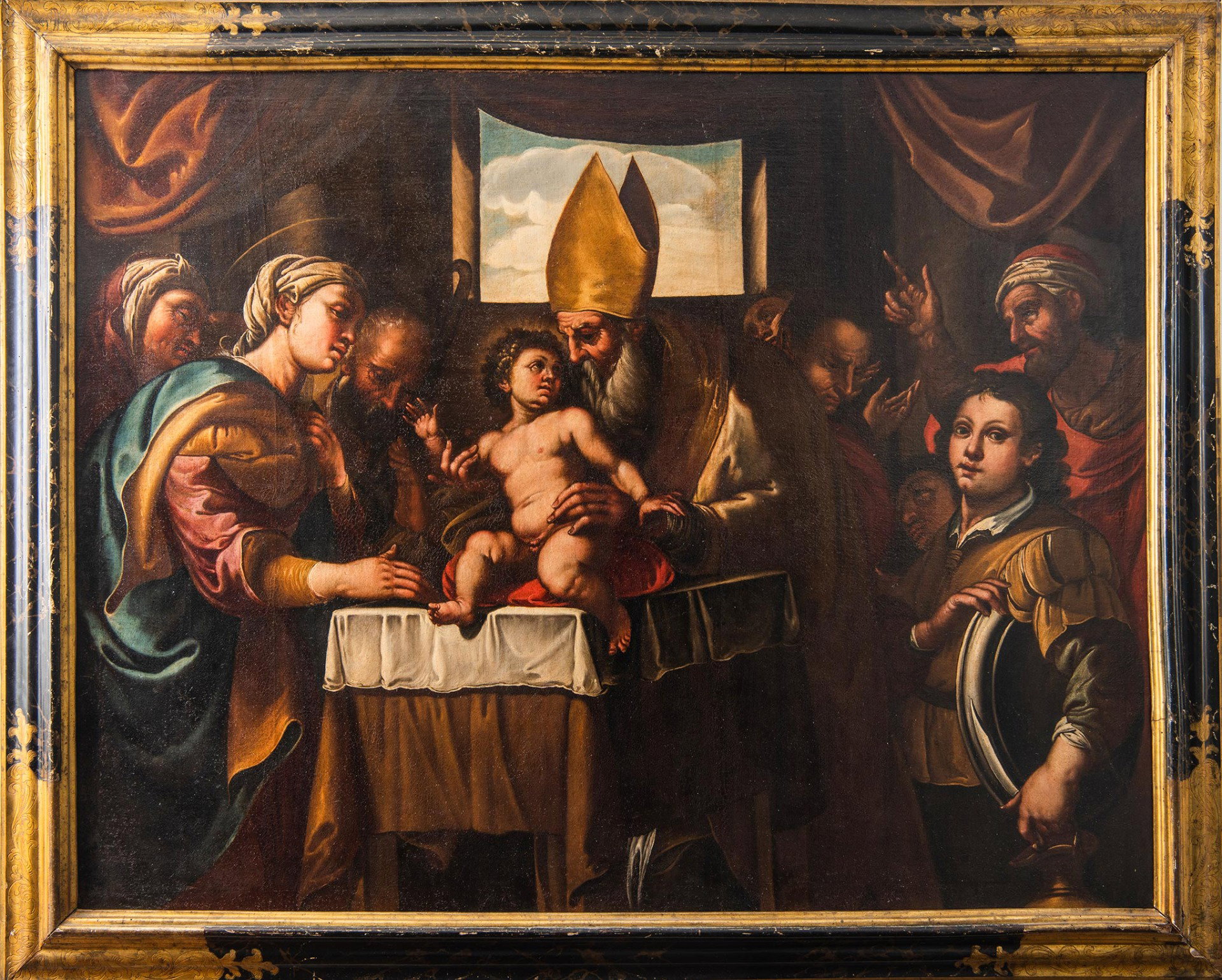
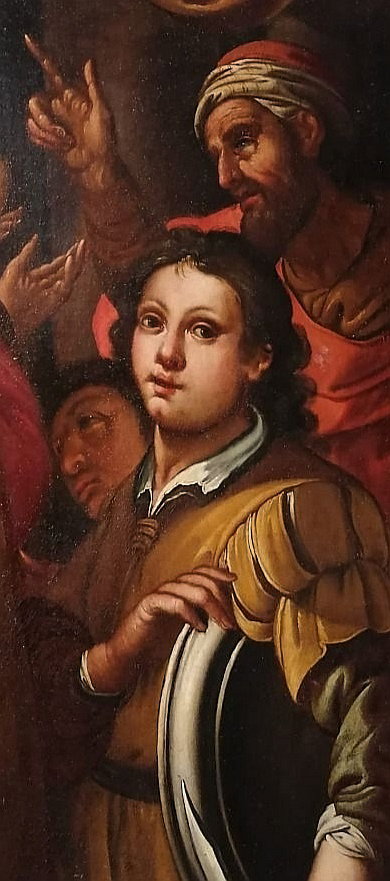
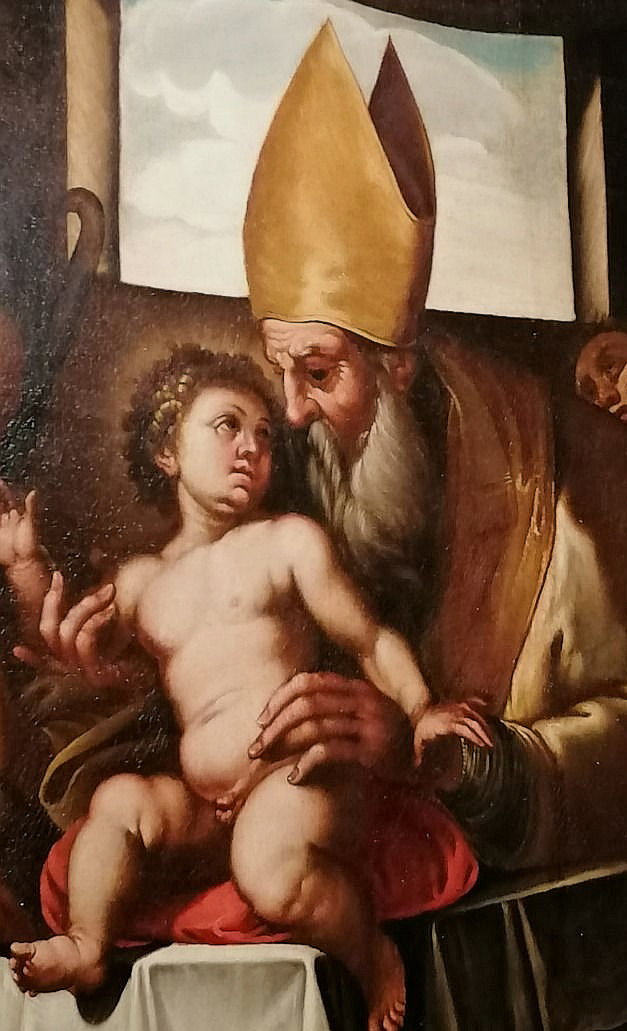
Circumcision of Jesus - First half of the 17th century. Attributed to Ferraù Fenzoni or Ferraù da Faenza (Faenza, 1562 – Faenza, April 11, 1645).
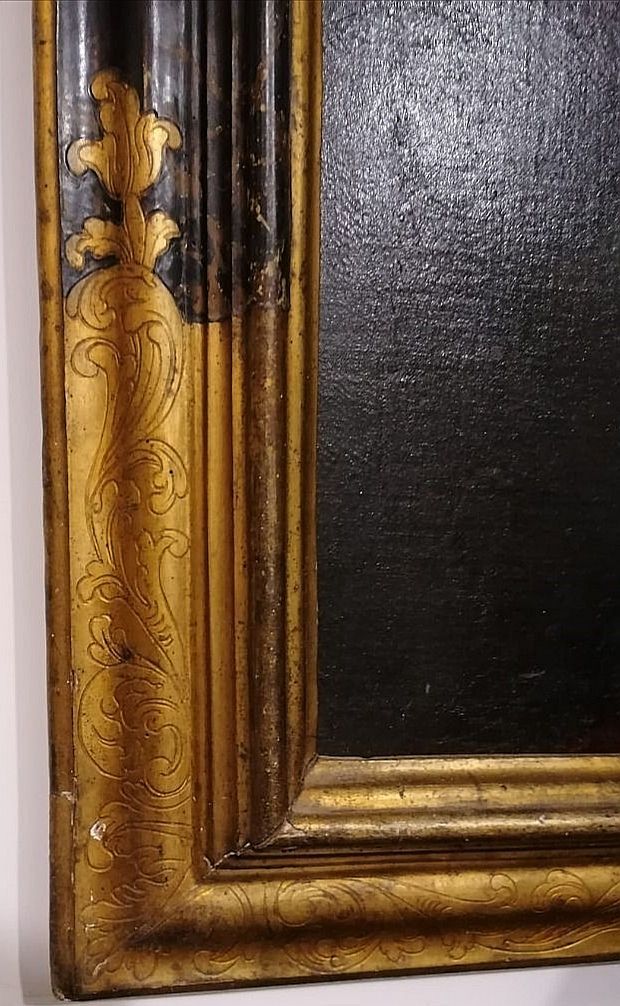
Important oil on canvas (195cm x 124cm) on a splendid coeval marbled frame with gilded and engraved angles with vegetal spirals. This work can, in fact, be introduced into the pictorial repertoire of the mature phase of the Faenza master.
This is an unpublished work that has never appeared on the antique market.
FENZONI (Faenzoni, Fanzoni, Fanzone), Ferraù (also called Ferraù da Faenza). Third of five children, Faenzoni was born in 1562, according to Mancini (1617-1621, p. 241), "in his homeland having had the opportunity, due to the abundance of good paintings, to learn the principles of art...", he soon manifested his natural gifts for painting and drawing. He went to Rome towards the end of the pontificate of Gregory XIII (died in 1585) and here, according to Baglione (ms. 1642), he carried out his first public assignment by participating, together with V. Salimbeni, G. Stella and others, in the decoration of the loggia of blessings in S. Giovanni in Laterano. The Roman affair of the painter from Faenza must be interpreted within that variegated, emblematic, sometimes spirited and distraught, harshly conflicting climate of late Roman Mannerism. In this climate, it is often difficult to identify the overlapping influences, which necessarily must have been there, especially among the painters who worked on the Sistine cycles. According to Baglione, Fenzoni was primarily responsible for the decoration of the passageway between the right aisle of S. Giovanni in Laterano and the staircase leading to the Lateran Palace (the work was lost during the Borrominian renovations).
Probably the most important contribution that the artist made to the Sistine program is that of the frescoes in the Scala Santa (1589); Baglione attributes to him Moses and the bronze serpent, The Crucifixion, The Flagellation (which however Scavizzi, 1960, assigns to Salimbeni) and Cain and Abel. Beyond Michelangelo-esque reminiscences, and despite being influenced by Lilio, Fenzoni achieved effects of a softened pictorialism, and at the same time of strong compositional dynamism and accentuated expressionism. In the early years of the last decade of the century, Fenzoni participated, together with other artists from the group of Sixtus V, in the realization of the cycle of frescoes of the Life of the Virgin in S. Maria Maggiore, on the walls of the central nave between the windows, completed in 1593.
These frescoes open a new stylistic course to Fenzoni's painting, which, perhaps also due to a hypothesized trip to the Emilian region, came into contact with the Bolognese environment, from B. Passarotti to the Carracci. The often dry and nervous execution of the other Roman works is replaced here by a broad and sometimes solemn drafting, supported by a wider and softer line; according to Viroli (1992, p. 316) one perceives "the influence of Barocci's culture".
At the turn of the century, there was a stay in Umbria, marked by a considerable number of works. Fenzoni resided and worked for about six years (perhaps as early as 1593 and until 1599) in Todi, where he was called by Bishop Angelo Cesi who commissioned him one of his most notable and prestigious enterprises was the intervention in the decoration of the interior of the cathedral of Todi, which started from the grandiose Universal Judgment frescoed on the counter-façade, dated in an inscription 1596, where an academic conception and notes of surprising realism intersect. Other works by Fenzoni in Umbria: Foligno, bishopric, an Annunciation, executed for the duomo; Gualdo Cattaneo, parish church, chapel of the Santissimo, frescoes with Stories of St. Michael the Archangel and figures of Saints; the Deposition of the sacristy of the cathedral of Perugia is "perhaps among Fenzoni's oldest Umbrian works" (Sapori, 1989, pp. 95 s.).
Returning definitively to Faenza in 1599, on May 2, 1603 Fenzoni married Anna di Cesare Naldi, his fellow citizen, of excellent birth. In these years, the sporadic academic tendencies, already expressed in the cathedral of Todi, become more consistent and the memory of early Mannerism, in the search for rhythms suitable for balancing masses and movements, is evident in the compositional themes of his last Romagna activity. From 1600 he will be the protagonist of an intense and flourishing pictorial activity, in the city that gave birth to him, including the frescoes of the cathedral, characterized by a greater search for a more reserved and sweet compositional balance. In Faenza, where his art is highly appreciated by his fellow citizens, Fenzoni seems to have reached a solid bourgeois status. Fenzoni died in Faenza on April 11, 1645; he was buried in the church of S. Cecilia (destroyed).
We attach a historical guarantee certificate of authenticity. The painting is visible in our gallery in Foligno (PG).
For further information: 3356925388 or via mail
[email protected]
Discover our online catalog with many proposals for ancient art. at the website www.antichitabompadre.com