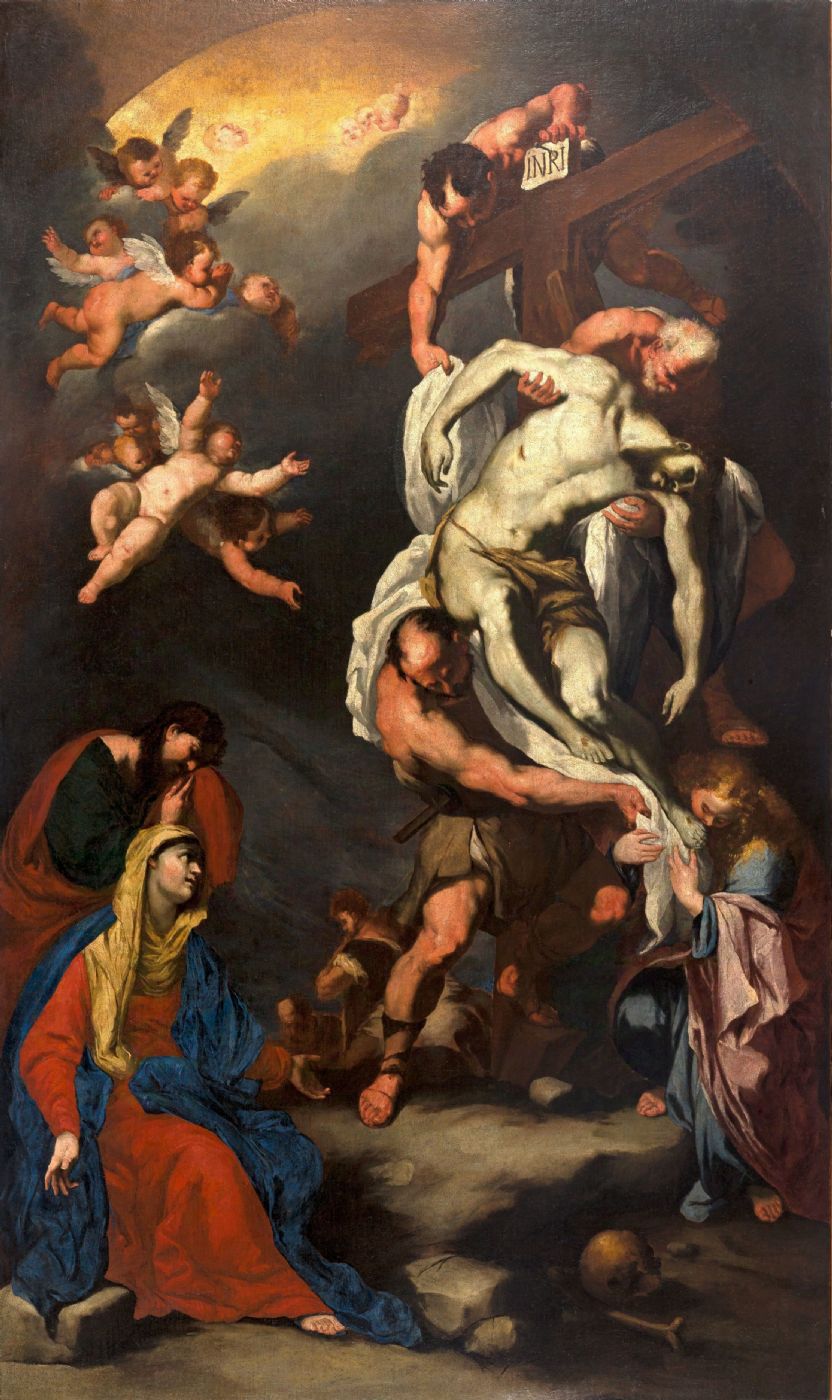
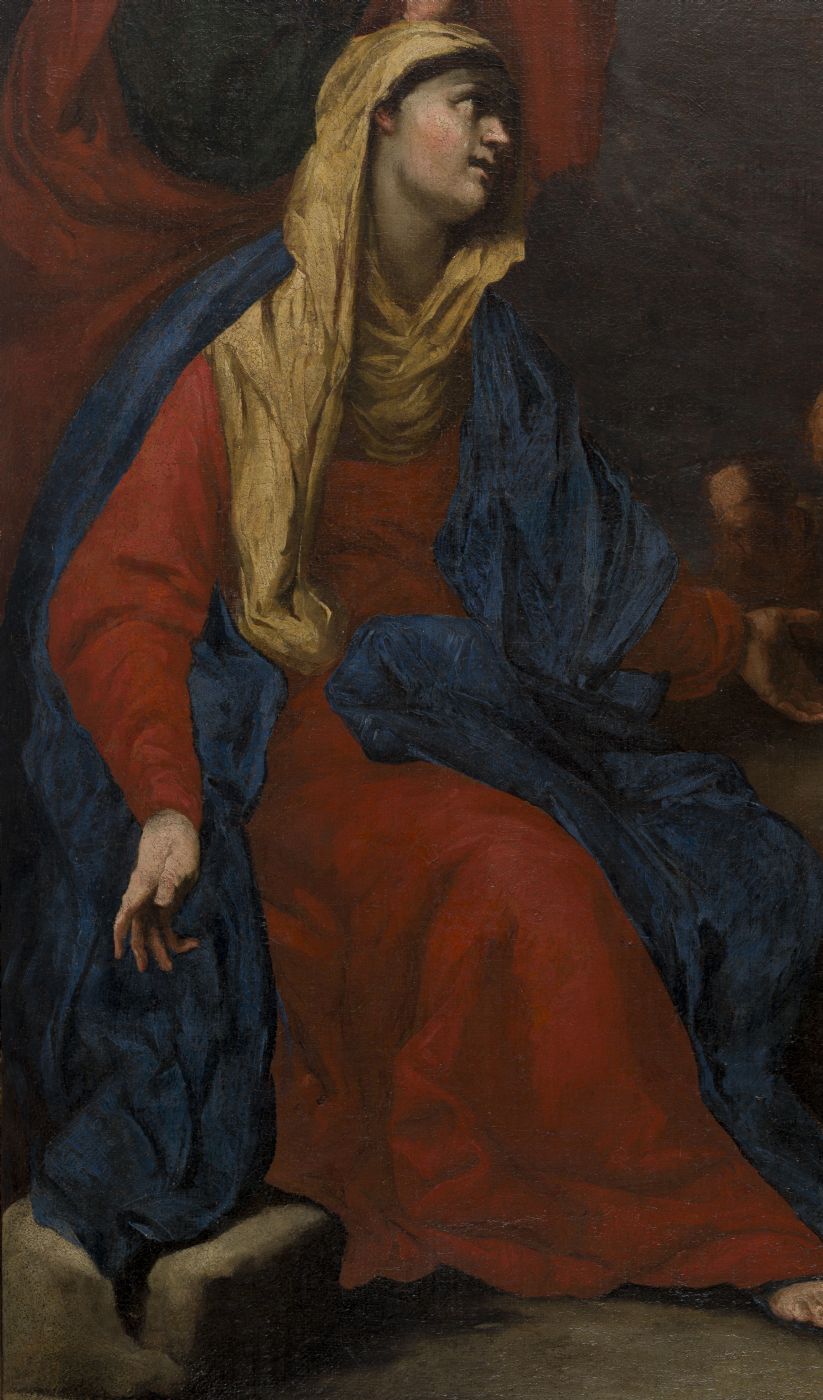
In the master's kitchens: a sketch by Giordano for the Venetian canvas of Santa Maria del Pianto.
Almost intact and unknown to specialists, the painting under examination, rendered with a fluid and concise style, is one of the rare fully autograph sketches from Luca Giordano's early maturity, dating to around the late 1660s; a period of unparalleled stylistic and cultural growth for the master of the late Baroque, which has been extensively discussed, especially recently, and repeatedly since 2005, at the instigation of the author.'
The canvas, about the size of a headboard, is a precious piece to observe closely or, better, 'from within,' a pinnacle like the 'Deposition of Christ from the Cross,' kept for over two centuries at the Gallerie dell'Accademia in Venice. Never published, our painting is a preparatory sketch without significant variations for this Venetian canvas from the church of Santa Maria del Pianto; at the moment, it is, in fact, or could be, the only one, of those yet to be found, that Giordano must have prepared in view of the immense creation. The others, judging also from the photographs, appear more refined and contoured. The impression, in short, is that they are subsequent versions: regardless of whether they are considered originals or workshop replicas.
As always in the practice of ancient workshops, the medium of the sketch is precious not only to document the steps leading up to the finished work; but its re-emergence allows us to enter, so to speak, into the painter's laboratory or kitchens.
Sketch rather than model
Attention: It seems unthinkable that, for an altarpiece of this commitment and ambition, the master, mentally devoted to frescoes and intolerant of the limits of the frame, would not prepare with every care (without excluding, of course, the drawings and engravings that were made from it, starting with one, of great fidelity, preserved at the Gabinetto Disegni e Stampe in Bergamo).
On the sketches of Giordano (and his school), the thirty-year opening of a historical specialist of the master like Oreste Ferrari 2 remains fundamental. Together with Giuseppe Scavizzi - first in the opening monograph of 1966, then in 1992 - he developed a list of copies (or replicas) of the canvas of Santa Maria del Pianto. This list has grown especially due to market emergences. A copy was reported at the Accademia Carrara in Bergamo (165 x 77) by the young Ferdinando Bologna in 1958; others in Veneto and in private collections. One, of great importance and which we have illustrated at the end, in the church of San Lorenzo in Vicenza, known since 1956, is considered, on what basis is unknown, by Michele Desubleo.
In the mentioned volume on the master of 1992, which constitutes one of the great books of art history published at the end of the last century, only the exemplary work of the Art Museum of Worcester (130 x 165) is illustrated as a sketch, dated to 1665. The painting, purchased by the American museum in 1969, boasts provenance from an ancient Venetian collection. However, the reading of the style leads us to believe that even here we are in the presence of a later version, in room format (130x165)9. It must be said that, as a postscript to the card of the Venetian painting by Giordano, the excellent monographers list six 'copies' without specifying whether they are sketches (or models) and to what extent they are from the workshop or another hand. Of good workmanship is also the painting of the Pinacoteca "Corrado Giaquinto" of Bari (of 97 x 55 cm); together with another, recently appeared on the market (175 x 120), several are known for which it appears very difficult to pronounce on the autograph.
Giordano's opus magnum in and for Venice
Connoisseurs of Venetian painting will certainly not need to be reminded. Giordano's opus magnum was, in the church, the only southern number, although the most baroque of all, admitted in a combination of northern names of the first eclectic and energizing cartel. It includes the Paduan Pietro Liberi, born in 1605, the Lucca-born Pietro Ricchi (deceased in Udine in 1675), the Tuscan Sebastiano Mazzoni (died in Venice in '78) and, finally, the Venetian Pietro della Vecchia died the same year as Mazzoni. All of these, older than Giordano, enriched the poker of remaining altars in an organism of the full 600, organized by the architect Francesco Contin in the Castello district in the Fondamenta Nuove, in significant reference to the supreme dome of Longhena della Salute.
A constantly more engaged viewer
A sort of summa of all of Giordano’s cultural agenda up to that date (from Rubens to Caravaggio, to the Spanish Ribera up to Pietro da Cortona), the "Deposition" of Santa Maria del Pianto sees the thirty-year-old master boldly insert himself into a theme revisited so many times, first of all by himself; but with a brilliant idea the painter decentralizes the Cross moving it to the side, so as to create an effect of dynamism that still leaves breathless, since we are talking about a painting of almost five meters that, on the altar of a church, prevailed over the viewer to crush him.
As can also be seen from our sketch rendered with quick strokes and in patches, the painting is hyper mature and full of ideas. The practice of involving the viewer to the point of making him participate, which is one of the strategies put in place by the Baroque, is here brought to a high degree of virtuosity. Executed for the Venetian church of Santa Maria del Pianto, towards the end of the seventh decade of the century, it is one of Giordano's masterpieces as well as the most majestic and ambitious, but also unknown, Neapolitan painting preserved on the lagoons and, ultimately, in Northern Italy*.
Majestic: because it is an altarpiece of over four and a half meters high by two and a half wide, a kind of enormous machine, where it immediately becomes clear how Giordano tended, more or less unconsciously, to rival, first of all in dimensions, with a pinnacle of the Baroque, half a century earlier, like the astonishing "Burial of Saint Petronilla" by the Ferrarese Guercino for the basilica of San Pietro (1624).
Ambitious: because here Giordano, now an absolute and uncontested master of the local scene, tries to affirm himself, with talent but also entrepreneurial sagacity, on exceptionally competitive markets such as the Florentine, Ligurian or, indeed, Venetian one. If Giordano's stay in Venice now seems to fall in 1668, it is true that his works had been circulating for some time in the word-of-mouth of collectors with sharp antennae.
Someone would not be wrong to say that the altarpiece of Santa Maria del Pianto had two consecutive and non-parallel lives: exiled in 1810 from the church, where it was hung in the company of authentic heroes of the early 600 in Venice, the painting arrived in the galleries of the Academy in the late spring of 1829.
Little known or semi known: because in the passage from the church to the museum, while losing cultural value to gain a cultural one, the immense painting, for reasons not only related to the format, never managed to find the proper wall to be hung. Only in recent years, in the renovated rooms on the ground floor of the Venetian art gallery, the immense altarpiece, the epitome or antonomasia of the late pictorial Baroque in Venice, has found a congruent location. Despite all this, it cannot be said frankly that it is among the most seen Giordano's.
But if it is true that the painting is not missing from anyone or almost any of the good directories on Venetian painting of the '600, from Luluchini onwards, the doubt comes that it is difficult to understand the scope for the contemporary Neapolitan panorama. In short, in the same way that one of the mural landings of the mature Giordano is located in Florence in Palazzo Medici Riccardi, so one of the greatest and most complex works of the master is located in Venice. As paradoxical as it may sound the peaks of the late Neapolitan and southern Baroque are not found in Naples.
Latest spotlights on Giordano
Giordano as we all know by heart is not a rare painter. Indeed. His paintings, of greater or lesser level, appear continuously. Moreover, especially after the monographic outings implemented in the last sixty years (from 1966 to '92 up to 2003 and even later), even on the level of chrono-biography, the date-givers now detail, with admirable acribia, every movement: from the beginnings in the 1650s to death in 1705, after the triumphant Spanish decade.
Nevertheless, some segments such as, precisely, that of preparatory sketches or models, not to mention drawings and graphics, remain largely to be explored according to the right. On the other hand, any addition especially if, as in our case, of merit, obliges to do maintenance of ideas on a decisive master who, however always kept an eye on, has recently enjoyed a certain critical effervescence with some spotlights curated by the writer in Paris, at the Petit Palais (2019) and, in the midst of the pandemic emergency, in the Hall Causa of the Capodimonte Museum in Naples (2021)