Author: Late Mannerist painter from the school of Giulio Romano
Period: Sixteenth Century
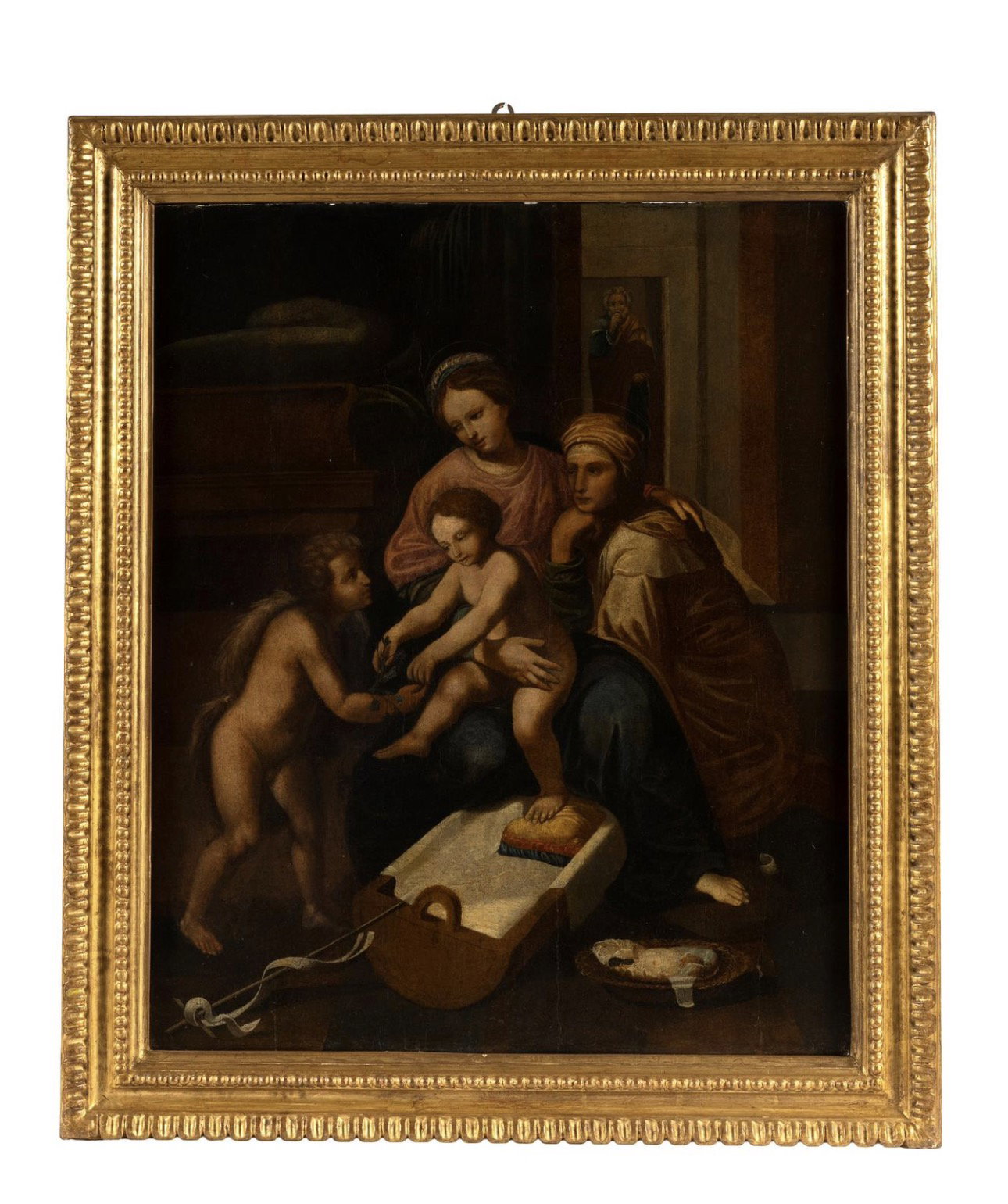
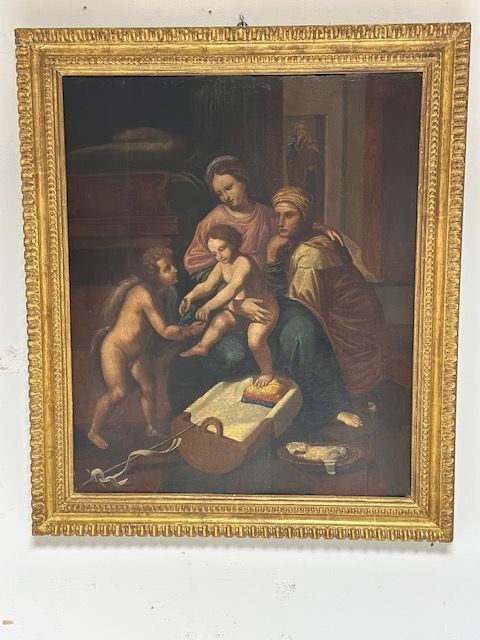
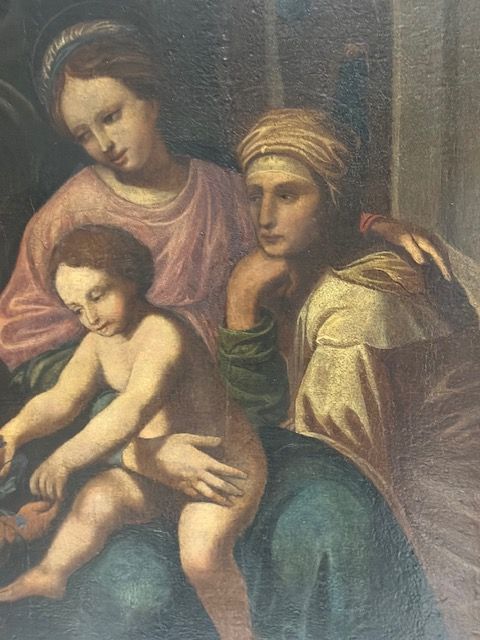
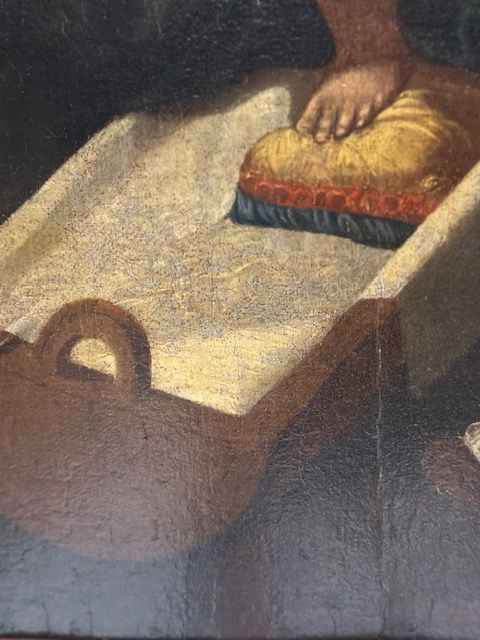
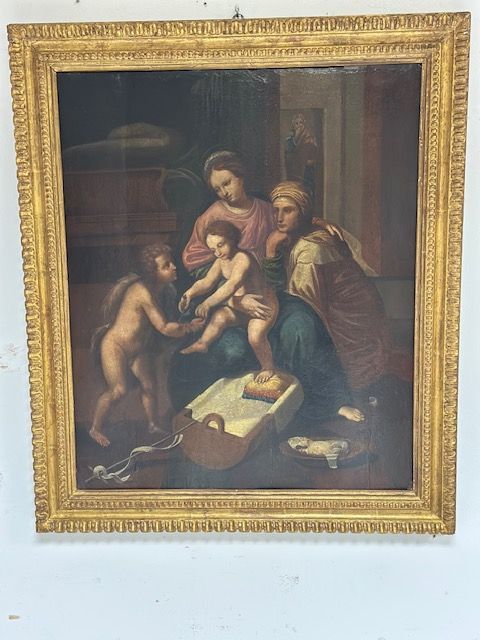
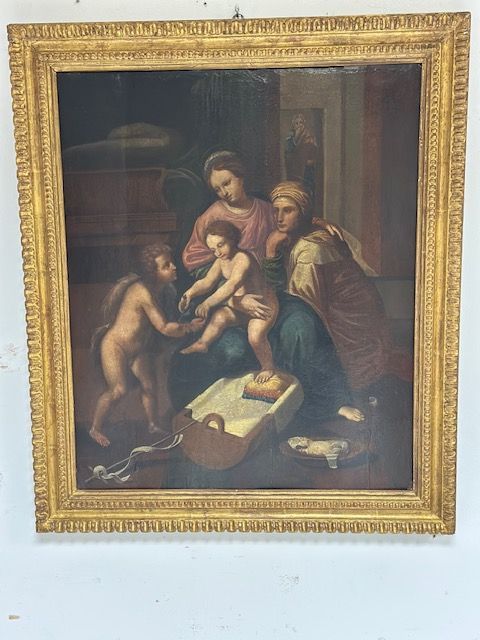
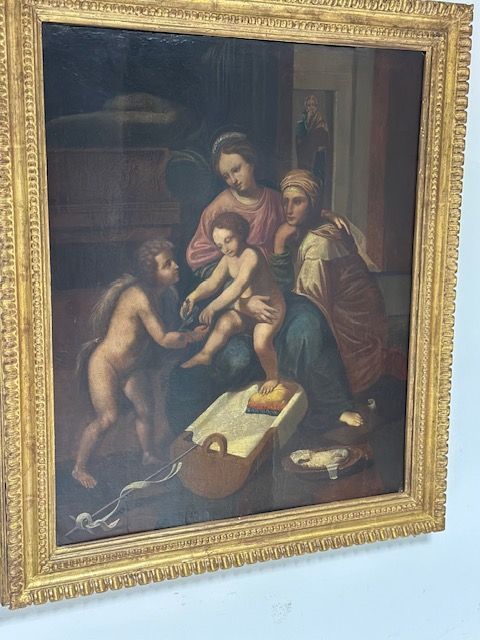
The painting we present represents a valuable homage, identical in support and pictorial technique, to the famous "Madonna della gatta" by Giulio Romano, a work datable between 1521-1524 and preserved at the National Museum of Capodimonte in Naples.
Our work is, in fact, a valuable workshop replica of the aforementioned painting, attributable to a late-Mannerist painter, belonging, precisely, to the atelier of Giulio Romano.
The pyramidal scheme of the hagiographic composition constitutes a direct reference to the lesson of Leonardo and Raphael, who had, so to speak, fixed the guidelines for the realization of analogous subjects (Holy Families).
Direct, in fact, is the comparison between our painting, the matrix of Giulio Romano, and the "Madonna della Perla" by Raphael, currently preserved at the Prado Museum in Madrid, initially (starting from 1656) kept at the monastery-pantheon of the Escorial and, so named by the King of Spain Philip IV, because it was considered the work of greatest value in his collections.
The fact that the "Madonna della perla", datable around 1518-1520, was realized by Raphael with the collaboration of his favorite pupil, Giulio Romano and that, subsequently it was the object of a very personal revisitation by the disciple of the Urbinate, allows us to advance some observations also regarding our panel, concerning analogies and differences of a subject that, apparently, must have enjoyed particular iconographic fortune.
First of all, with respect to the "Madonna della perla" and, in full continuity, instead, with the "Madonna della gatta", it is evident, in the workshop replica in question, a total abandonment of cold colors in favor of a sharp and dramatic chiaroscuro (see Stefania Pasti, Giulio Romano and the Madonna della gatta: an iconographic study in "Storia dell' Arte" 31, 2012).
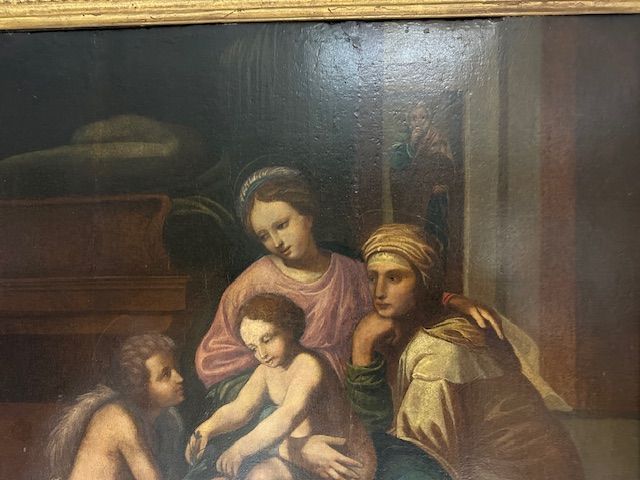
If the scene follows the pyramidal scheme of Raphael, if it is equally rich in emotive resonances, the chromatic tones of the clothes, from those of the Virgin to those of Saint Anne, are diluted in the search for a greater, albeit always composite, stylistically balanced, drama.
As in the "Madonna della gatta", the executor of this panel shies away both from the sweetness of Raphael and from the Leonardesque "sfumato", in favor of an incised, almost graphic sign (see Renato Barilli, Maniera moderna e Manierismo, 2004).
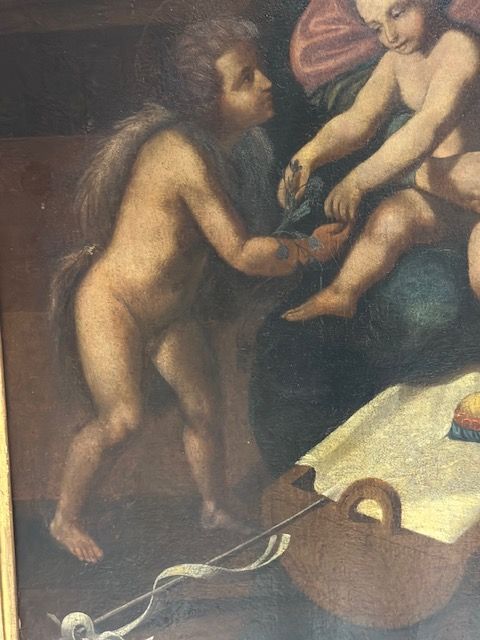
An indisputable element of specularity and continuity with the exemplar of Raphael and the panel of Giulio Romano is, instead, the hierarchization of the characters: their intense play of glances leads the eye of the spectator to move between them, analyzing them slowly one by one, from Mary to Saint John to the Child up to Saint Anne. Only Saint Joseph plays a secondary role, relegated, in both paintings, in the background, almost as an external observer.
Like the exemplar of Giulio Romano, also our panel is datable, more or less, to the years immediately following the death of Raphael (1520), when the Pupil inherits by will from the Master the workshop and the commissions already started realizing together with Gian Francesco Penni the Hall of Constantine in the Vatican qualifying as the most brilliant heir of Raphael's style.
These are the years, those Roman ones, in which Giulio Romano is engaged in various paintings of hagiographic subject, among which deserve to be remembered the "Pala Függer" in the Roman church of Santa Maria dell' Anima and the "Lapidation of Saint Stephen".
It remains to be questioned on the topos iconographic of the presence of the cat, which oscillates, in an authoritative tradition dating back to Lorenzo Lotto (Annunciation of Recanati) and which, will be particularly dear to the Barocci, between natural representation of a domestic context and symbolic meaning, negatively connotated, as connected to Evil and the anti-salvific work of the Devil.
Measurements: H 76 x 63