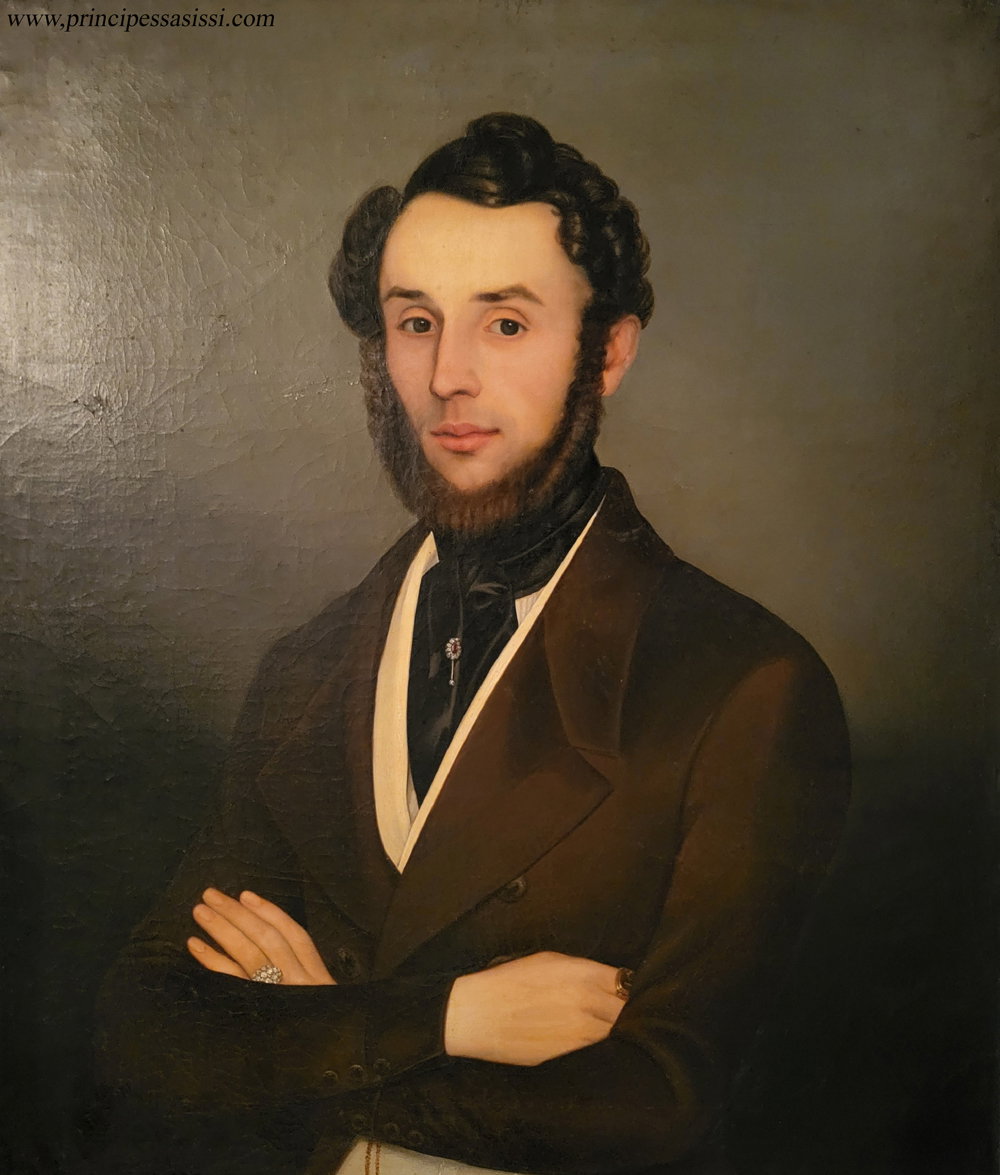
Ferdinand Georg Waldmüller (1793–1865) Masterful male portrait of a wealthy bourgeois attributed to him.
Oil on canvas. Dimensions: approx. 74 x 63 cm
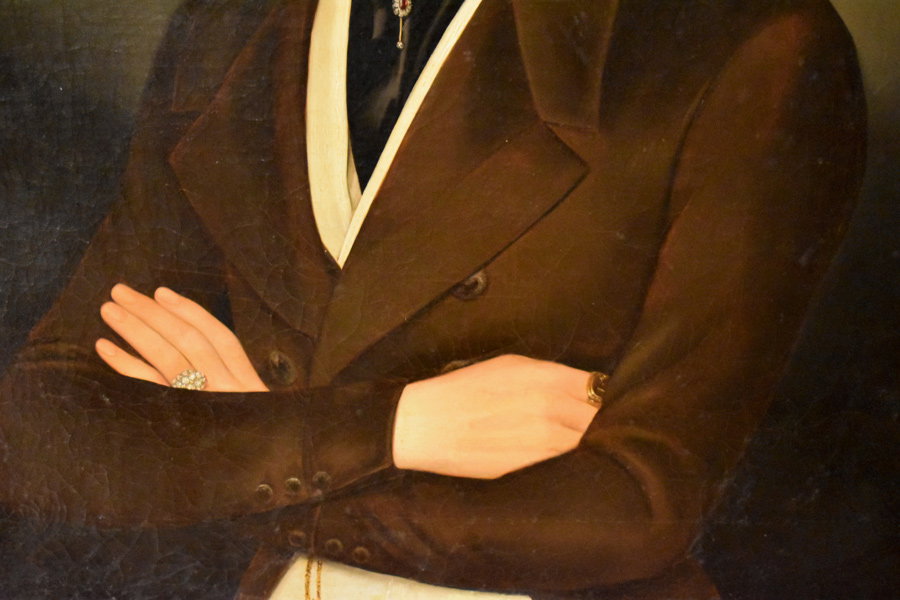
Subject: Half-length male portrait, figure with a Biedermeier fashion brown velvet suit with a black silk shirt; hands crossed embellished with a diamond ring, neutral background.
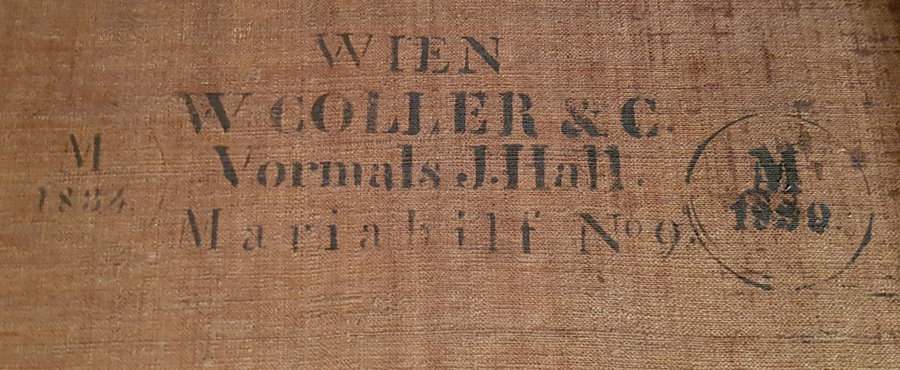
Date: Vienna, from 1835 to 1840. On the back of the canvas, the stamp of the company "W. Coller & C., Wien Mariahilfe 9" with the date 1835 is visible, in the center of Vienna, at the time the documented supplier of pictorial materials in the early nineteenth century. It is confirmed that Ferdinand Georg Waldmüller purchased canvases and materials from this company, as evidenced by archival studies on his activity. Recently at the Im Kinsky auction house in Vienna, another painting by Waldmüller appeared bearing the same stamp on the canvas purchased from the same retailer of the time (19th-century paintings auction of 6.12.2022, lot 242).
Stylistic analysis / studies and attribution path
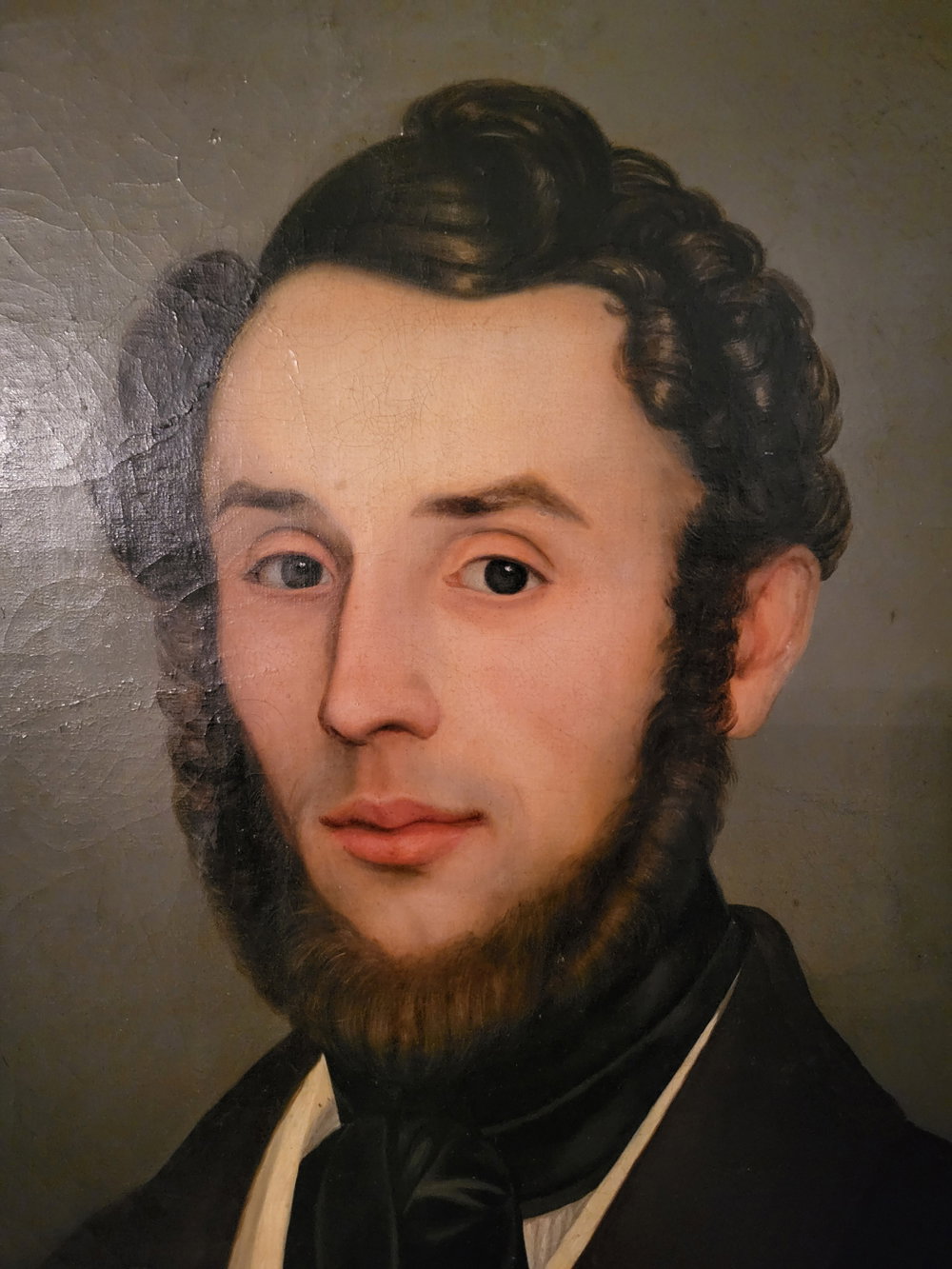
The face presents a very fine modeling of the complexion, with very soft tonal transitions and absence of sharp contours, typical of Waldmüller's mature style in the 1830s.
The eyes are treated with extreme care; the light and well-defined iris, the reflected light precisely placed, the spherical effect rendered through subtle transparencies.
The lips show a soft line, with the lower lip slightly more pronounced, in line with numerous similar portraits by the painter.
The hair is treated with almost microscopic meticulousness, made shiny with the wise use of light reflections and soft shadows. Waldmüller was known for this almost "hyper-realistic" approach to rendering surfaces, especially in skin and hair.
Brightness and color: even the chromatic range, which balances warm and soft tones with great naturalness, is typical and similar to other works by Waldmüller. Observe how the light in the curls emphasizes the volume, with a refined treatment of depth.
Psychological trait and posture: the composure, the direct but not rigid gaze, and the elegant but not idealized posture are also typical features of portraits signed or attributed to Waldmüller in that period.
Points that further strengthen the attribution:
1. Face and complexion: The pearly complexion, defined but soft, is characteristic of Waldmüller, as observed in many of his youthful portraits, including his youthful self-portrait at the Kunsthistorisches Museum.
2. Hair and beard: The graphic and minute rendering of the hair, and in particular of the sideburns, is extremely similar to that which Waldmüller adopts in portraits between 1828 and 1835.
3. Drapery and hands: The crossed hands and the folds of the jacket have an almost sculptural plastic quality, also found in portraits of figures of the Viennese bourgeoisie made by him.
4. Setting and pose: The proud but measured pose is similar to that adopted by Waldmüller in male portraits, in which the subject is represented frontally or three-quarters, with attention to psychology.
All these characteristics directly recall other certain works by the master, including those shown for comparison visible on the page of our site to which the link at the bottom of the page refers.
Notes: the canvas in the lower part has been slightly reduced in height in the past, probably to adapt it to a frame. It is probable that the author's signature was placed in the contained lower part of the painting that was lost. Waldmuller usually signed in the lower right end of the paintings. This element strengthens the attribution.
Storage conditions: Very good, the work is free of significant restorations. Minimal corrections of limited color losses in peripheral parts, clearly visible with UV reflectography. Loss of a small portion in the lower side of the painting, probably bearing the signature.
Bibliography and references "Ferdinand Georg Waldmüller – Leben und Werk", ed. Österreichische Galerie Belvedere Dorotheum catalogs, sessions 2015–2024, paintings of the Austrian Biedermeier Archives on Viennese suppliers of materials for painting (W. Coller & C., Wien)
Final considerations. In light of the stylistic, technical and material evidence, the attribution to Ferdinand Georg Waldmüller is considered highly probable, with a margin of uncertainty plausibly only limited to the possibility of a work created in his immediate and direct circle or workshop.
Ferdinand Georg Waldmüller, biography
He was born in 1793 near Vienna, in the town of Hinterbrühl. He is considered one of the most important Austrian painters of the Biedermeier period. He left his father's house at the tender age of 14 and studied at the Academy of Vienna. He later earned a living by selling miniature portraits and, from 1811 onwards, as a drawing teacher at the house of Count Gyulay in Agram in Zagreb, Croatia, at the time belonging to the Austro-Hungarian Empire. He had the court opera singer Katharina Weidner as his first wife.
The couple then lived in Baden, near Vienna and later in Brno and Prague in Bohemia, where Waldmüller worked for the theaters of these cities as a scenographer and set designer until 1817, the year of his return to Vienna. Here Waldmüller dedicated himself mainly to portraiture, receiving numerous commissions from wealthy bourgeois and aristocrats of the time.
Waldmüller also undertook several study trips to Italy and Paris and also stayed in the Salzkammergut region (near Salzburg) to complete naturalistic studies.
In 1830 he was appointed curator of the painting collection of the Vienna Academy, where he taught as a professor. The golden age of Waldmüller's portraiture was in the 1830s.
Later he dedicated himself more and more to genre and landscape portraits. Waldmüller achieved great international success with an exhibition at Buckingham Palace in London in 1856. However, due to differences of opinion, he lost his position as a teacher at the Academy of Fine Arts in Vienna in 1850. Due to the consequent financial difficulties , he was forced to auction all his paintings and to work in the fashion salon run by his second wife, Anna Bayer.
In the end he was rehabilitated as a teacher by Emperor Franz Joseph and his salary was restored. Waldmüller's most important students include Anton Romako, Hans Canon, Michael Zichy, Anton Ebert and Adam Brenner.
He died stabbed to death for a disagreement with another patron in an inn in Mödling, near Vienna in 1865.
In accordance with the provisions of the New Code of Cultural Heritage, the selling company provides at the time of sale detailed written photographic guarantee of originality and provenance of the works sold. The data with which the works are described and then contained in the written guarantees are expressed determinations resulting from accurate and documented technical / historical / artistic investigations, even of expert relevance.