Master of Saint Sebastian Monti
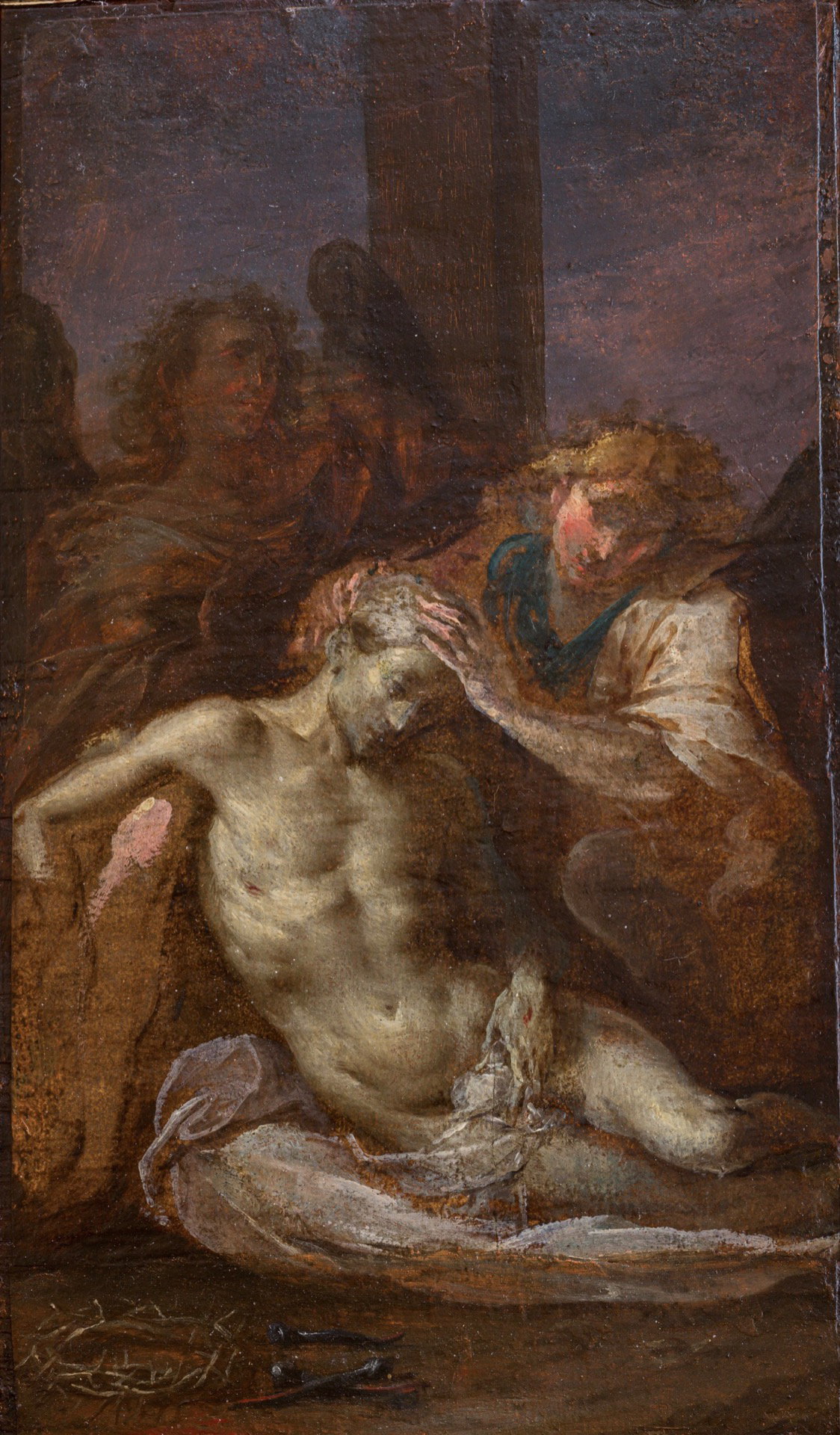
Lamentation of Christ with Angels
Oil on paper applied to panel, 29.3 x 17 cm, circa 1625.
Provenance: private collection
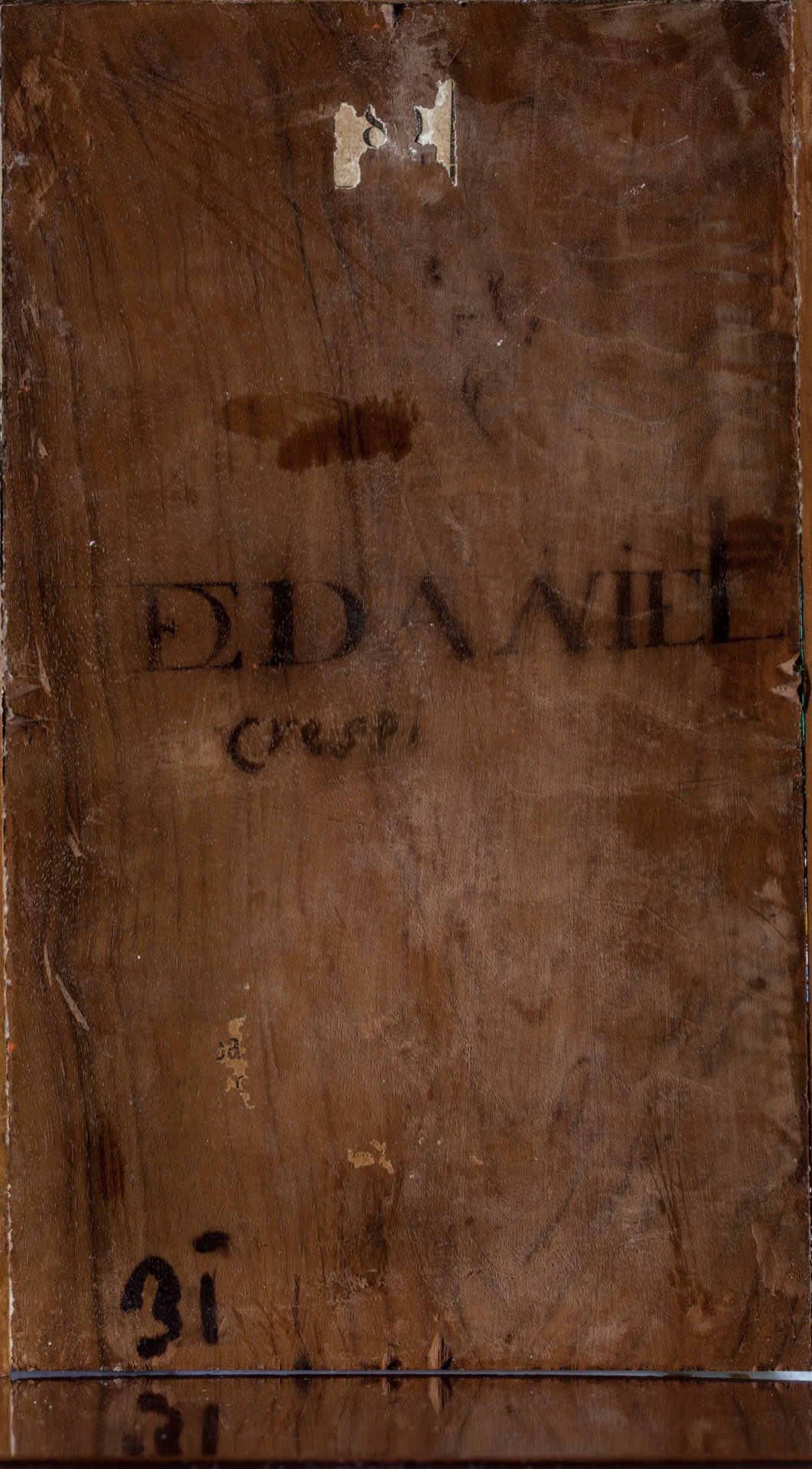
On Golgotha, leaden clouds evoke an eclipse. A sweet light spreads in the evening, caressing the artificial naturalness of the Deposed Christ. The shapely thighs rub against each other with veiled sensuality; it is the majestic, silent abandonment of an ancient wounded hero. Surrendered and triumphant. An Angel lingers helpfully in the shadows, his tunic sculpted by the wind, his hair disheveled amidst large dark wings, while another, bent over, affectionate in the golden light, ignites with a devout fervor, both virile and feminine. The obvious narrative centrality of the Cross is freed from traditional symmetries; the figures, arranged in an undulating, scalene animation, are already leaning towards the Baroque. Despite the sublime consonance of composition, gesture, and drawing, indicative of an undoubtedly original invention, the face of Christ corresponds to a physiognomy recurring in Cerano [Cf. Op. cit., 2005, pp.190-191, tav.44] in works datable to the second decade of the 17th century [Op. cit., 1989, pp.134-135], while the Angels seem to be cut out from a canvas by Giulio Cesare Procaccini. Daniele Crespi, a genius who burned out with tragic precocity, knew how to synthesize the Lombard tradition with the Bolognese classicist one in a lofty, sunny manner, although not free from visionary, Nordic anxieties. This stylistic apogee, which our painting embodies exemplarily, is situated in the year 1623-24 [Cf. Op. cit., 1996, p.7 and Op. cit., 2012, p.71], in conjunction with the execution of a cycle of paintings in Milan, in the destroyed Church of San Protaso ad Monachos, for the Chapel dedicated to Saint John the Baptist. Similar turn followed the new post-Tridentine aesthetic directives outlined by Cardinal Federico Borromeo, founder of the Accademia Ambrosiana (1620), condensed in his De Pictura Sacra (1624) in the triple imperative: delectare, docere, movere. The polished anatomy of Christ, the angelic faces, give estatic pleasure, exalting the extreme sacrifice. Lectio on the supreme sense of martyrdom are the crown of thorns and the blood-veined nails, placed laterally, without emphasis; not horror and contrition have infused degradation and death in Jesus, but an almost childlike tenderness, a desire to rise again in the supernal peace. The same virile model of our Lamentation recurs obsessively in a large series of paintings, not by chance variously attributed to Cerano, Procaccini, Morazzone, Crespi, which part of the critics trace back to a single, new, not-better-documented personality: the Master of San Sebastiano Monti. The ex nihilo emergence of the Master occurs as a solution to the attributive diatribe [Cf. Op. cit., 2006, p.33] concerning the well-known and controversial Altarpiece with the Beheading of the Baptist preserved in S. Alessandro in Milan (and related stupendous sketch in a private collection) [Op. cit., 2012, tav. 37-38]; he derives his name from a San Sebastiano from the ancient Collection of Cardinal Monti, successor of Federico Borromeo [Cf. Op. cit., p.75] and would also be the author of the San Francesco in ecstasy and Angels [Ibid. tav.43] and of the San Francesco in meditation [Ibid. tav.42] in which the model portrayed is also always the same one of our painting. Among the canvases attributed to the Master, we finally encounter two large altarpieces preserved in the Church of San Simpliciano in Milan; our Lamentation evidently constitutes the first idea for the central part of the Lamentation of Christ [Op. cit., 2012, tav. 48-49, fig. 1]. The "spiritual tension" and the "imaginative vocation" of these two altarpieces would let us recognize in the Master a true and proper "alter ego" of Crespi, as if the two painters were united by a "mysterious psychological and stylistic thread" [Op. cit., 2012, pp.77-78], not excluding that the Master may have been the unknown initiator of Crespi to painting [Op. cit. 1989, pp.83-85]. There is also a small painting, recently sold with attribution to Giovanni Andrea Ansaldo at Farsettiarte (Auction n°169, lot n°647), now in prestigious Antiquarian Gallery as Master of San Sebastiano Monti, which resumes with variants the theme of the Lamentation. The logical precedence of our vibrant first idea with respect to the monumental canvas of San Simpliciano, lacking any documentation on the commission and the pristine collocation, would suggest attributing this Lamentation of Christ with Angels to the Master of San Sebastiano Monti. On the back of the thin walnut panel, written in bistre with three different writings, we read: the enigmatic initials "D,C,F" (?), "DANIEL'', "crespi", the inventory number "31". Panel and strips of paper are united from the beginning, since in several points the original application of the color passes from the paper support to the underlying wooden one; this makes plausible that part of the writings is coeval to the painting, or rather, a signature. It would be prejudice therefore, if not error, to exclude in principle that our Lamentation could be a creation of Daniele Crespi himself, promptly welcomed by his own phantom alter ego.
Leonardo Scarfò