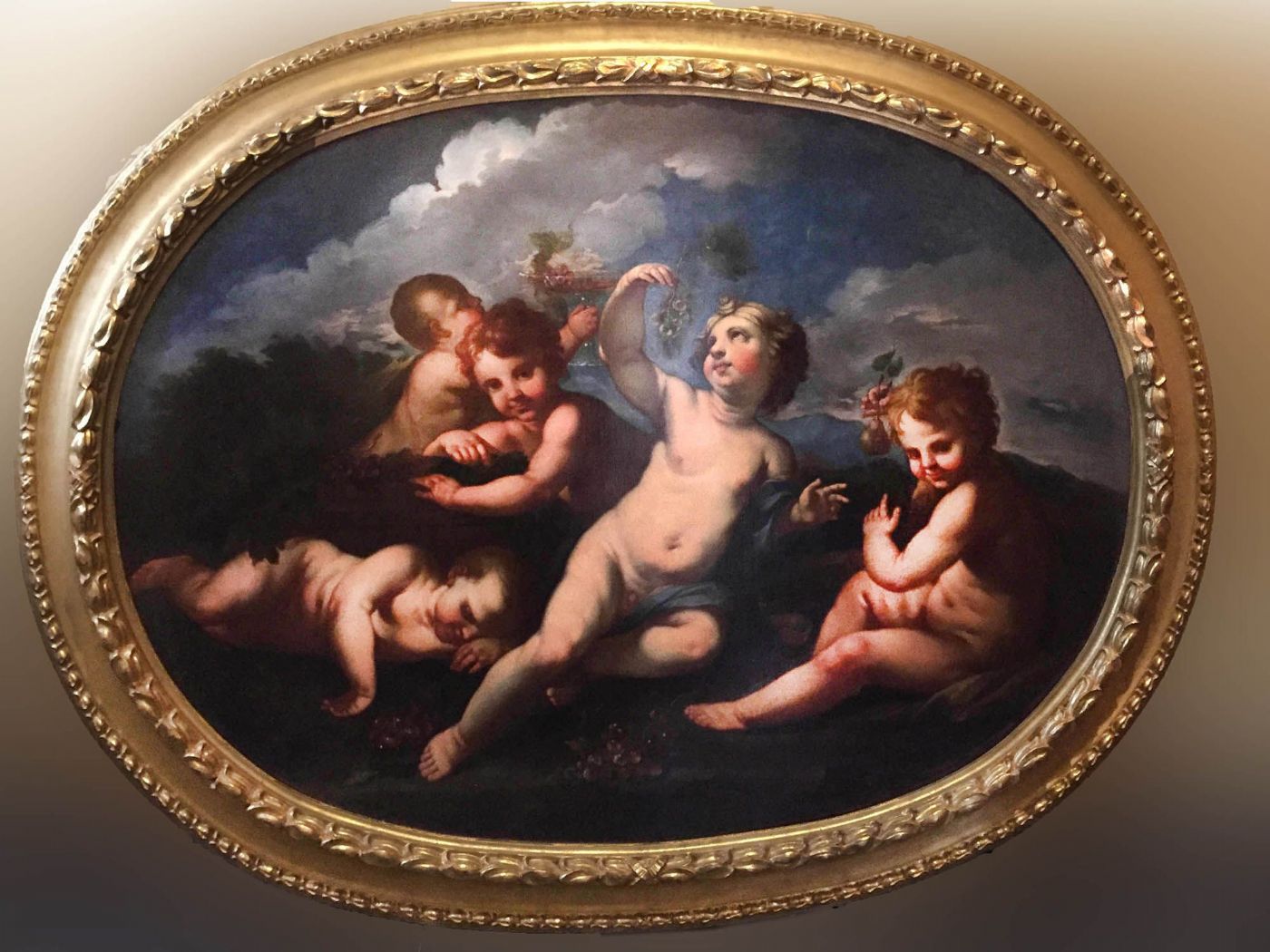
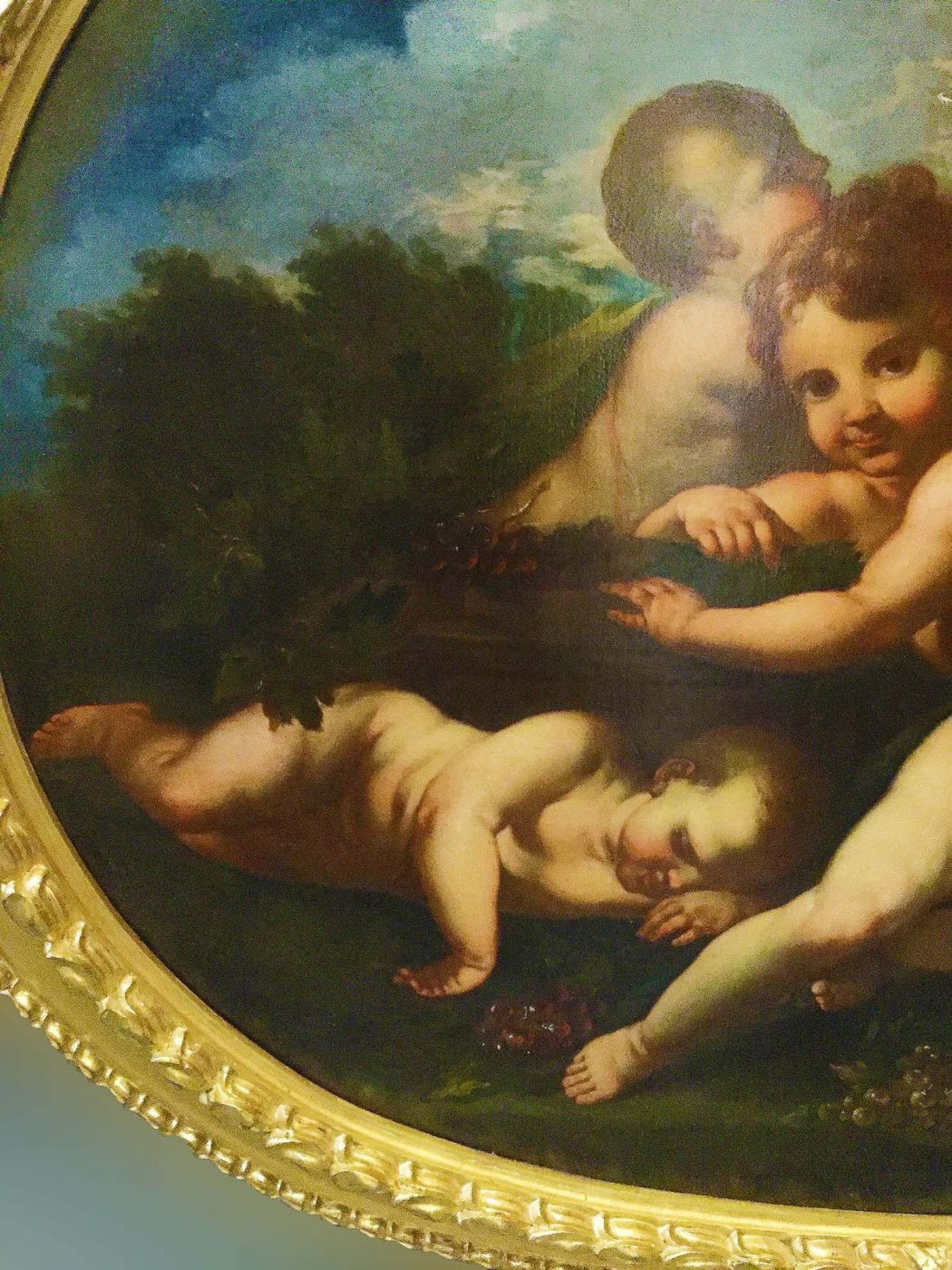
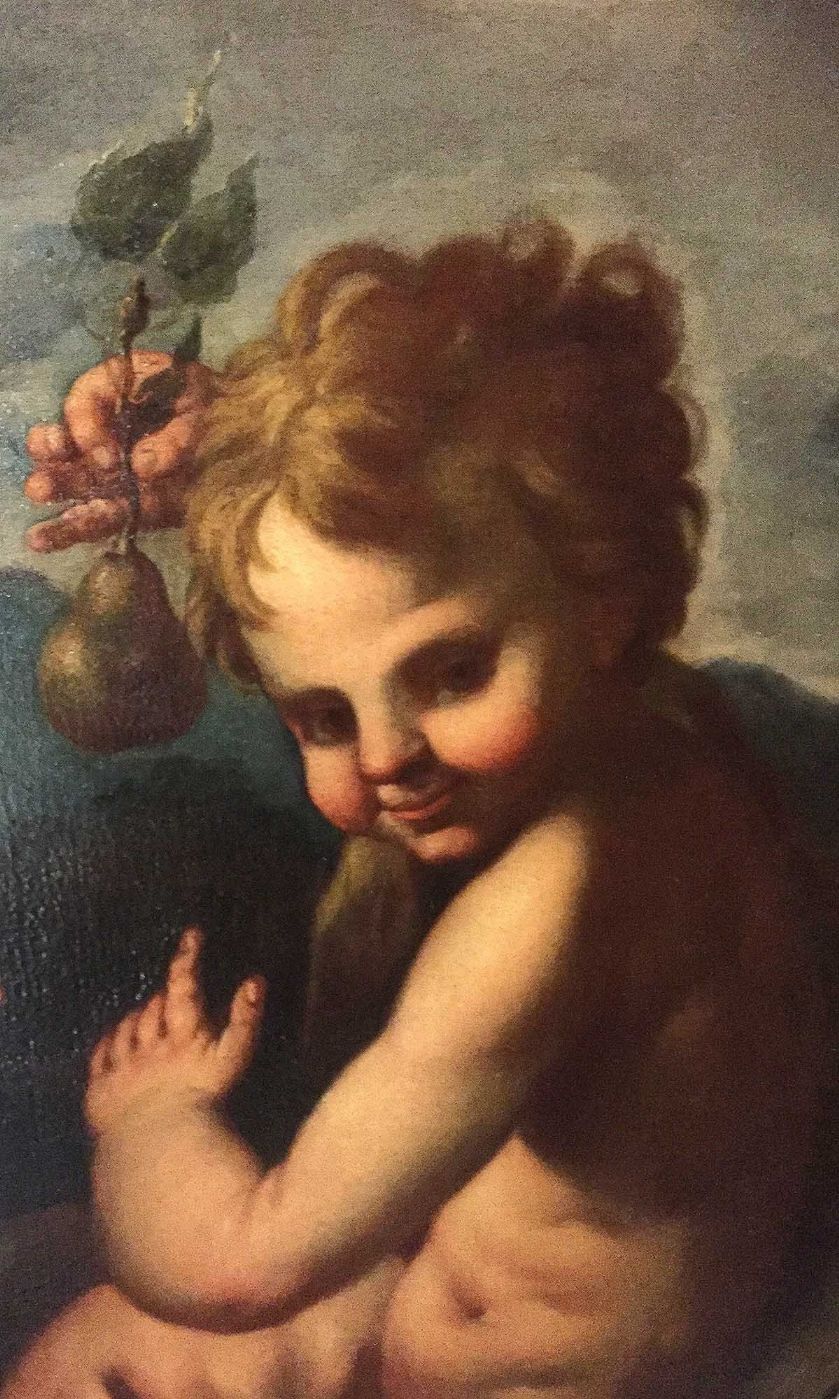
YOUNG BACCHUS AND BACCHANAL WITH PUTTI AND FRUIT
Michele Rocca known as PARMIGIANINO the Younger (Parma, 1666 - Venice, after 1751)
(attributed) - around 1730
Measurements: cm. 115 x 153 (canvas) – cm 149 x 187 (with frame)
Price: euro 39,000.00
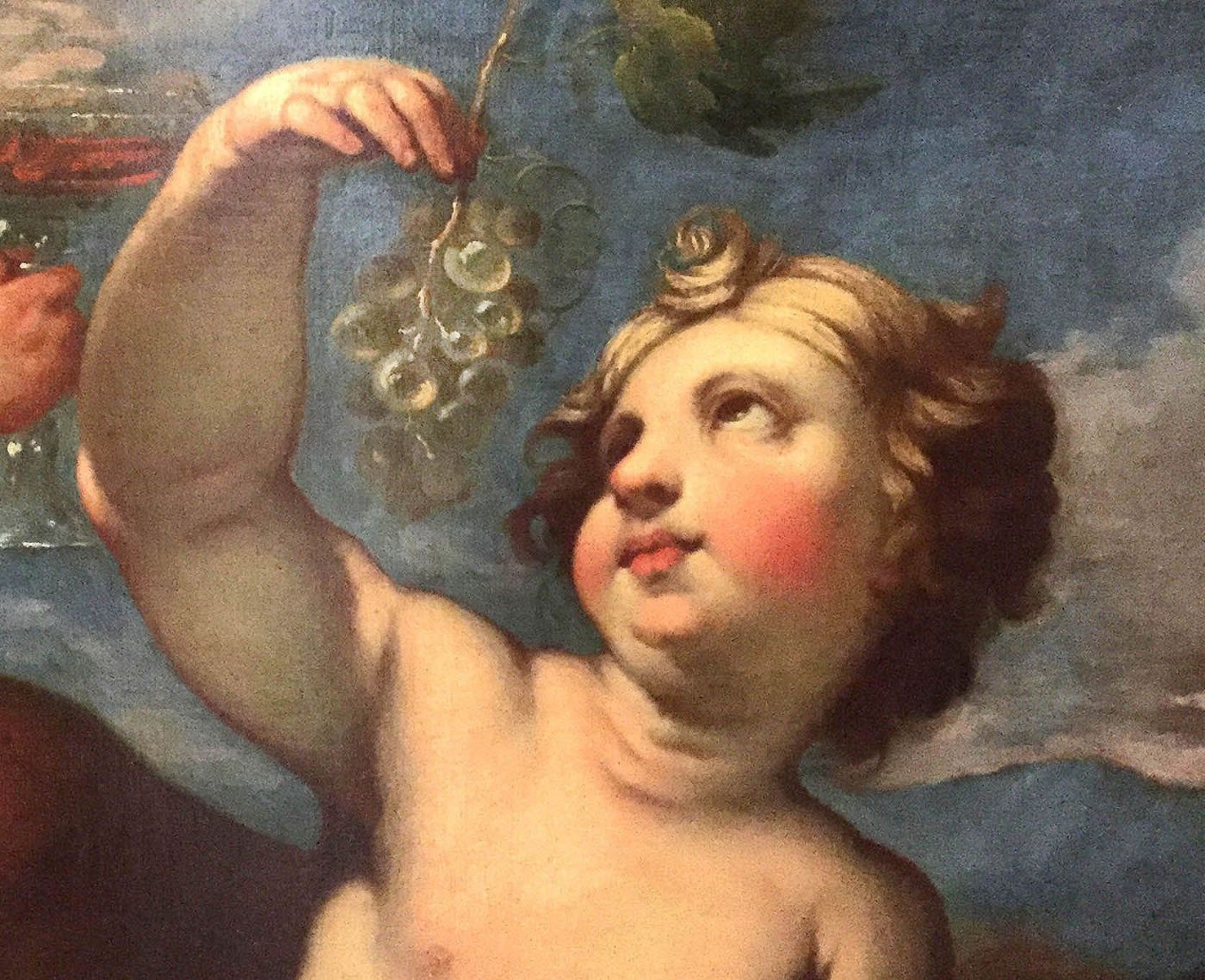
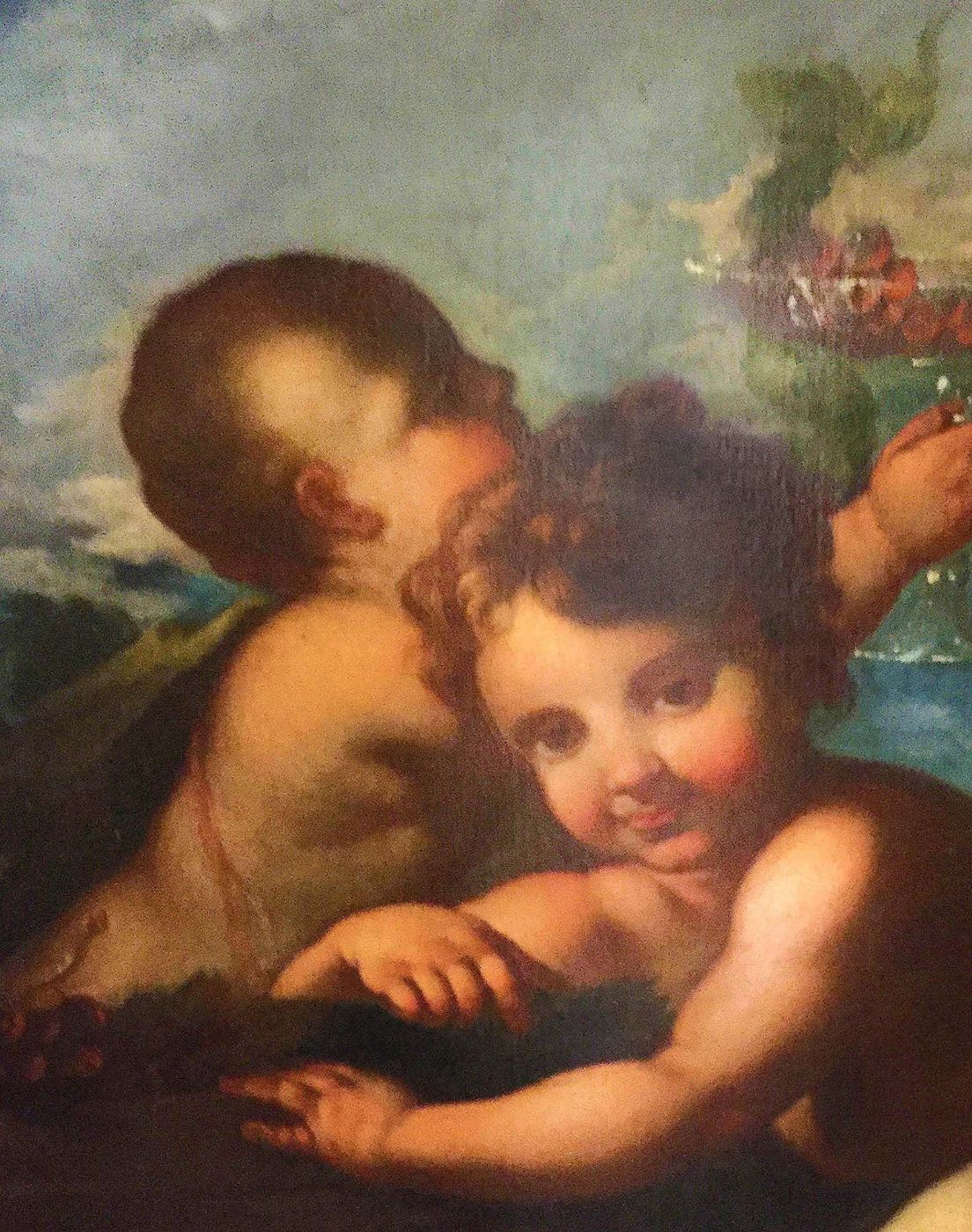
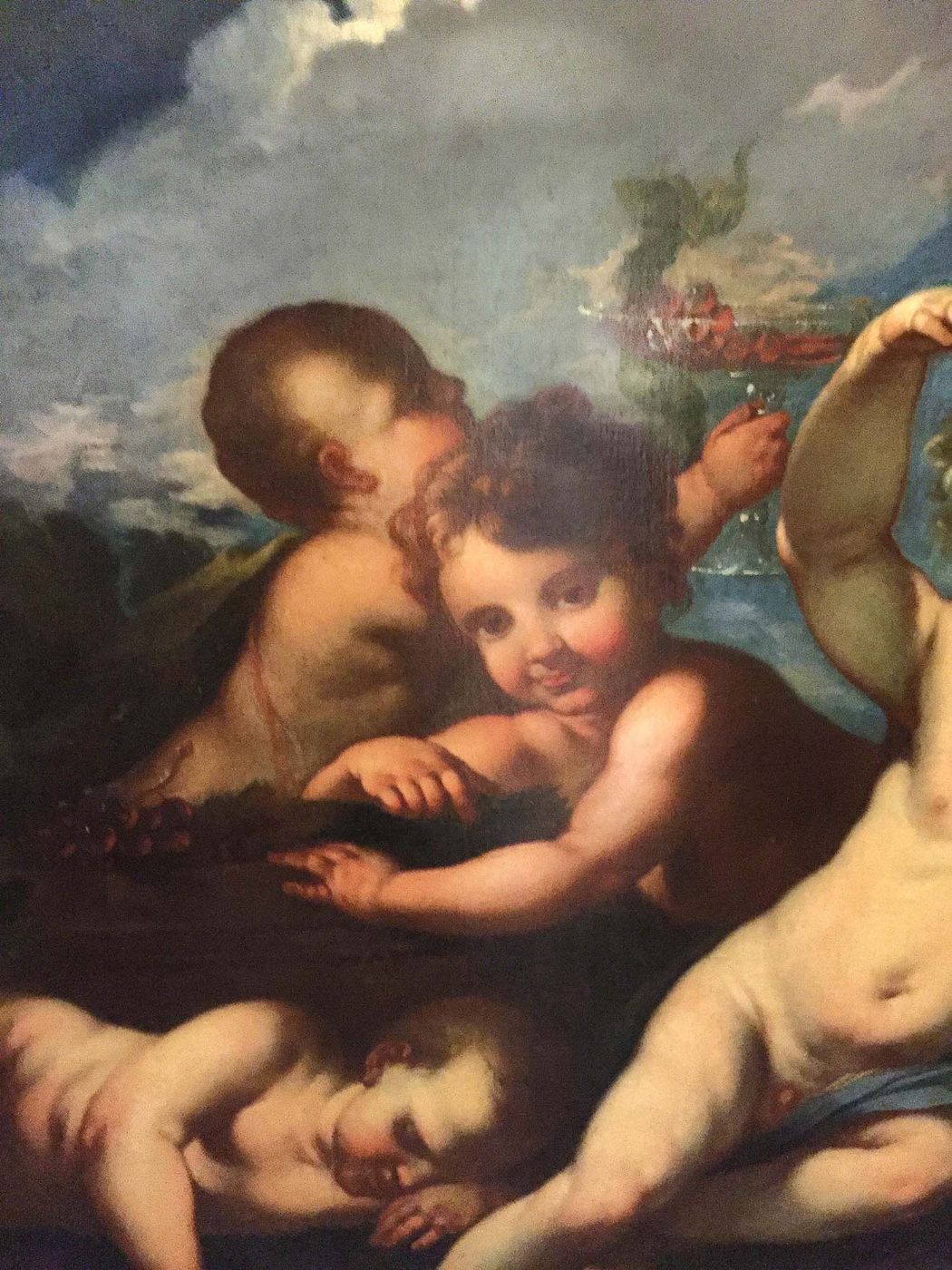
A rare oil on canvas within an antique gilded and carved wooden frame in an oval shape. A museum-quality work, of refined stylistic signature and exquisite Rococo taste, attributable to the Parmesan master in his best phase, the more mature one. That is, after his experiences derived from Sebastiano Conca, Carlo Maratta, and other distinguished painters of the late Baroque (between Parma, Rome, and, later, Venice). The theme of this "allegory of the grape harvest," with a very young Bacchus in the center surrounded by putti holding bunches of grapes and fruit in playful and childlike attitudes, is treated with pictorial skill and descriptive delicacy. According to a "light" approach to these celebrated mythological themes, which will become typical of the Rococo period.
Bacchus is a deity of Roman religion, his name comes from the Greek term ?????? (Bákkhos), with which the Greek god Dionysus (?????s??) was indicated at the moment of ecstatic possession. In Roman religion, Bacchus, from being an appellative, becomes the actual name of the deity. In the Etruscan context, he corresponds to Fufluns. God of wine and the grape harvest, as well as the pleasure of the senses and amusement, his cult (bacchanal) arrived in the Italian peninsula in the 2nd century BC. He is often depicted as a man with his head crowned with vine leaves, neither thin nor muscular: usually drunk, he often holds a cup of wine or the thyrsus in his hand. In our case, he is represented here as a child, a carefree, amusing, and "demythologizing" choice by the painter.
NB: the work was attributed to the master and cataloged in 1974 by Finarte, with a price (at the time) equal to 2,400,000 lire.
In a written communication dated June 25, 2009 (reported on the back of a photo of the work), Prof. Daniele Benati, art historian at the University of Bologna, confirms the attribution and autography of the painting to Michele Rocca.
Brief critical and biographical essay on the author
(by Prof. Giovanni Morsiani)
Michele Rocca known as Parmigianino the Younger (Parma, 1666-Venice, after 1751).
Known by the nickname Parmigianino the Younger or Parmigiano, he was born in 1666, perhaps in Parma. The date of birth is reported in the biography of Nicola Pio (1724, 1977, p. 111) and is confirmed by the inscription on the artist's self-portrait (Stockholm, National Museum).
His initial training took place in Parma, with Filippo Maria Galletti, a painter of Cortonesque origin, from whom he "began to learn drawing and the profession" (ibid.). It seems that Rocca arrived in Rome at the age of sixteen, around 1682 (Sestieri, 2004, p. 11), and that he frequented the workshop of Ciro Ferri (Clark, 1970, p. 208). The apprenticeship with Ferri does not appear to have marked his production. Rocca was attentive in reinterpreting the lessons of numerous painters such as Filippo Lauri, Carlo Maratta, Francesco Trevisani, Benedetto Luti, Sebastiano Conca, but also Luca Giordano, Francesco Solimena, Sebastiano Ricci, and Giovanni Antonio Pellegrini (Sestieri, 1973, pp. 84-92).
Following his stay in Rome, he returned to Parma, where on January 18, 1687, he was called to estimate "the paintings exhibited in the lot of fortune of Mr. Giuseppe Attiglio" (p. 95 note 8). It is not known how long he stayed in the city, but Pio remembers him "in his homeland, where, with a long and exact application to the paintings of the famous Correggio, he made himself a perfected and good painter" (Pio, 1724, 1977, p. 111).
In 1691 he returned to Rome: his presence is attested, together with his wife Maria Roè di Burgundia, in the parish of S. Salvatore in Onda, where he remained until 1730 (Debenedetti - Pergoli Campanelli, 2001, pp. 60 ff.).
For the church of S. Paolo alla Regola he created the S. Francesco receives the stigmata, dated 1695.
In the altarpiece, which bears the signature "Michael Rocc. Par/mensis / Pinxit anno / 1695" (where the wording seems to prove the Parmesan origin of the artist), that stylistic signature that he would later develop is not found.
In 1696 he ventured into a large-scale mythological subject canvas: Bacchus and Ariadne (Reggio Emilia, private collection).
The painting, one of the few signed and dated, denotes a language suspended between elements of late Cortonism and compositional solutions typical of the prevailing Marattism.
The Camillian fathers entrusted him in 1698 with the altarpiece of the high altar of S. Maria Maddalena. The painting, a Penitent Magdalene, was among the few works of religious subject by the artist with a church destination.
The canvas is stylistically contested between different artistic languages: "from an expository point of view, the composition appears to be a compromise between the late Baroque influences, deriving from his apprenticeship with Ferri [...] and the opposing lesson of Maratta [...]" (Sestieri, 2004, p. 256). Of similar subject, but of different layout, is another Penitent Magdalene (private collection), also signed.
Another of the few chronologically defined works dates back to the same years, the signed altarpiece of S. Barbara with s. Giuliano confessor, s. Quirico martyr and the Holy Trinity in the church of S. Maria Assunta in Barbarano Romano, executed between 1698 and 1704 (Lo Bianco, 1993, pp. 107-120).
In 1704 he participated in the exhibition of S. Salvatore in Lauro with a Hercules and Antaeus, a Crucifixion, and a Pietà, as a "painter recommended by the agent of Spain" (Ghezzi, 1987, pp. 185, 189).
A few years later, in 1707, Rocca lost his wife, from whom he did not seem to have had children (Debenedetti - Pergoli Campanelli, 2001, p. 61 note 8).
The artist was admitted in 1710 to the Virtuosi al Pantheon (Bonaccorso - Manfredi, 1998, pp. 70 ff.), and to the Accademia di S. Luca in 1719 (Rome, Historical Archive of the Accademia di S. Luca, Registers of the Congregations, vol. 47, c. 7v), where in 1727 he received the office of "visitor of the sick and prisoners" (vol. 49, c. 10).
His production, since the Bacchus and Ariadne, was characterized by paintings for private destination, often small or medium in size. The painter was active for illustrious clients such as Cardinal Pietro Ottoboni, who commissioned him a S. Mattia, exhibited in the exhibition of S. Salvatore in Lauro in 1713 (Ghezzi, 1987, p. 283), and the future Cardinal Carlo Leopoldo Calcagnini (Vicentini, 2016, pp. 226-229, 438-441).
The themes treated are often repeated, and mythological ones prevail (like our work under consideration) such as the Birth of Adonis, Acis and Galatea and many Bacchanals (like the already Briganti example). Others are taken from Ludovico Ariosto, such as Angelica and Medoro (Prato, Palazzo comunale, Quadreria comunale) and Rinaldo and Armida (private collection), or from sacred history, such as the Massacre of the Innocents or the S. Sebastiano (both in Ariccia, Palazzo Chigi). Exemplary is the case of the S. Cecilia (Rome, Accademia di S. Luca), of which there is an engraving made by Pieter Tanjé in 1727, a painting that enjoyed a vast fortune attested by numerous variants. The high quantity of autograph replicas, and perhaps of the studio, together with a continuous and uniform style, makes it difficult to punctually date Rocca's vast pictorial production (Sestieri, 2004, p. 9).
In 1730 he moved together with his nephew Francesco to casa Longhi, where he lived until 1738 (Debenedetti - Pergoli Campanelli, 2001, p. 61 note 10). From 1738 to 1747 there is no news of him in the States of the souls of S. Salvatore in Onda.
Rocca was seen in Venice by Matthias Oesterreich in 1751 "fort vieux et fort décrépit" (Oesterreich, 1770, 1771, p. 164). Although there is no documentary evidence, his death in the lagoon city can be traced back to that date.
Price: PRIVATE NEGOTIATION
www.palazzodelbuonsignore.com
https://www.romagnavirtualtour.it/virtual-tour-palazzo-del-buon-signore/