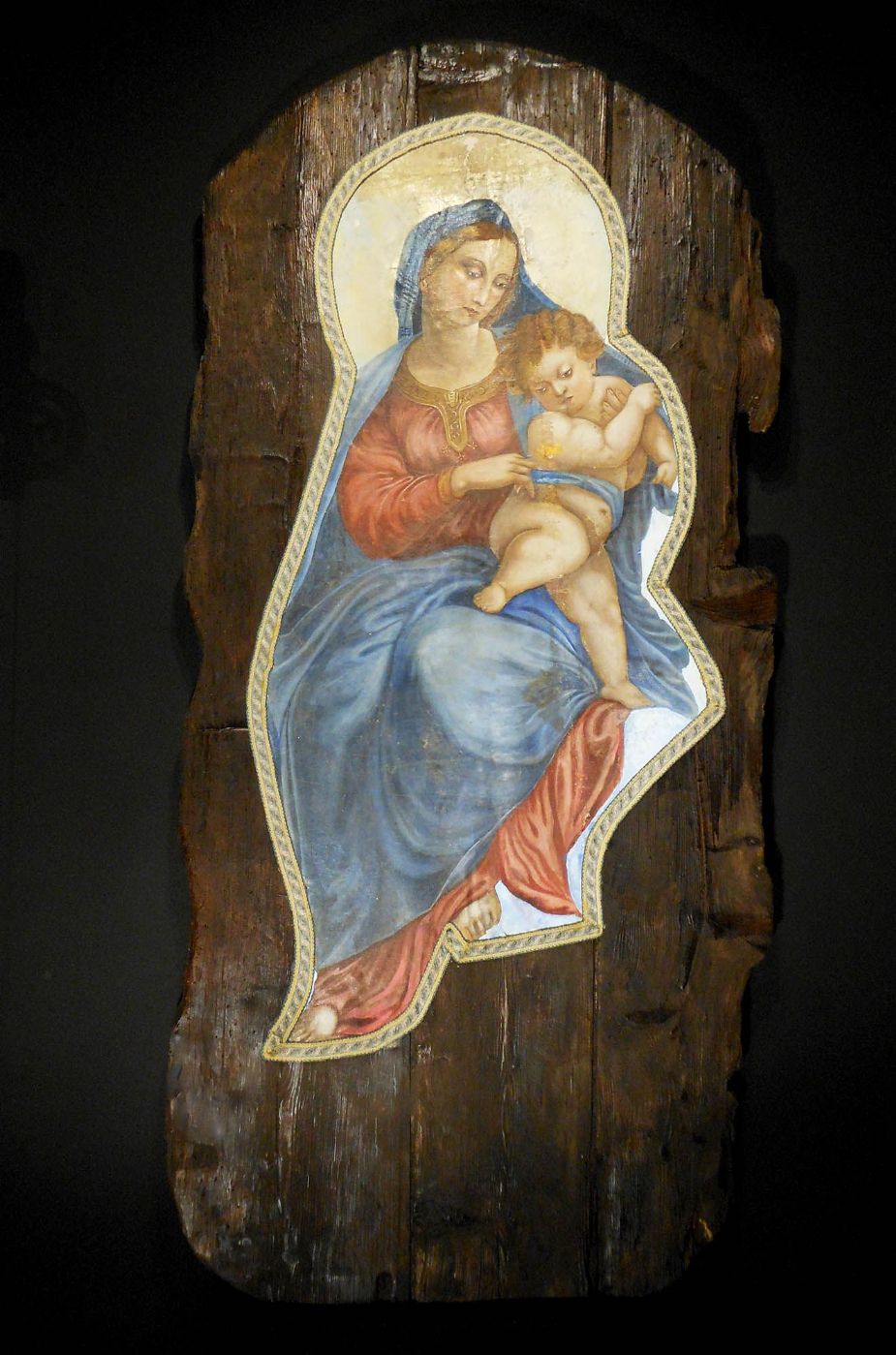
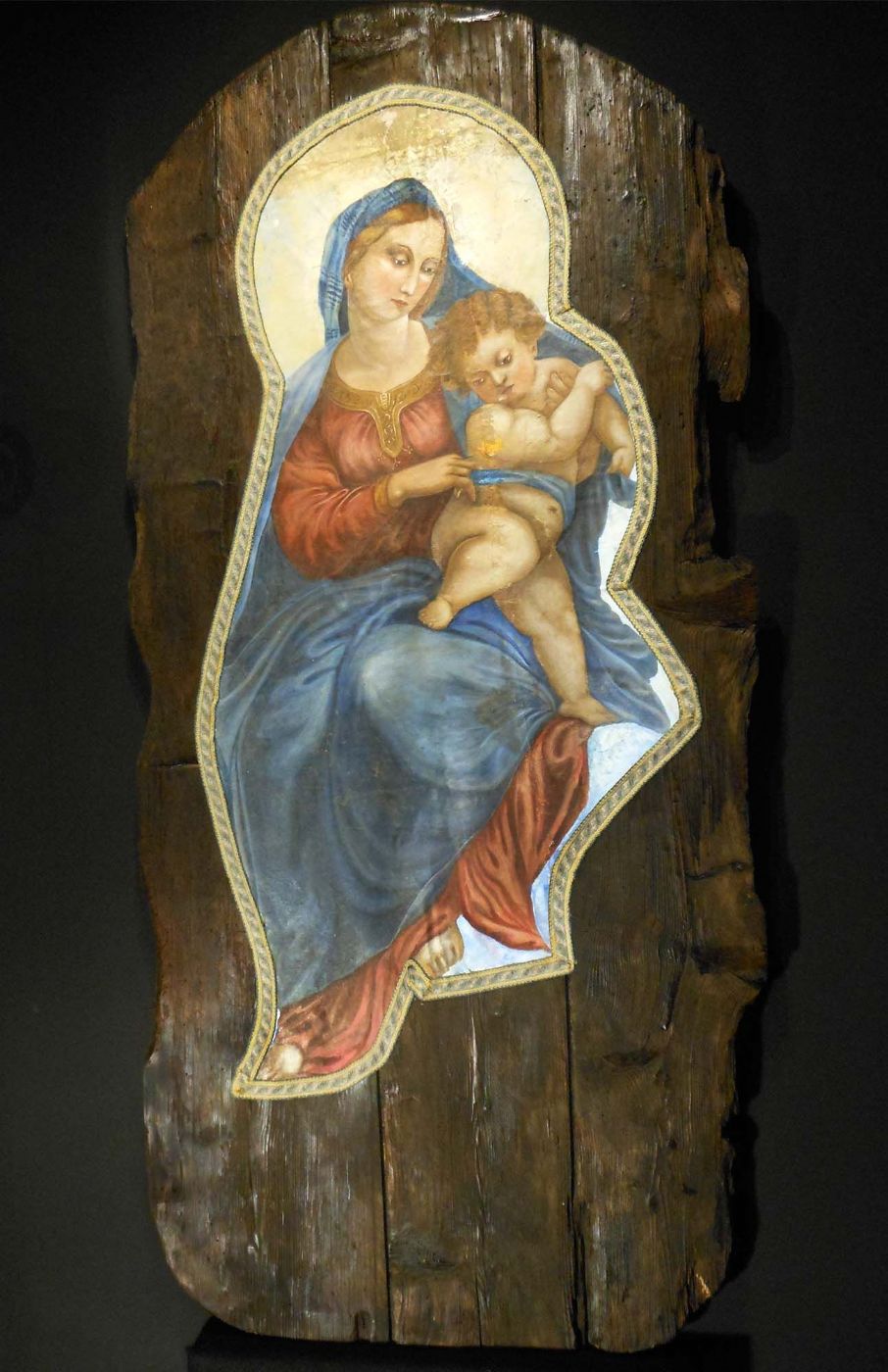
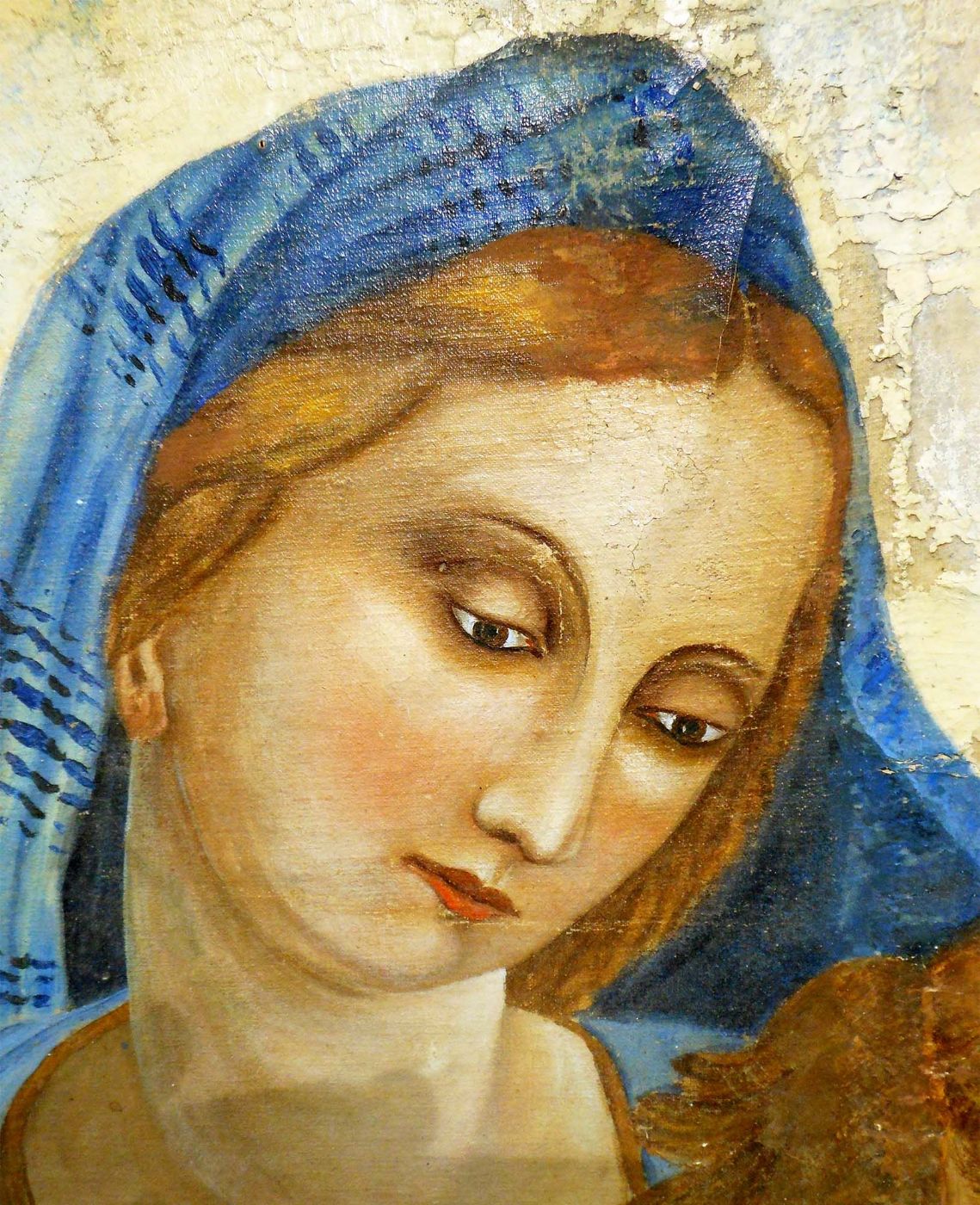
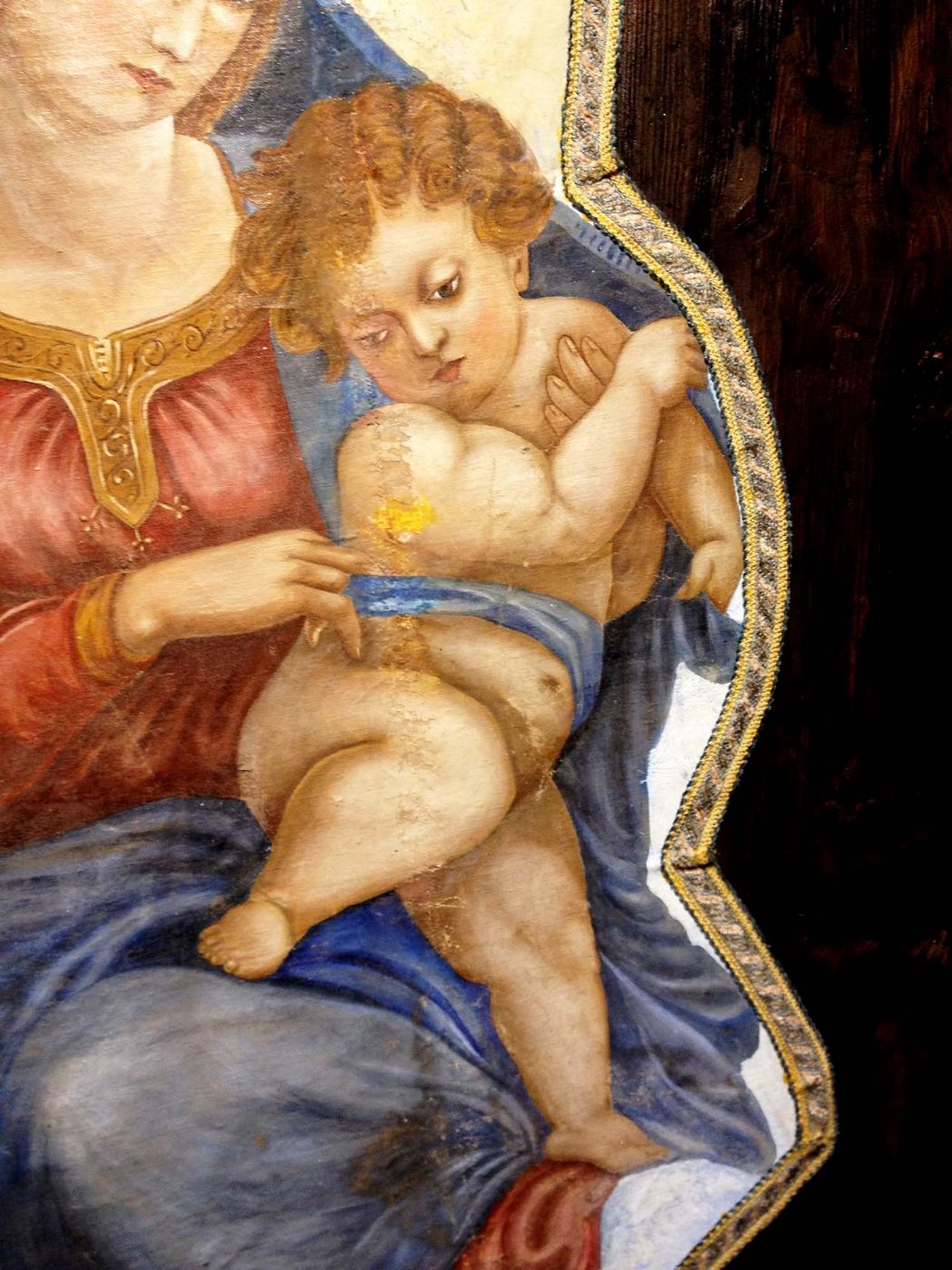
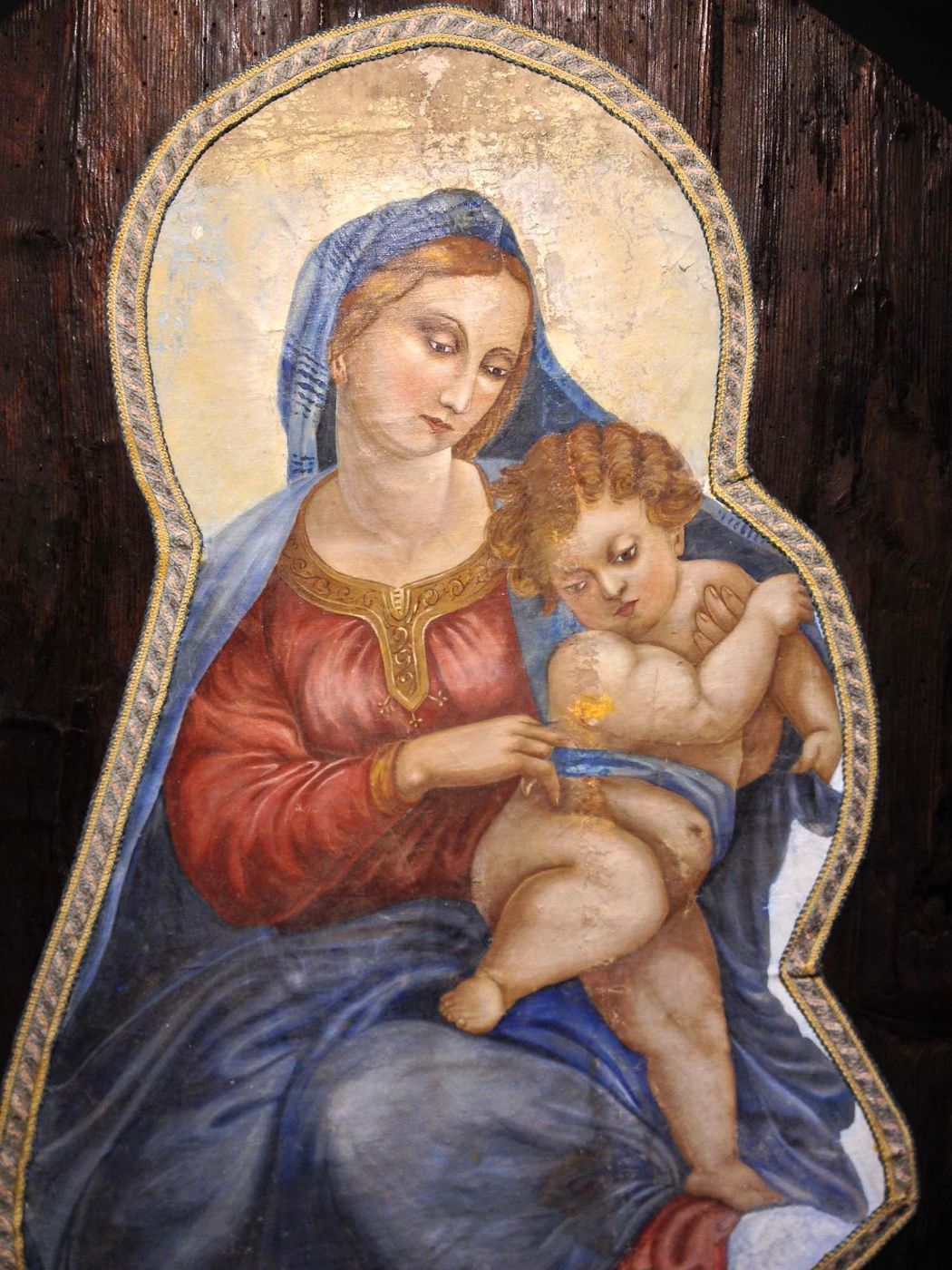
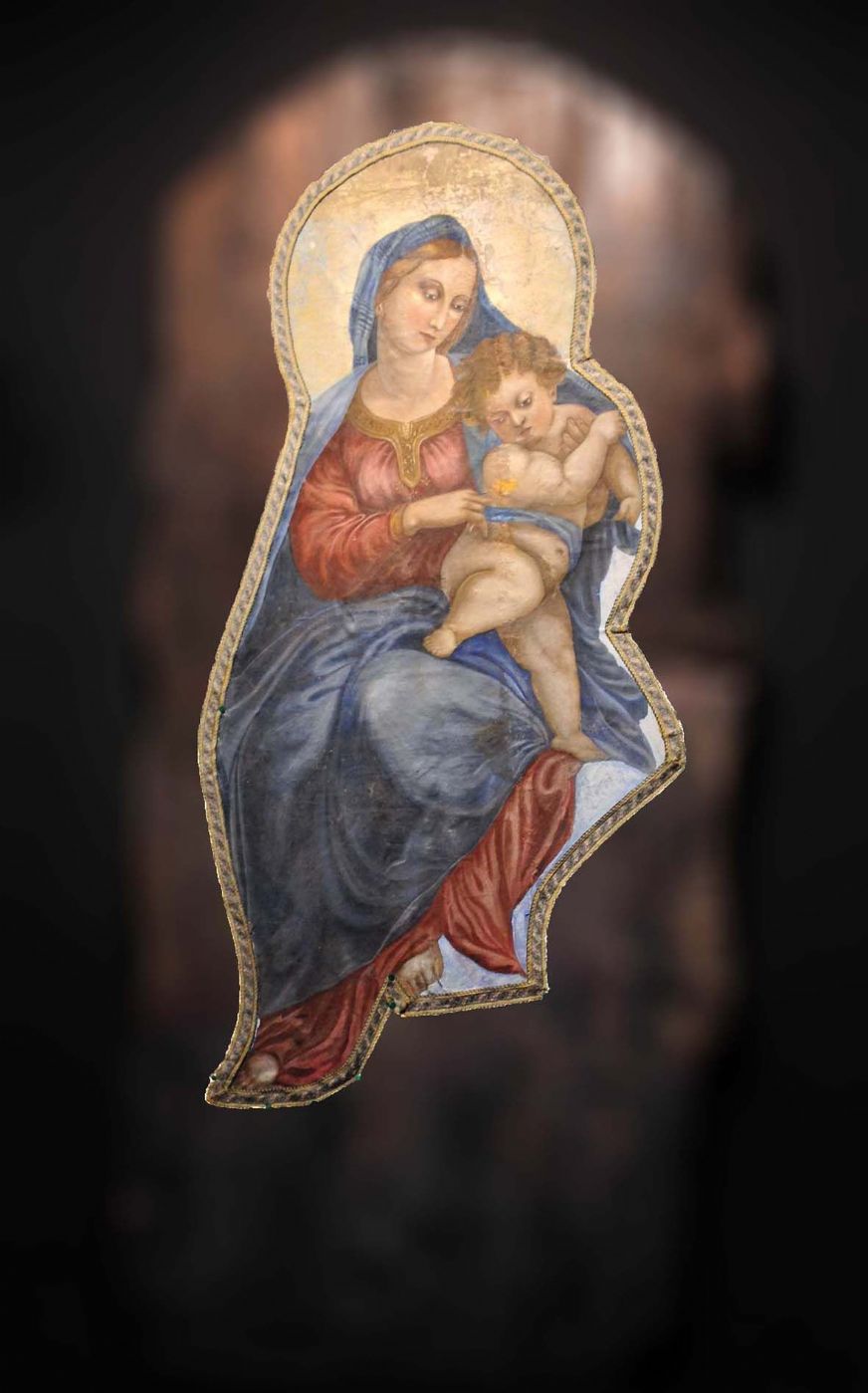
MADONNA AND CHILD
Detail from RAFFAELLO'S MADONNA OF FOLIGNO
tempera and oil on canvas mounted on antique panel
Interesting detail, regarding only the Madonna and Child, taken from the very famous altarpiece of the same name by RAFFAELLO and preserved in the Vatican Pinacoteca.
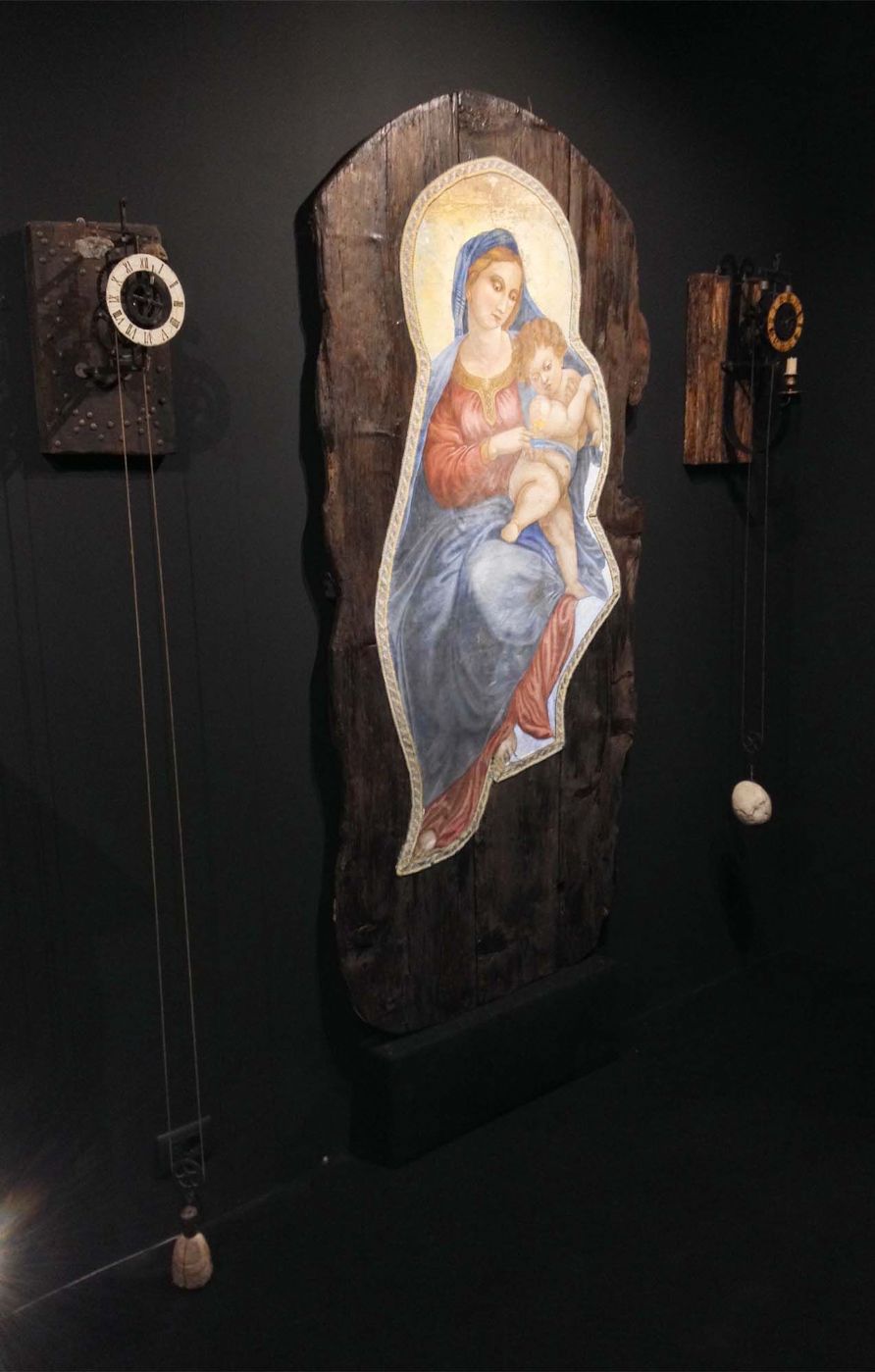
Our painting, datable to the late eighteenth - early nineteenth century, made on canvas based on a mixed technique of tempera and oil, is positioned on antique wooden boards that enhance its pictorial color and the typically Renaissance vivacity and luminosity. A kind of "return to the origins" of this detail of the Madonna and Child, the undisputed protagonist of the entire altarpiece which, as is known, Raffaello originally painted on panel. Then mounted on canvas at a later date.
An unusual work with great decorative and devotional effect that effectively synthesizes the value of the painting from which it originates. A real "painting within a painting," an elegant synthesis of unusual originality.
Italy - late 1700s - early 1800s
Measurements: height cm. 140 – width cm. 70 (image)
height cm. 203 – width cm. 88 (support board)
€ 7,800.00
A brief critical essay on Raffaello's Madonna of Foligno
The Madonna of Foligno is an oil painting on panel transferred to canvas (320 × 194 cm.) by Raphael, datable to 1511-1512 and preserved at the Vatican Pinacoteca in Vatican City.
The painting was commissioned by Sigismondo de' Conti, secretary (scriptor apostolicus) to Pope Julius II, as an ex voto for the miracle in which his house in Foligno emerged unscathed after an event of unclear origin (meteor or globular lightning, or even a burst of bombard that launches a fiery ball). The work, which was the first Roman altarpiece painted by Raphael, was located above the high altar of the Basilica of Santa Maria in Aracoeli in Rome, in whose apse Sigismondo's tomb was located. In 1565 Anna Conti, a nun and niece of the donor, had it transferred to the church of Sant'Anna in Foligno, at the Monastery of the Contesse of Beata Angelina dei Conti di Marsciano. In 1797 it was requisitioned during the French occupation and taken to Paris, to the Grande Musée Napoléon du Louvre. Given the precarious state of preservation of the painting, it was decided to transfer it to canvas: the restoration was carried out between 1800-1801 by Francois Toussaint Hacquin. Following Canova's recoveries who maintained the invalidity of the Treaty of Tolentino, the painting returned to Italy (1816), but Pope Pius VII decided to keep it in Rome in the Vatican Pinacoteca, like other important works of sacred art. The work is dated to 1511-1512, while the artist was working on the Stanza di Eliodoro, and is the closest precedent to the Sistine Madonna.
In 1957-1958 it was restored by Cesare Brandi.
After the exhibition in Milan, which ended on January 12, 2014, the work returned to Foligno and was officially presented on Saturday, January 18, 2014, at 12 noon, in a conference at Palazzo Trinci. The work was exhibited at the monastery of Sant'Anna until January 26, 2014.
At the foot of Mary stretches a natural landscape from which emerges a town dominated by a luminous arch, within which is inserted a fiery ball that seems to fall on the houses. The Madonna and Child, dressed in robes with the two traditional colors red as mother and blue as queen, appears seated on the clouds and surrounded by an aureolar disc, in turn surrounded by a blue crown of seraphim that take shape from the clouds.
In addition to the consolidated interpretation of the painting as an ex voto, the iconography of the altarpiece has been related to a pre-existing fresco (now destroyed) by Pietro Cavallini in the same Basilica of Santa Maria in Aracoeli, which represented the apparition of Mary with Child wrapped in a circle of light on the Campidoglio in Rome to Emperor Augustus on the day of Jesus' birth, according to the story told in the Golden Legend of Jacopo da Varagine. The painting, originally positioned under this fresco, would resume the theme adapting it to the sepulchral epitaph of the client, who died about 80 years old, before the completion of the altarpiece.
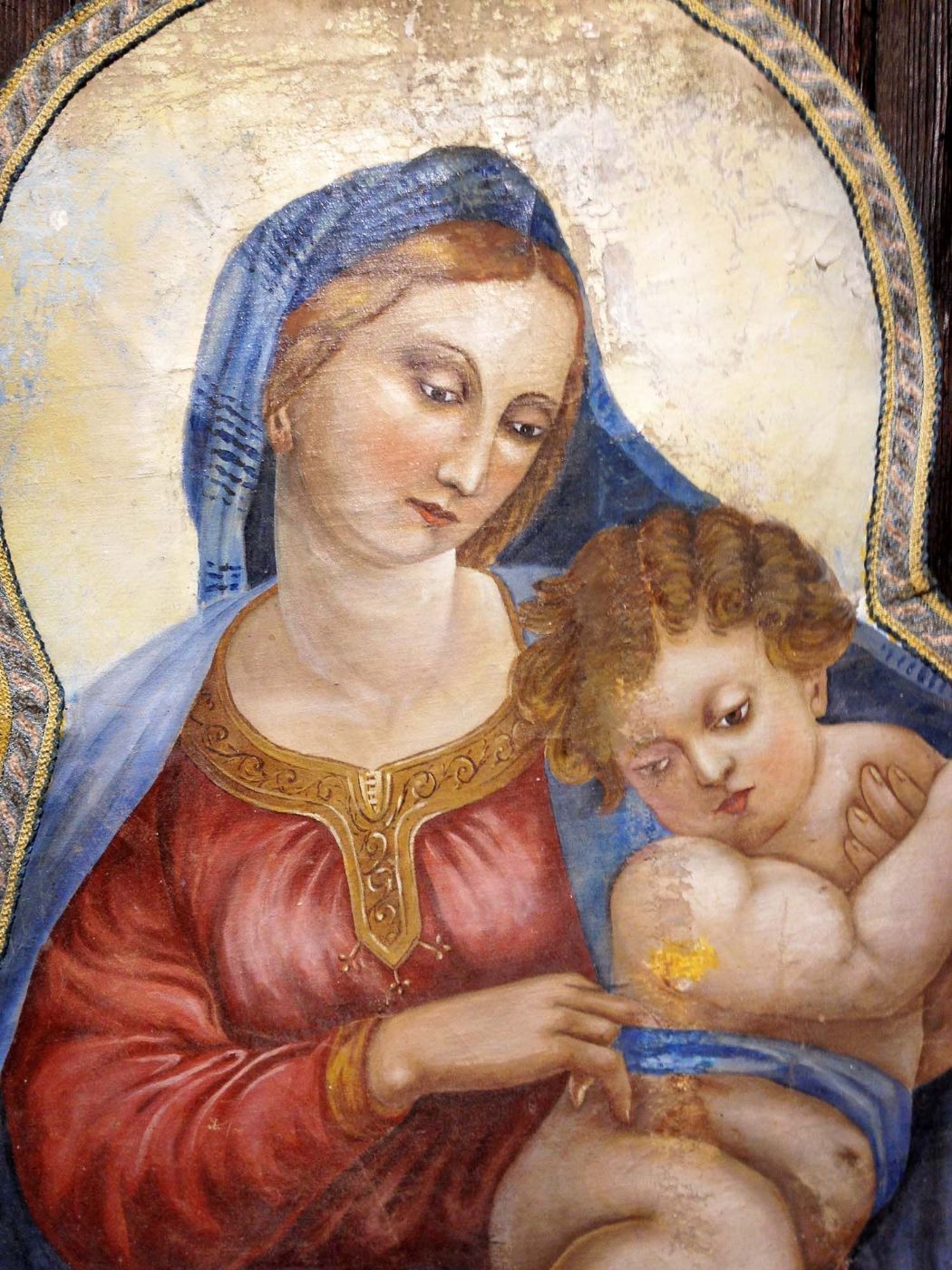
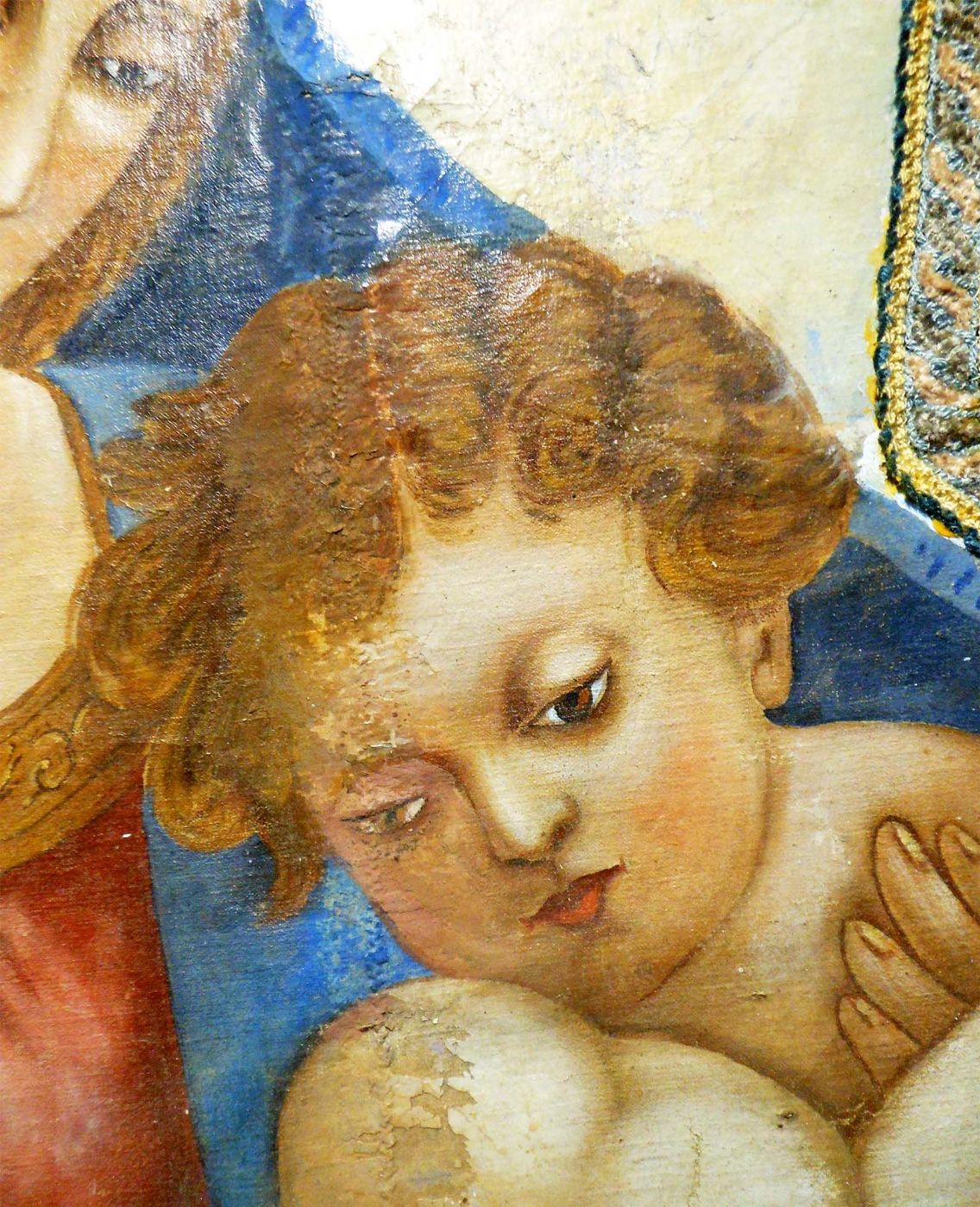
The group of the Madonna and Child, a true "painting within a painting" (the exclusive object of the work we present here), is gathered in an oval under the protective mantle of Mary and, as in the best works of Sanzio, has that lively naturalness that makes the ideal beauty extremely familiar to the viewer. The Child, for example, is not portrayed as the beneficent god conscious of his mission, but as a real child who seems to wriggle away from the Mother's embrace to cover himself under the veil. The son, very beautiful, serene, sleepy, is in a specular position: he rests his left leg bent on the mother's thigh, while with the right, straight, he rests on a cloud, with a similar longitudinal effect. Mary supports the infant with her left arm, who wriggles gracefully or rather undergoes one of those torsional flinches that are caused by tickling. In fact, the middle finger of the playful mother's right hand seems to tickle the child under the armpit with playful affection The Virgin recalls that of Leonardo's Adoration of the Magi and the Child that of Michelangelo's Doni Tondo, as if to follow a sort of "contaminatio" of illustrious models.
website: www.palazzodelbuonsignore.com