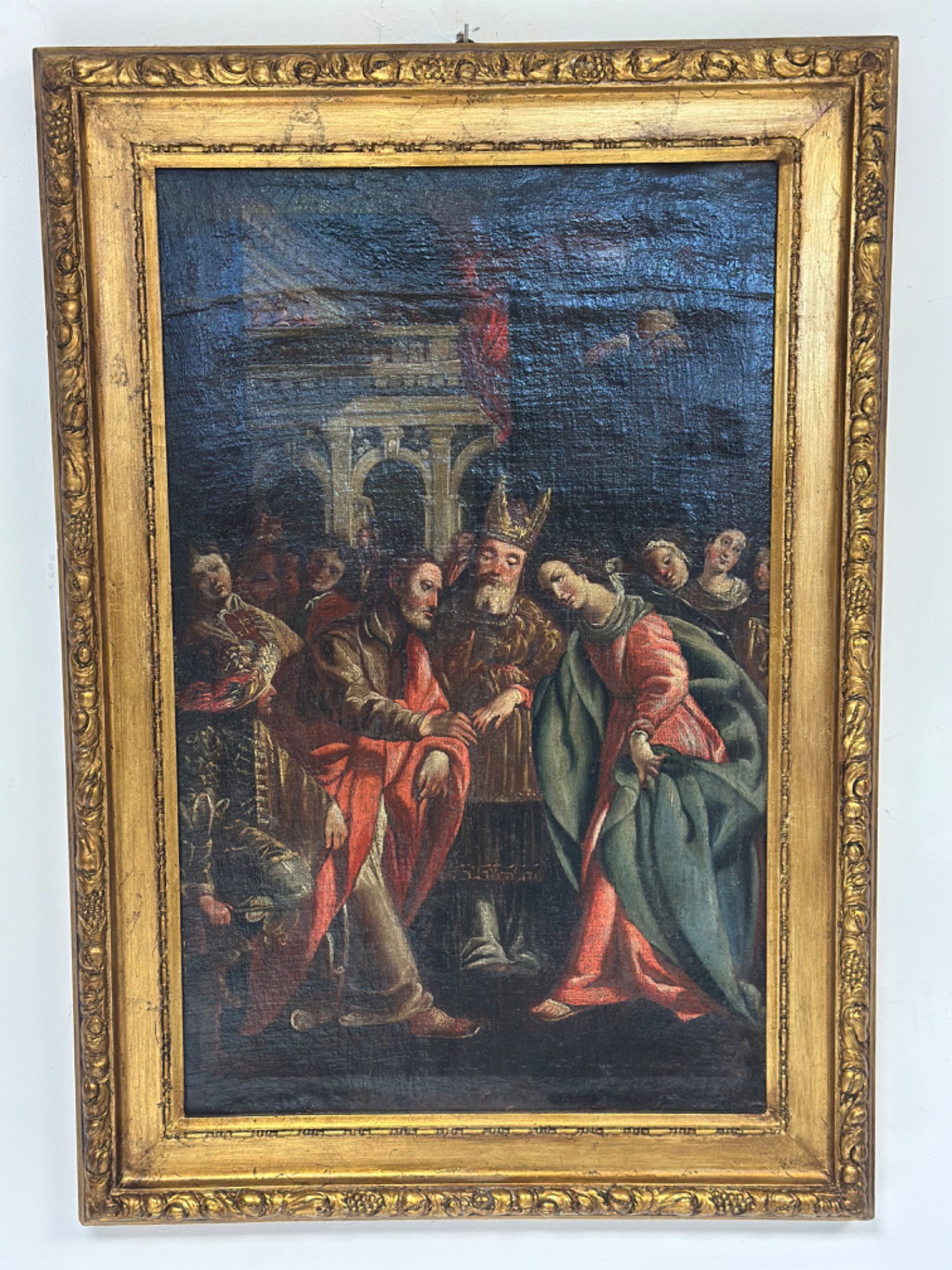
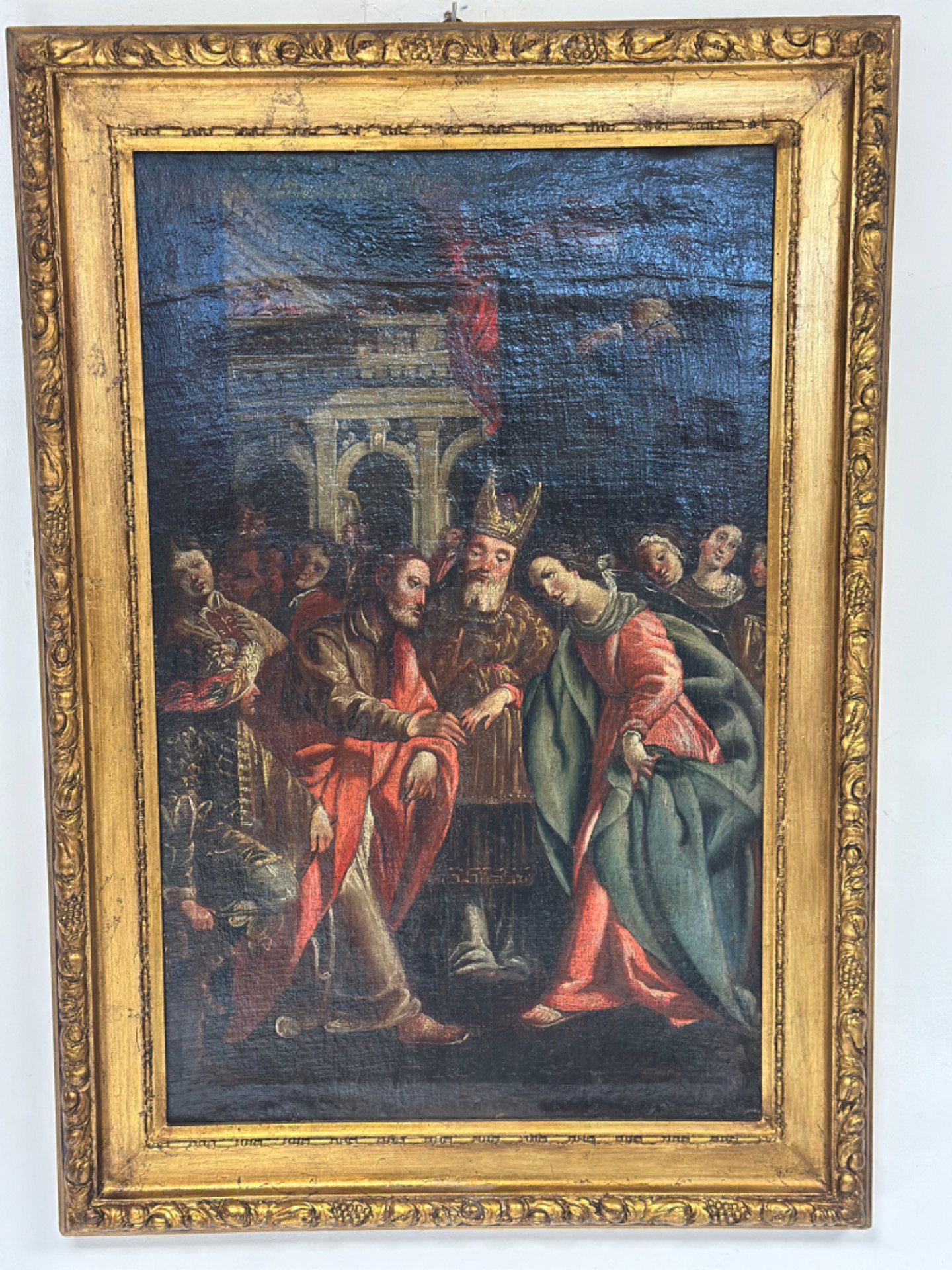
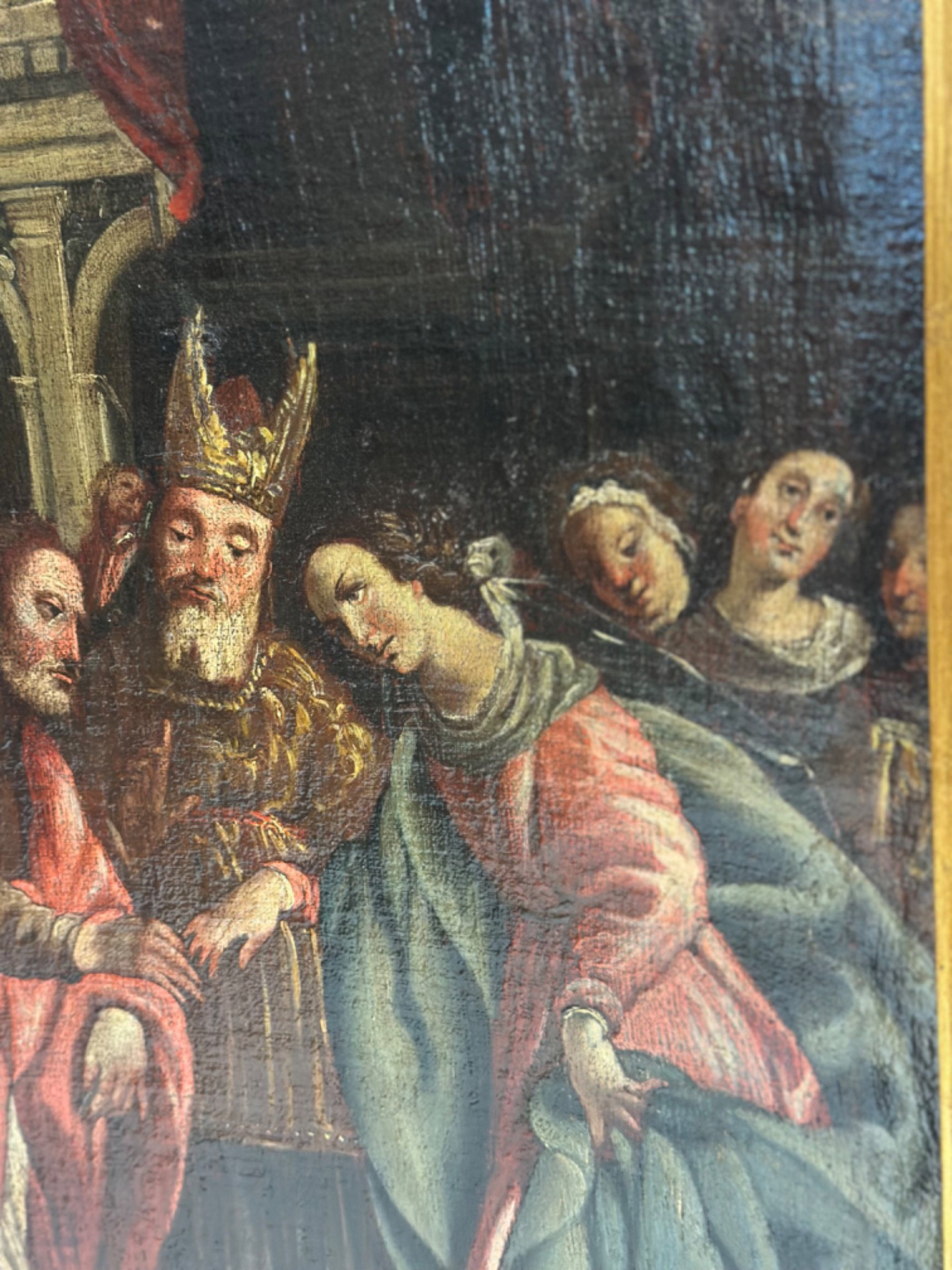
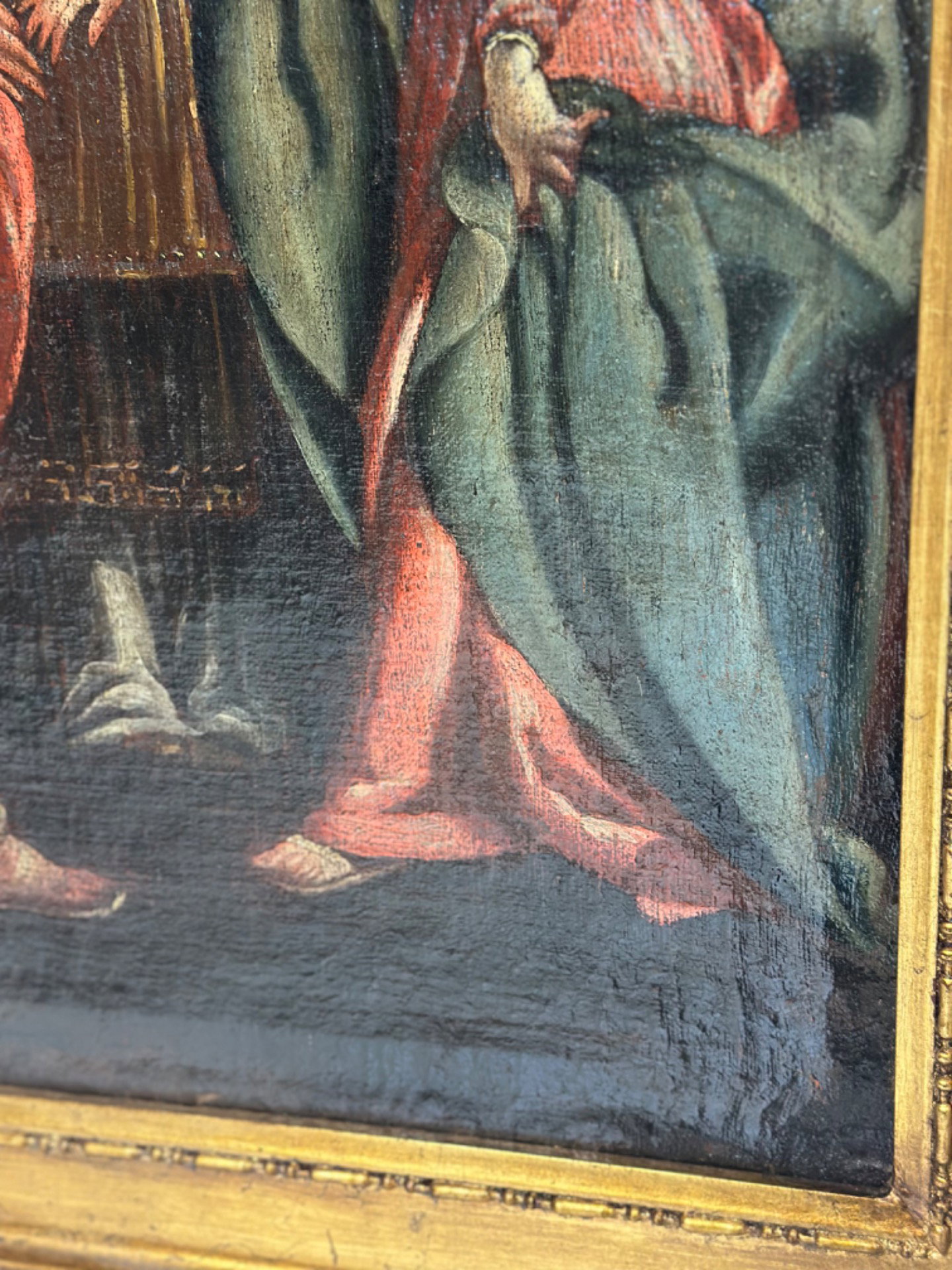
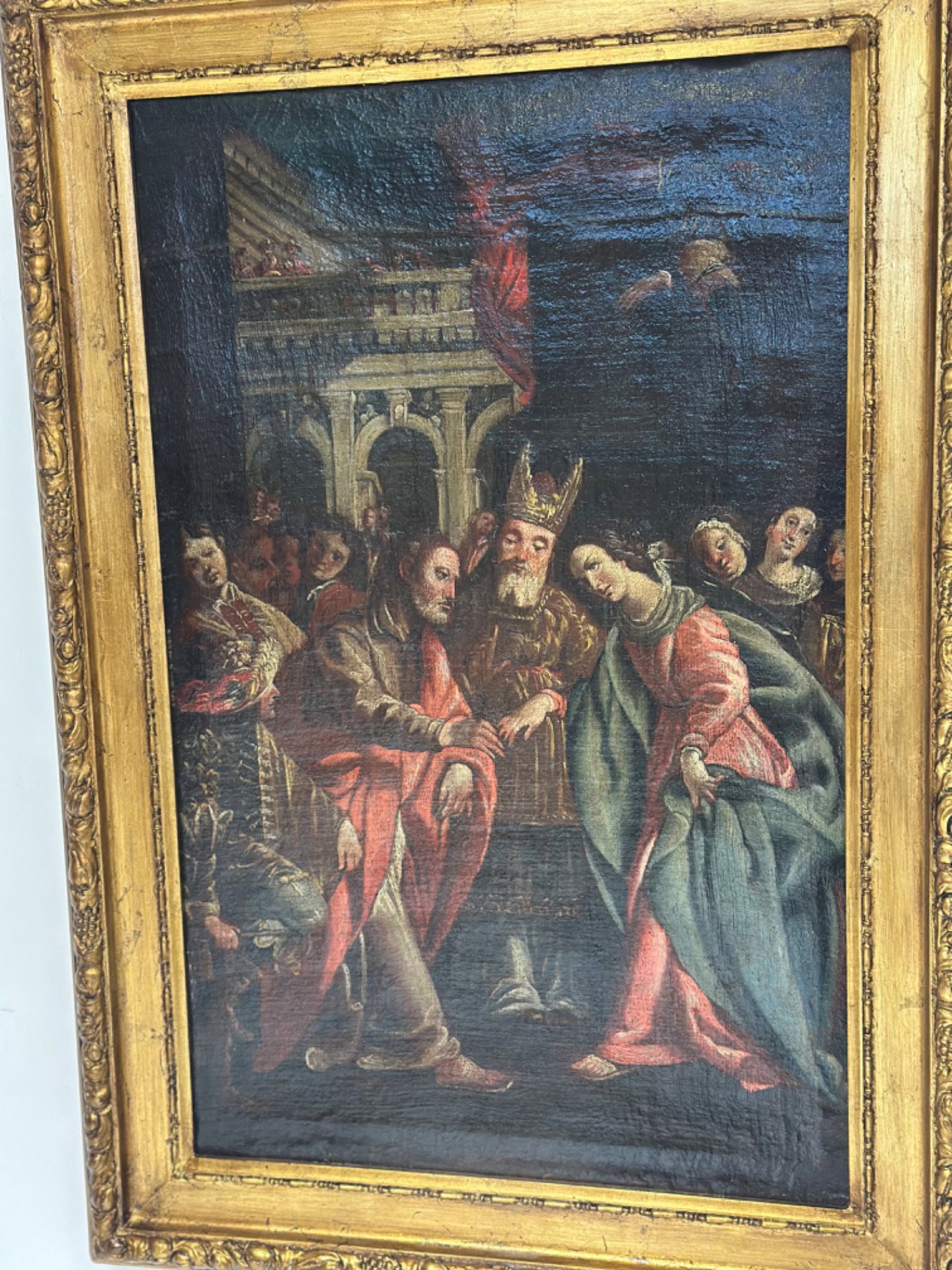
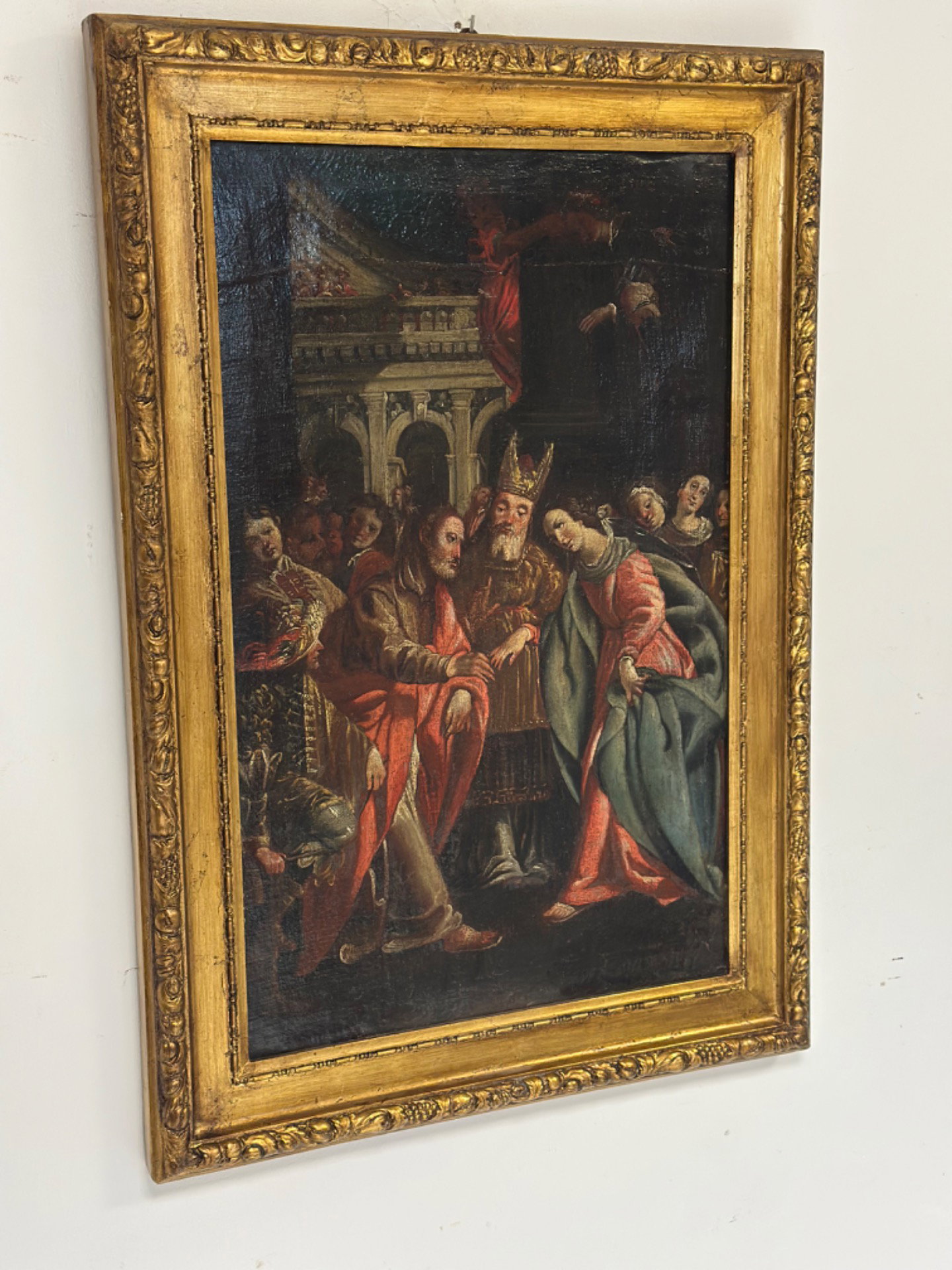
Subject: Marriage of the Virgin.
Technique: Oil on canvas.
Author: Toledo school, circle of Luis Tristán.
The painting we present is a valuable example of Spanish Mannerism, probably attributable to the "Toledo school," and, more precisely, to the entourage of Luis Tristán, a student of El Greco and his immediate successor at the head of his painting school in the former capital of Spain, of which he will mark the end at the same time.
Present at El Greco's workshop between 1603 and 1607, as well as at the Master's death in 1614, Luis Tristán, despite his premature death, which occurred in 1624, just ten years after that of the Cretan, left us an abundant production of works, faithful to the Master's themes, but simplified in the compositional scheme through a lyricism of forms mostly reduced to the proportions of reality.
Already in the altarpiece of San Benedetto of Ypes (a town near Toledo) there are signs of an incipient liberation from El Greco, especially in the elongation of the figures, partly rendered with difficulty.
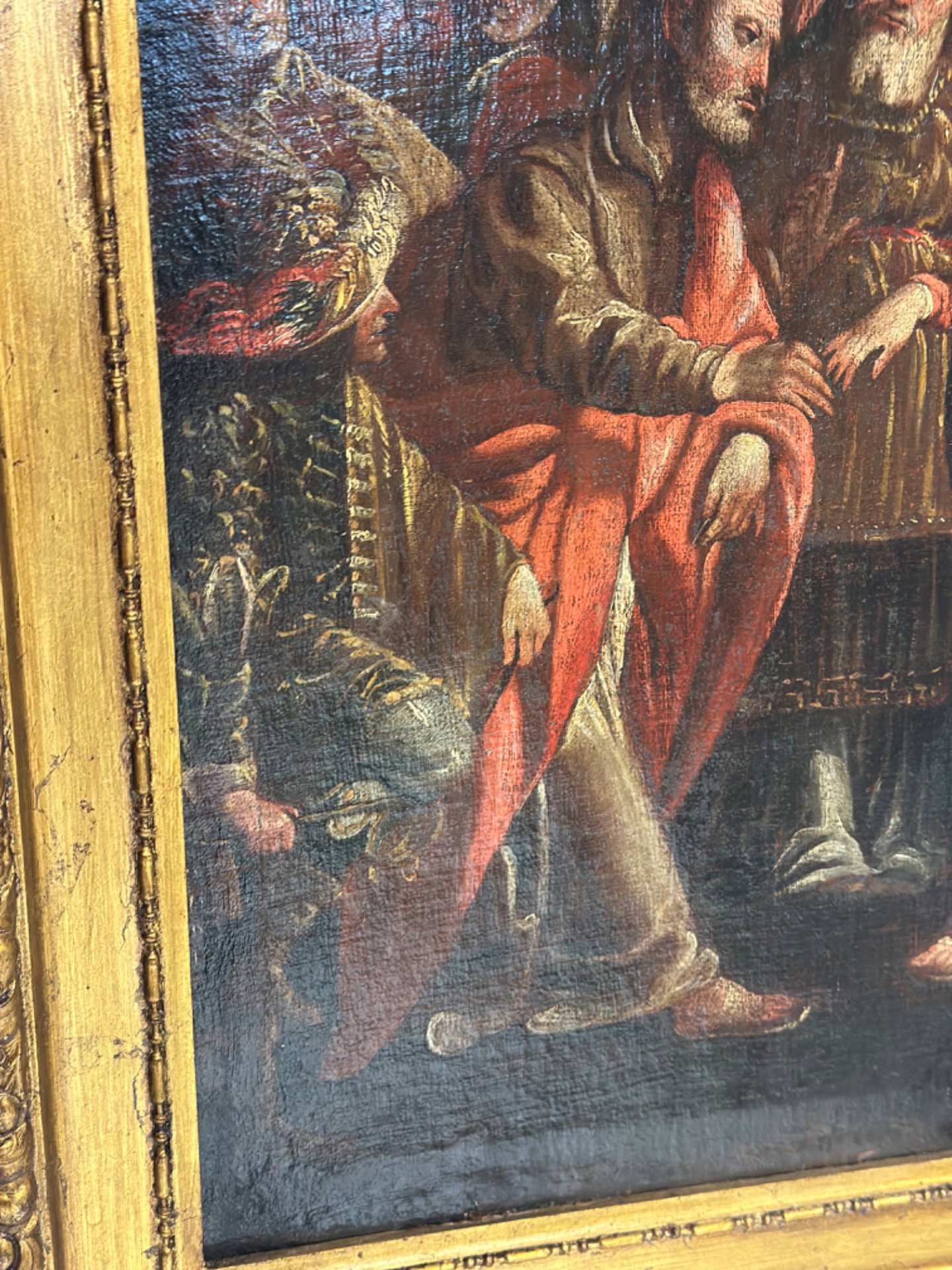
Eloquent is the chromatic aspect, with muted colors that have now abandoned the aerial transparency typical of El Greco's palette.
A determining role must have been played for Tristán both by the influence of Italian artists (Cambiaso, Zuccari) active at the Escorial (the great construction site of Philip II) and, to no lesser extent, by the trip to Italy (1606-1613), in which the artist was able to directly confront the lesson of Caravaggio, the first and direct cause of this stylistic return to the humble reality of everyday life without necessarily abandoning the mysticism of El Greco, thanks to which Spanish art had been deprovincialized, mysticism, however, now lowered to more humble and modest tones.
A pictorial rendering constantly poised between the Italian "academic" tradition and the transfigurative lesson, all leaning towards the eternity of El Greco, appears to be the main characteristic of Tristán's work, all filtered through a serious awareness of Caravaggesque realism (paradigmatic is the Saint Peter and Saint Francis (Segovia, Palacio de Riofrío) or the Saint Monica of the Prado.
This stylistic oscillation is evidenced by the full return of Tristán to the compositional modules of El Greco in the late altarpiece (1623) for the convent of Santa Clara in Toledo, an altarpiece that closely echoes the stylistic vibrations of El Greco's "Baptism of Christ" and "Pentecost," so much so that it erroneously led the critic Ceán Bermúdez to attribute it to El Greco himself and not to Tristán.
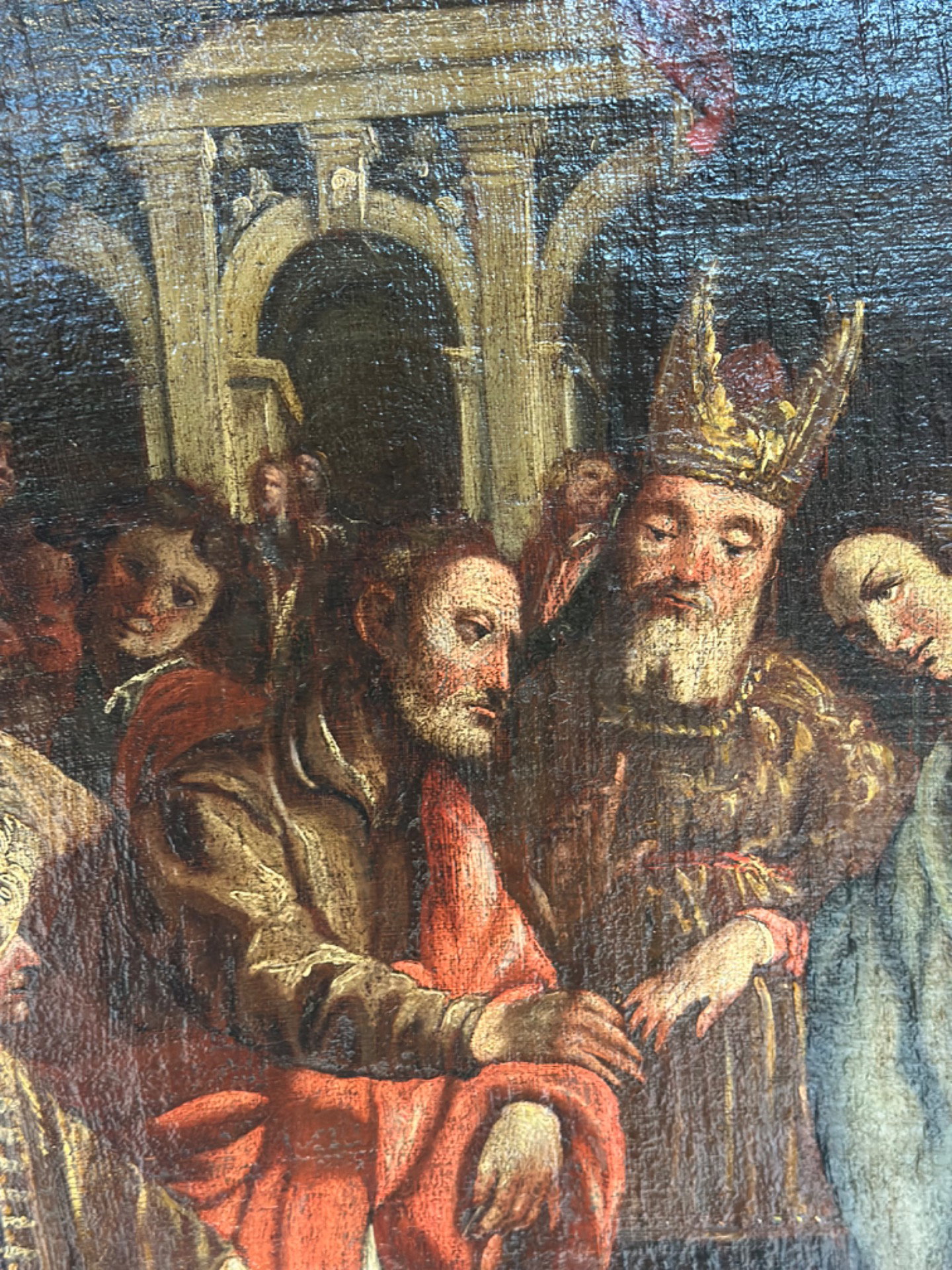
As for our painting, a comparison with El Greco's "Marriage of the Virgin" (Bucharest, National Museum of Art of Romania) allows us to trace the evolution of Tristán's manner, framing the work in question in a period (not precisely identifiable in terms of a precise date due to Tristán's aforementioned "oscillation") partly marked by adherence to El Greco's "deformation," of which, however, the chromatic aspect expressed by the prominence given to muted colors is abandoned here.
Likewise, the compositional scheme of our painting attests to an homage to the Raphaelesque layout (that Raphael that El Greco, like architecture, had honored, including him along with Michelangelo, Titian, and Clovio, in his "Expulsion of the Merchants from the Temple") with a certain acribia reserved for the architectural detail of the temple, absent in El Greco's Marriage, all concentrated on the scene, set inside it with a clear departure from classicist perspective solutions.