Certificate of authenticity.
Firmin Baes (Saint-Josse-Ten-Noode 1874-Uccle 1943)
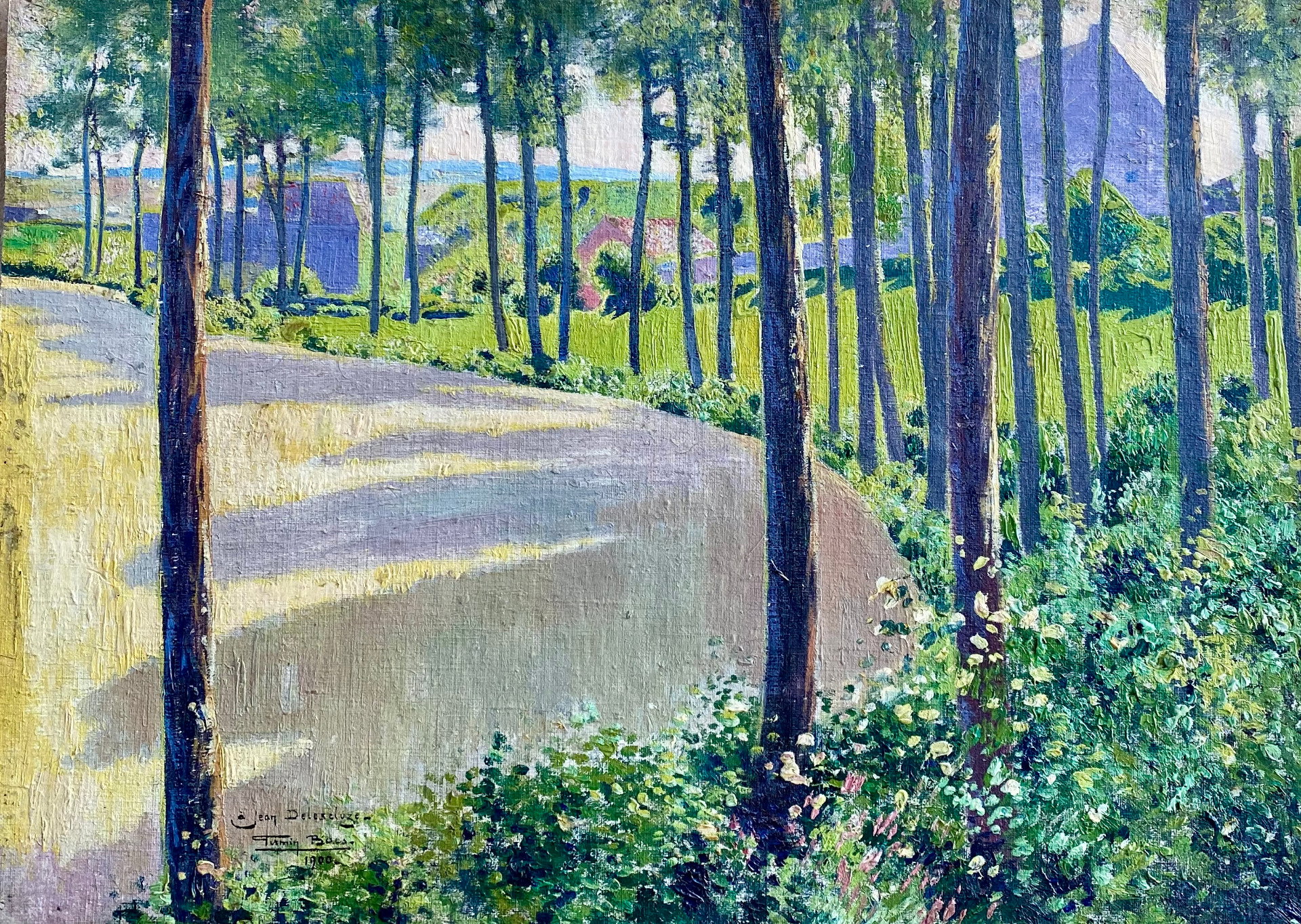
«Tree-lined Avenue”
Oil on canvas glued on cardboard
37 x 51 cm
60 x 74 cm with 19th-century gilded frame.
Signed and dated lower left Firmin Baes 1900
Dedicated to Jean Delescluze
Firmin Baes was born on April 19, 1874, and died on December 4, 1943.
Painter, pastel artist, draftsman, and engraver.
Particularly skilled in the use of pastel, he painted still lifes, genre scenes, portraits, nudes, landscapes, and interiors.
Son of Héloïse Boly and Henri Baes, a painter, architect, director of “L’Ecole des Arts Décoratifs” in Brussels, and a member of the “Commission des Monuments historiques”.
Raised in a family of artists, his uncle Jean-Baptiste Baes was also an architect. Baes began his artistic career working with his father as a decorator.
Later, he trained at “l’Académie Royale des Beaux-Arts” in Brussels under the direction of Léon Frédéric (1888-1894).
From 1894 to 1900, he perfected his style at “l’Académie de la Patte de Dindon”. This was a free academy where art lessons were held, named after a homonymous café located in the Grand-Place of Brussels.
With his father's collaborators, Firmin Baes developed a pastel-on-canvas technique described in the monograph dedicated to him by his niece, Georgette Naegels-Delfosse.
This technique allowed the application of powder with the tip of the thumb or little finger, creating discreet or vigorous tones and a velvety delicacy in the compositions.
The softness of his pastels and his introspective ability in rendering figures earned him, starting in 1915, commissions for numerous portraits from Belgian “société”.
Baes was the Secretary of the circle “Pour l’Art” (Brussels 1892-1934), for whose exhibitions he created several posters.
(Attached is the poster for the XXI° Salon)
This association was founded by a group of artists with the aim of organizing exhibitions with a particular openness to foreign painters.
In 1902, Baes married Marie Nélis, a friend of his sisters Irma and Alice. They had three daughters.
His artistic career took off, earning numerous awards both at home and abroad.
The artist participated in the “Salons Triennaux” of Brussels and Ghent, considered a very important showcase for artists seeking to get noticed to sell their works. These contemporary art shows were of great interest to the public and often the scene of heated aesthetic discussions.
Baes regularly participated in the «Exposition Générale des Beaux-Arts» in Brussels, exhibiting:
in 1897: «Le retour de l’enfant prodigue»;
in 1900: «Les porteuses de trèfle», “Portrait de Mme V.R.”;
in 1903: «Le défi»;
in 1907: «Les foins», «La Bénédicité»;
in 1914: “L’enfant”;
At the “Salon de Gand” he exhibited:
in 1913: “La femme au chou”
At the Universal Exposition in Paris in 1900 he exhibited: “Le Tir à l’Arc”
(Bronze Medal)
He also participated in the Universal Exposition in Brussels in 1910 and numerous other important events.
(see attached sheet)
He exhibited frequently in Brussels at the “Petite Galerie” and the “Galerie du Studio” and in Charleroi at the “Nouvelles Galeries”.
In 1919, Baes became a member of the “Société Royale des Beaux-Arts”
In 1923 he was appointed **Officer of the Order of the Crown**.
A writer in his spare time, he published an illustrated booklet entitled “Histoires de peintres racontées et illustrées par Firmin Baes” (Stories of painters told and illustrated by Firmin Baes), containing anecdotes relating to painters and their works (published in Brussels in 1941, Librairie Générale-Cooreman).
Description:
The painting described here represents a tree-lined avenue where the succession of trunks skillfully leads the observer into the landscape.
Through the evocative effect of light that penetrates through the trees to illuminate the path and the flowers in the foreground, Baes showcases his well-known ability to handle light effects.
The painting dates back to 1900, the year in which the artist won the bronze medal at the Universal Exposition in Paris, and is dedicated to Jean Delescluze, a decorative painter whom Baes probably met during his early artistic training.
To demonstrate the painter's particular interest in wooded landscapes, I am attaching a part of the numerous paintings, depicting the same subject, present in the collection of the Royal Museum of Fine Arts in Brussels.
Works in the following museums:
Brussels: Musées Royaux des Beaux Arts de Belgique; Ixelles: Museum of Fine Arts; Antwerp, Charleroi, Ostend, Ypres, Paris: “Musée d’Orsay”
E.Bénézit
«Dictionnaire des peintres, sculpteurs, dessinateurs et graveurs»
Ed.Grund vol.1 (p.372)
Paul Piron
«PIRON: Dictionnaire des Artistes Plasticiens de Belgique des XIX et XX siècles»
Ed. Art in Belgium (p.48)
Andrée Dessert -Corvol
«ARTO: Dictionnaire Biographique Arts Plastiques en Belgique»
(pp. 32,34)
Paul Piron
"Deux siècles de signatures d'artistes de Belgique"
Ed. Art in Belgium (p.22)
«Dictionnaire des petits maitres de la peinture 1820-1920»
Schurr & Cabanne
Les Editions de l’Amateur (p.48)
Condition: excellent