Certificate of authenticity:
Médard Maertens (Koolskamp 1875 - Brussels 1946)
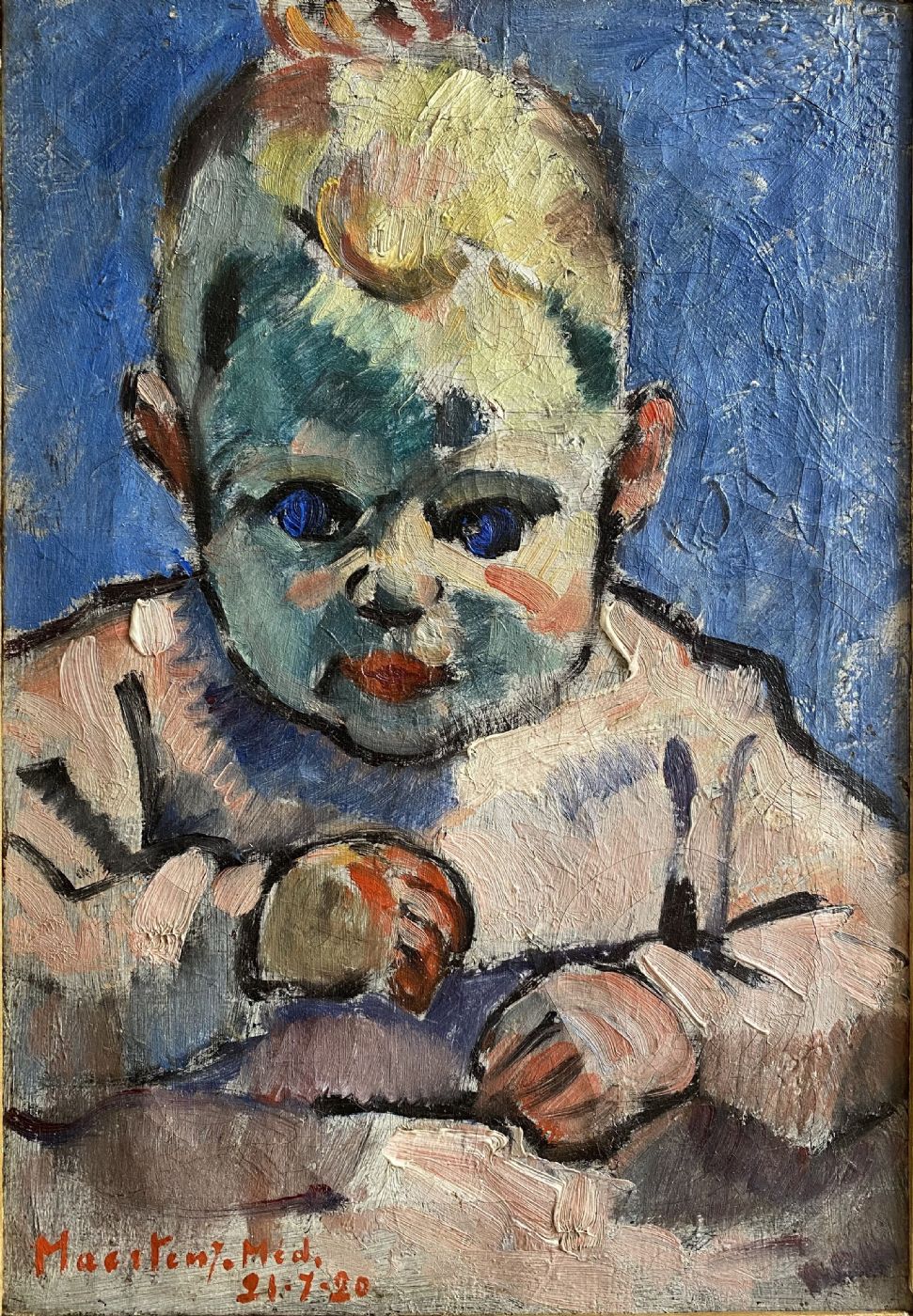
"Portrait of the Artist's Son"
Signed and Dated lower left: Maertens.Méd: 21-7-(19)20
oil on canvas (24 x 34 cm)
Painter, draftsman, and graphic artist of landscapes, figures, nudes, and interior scenes.
Maertens took drawing courses at the academies of Tielt and Roulers, then, during his military service, at the academy of Antwerp.
In 1899, the artist moved to Woluwe-Saint-Lambert where he met Jan Cockx, Henri François Ramah, Albert François Mathys, and Ferdinand Schirren, considered the most significant painters of "Fauvisme Brabançon."
Maertens exhibited for the first time in 1908, within the artistic circle "Doe stil voort", presenting Luminist works. The same year, he participated in the Salon of Ghent and later in the "Salon des Indépendants" in Paris.
(The circle "Doe stil voort" was founded by the musician Paul Gilson and the writers Paul de Mont, Willem Gijsels, and August Vermeylen to promote the arts and letters by organizing exhibitions.
From 1910, Maertens evolved towards a "Fauvisme personnel", with black outlines and vivid and contrasting colors, as demonstrated by the painting described here. In 1912, he joined the "Fauvistes Brabançons" movement (1906-1923).
Inspired by Ensor, Van Gogh, and Cézanne, these artists proposed a painting with intense expressive power, seduced by the synthetic and constructive composition, pure and unprecedented colors, and freedom of form.
Maertens participated in the exhibitions of the "Libre Esthétique", a Belgian avant-garde artistic association founded in Brussels in 1894 by Octave Maus.
The strength of this association was the internationalization of contemporary aesthetics.
The participation of foreign artists was so important that the French critic Gustave Geffroy wrote: "Ce n'est pas d'art belge qu'il s'agit mais d'un commencement d'art européen en Belgique, d'un rendez-vous donné dans une grande ville aux différentes formes de pensée qui parcourent le monde civilisé…" ("It is not about Belgian art, but about a beginning of European art in Belgium, a meeting place in a big city for the different forms of thought that run through the civilized world…")
Maertens also exhibited in exhibitions organized by "Art Indépendant", was a member of the "L'effort" movement, and the "Le Sillon" and "Cercle des XV" circles.
During the First World War, Maertens fought as a volunteer on the Yser front, and in 1917 he met his future wife, Marthe Guillain, a war nurse and "fauve" artist.
In 1920, the Maertens family moved to Paris where he came into contact with the avant-garde masters of the time such as Soutine, Valadon, Léger, Vlamynck, and their studio in Nogent-sur-Marne became a reference point for Belgian artists in France.
Around 1930, he traveled to Turkey, then in 1932 he returned to Belgium.
Description:
The painting described here, which dates back to 1920, represents the artist's firstborn son, whom he portrayed in other paintings in his mother's arms.
(see attached photo)
The work, which presents all the characteristics of the painter's "Fauve" period, strikes the observer with the extraordinary expressive power of the child.
Works present in the following museums:
Brussels: Royal Museums of Fine Arts of Belgium, Foundation of Contemporary Belgian Art; Antwerp, Ixelles, Ostend, Grenoble: Museum of Fine Arts: "The Pose".
Bibliography:
"L'impressionisme et le fauvisme en Belgique"
Musée d'Ixelles 12 octobre-16 décembre 1990
(p.286,287,288,289)
Paul Piron
«PIRON: Dictionnaire des Artistes Plasticiens de Belgique des XIX et XX siècles»
Ed. Art in Belgium (p.107)
Andrée Dessert -Corvol
«ARTO: Dictionnaire Biographique Arts Plastiques in Belgique»
(pp. 328-329)
Serge Goyens de Heusch
"L'impressionisme et le fauvisme en Belgique"
Fonds Mercator Albin Michel (pp.302,316,328,332,333,350,351,366,369,382,384,385,397,398,417,422,423,428,429,433)
Condition: good