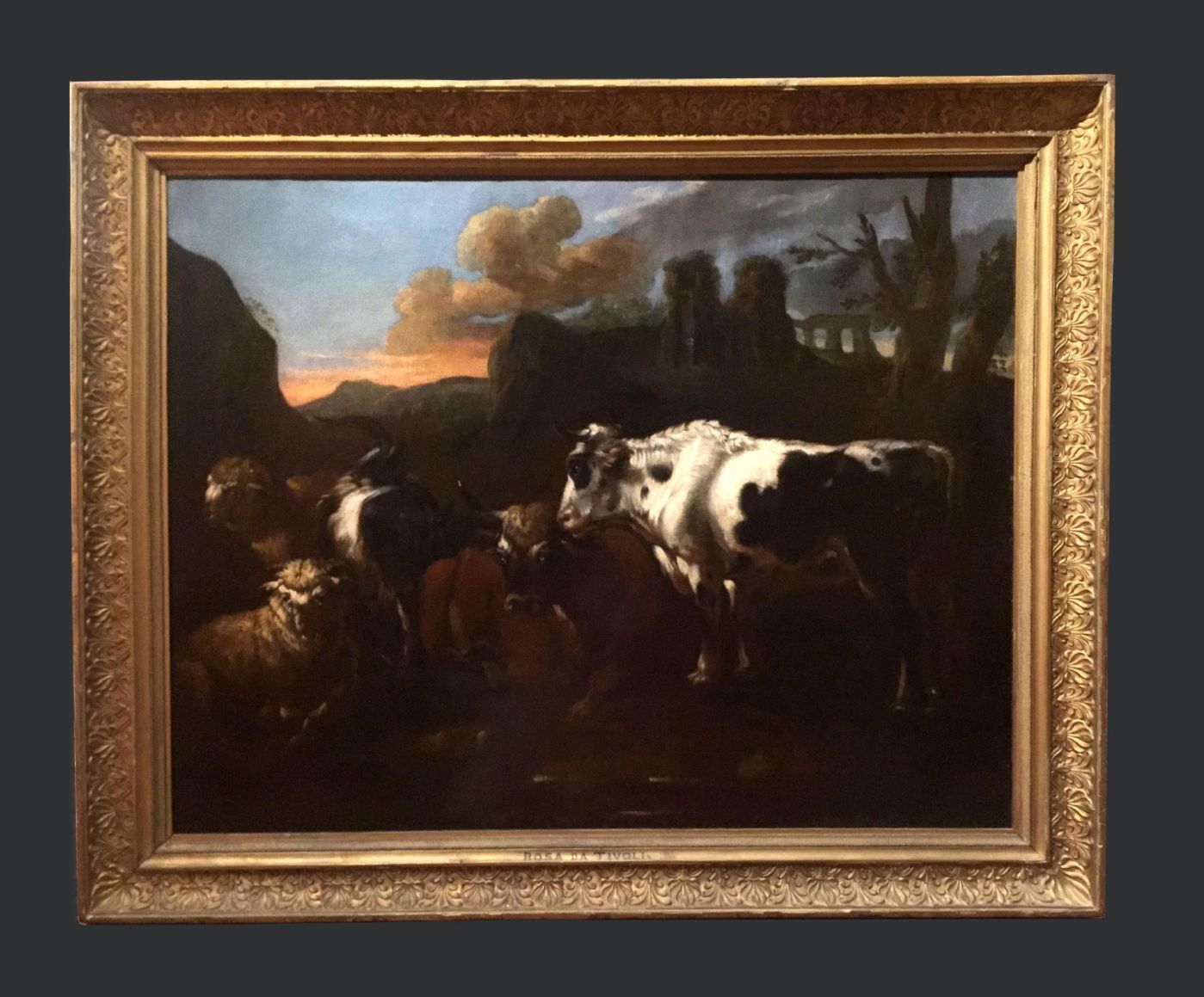
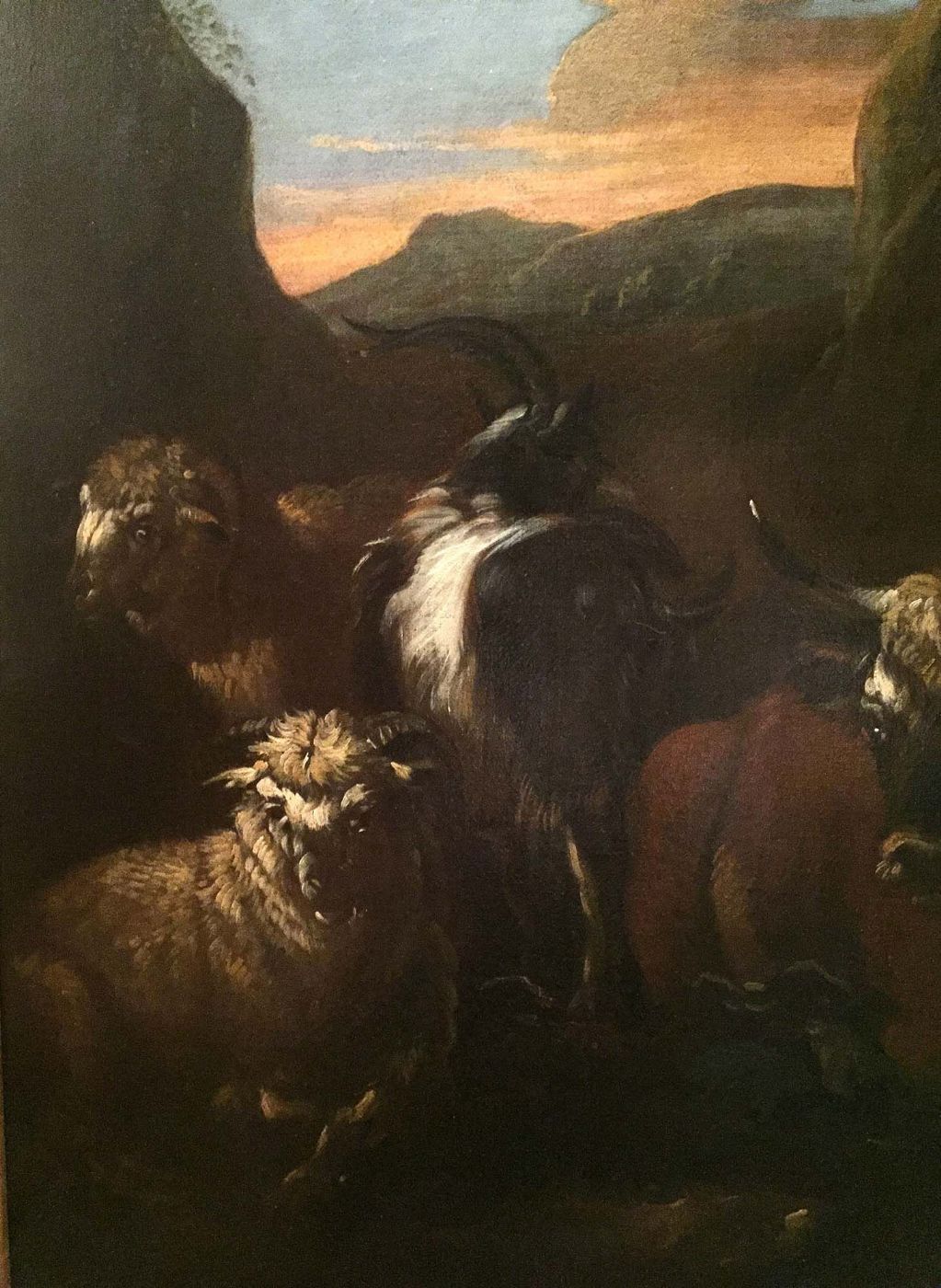
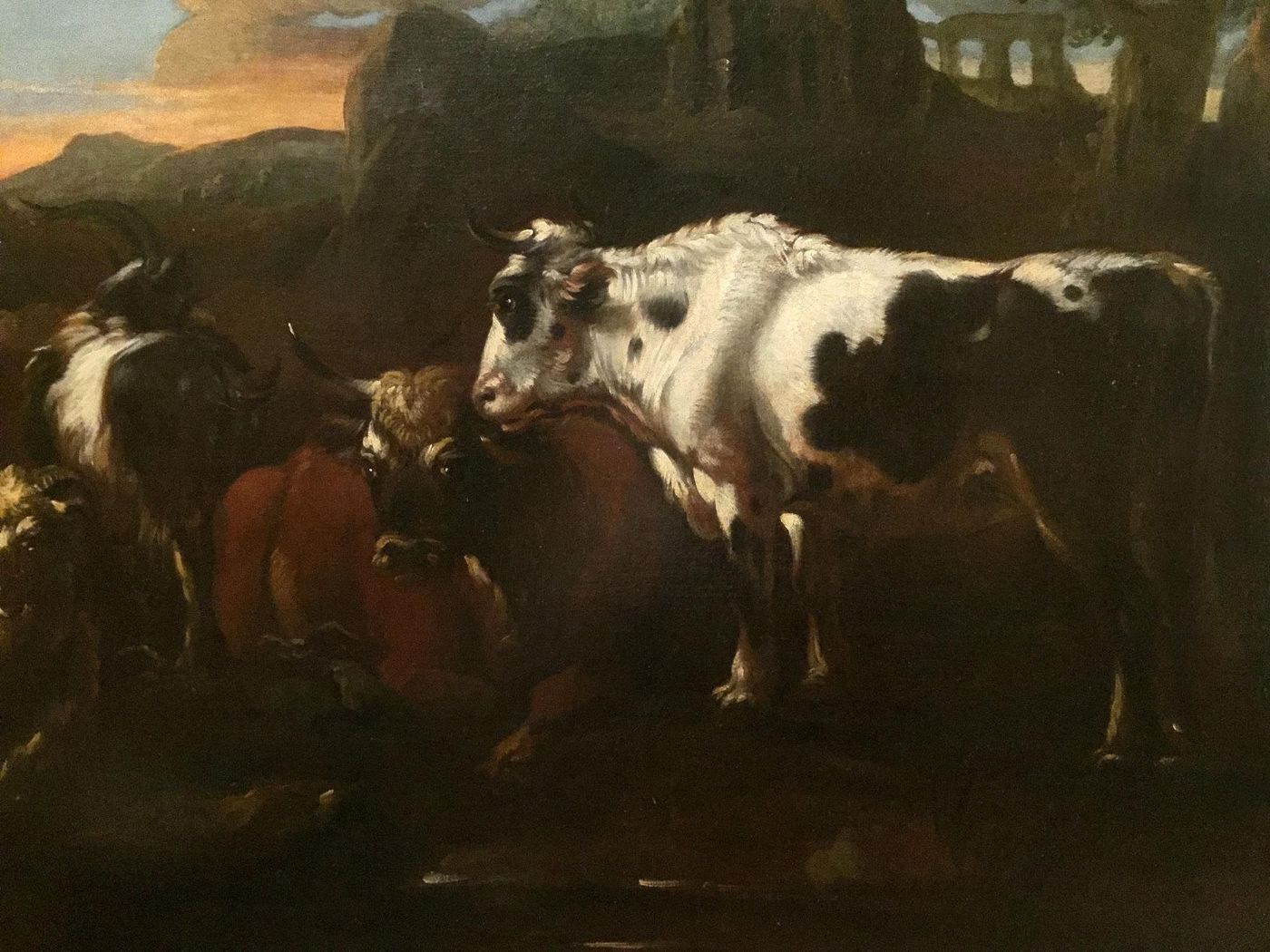
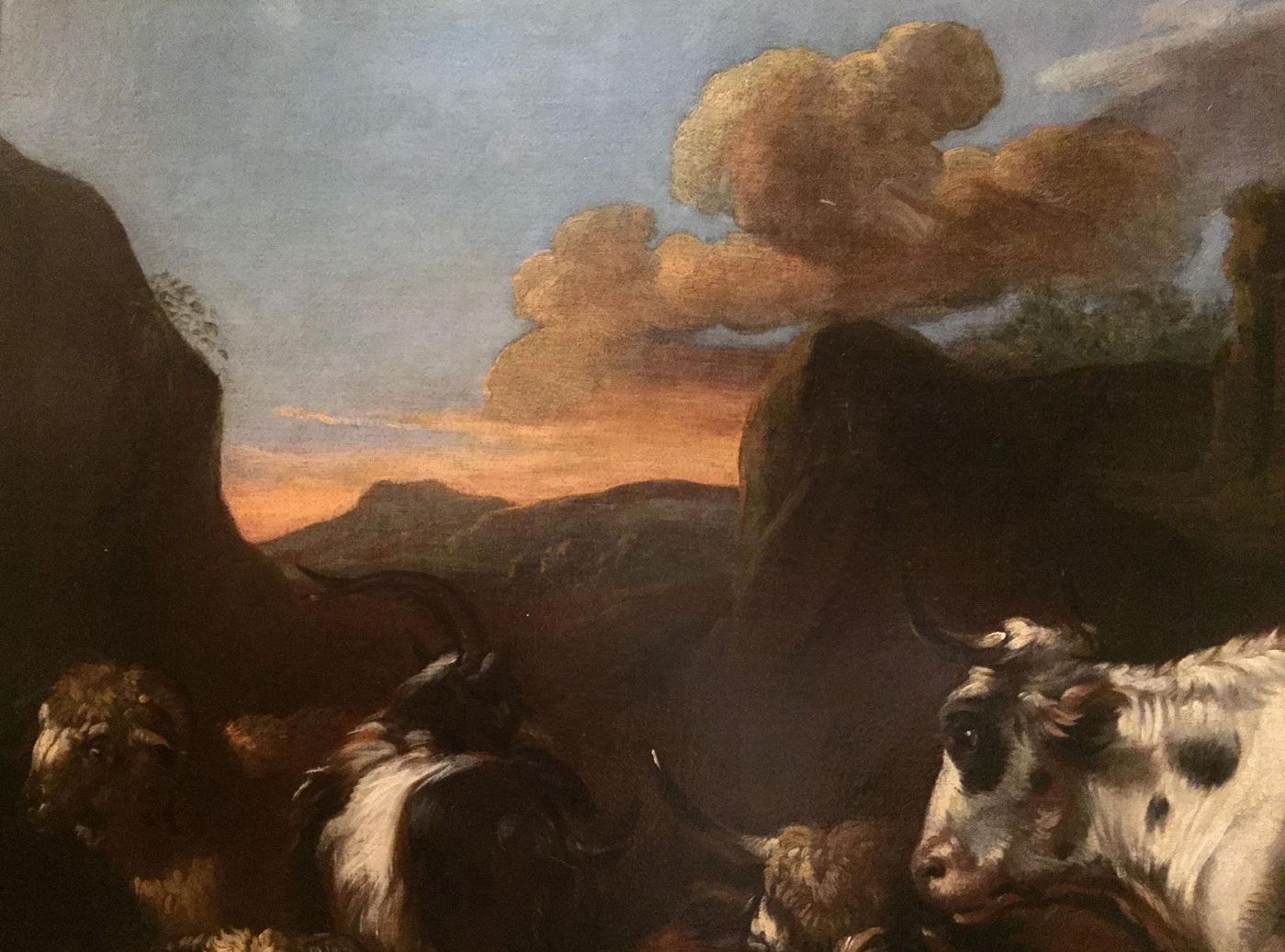
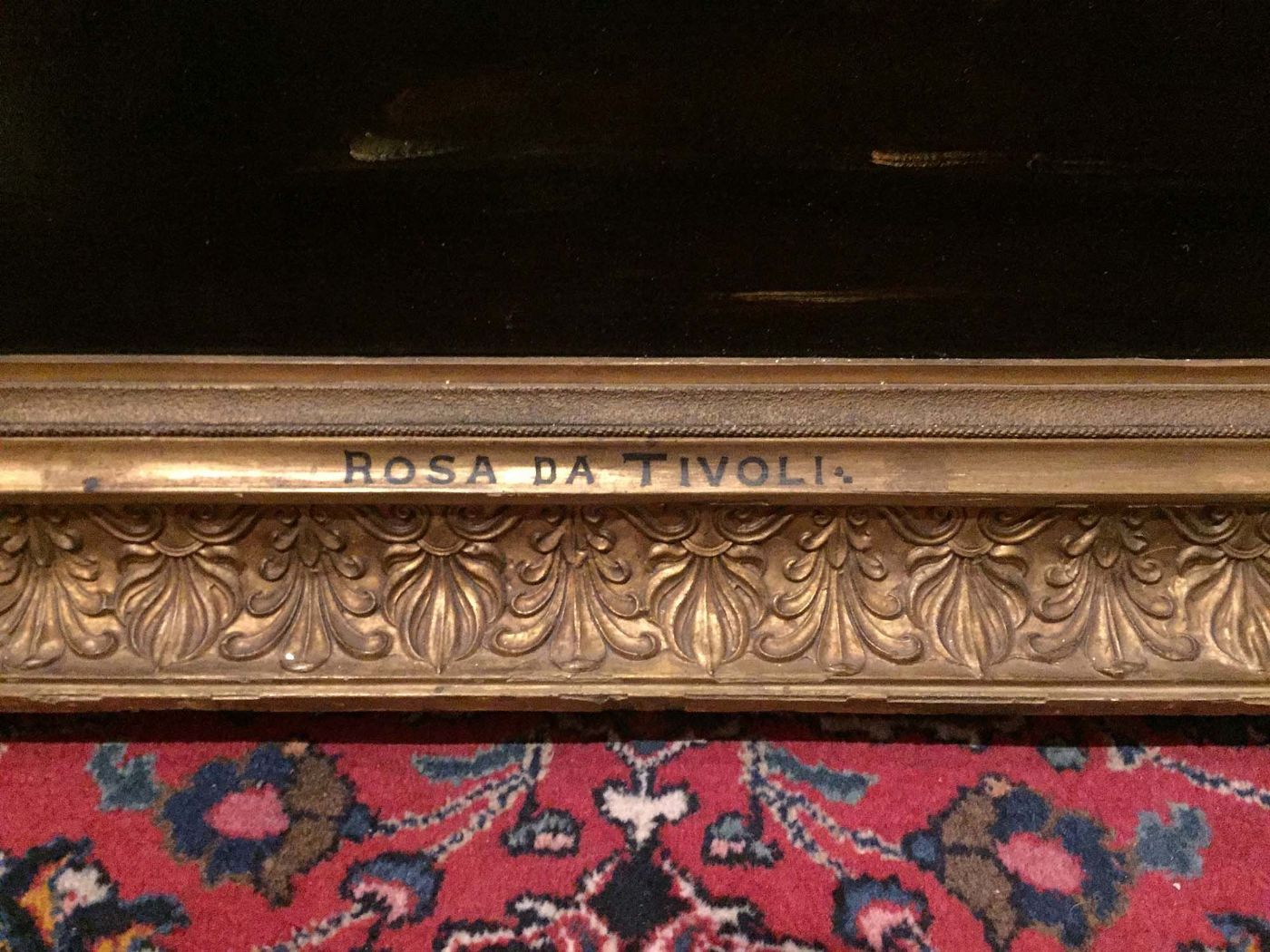
COUNTRY SCENE - important 17th-century oil painting on canvas by Philipp Peter Roos, known as ROSA DA TIVOLI
COUNTRY SCENE
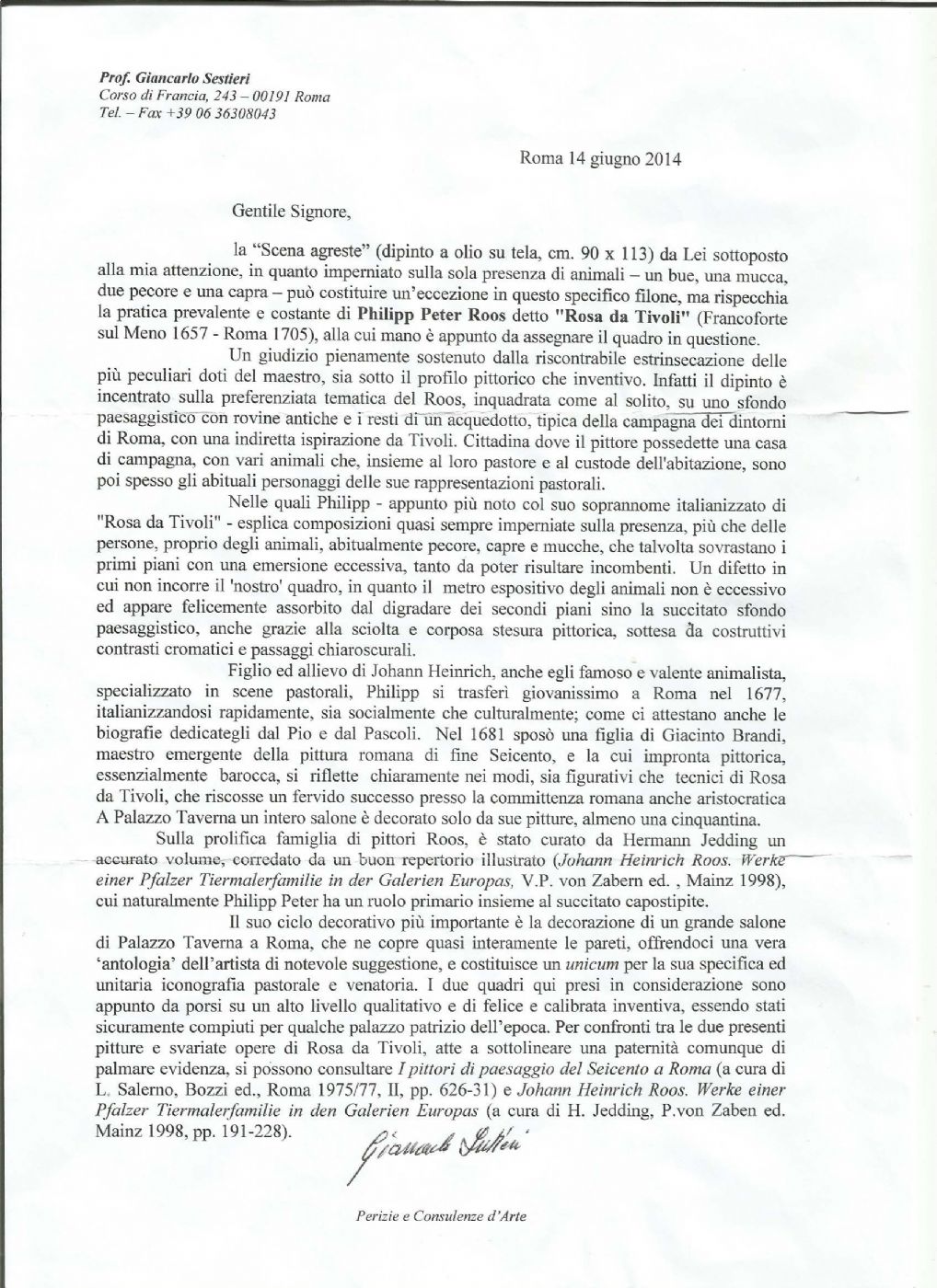
(see expertise of Prof. Giancarlo Sestieri in the image gallery)
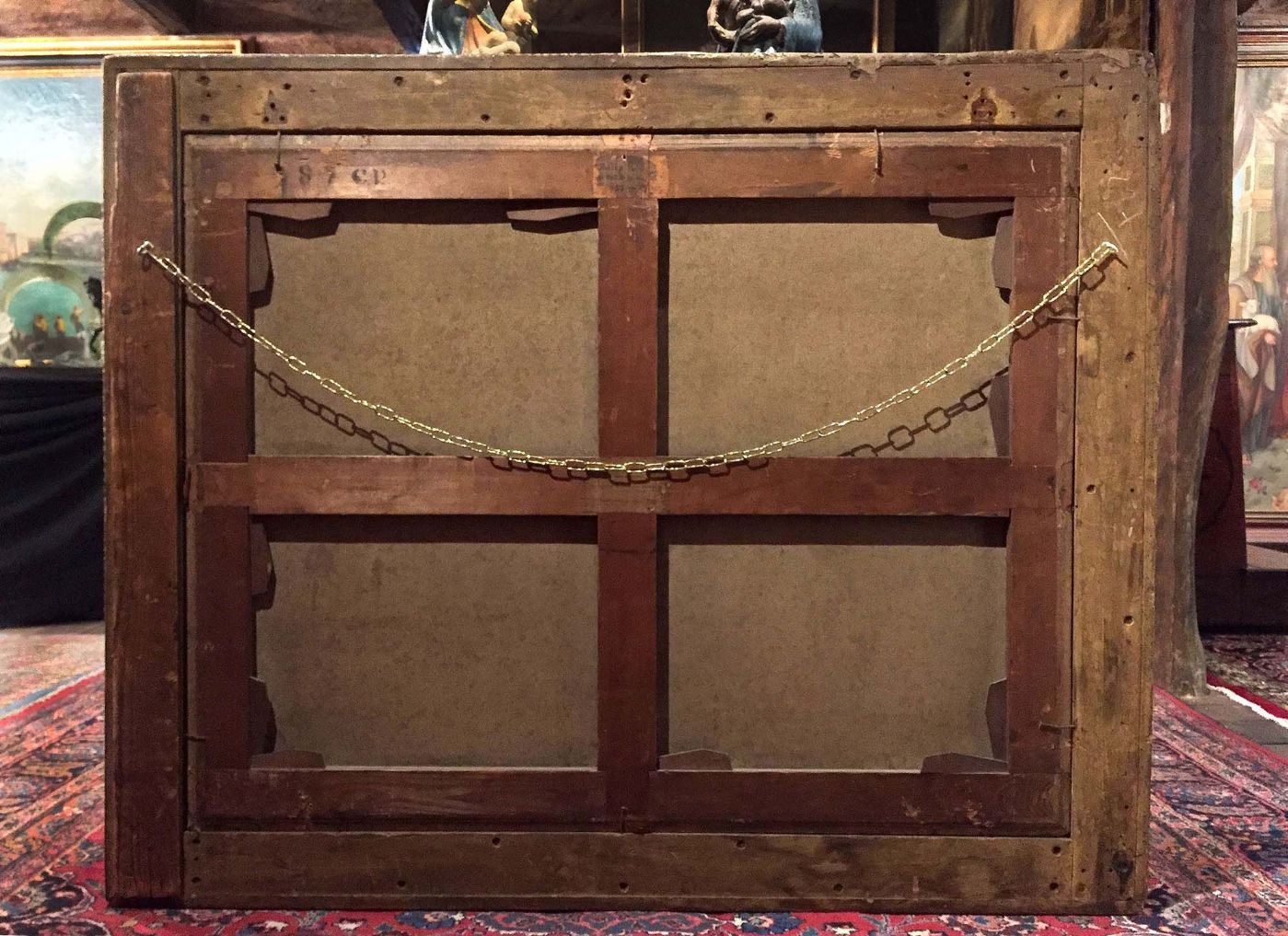
Oil on canvas painting, cm. 90 x 113 – autograph work by Philipp Peter Roos, known as Rosa da Tivoli – within an antique carved and gilded wooden frame.
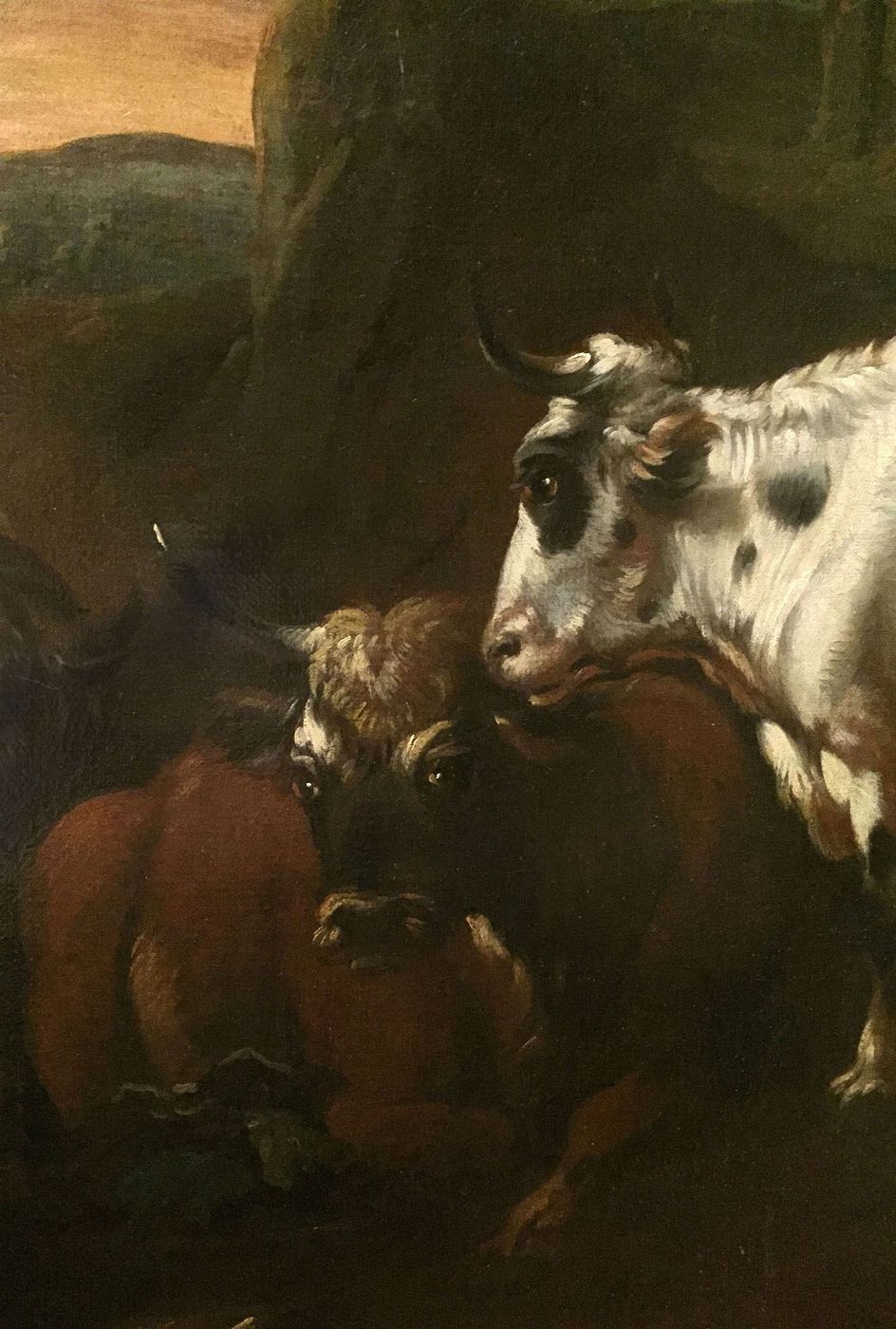
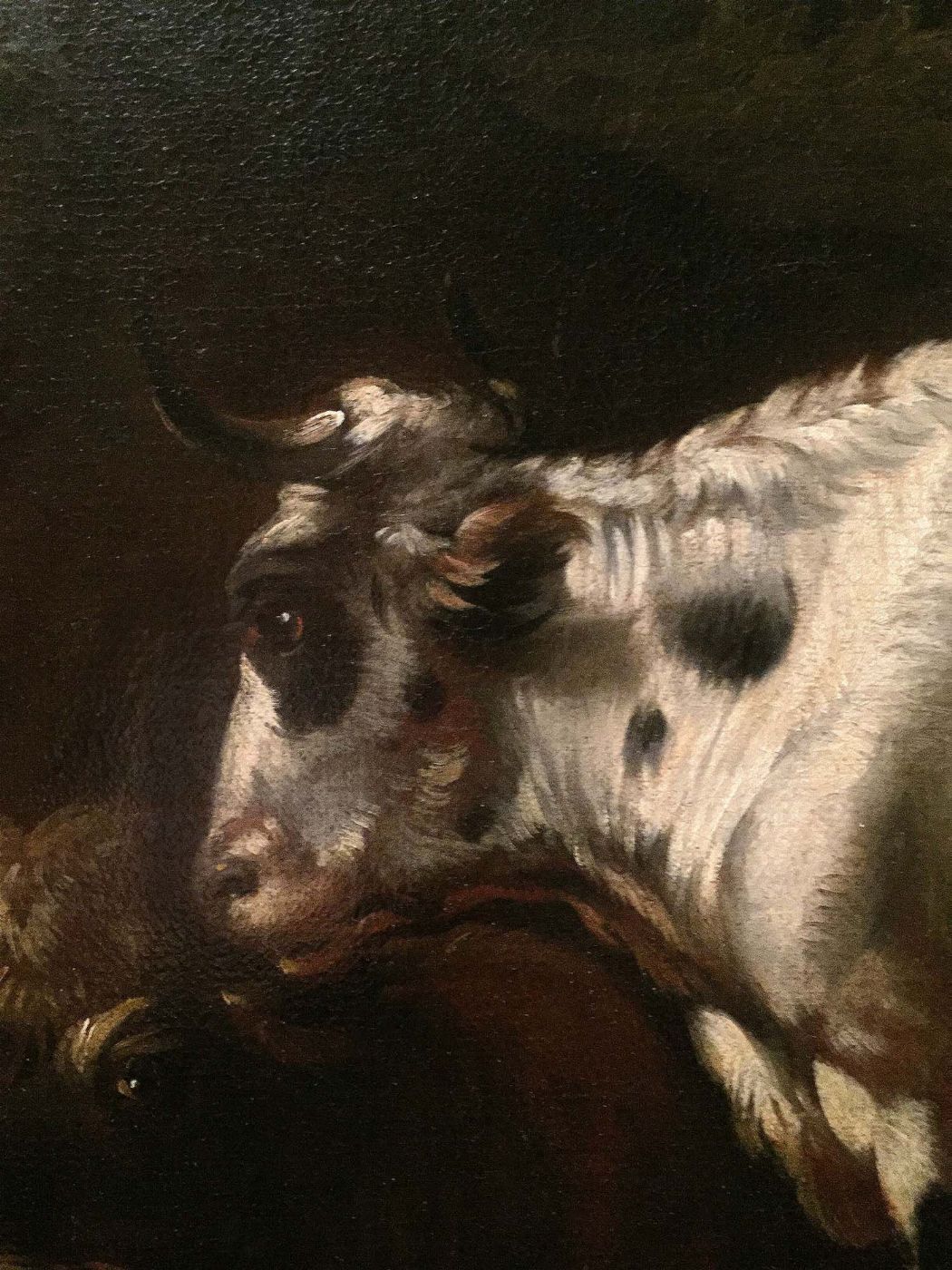
Philipp Peter Roos, known as Rosa da Tivoli (Sankt Goar (Frankfurt am Main), 30 August 1657 – Rome, 17 January 1706), was a German painter and engraver of the Baroque period. He belonged to a well-known family of German painters and engravers: his father was Johann Heinrich Roos, the most important German animal painter of the 17th century. He arrived in Italy in 1677 with a scholarship from the Landgrave of Hesse, on the condition that he would return to his court. However, disregarding the Landgrave's conditions, he never returned to Germany. He studied in Rome with Giacinto Brandi, whose daughter Maria Isabella he married in 1681, after embracing the Catholic faith. In 1684-1685 he bought a house near Tivoli, which earned him the nickname Rosa da Tivoli. Roos personally raised the animals he painted near this dilapidated house, which was therefore called "Noah's Ark." The house was in the rione San Paolo, still called "vicolo del Riserraglio" today. Gino Mezzetti, a local historian, wrote: «It is customary to derive the name of this artery from that barred environment, located in the silent square of the rione, in which the German painter Philipp Roos, known as Rosa da Tivoli (because he worked especially in the Tiburtino area) enclosed various animals in a pen, which he then reproduced in his appreciated paintings, some of which are still in the Vatican Art Gallery. From the animal pen to the "rinserraglio" and therefore to the "Riserraglio" the step is short. Also vicolo del Pittore, in via del Duomo, took its name from the artist, who lived in that small cul-de-sac». From 1691 he lived mainly in Rome, where he became a member of the Schildersbent (clan of painters) with the nickname "Mercurius", for the speed with which he executed his paintings and for the ease with which he painted. This speed of execution was particularly useful to him: in fact, often without money, he painted one or two pictures which he had his servant sell at any price in order to pay the inn bill. He lived in a deliberately free, rule-defying and dissolute way and, as often happened, then as now, he died in poverty. Most of his works depict domestic animals with their herdsmen in the Roman countryside. The animals, as in our painting, are generally painted in the foreground and dominate the scene, while the landscape can be glimpsed below. Roos spreads his paint impasto rendering the coats, position and movements of each species with great talent. As can also be seen in the important painting that we propose here. In the years around 1680 the artist generally portrayed small groups of animals (sheep and goats, often led by a ram with curved horns), with shepherds on the side in rough clothes, near the animals. In the distance, wild valleys alternated with steep walls illuminated by a yellow-brown light; the distant mountains were rendered in shades of blue. Ancient ruins were often painted in the background. Around the 1690s, Roos mainly painted landscapes.
Overall, his paintings are characterized by a ghostly, gloomy and wild tone. Furthermore, Roos was able to transform natural landscape motifs into unusual and dynamic visions. A direct representation of Nature, as an attentive and present observer on the spot, a solitary witness to the scene depicted. Even if this artist generally painted landscapes and animals, he was nevertheless able to create more complex compositions, as demonstrated by the drawing Deposition from the Cross, now at the Jean Paul Getty Museum in the USA. Other of his works can be found in Florence (Uffizi), Madrid (Prado), Dresden (Gemaeldegalerie), as well as in prestigious private collections.
Philipp Roos' style, a passionate and uncompromising man, reflected his way of working. It was in fact characterized by an use of intense brushstrokes, sometimes almost coarse and by a strong contrast between light and shadow. This personal manner was quite popular and attracted various imitators. His well-defined works are real portraits of domestic animals with shepherds in the Roman countryside. The animals, as we have seen, in the foreground, always protagonists, the man smaller or absent, the spacious and distant landscape. Roos softly moves an impasto painting by carefully painting the coats of the animals, in different positions and movements, with spontaneous compositions.
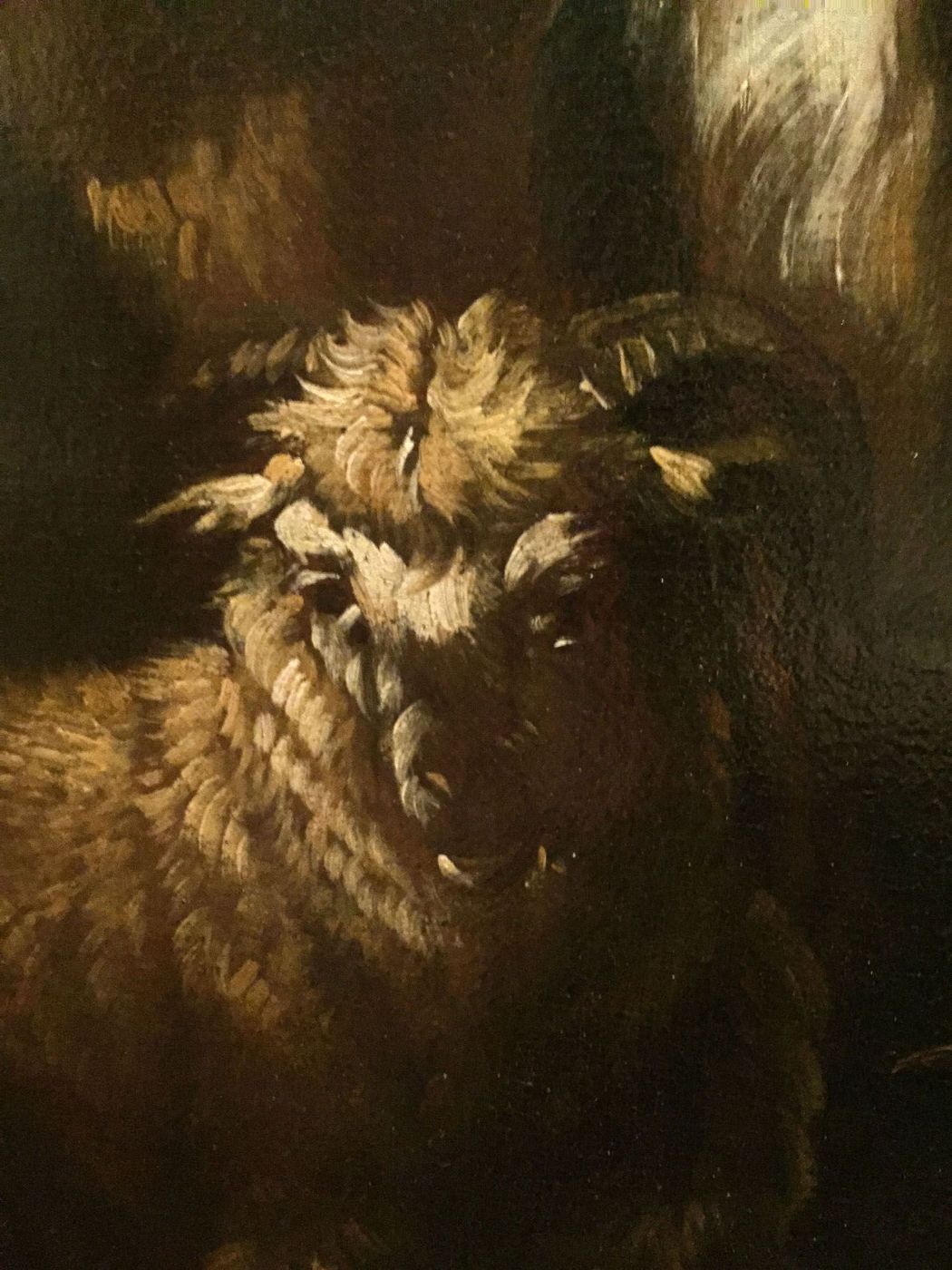
In the 1980s, in his first laborious maturity, Rosa composed small groups of animals, especially sheep and goats, led by a ram, with the shepherds in the background to control the animals, within valleys and mountains of prevalent yellow-brown tones, painted with creamy brushstrokes. On the bottom, azure mountains against pinkish skies and clouds. Sometimes, as backdrops, ruins of ancient buildings, in an arcadian calm.
Works of particularly intense works belong to this period, which have the characteristics described above: dominant figures of the ram with twisted horns, the cow in the foreground, often the resting goat with the kid, sometimes a flourishing sheep of soft wool, in the background a rocky landscape, with ruins, harsh and wild. Resumed at sunset or sunrise, with the warm light of sunset or dawn that seems to originate, as if by magic, from the bottom of the painting. In the eyes of his goats there is a painful truth, an alternative consciousness of the world, a masked humanity. As Umberto Saba will say: «I spoke to a goat, / She was alone on the meadow, she was tied up. / Full of grass, wet / from the rain, bleating. / That same bleating was fraternal/ to my pain. And I replied, first / as a joke, then because pain is eternal, / it has a voice and does not vary. / This voice I felt / moaning in a solitary goat. / In a goat with a Semitic face / I felt every other evil complaining, / every other life». Far away, in the background, grey and pink clouds, against the unmistakable blue sky. Fresh and dense the painting, as nothing renders the coat of animals. Later, in the 1990s, Roos will mainly paint landscapes.
All together his paintings, a bucolic and never metaphorical epic of animals, in their quiet inhabiting the world of men, tell of a parallel people, in remote and uncontaminated landscapes. Roos' painting is shown in lively and dense brushstrokes, with formidable and fragrant chromatic effects. Other animal painters, such as Domenico Brandi and Nicola Viso, have sometimes been mistaken, for the genre, not for the unattainable quality of Philipp Roos, in the mimesis with respect to the reality, with the head of the school Rosa da Tivoli. In the flourishing workshop, also brothers and sons of the artist, as had been in the pastoral workshop of the Bassano, will continue, deliberately generating misunderstandings, to paint the same subjects.
Prof. Giancarlo Sestieri, whose expertise we publish in the image gallery, is certainly one of the greatest scholars of this great artist, considered the most important exponent of the "bucolic and arcadian" genre.
Bibliography
• Julius Samuel Held, Detroit Institute of Arts, “Flemish and German paintings of the 17th century”, 1982, pag.73-74-75
• Musée du Louvre, Frédéric Villot, “Notice des tableaux exposés dans les galeries du Musée impérial du Louvre”, pag.221
• Musée des beaux-arts, Clara Gelly, “Nancy, Musée des beaux-arts: peintures italiennes et espagnoles, XIVe-XIXe siècle”, 2006, pag .141-142