Expertise Report
Technique: Oil on canvas
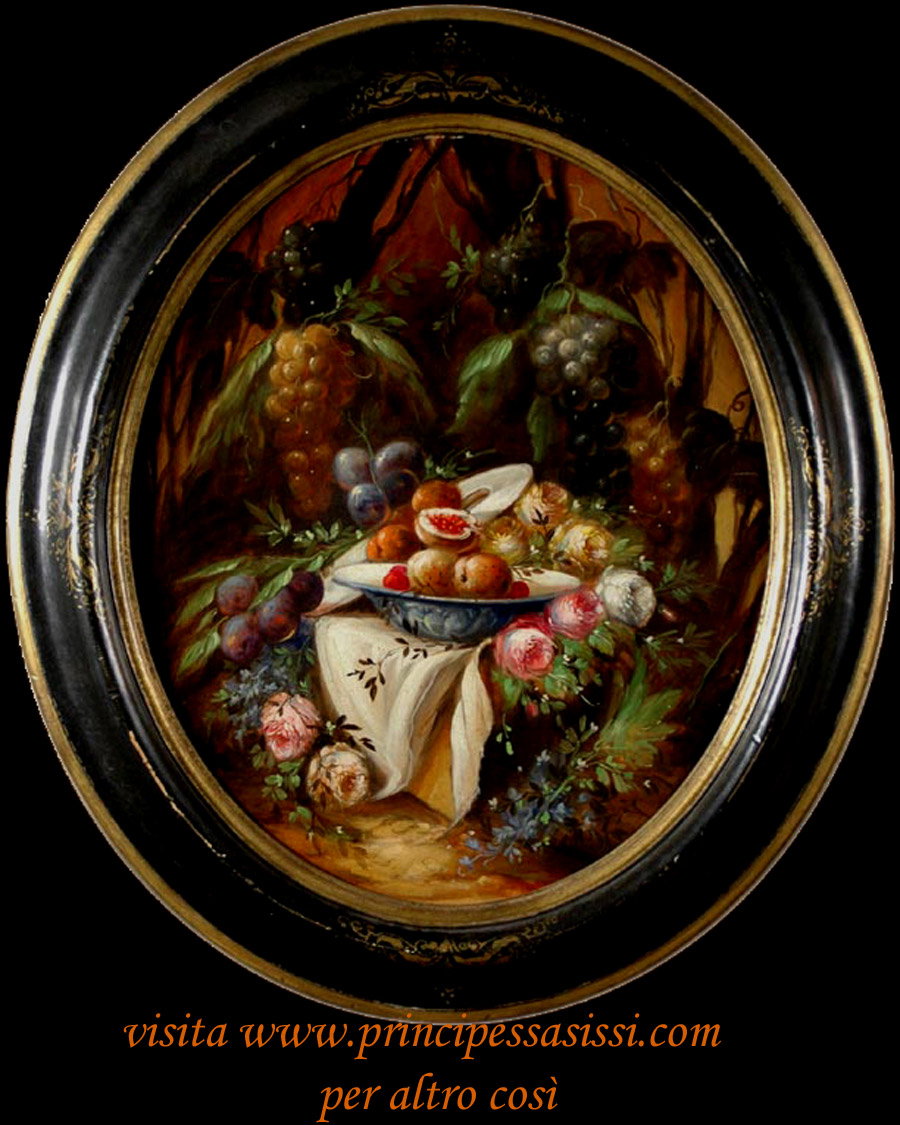
Subject: Still life with fruit (grapes, figs, peaches, pomegranates) and flowers (roses), on a dark background with strong chiaroscuro contrast.
Measurements: cm 58 x 48 (canvas) cm 80 x 70 with original frame.
Condition: Very good. Not restored. No intervention needed. Patina and craquelure corresponding to the antiquity.
Composition: Typical central pyramidal setting on a raised plane (plate with tablecloth).
Light: Clear Caravaggio-esque intention with theatrical lateral light, common in post-seventeenth-century Central European painting.
Format: Oval with black and gilded decorated frame — very common in bourgeois living room works of the early nineteenth century.
The way the fruits are arranged and the rendering of the white fabric is very reminiscent of the works of Franz Xaver Petter.
Valuable painting with typical Biedermeier characteristics that confirm the area and attribution, including the intimacy of the scene and the attention to detail that reflect the bourgeois aesthetic of the period. The dark background with a light that isolates the subjects is very characteristic of the Viennese school. The oval cut and the sumptuous frame suggest a production intended for the private decoration of an upper-middle-class house.
Assessment of the pictorial quality from medium-high quality: we observe:
1. Well-balanced composition with a classic pyramidal structure, with excellent balance between fruit, flowers, and background. The drapery is rendered with a certain softness and volumetric credibility.
2. Light and atmosphere:
The dark, almost tenebrous background highlights the fruits with a refined chiaroscuro effect, of seventeenth-century inspiration. Good management of light on shiny surfaces (such as grapes and fig pulp).
3. Floral and fruit details:
The flowers (roses and peonies?) and the fruits are well identifiable and show a good level of botanical accuracy. The cut of the fig is rendered with particular attention — a subject often used by more experienced painters to demonstrate skill.
Conclusion:
Work of typically biedermeier taste depicting a composition of fruit and flowers on a stone top covered by a white drape. The scene presents a rich botanical variety, including open figs, peaches, white and black grapes, plums, pomegranates, and flowers (roses and peonies), arranged according to a classic pyramidal construction. The setting, dark and deep, accentuates the effect of lateral light that enhances the pictorial material and naturalistic details. The compositional setting, the treatment of light, and the realistic rendering of the subjects suggest a painter active in the Viennese area, in line with the Central European academic tradition of Johann Baptist Drechsler and close in style to Sebastian Wegmayr or Franz Xaver Petter.
Attribution: Circle of Franz Xaver Petter, perhaps a student of his or, in any case, a Viennese workshop active in the second quarter of the 19th century.
Franz Xaver Andreas Petter (October 23, 1791 – May 11, 1866) was an Austrian artist. Petter was born in Lichtental; his father was a porcelain painter and it was expected that he would follow the same profession, but Petter developed an interest in oil painting. He studied with Johann Baptist Drechsler at the Academy of Fine Arts in Vienna.
Franz Xaver Petter was one of the most important still life artists of the Biedermeier period in Vienna. He specialised in floral compositions, and later in compositions of fruit and landscapes with flowers, continuing the tradition of Dutch Golden Age floral still life. Petter's paintings were very popular among the Austrian nobility.
Petter married Catherine Hamböck (1793-1858). They had two children, Theodore, who became an artist, and Gustav, a musician. Franz Xaver Petter died in May 1866 in Vienna.
In accordance with the provisions of the New Code of Cultural Heritage, the selling company provides simultaneously with the sale detailed written photographic guarantee of authenticity and provenance of the works sold. The data with which the works are described and then contained in the written guarantees are expressed determinations resulting from accurate and documented technical/historical/artistic investigations, even of a peritial nature.