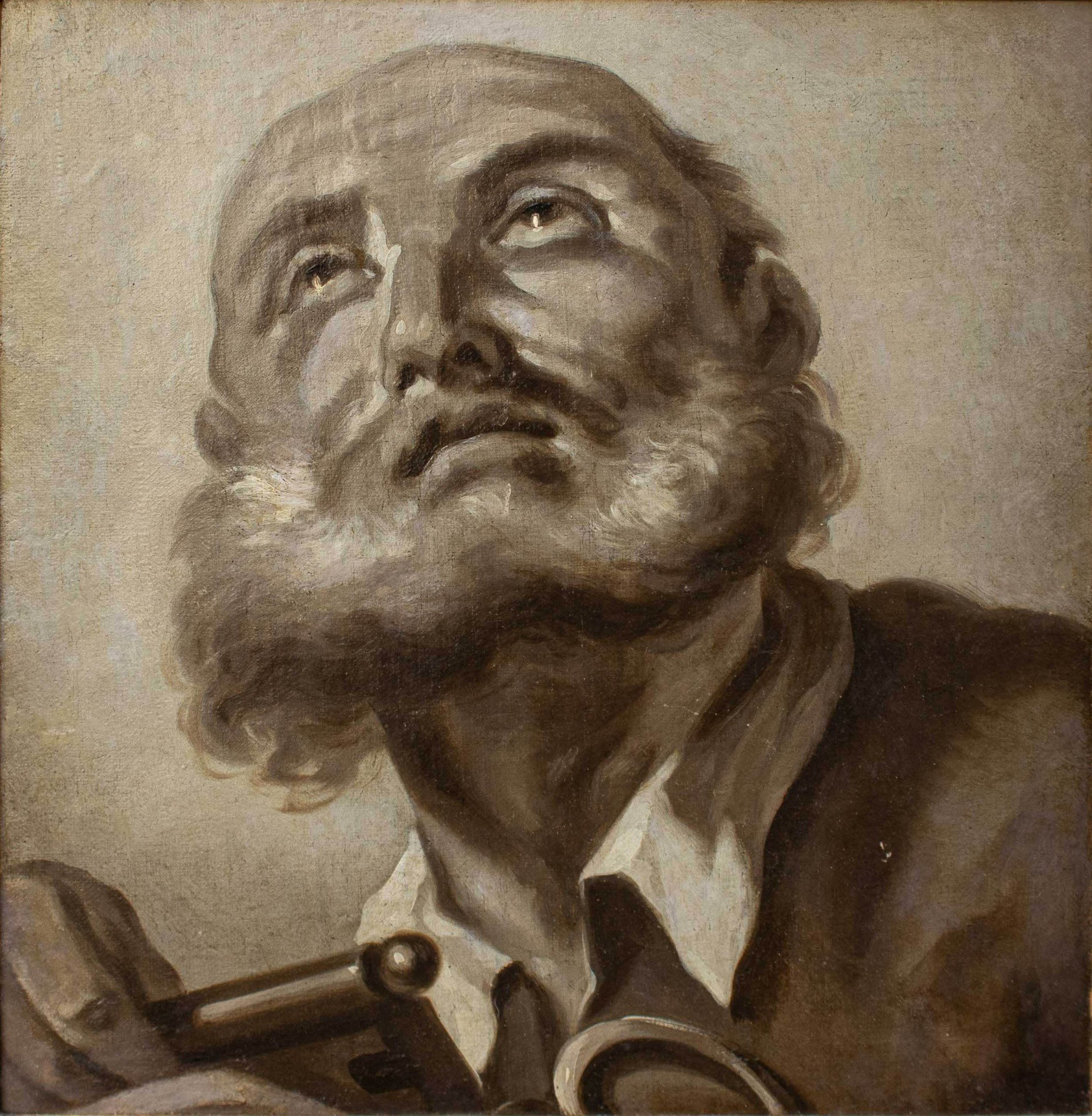
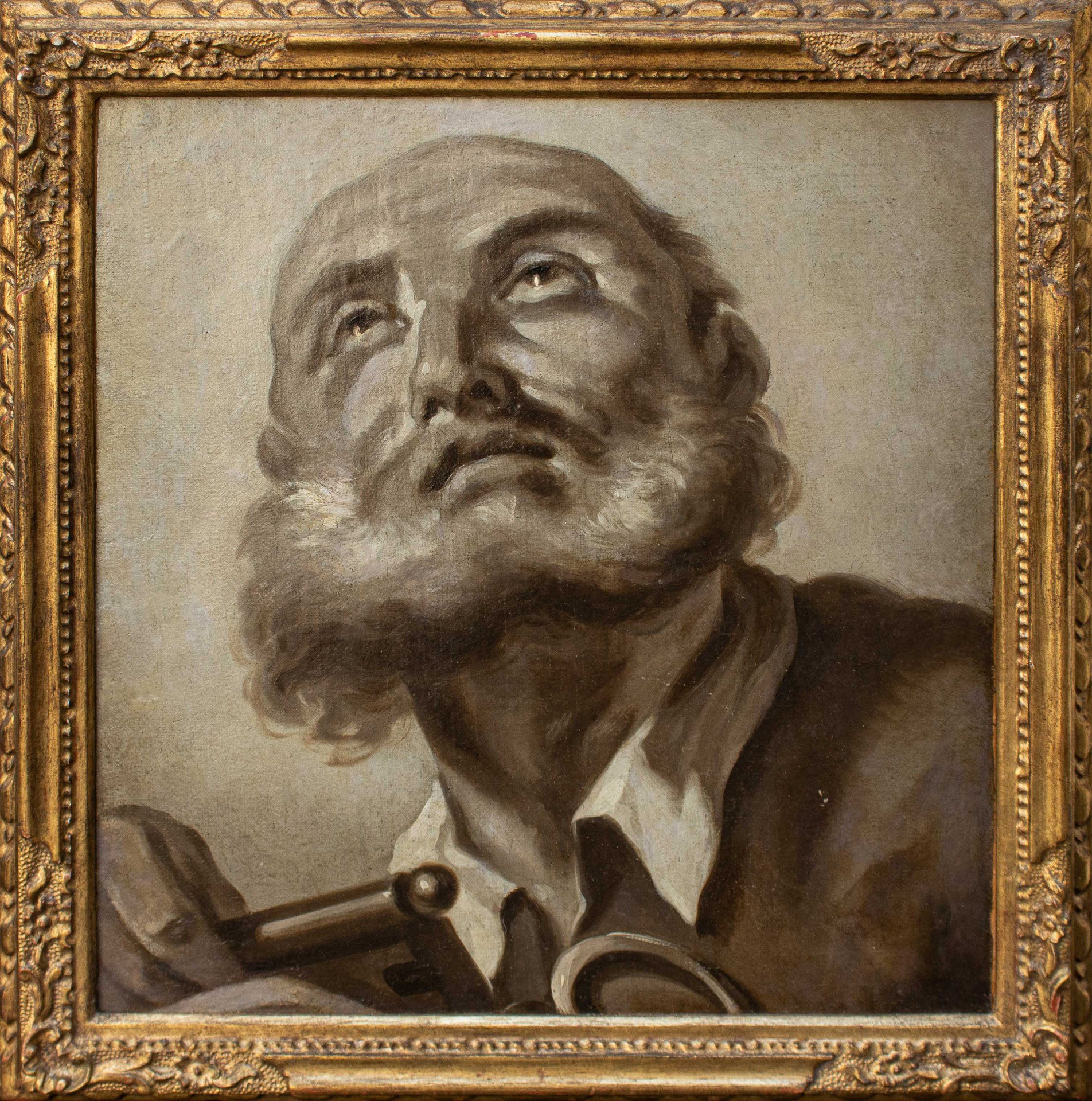
Follower of Giambattista Valentino Piazzetta (Venice, 1682 - ibidem, 1754)
Head of Saint Peter
Oil on canvas applied to cardboard, 36.5 x 34.5 cm
With frame 42.5 x 41 cm
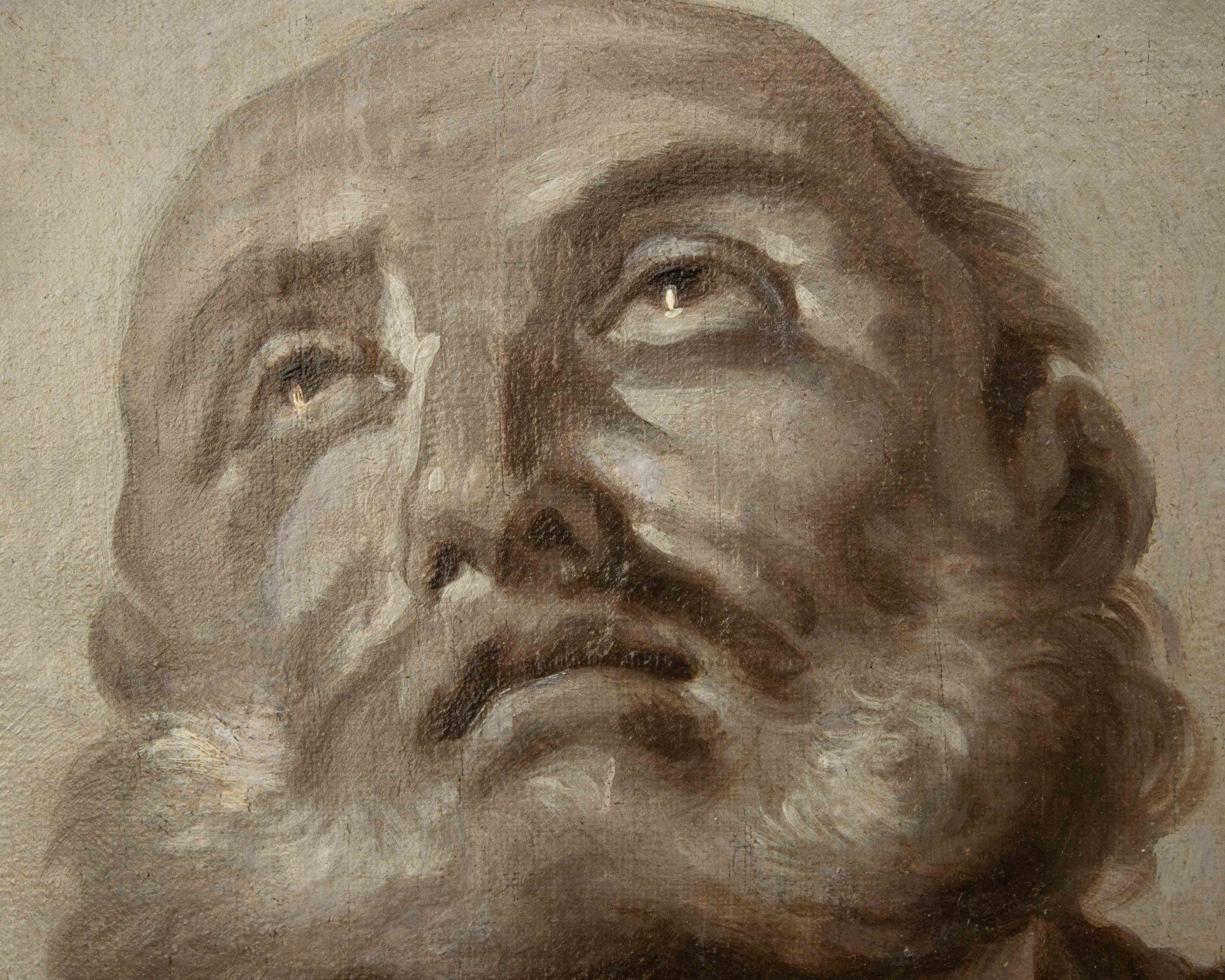
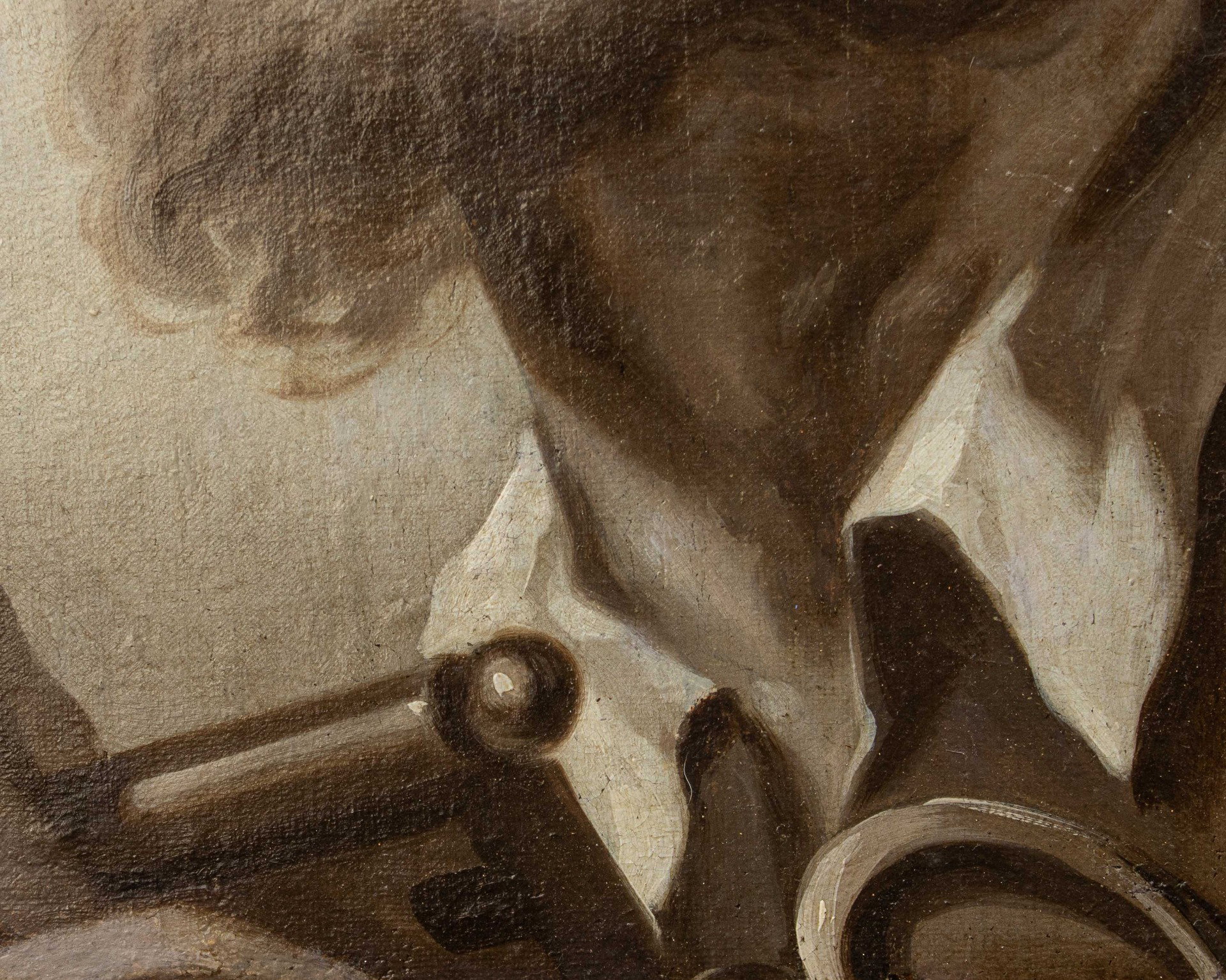
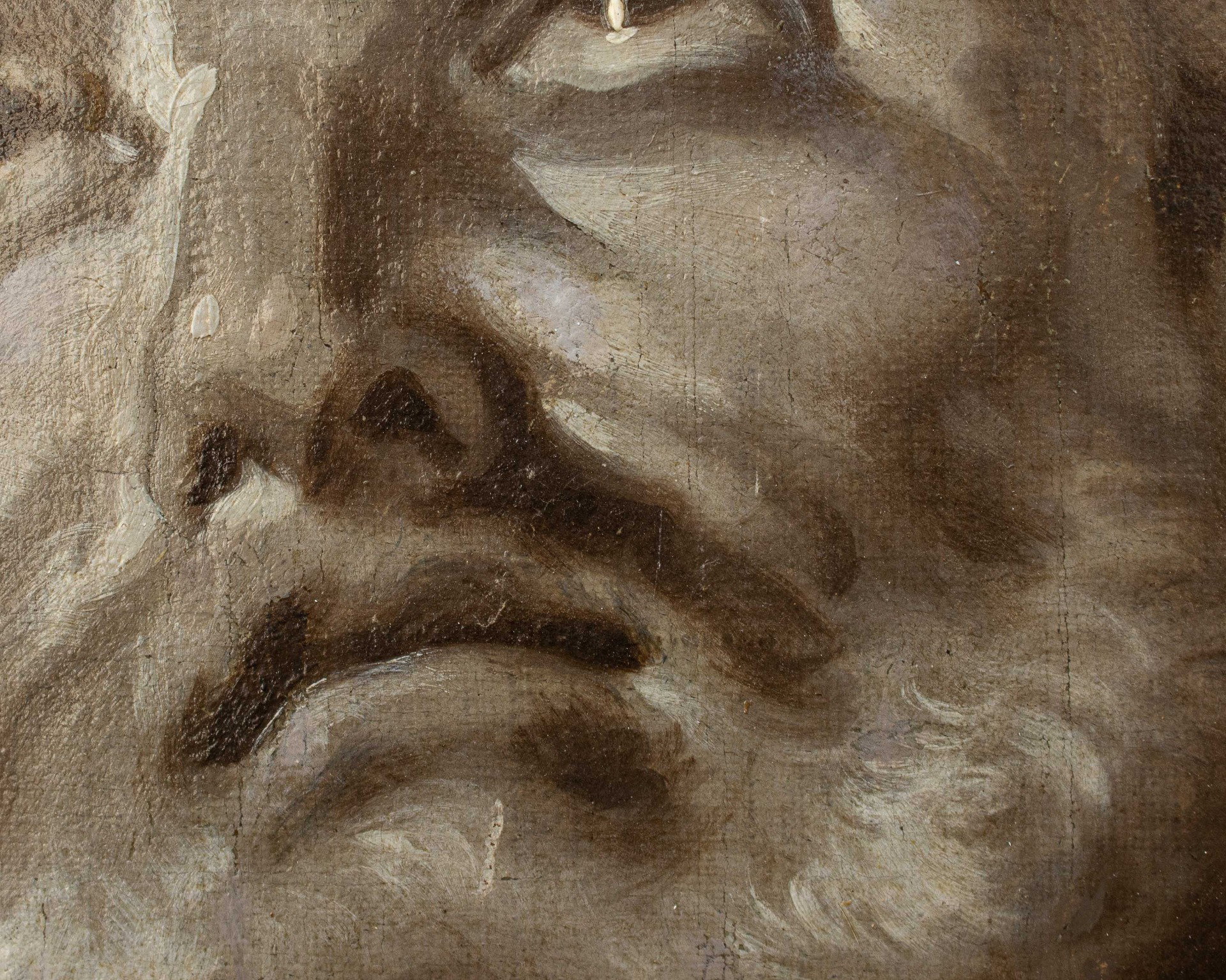
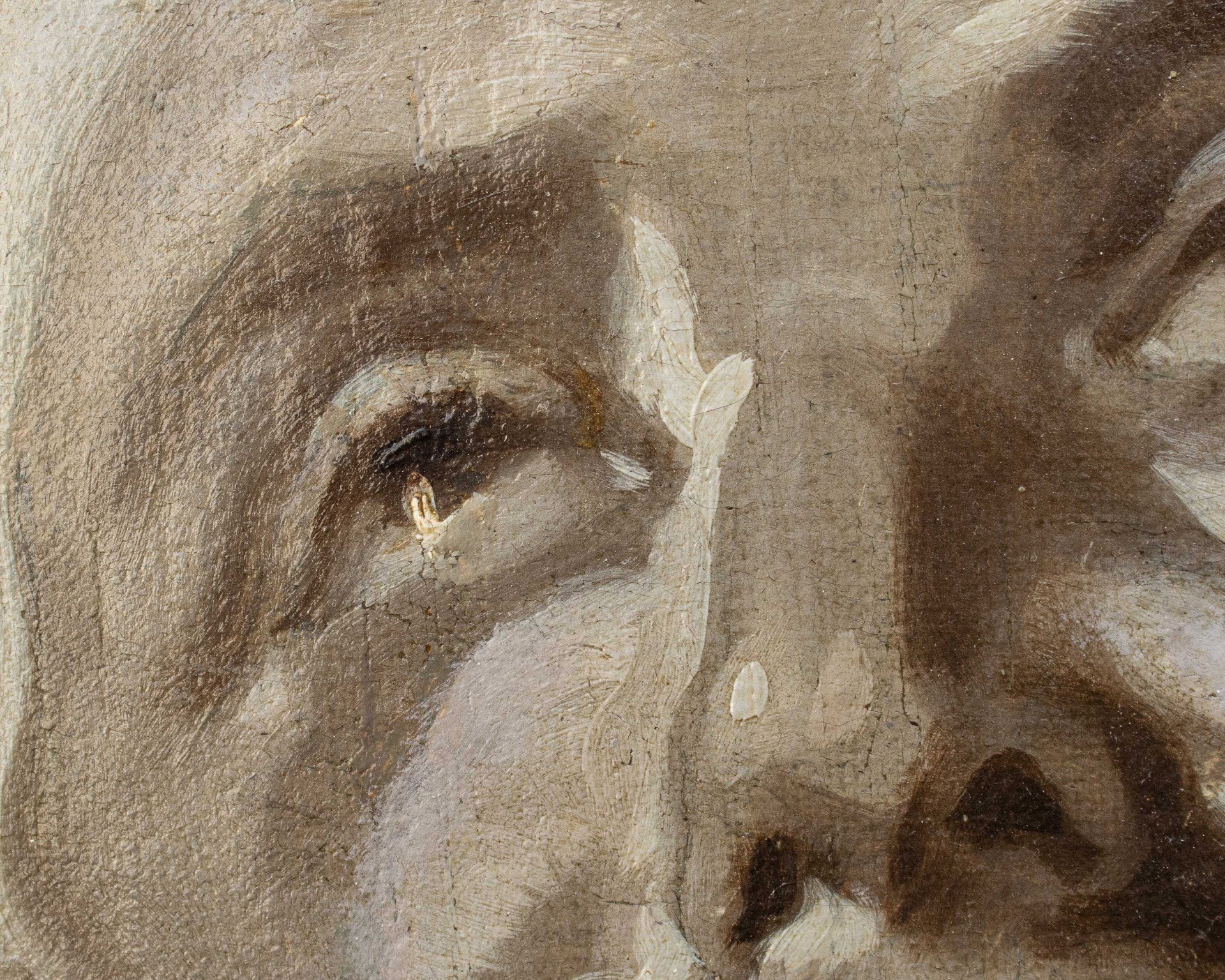
The claves Regni Coelorum, an essential attribute of Peter, timidly peek out in this painting, with the sole purpose of allowing the recognition of the character. The entire attention is indeed conveyed on the Saint, with his suffering humanity and divine inspiration. Peter is rendered with a liquid epidermis, illuminated by a pearly light that slides and drips to define the imposing nose, cheekbones and eyebrow arch; while the vitreous humor of the eye turns bright towards the sky, to investigate the highest wills of the divine mystery.
The portrait, here rendered in an intense monochrome, denounces the direct dependence of the present artist on the suggestions of Giambattista (Valentino) Piazzetta, one of the greatest Venetian masters of the eighteenth century. Following a bitter apprenticeship in wood carving with his father Jacopo, a sculptor from Pederobba, in the Treviso area, Piazzetta retired to the workshop of Antonio Molinari (1655-1704), an exponent of early Venetian Mannerism. At the turn of the century, the artist made the only formative trip of his life, headed towards the city of Bologna. Here he received the naturalism of Giuseppe Maria Crespi (1665-1747), with whom he became so involved that, later, a pupil of Piazzetta, Antonio Martinetti, left a cheerful testimony of Crespi's own amazement at the results achieved by the apprentice, in his comment: "You know more than me, and I need to learn from you". Piazzetta exceptionally adopted, being a Venetian artist, Caravaggio's colorism, taken as a declared model in the translation of strong chiaroscuro contrasts, combined with the immediate crudeness of the Emilian Guercino (1591-1666). Returning to Venice in 1711, the artist lightened his palette by studying, during the 1720s, Strozzi and Liss, who were directly active in the lagoon city, but also Solimena and Rembrandt, from whom he derived a serenely peaceful luminosity. The fresco of the Glory of Saint Dominic executed for the dome of the Church of Ss. Giovanni e Paolo (S. Zanipolo), to which Tiepolo had also aspired, dates back to 1725; trace of the hoped-for Tiepolo commission remains in the sketch painted by this artist on the occasion of the competition (1723, Venice, Gallerie dell'Accademia). The entry into the 1720s highlighted Piazzetta's most successful period: among all the works, The Fortune Teller (Louvre), Rebecca at the Well (Brera) and the capital Saint James dragged to martyrdom (Church of San Stae, Venice) should be remembered.
It is possible to compare the present painting with the more genuine pictorial matrix of Piazzetta, who made two petrine portraits very similar to the present one, re-proposed here by the follower in a renewed and very luminous humanity, one auctioned on the antique market (Christie's auction) on June 5, 1980 (lot no. 22), the other in a private collection. The same male face turned to the sky with intimate transport, of equal physiognomy, even in the beard, was re-proposed by Piazzetta in the Joseph of the Saint Joseph with the Child (Prague, Nàrodni Galerie) and also, clamorously, in the shocked Apostle of the Assumption of the Virgin (1735, Paris, Musée du Louvre), from which some critics argue that the model for the two heads of Saint Peter above should derive. Finally, remember the Saint Peter of Hamburg (Scholz-Forni collection), attested around the middle of the fourth decade by Goering, from which Piazzetta himself once again drew inspiration for the Abraham of the Sacrifice of Isaac in Baroda (Baroda Museum and Picture Gallery).
The object is in good condition
With Ars Antiqua it is possible to defer all amounts up to a maximum of €7,500 at ZERO RATE, for a total of 15 INSTALLMENTS.
E.g. Total €4,500 = Monthly installment €300 for 15 months.
E.g. Total €3,600 = Monthly installment €720 for 5 months.
For amounts exceeding €7,500 or for a longer deferral period (over 15 installments), we can provide a personalized payment.
Contact us directly for the best quote.
LIVE TV
– SUNDAY 19.00 – 23.00 Dig.terr. 126 + 809 SKY
- THURSDAY 21.00 - 24.00 Dig.terr. 134 + 809 SKY
– Streaming on our website www.arsantiquasrl.com and on our social media Facebook and Youtube
All the works offered by Ars Antiqua are sold accompanied by a certificate of authenticity in accordance with the law and an accurate in-depth sheet.
You can see the works directly at the Milan showroom gallery, in via Pisacane 55 and 57.
We personally organize transport and delivery of the works, both for Italy and abroad.