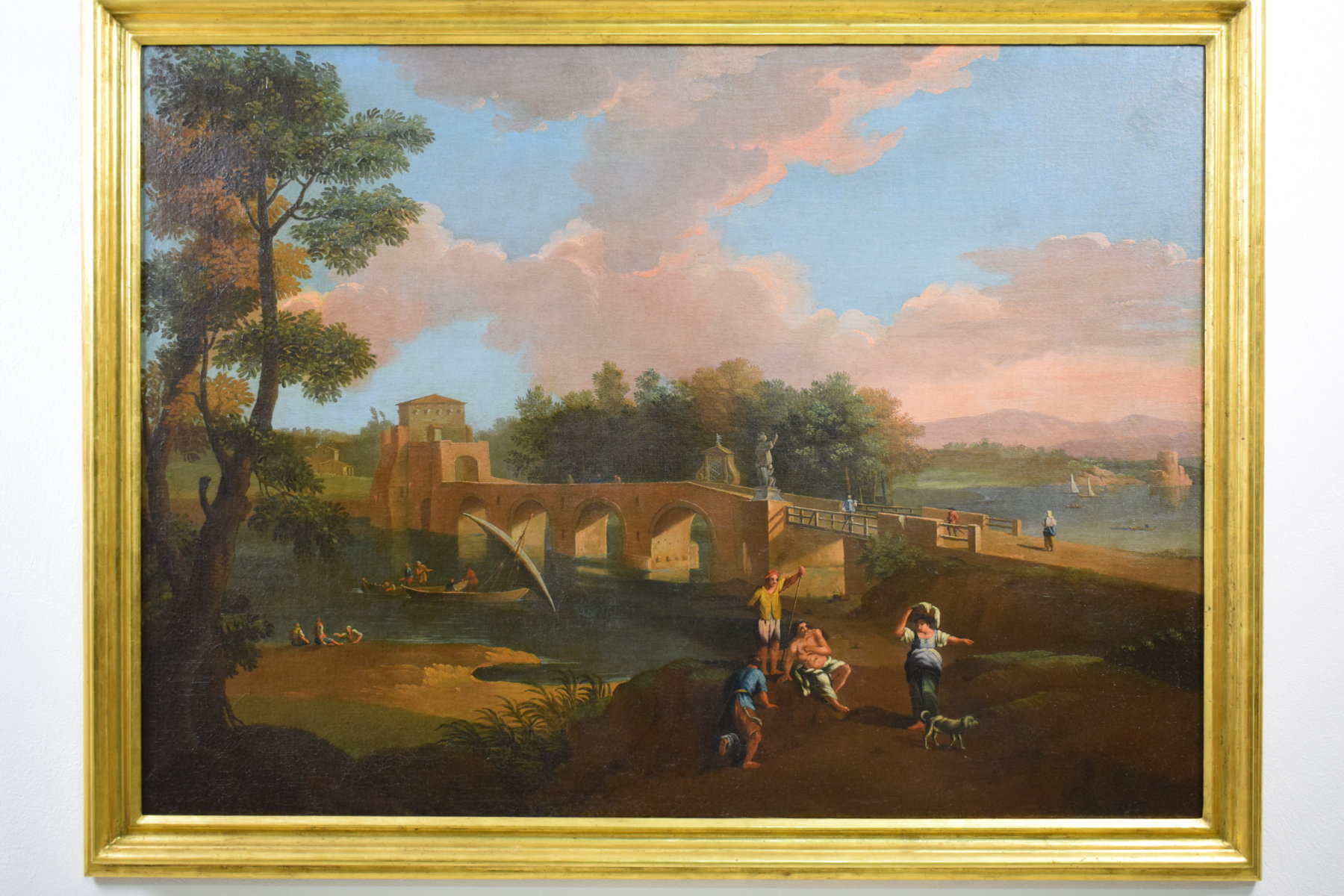
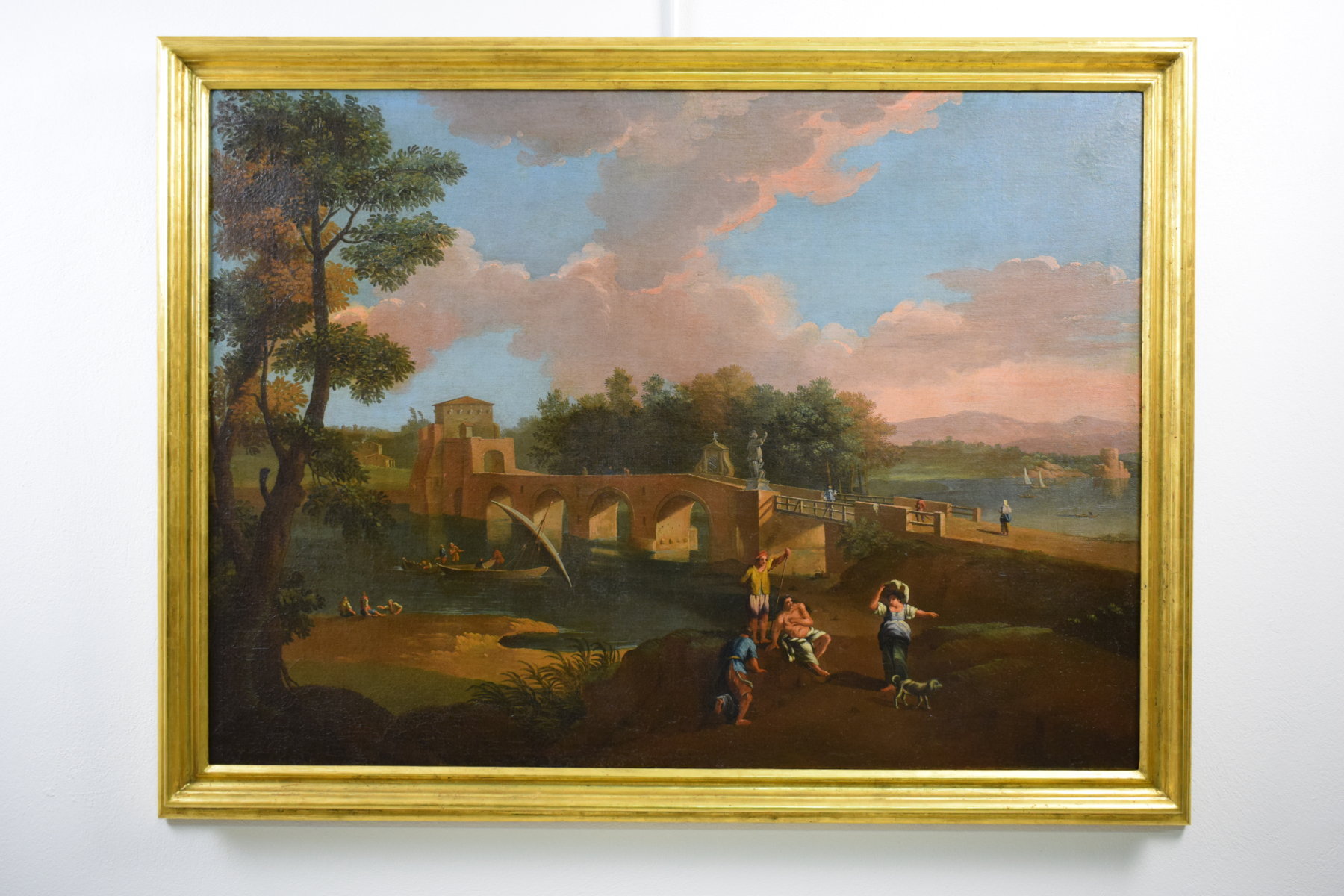
Roman school painter, follower of Paolo Anesi
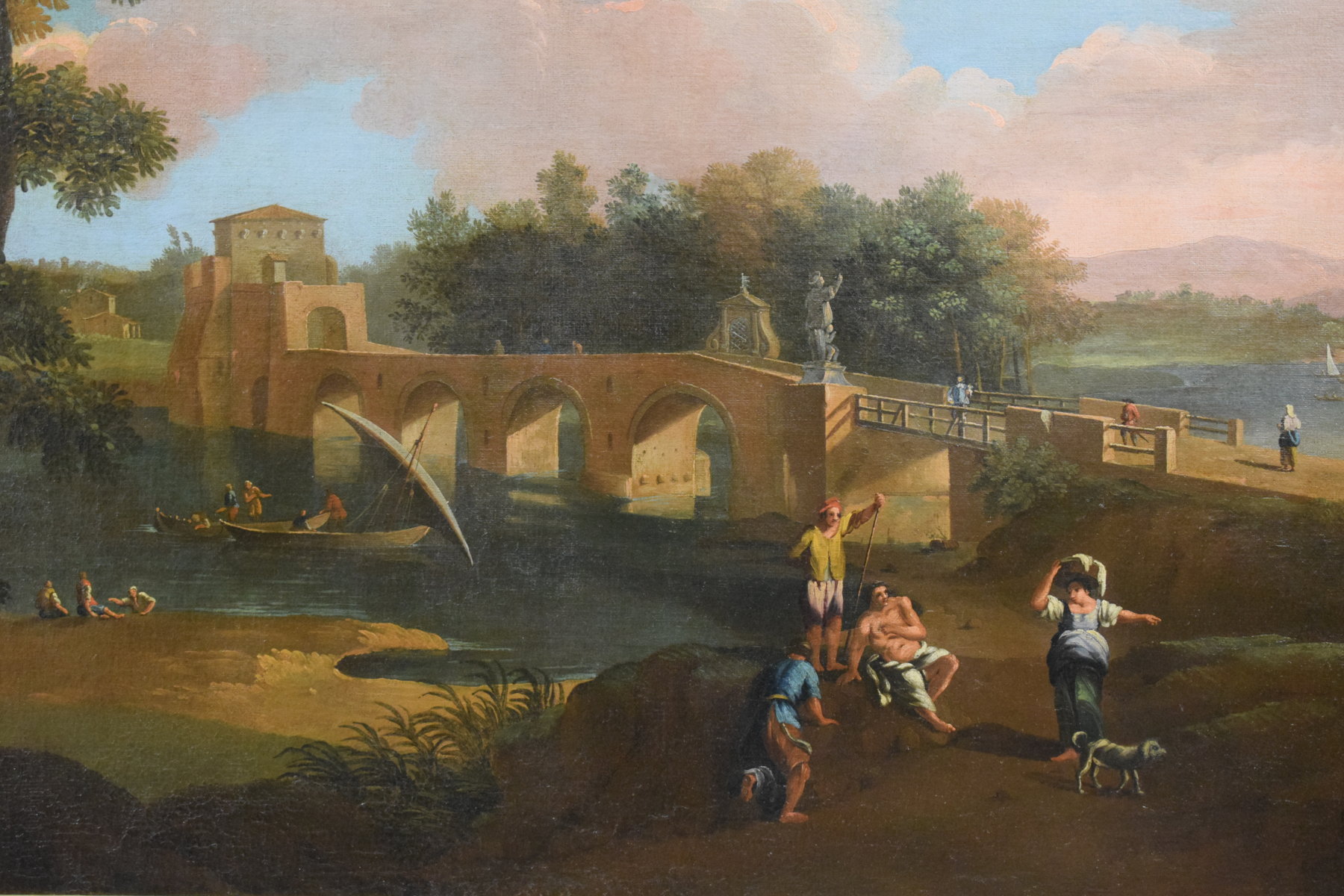
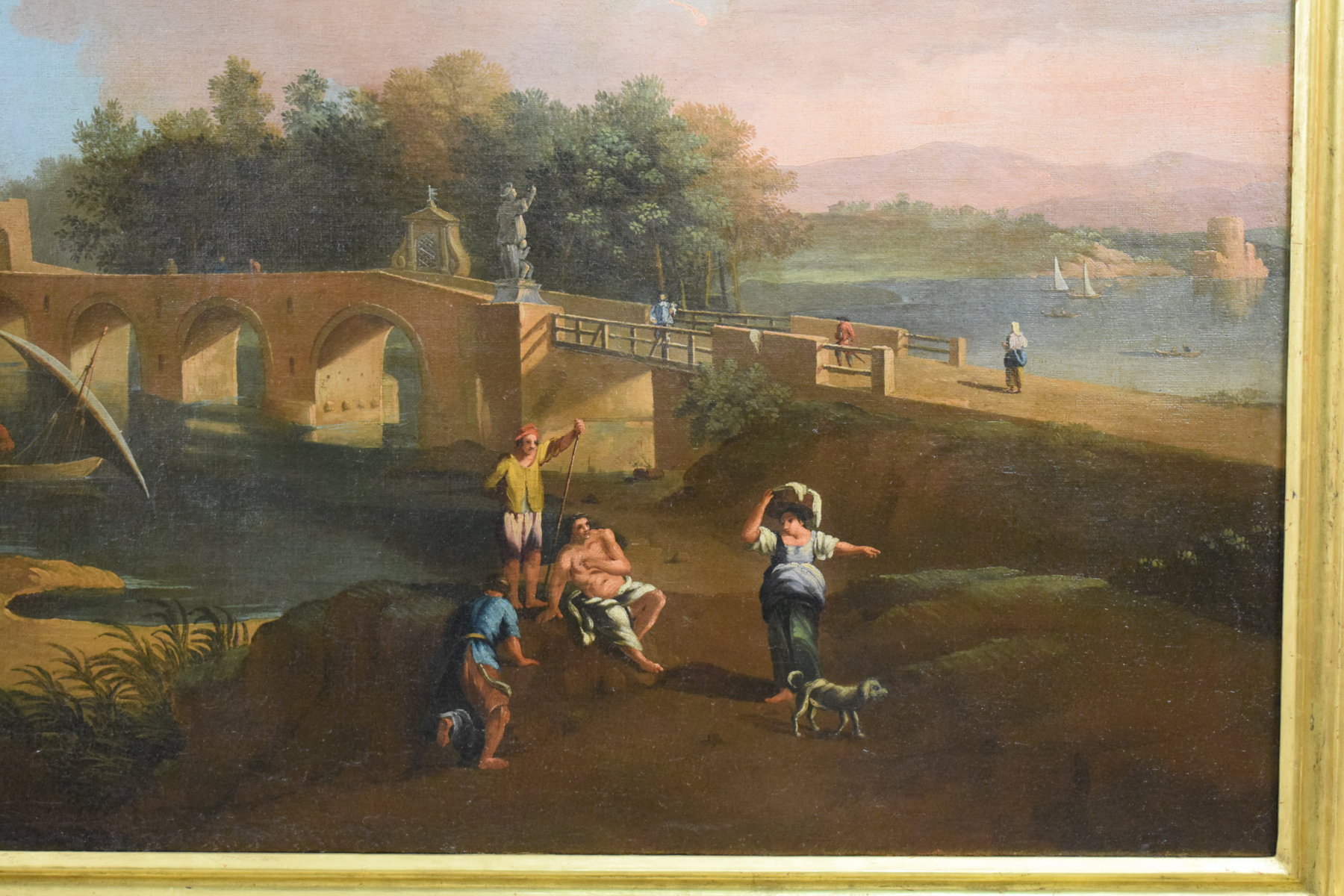
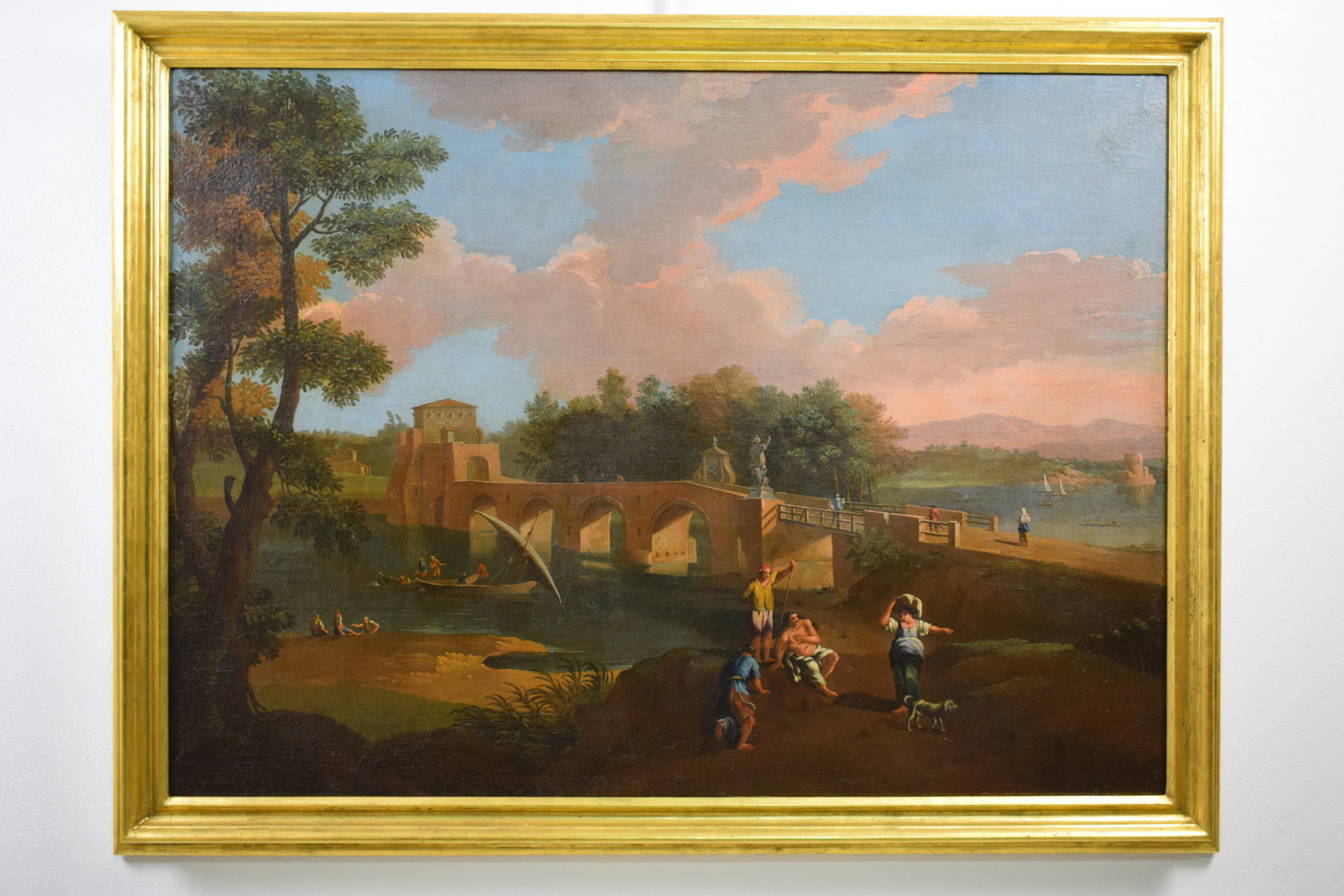
Roman landscape with the Milvio bridge and figures
Mid-18th century
Oil on canvas, 145 x 112 cm
Price between: 9,500.00/10,500.00 euros
Item accompanied by a certificate of authenticity and expertise (downloadable at the bottom of the page)
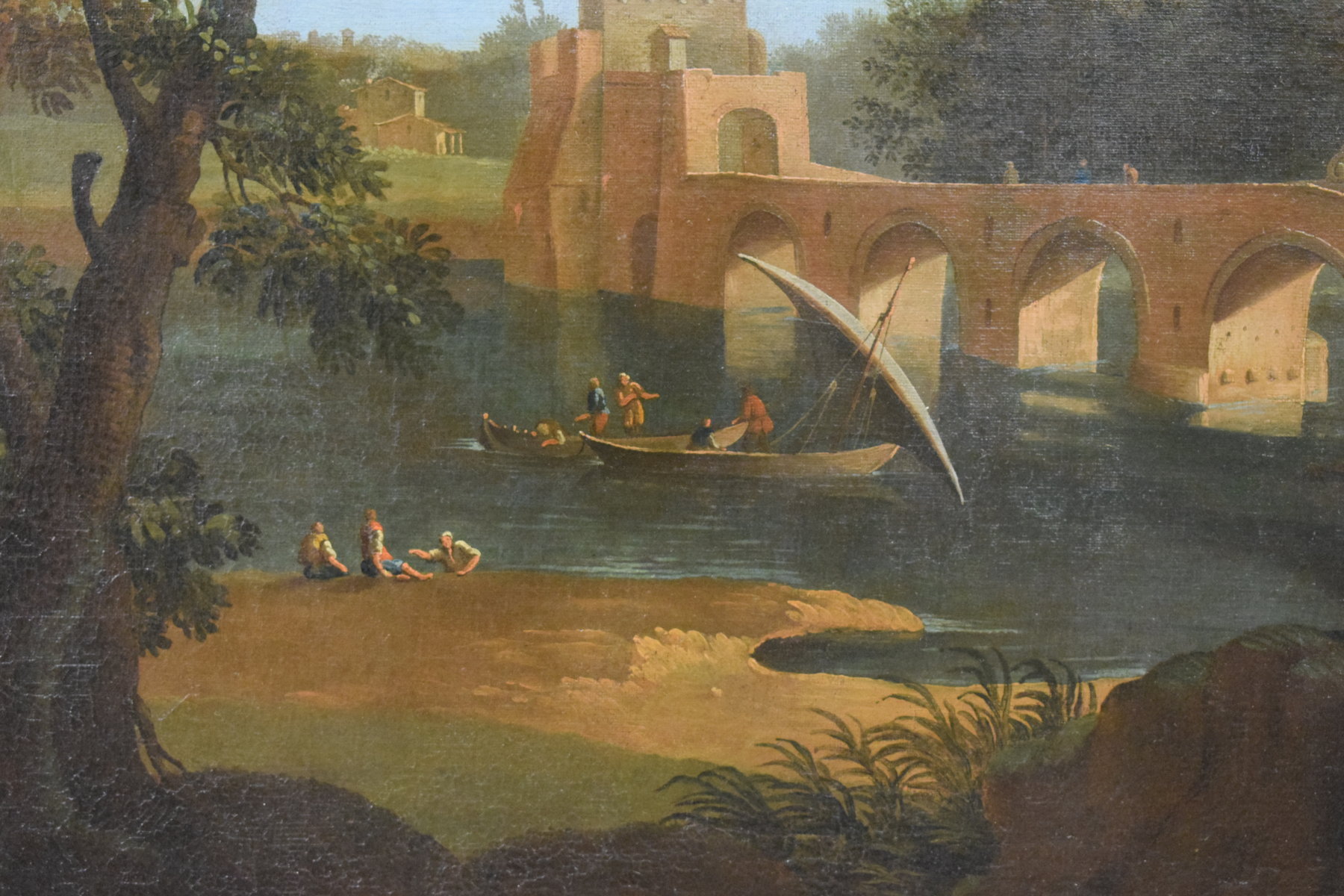
The painting depicts an evocative stretch of rural Roman landscape with the Milvio bridge crossed by some wayfarers. In the foreground, placed in front of the bridge, some figures enliven the scene. The bridge is safely identifiable with the famous Milvio bridge (Pons Mulvius), one of the oldest and most important in Rome. Originally made of wood and probably built by a censor of the gens Mulvia in the 4th century BC, it was rebuilt in masonry in 109 BC, by the censor Marcus Aemilius Scaurus. During the Middle Ages the bridge remained the main access route to Rome. Under Pope Callixtus III (1455) the wooden tower was replaced by a square tower. On June 26, 1731, the statue of St. John of Nepomuk, depicted in the painting, was placed on the bridge parapet, at one end of the bridge. The sculpture was commissioned from Agostino Cornacchini (Pescia, August 26, 1686 – Rome, 1754) by the Bohemian nobleman, Cardinal Michael Frederick of Althann. St. John of Nepomuk, of Bohemian origin, drowned in the Moldau in 1393. He is considered the protector of the drowned and is invoked against floods. He is also considered the protector of secret oaths and the putto placed at the base of the statue has the index finger of his right hand on his mouth as if to remember silence. The saint was canonized in 1729 by Benedict XIII and the statue was placed in 1731. It is therefore after this moment that the painting must be dated, executed however by the end of the 18th century because in the 19th century the physiognomy of the bridge changes. Pope Pius VII commissioned the architect Valadier in 1805 to carry out the arrangement work.
Two lateral arches were built and the tower was restructured with the opening of the large entrance arch. In 1825 two statues were placed in front of the tower, the work of Francesco Mochi, from the mid-17th century, representing the Baptism of Christ. A last statue takes its place on Ponte Milvio in 1840: it is the statue of the Immaculate Conception by Domenico Pigiani placed in a symmetrical position to that of S. Giovanni Nepomuceno. The bridge, partially blown up by Garibaldi in 1849 to hinder the advance of the French, was restored in 1850 by Pius IX.
Ponte Milvio is very dear to the Romans and is remembered for several historical events. In the days of Catiline's conspiracy, Cicero posted his men on the bridge to ambush and arrest the delegates of the Gallic Allobroges, who were in Rome to make a pact with some conspirators. The bridge was then the scene of clashes between Otho and Vitellius in 69 AD. and again it was the scene of the triumphal entry of Septimius Severus and his troops in 193 AD. In 312 AD occurred the final event of the famous battle of Ponte Milvio, fought between Maxentius and Constantine: after the retreat of Maxentius' troops, the emperor in an attempt to cross the bridge fell into the Tiber and lost his life.
Several eighteenth-century artists were inspired by the charm of the ancient Milvio bridge, precisely in a period in which the Roman landscape and ancient finds represented subjects much in demand by patrons. Among the numerous examples there is the engraving by Giuseppe Vasi, which proposes a point of view very similar to that of our canvas, and Giovanni Battista Piranesi. In both the statue of St. John has already been placed and we are before the intervention of Valadier.
The painter must be sought among the artists active in Rome in the mid-eighteenth century and among the followers of Paolo Anesi. Anesi (Rome, July 9, 1697 – Rome, 1773) is one of the major Roman veduta painters and engravers of the eighteenth century. He specializes in landscape painting and the technique of etching, reproducing, with a certain freedom, the surroundings of Rome. In the views he distances himself from the analytical and documentary rule of Vanvitellian and the decorative splendor of the contemporary Giovanni Paolo Panini and his landscapes are often enlivened by figures of wayfarers. Stylistically the painting in question can be compared with works by Anesi thus ascribing the hand of the painter to the circle of his followers.
Carlotta Venegoni