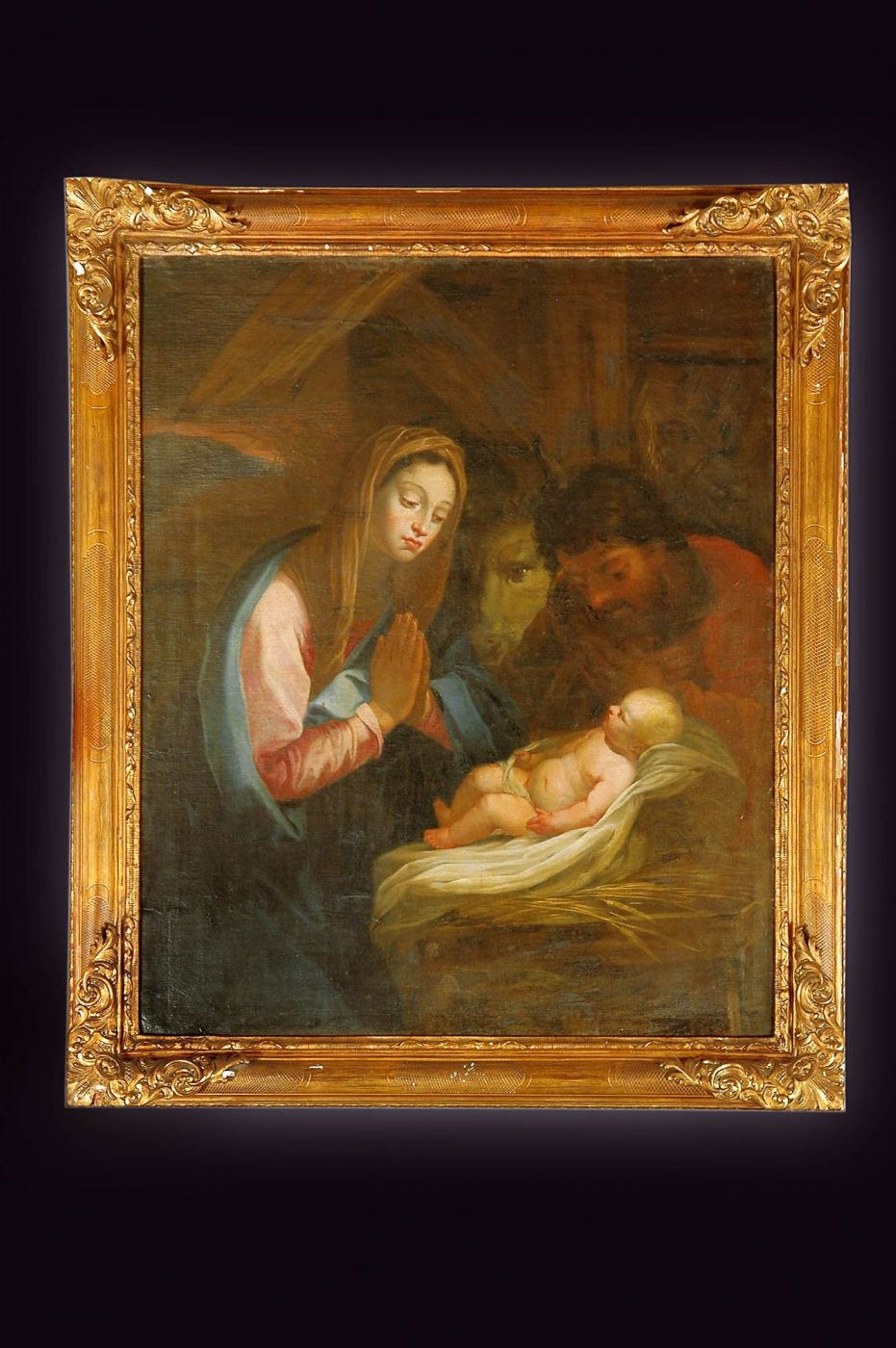
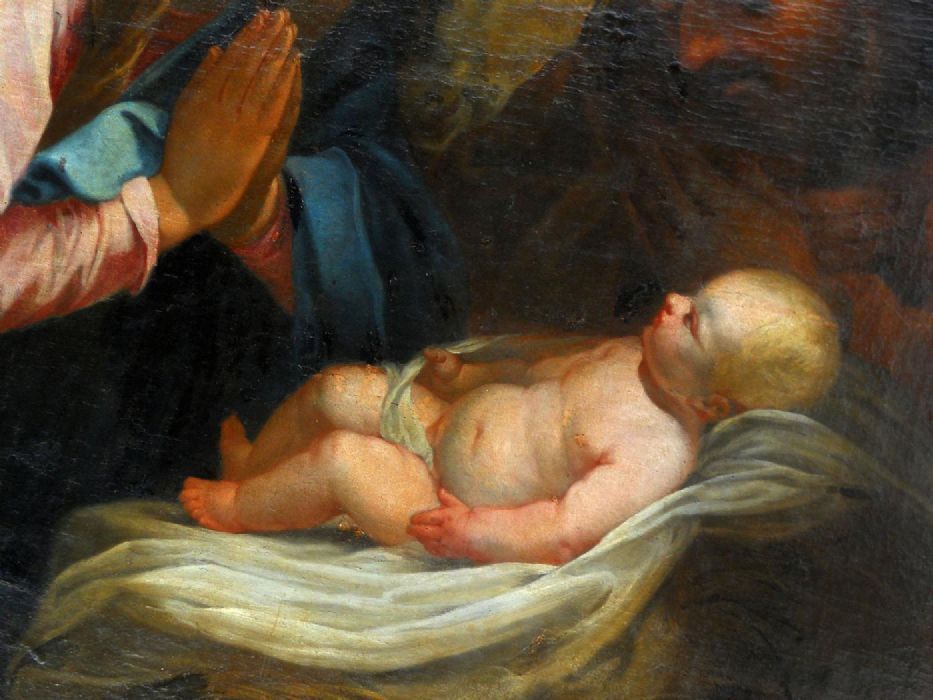
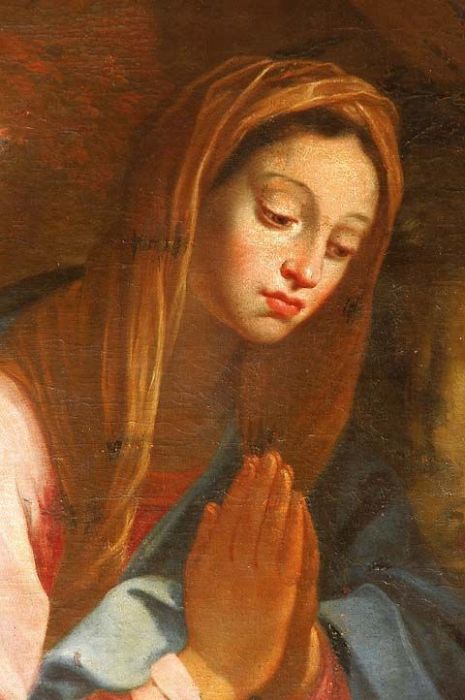
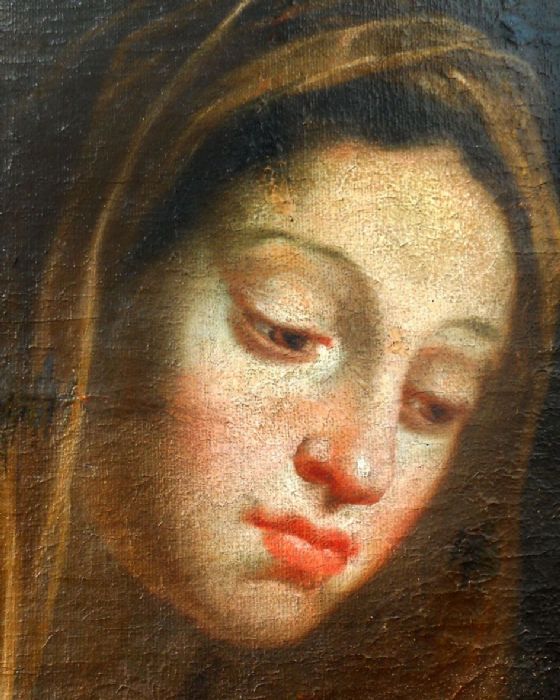
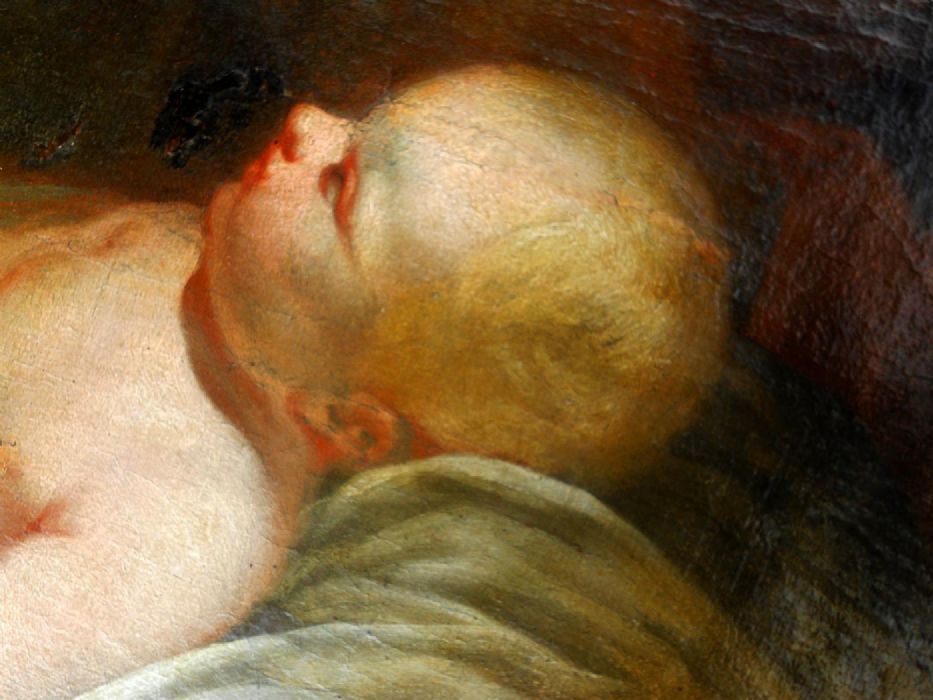
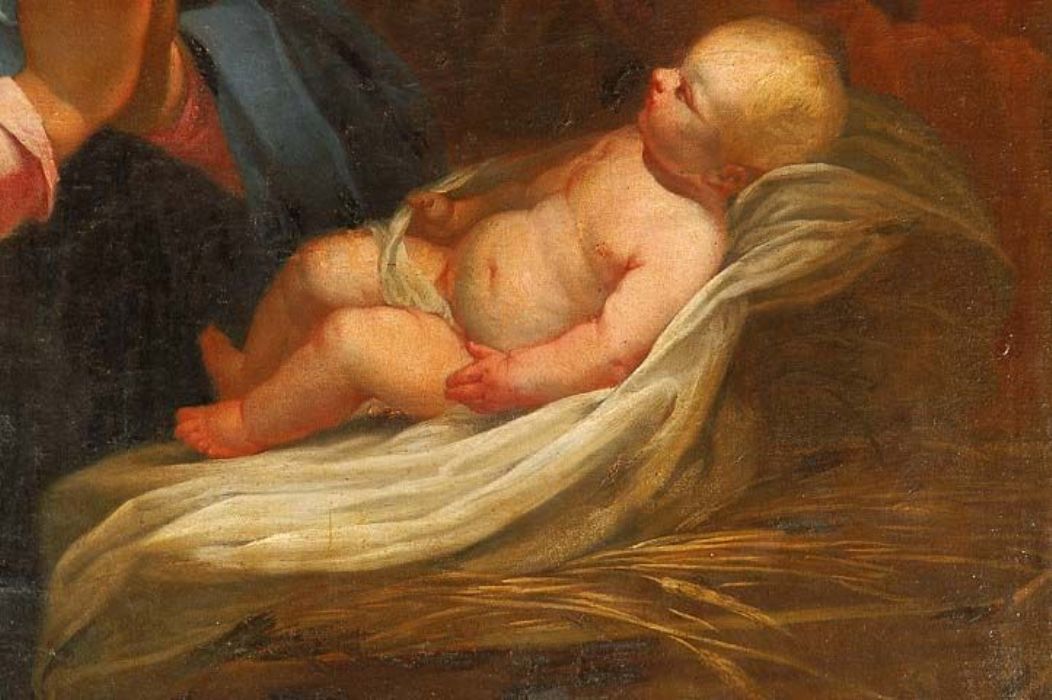
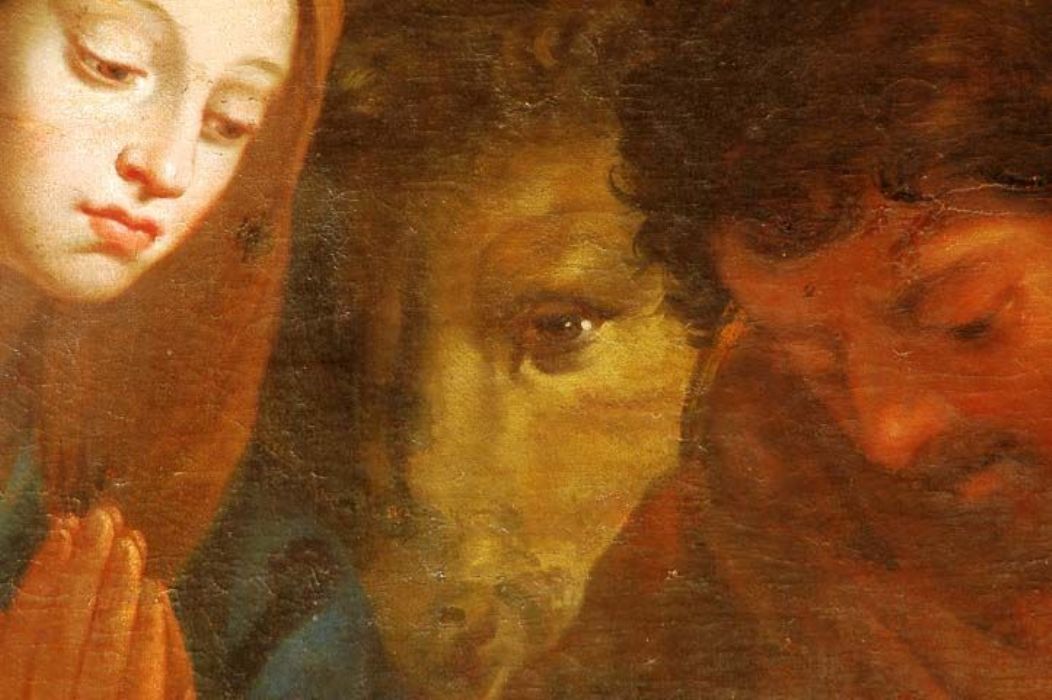
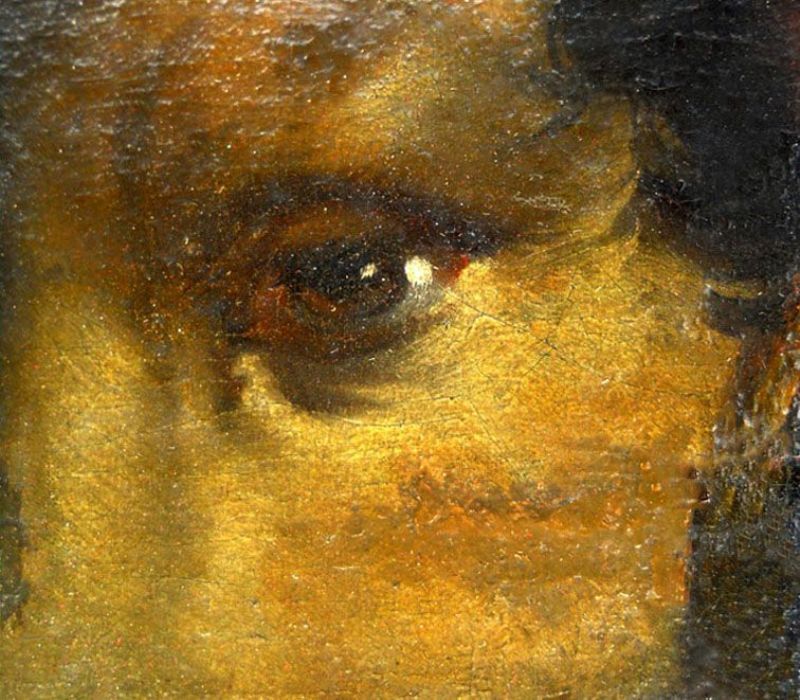
Francesco Trevisani (Capodistria, 1656 - Rome, 1746) and school (attr.) - Important work of great expressive force, rich in refined mysticism made evident by the evangelical simplicity of the composition. The diaphanous candor of the Child, delicately laid on a bed of wheat, which contrasts with the dark colorism and evident maturity of Saint Joseph, has an extraordinary emotional impact. The turgid eye of the ox is derived from Caravaggio (see, in this regard, the eye of the mule in Caravaggio's famous "Rest on the Flight into Egypt" kept at the Doria Pamphili museum in Rome). The Madonna appears here, in accordance with the dictates of the innovative masters of Baroque painting of the mid-seventeenth century, as a common "woman in prayer", in ecstasy before the renewed miracle of the Nativity of Our Lord in the magical atmosphere of an everyday Christmas.
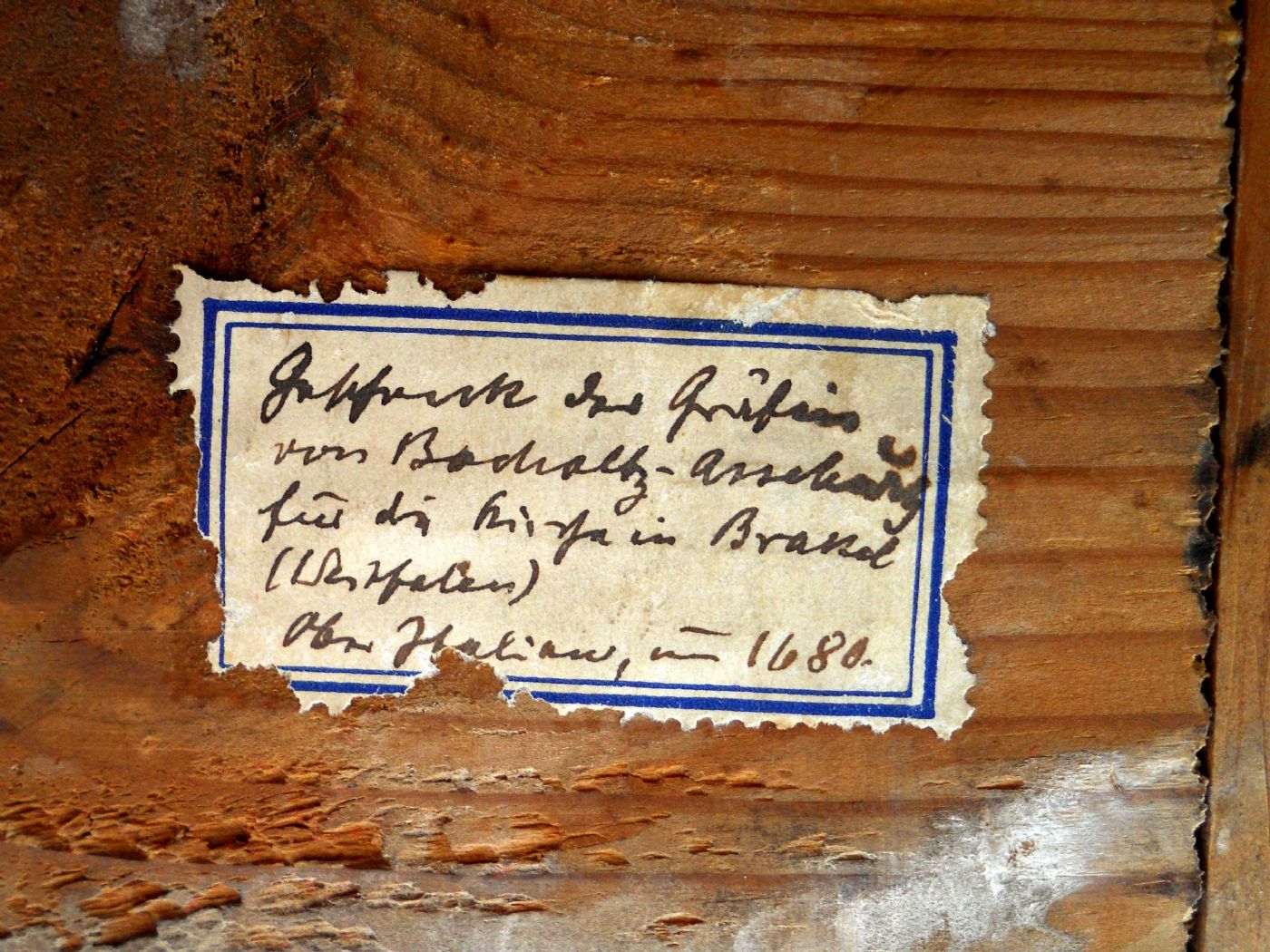
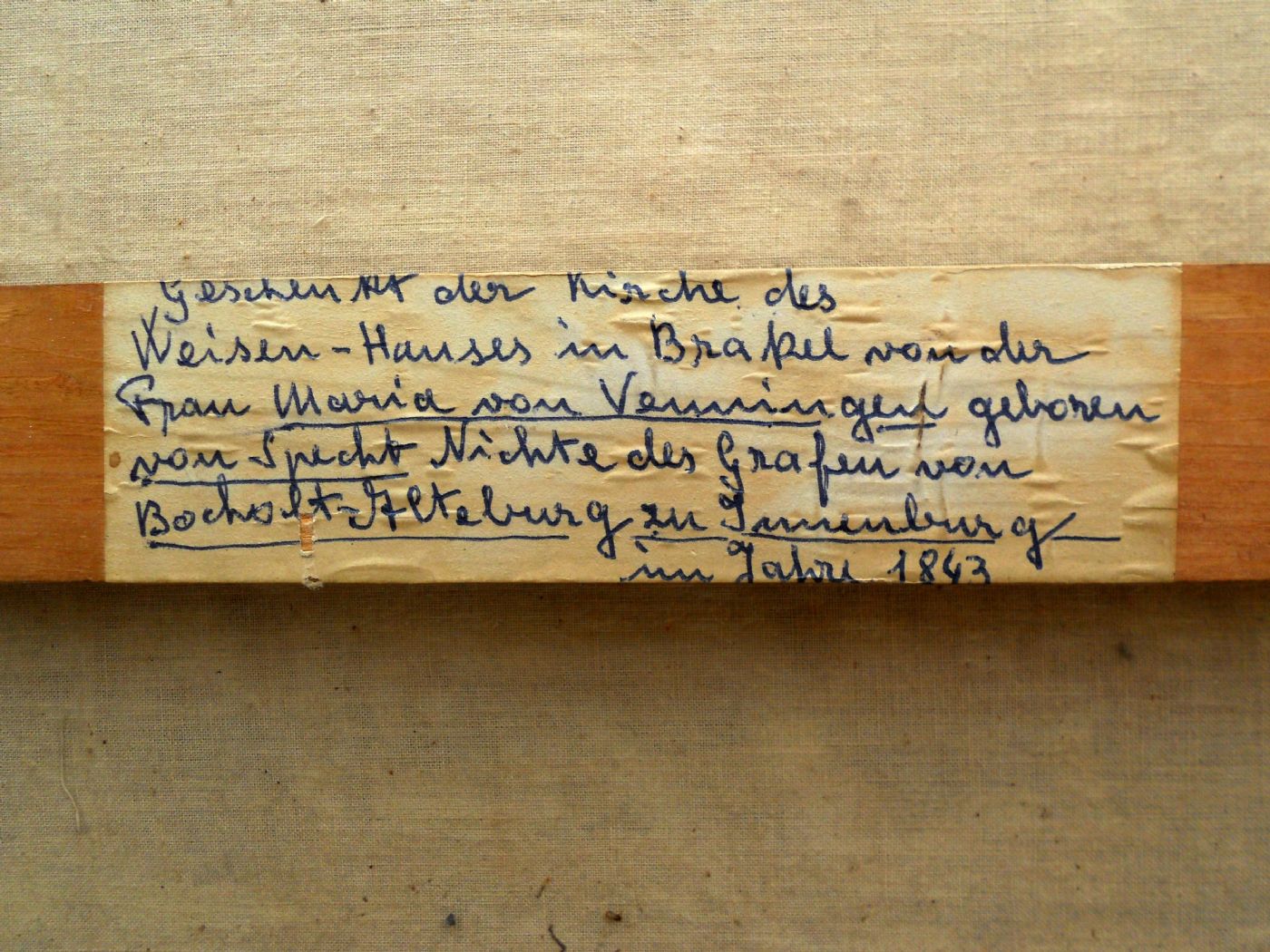
Oil on canvas in an antique carved and gilded frame. On the back, two labels bear, written by an ancient hand, the dates of 1680 and 1843, with dedications from families of the German aristocracy, including the von Bocholtz (Bocholt) counts of Westphalia.
Measurements with frame: height cm. 150 - width cm. 127
(cm. 132 x cm. 110 the canvas)
Italy
Period: 17th century.
A pupil of Antonio Zanchi in Venice, Francesco Trevisani arrived in Rome, where his career took place entirely, in 1678. His mentor was the Venetian cardinal Pietro Ottoboni, nephew of Alexander VIII, one of the most important patrons of the time (the young Filippo Juvarra and composers of the caliber of Arcangelo Corelli, Alessandro Scarlatti, and Georg Friedrich Händel were also under his employment).
In Rome, Trevisani became one of the most important artists who continued in the wake of Carlo Maratta, as is evident in the frescoes of the chapel of S. Chiara in San Silvestro in Capite and in the three paintings with Stories of the Passion of Christ in the chapel of the crucifix of the same church (1696 - 1697), in the cartoons for the mosaics of the baptismal chapel of the Basilica of San Pietro (where he succeeded Baciccio in 1709), in the oval with the prophet Baruch for San Giovanni in Laterano (circa 1718), in the altarpiece with the Death of St. Joseph in the Sacripante chapel at Sant'Ignazio, in that with the Ecstasy of St. Francis in the Church of the SS. Stimmate of San Francesco, and in the Feast of Cleopatra in the Galleria Spada.
Trevisani also created the altarpiece, depicting the Madonna with Child and Saint Anthony, on the high altar of the Basilica of Our Lady and Saint Anthony in Mafra, Portugal.
Characteristic of Trevisani's painting is languid sentimentalism, with the seventeenth-century pathos that fades into elegy. It is no coincidence that the artist (who was also a poet) was affiliated with the Accademia dell'Arcadia.