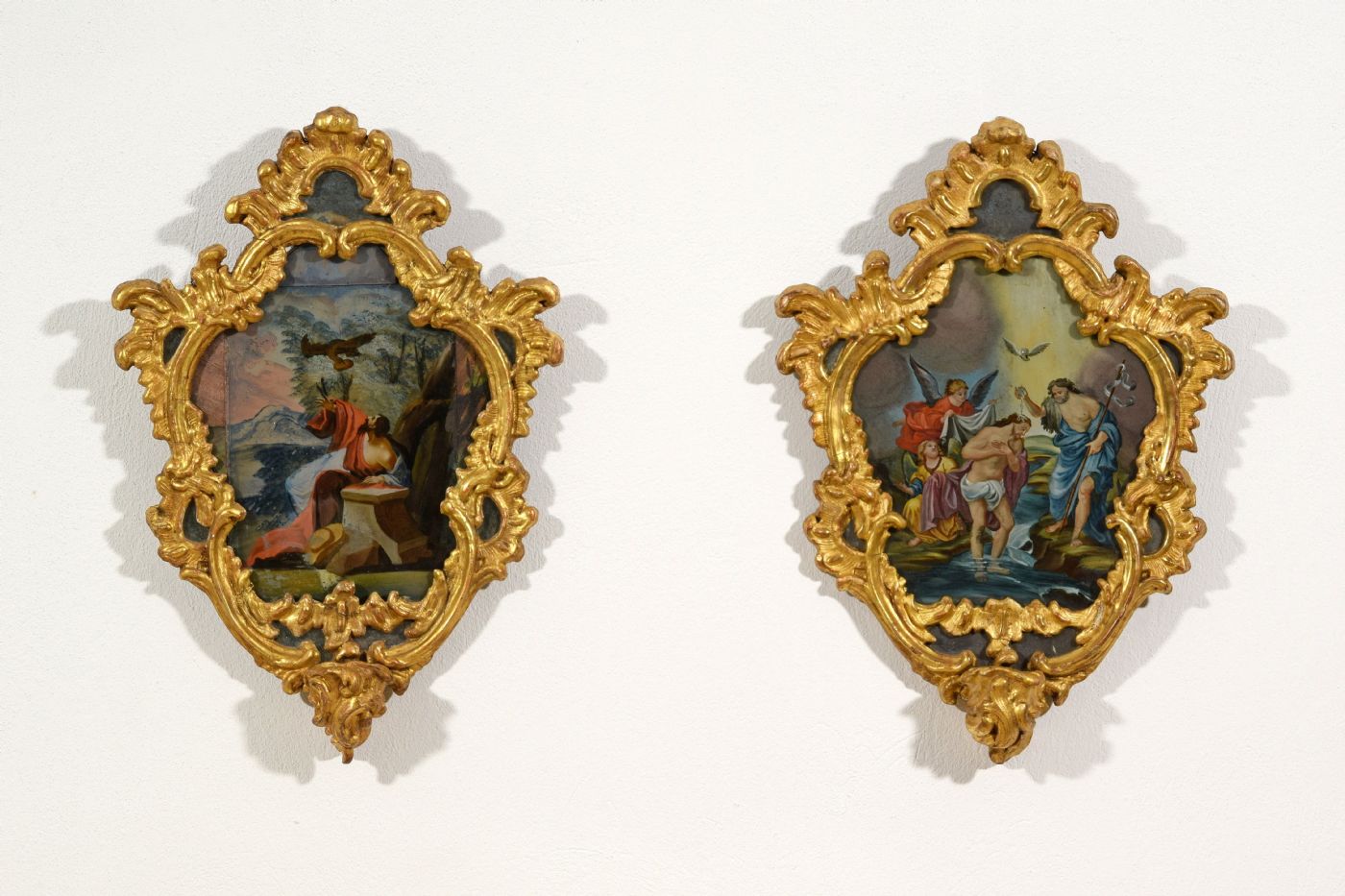
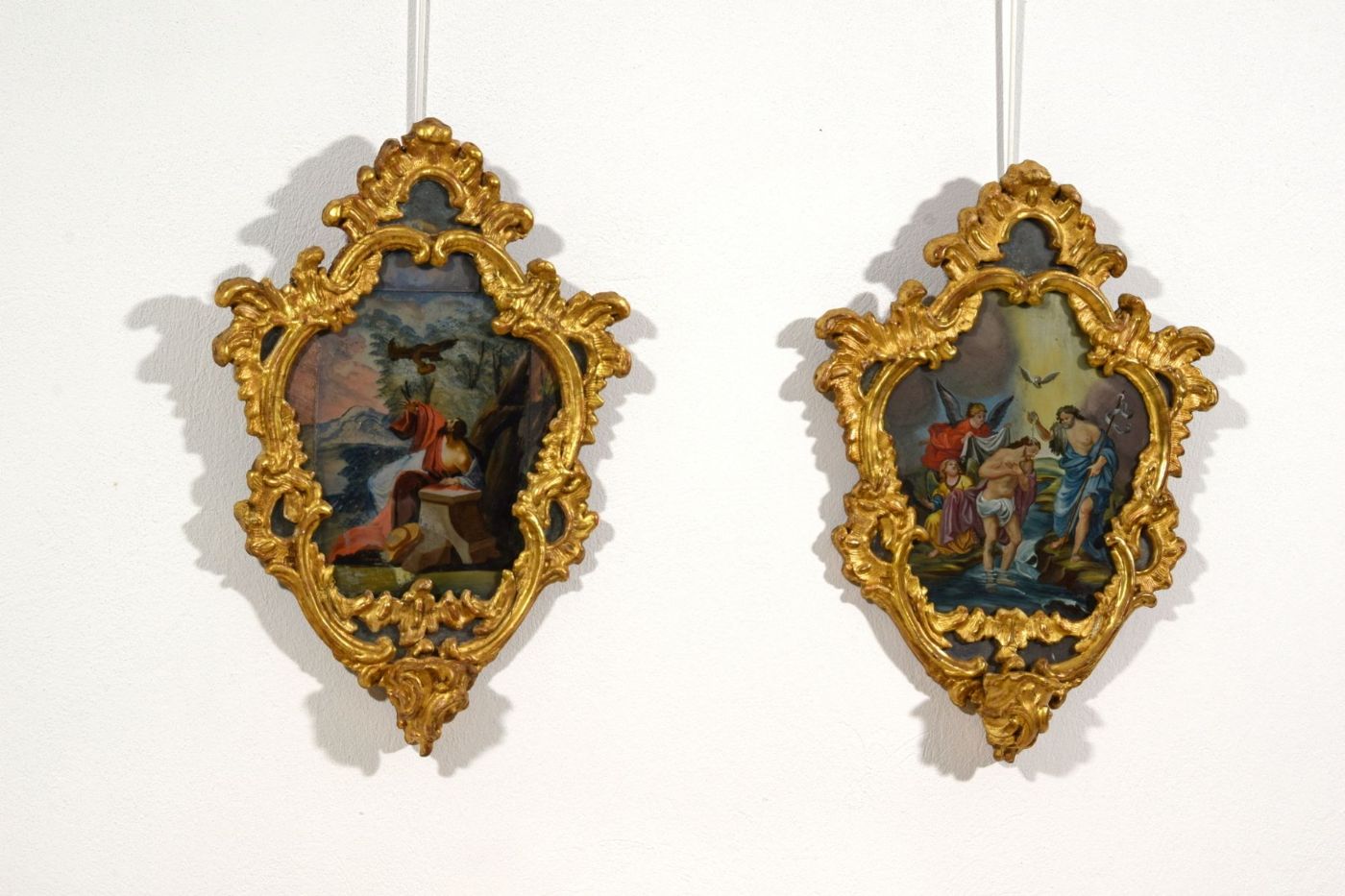
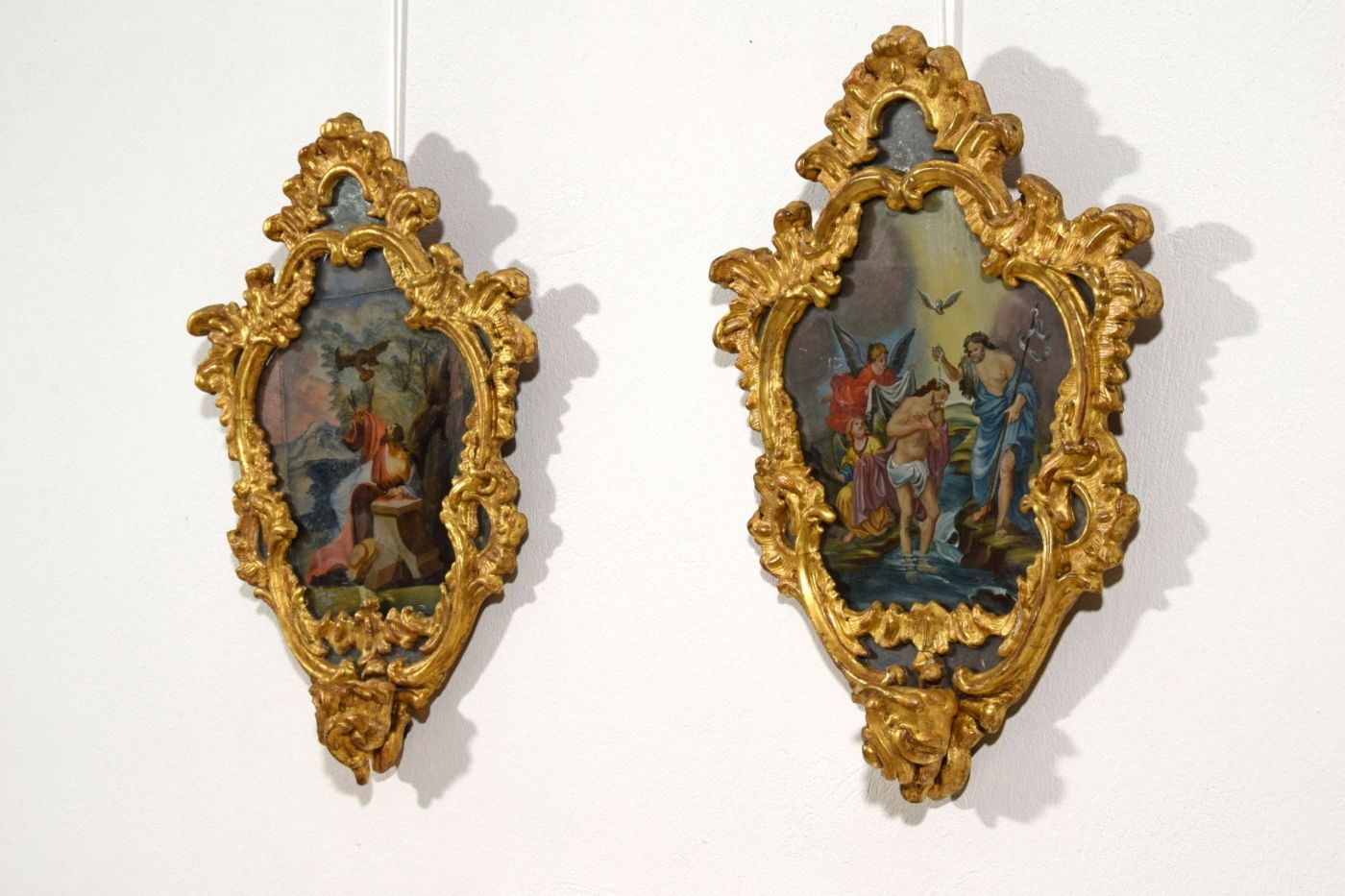
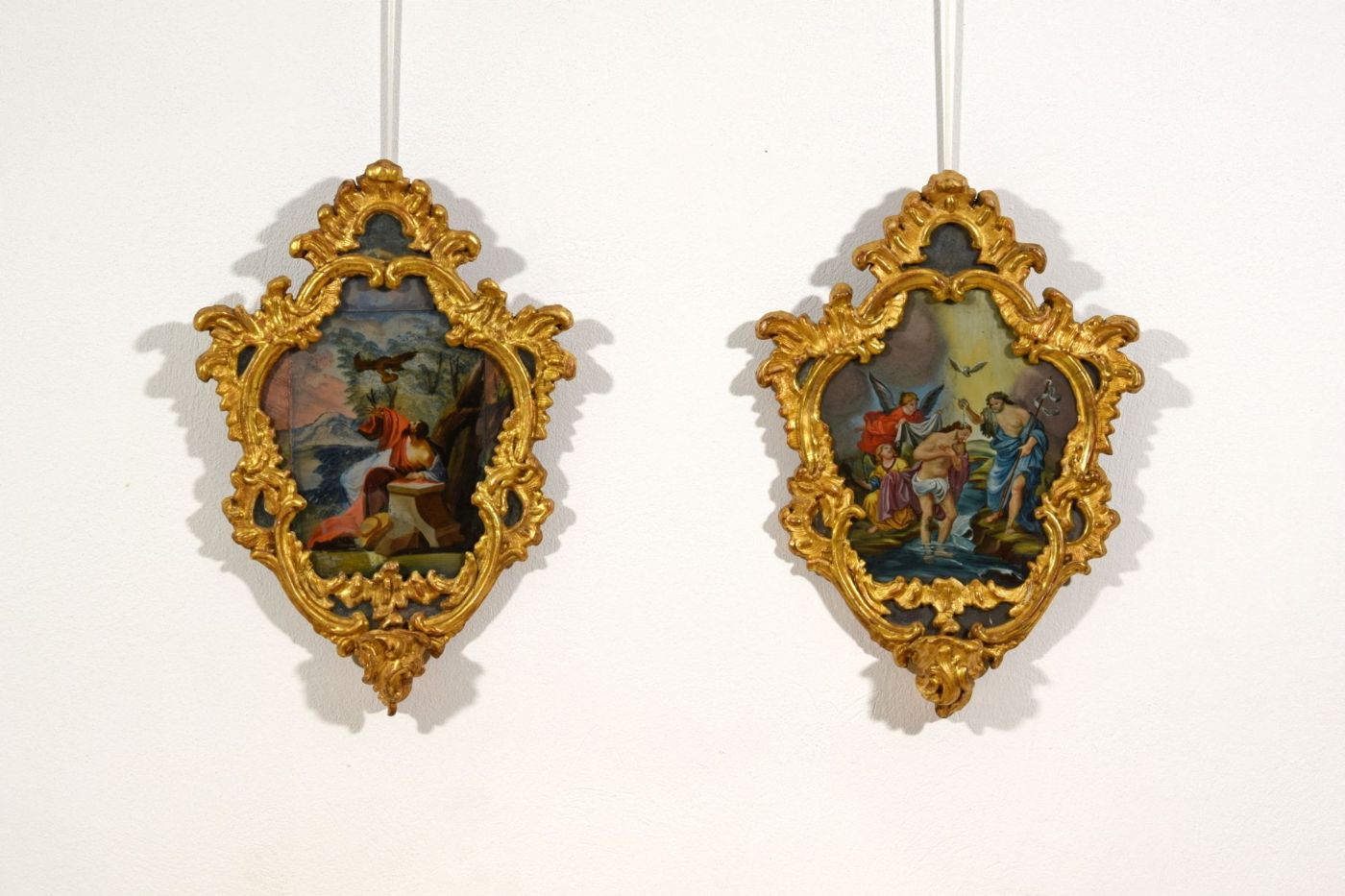
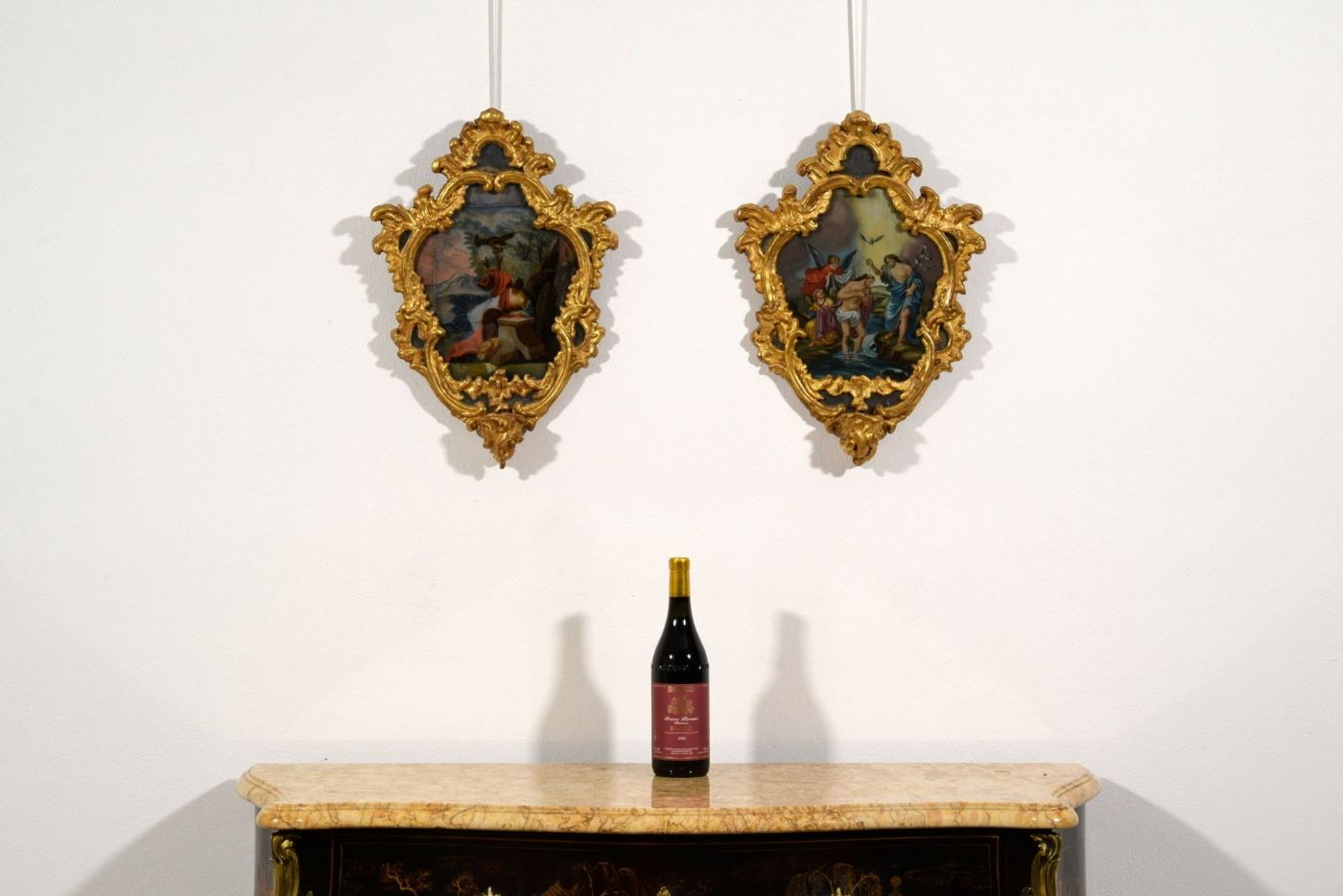
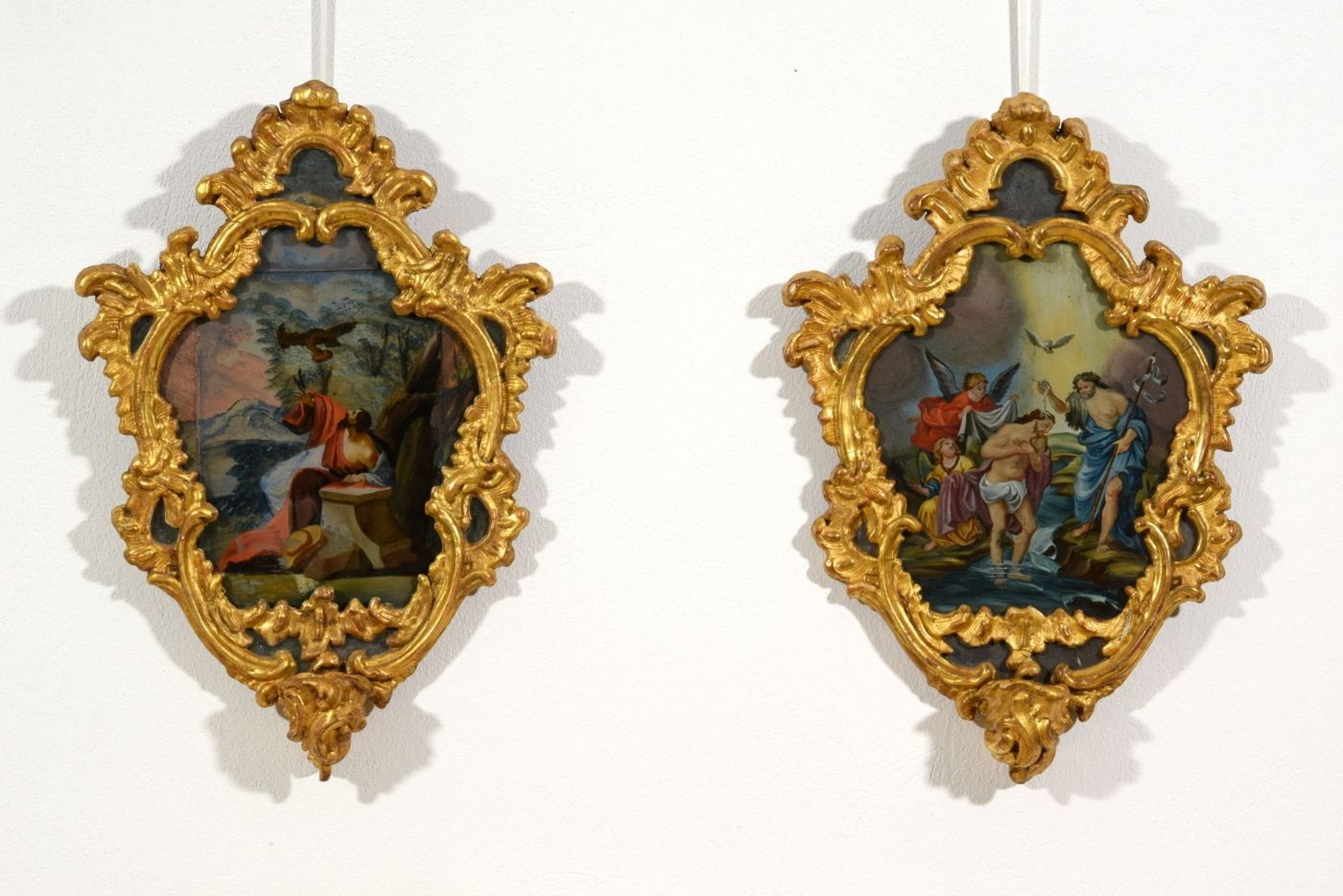
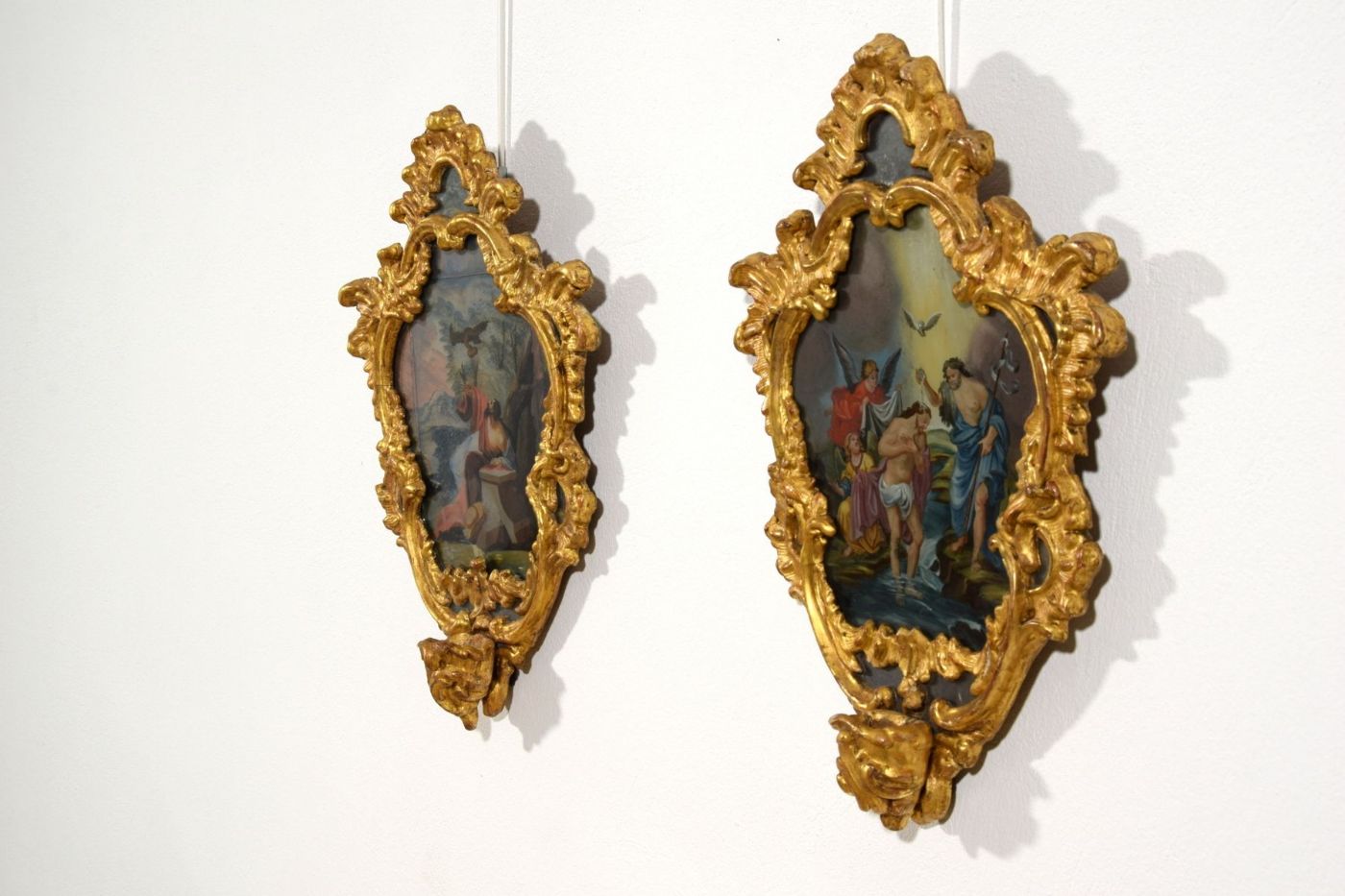
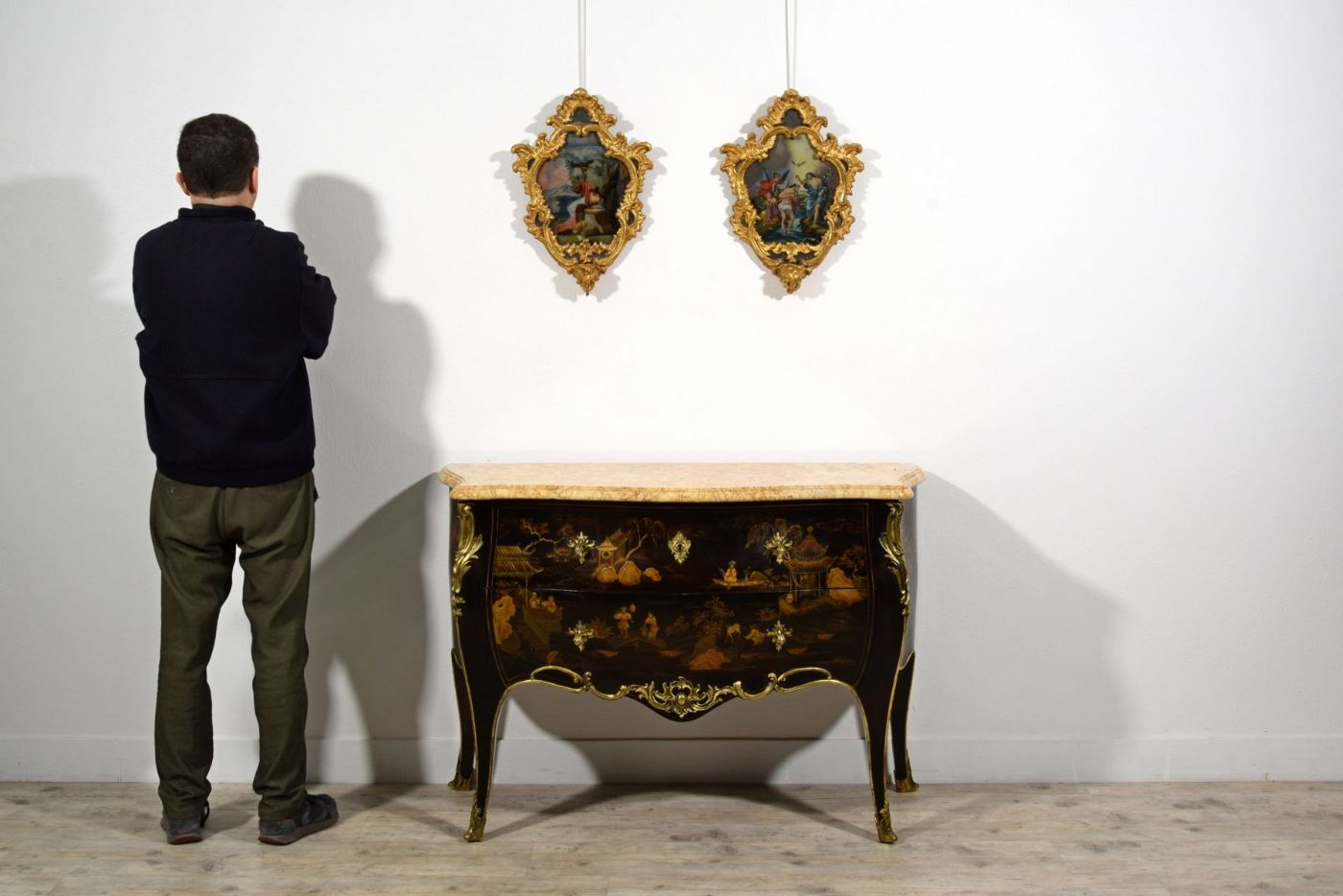
Michele Antonio Milocco (Turin, 1690 – Turin, 1772), Elijah Fed by Ravens and the Baptism of Christ
Oil on glass, Dimensions: cm H 51 x W 37 x D 9
Price: private negotiation
Accompanied by our certificate of authenticity and expertise (downloadable at the bottom of the page)
This precious pair of paintings was created using oil paint on glass and is presented within Rococo-style mirrors, made of finely carved and gilded wood, dating back to the mid-18th century and produced in Piedmont. The two paintings depict the biblical scenes of Elijah Fed by Ravens and the Baptism of Christ, respectively, and stylistically can be attributed to the Turin-based painter Michele Antonio Milocco (Turin, 1690 – Turin, 1772), who in his mature years, alongside large fresco decorations, also produced more intimate works intended for private devotion and noble residences. The choice of glass as a support, with its very luminous and precious effect, perfectly complements the rocaille taste of the gilded frames, which enclose the scenes like true wall treasures. The difficulty of painting on glass lies in the different fluidity of the brush on the smooth glass surface compared to canvas, and in the execution, which must be done in reverse and mirrored. The painting is therefore protected by the glass itself, which is set within the frame.
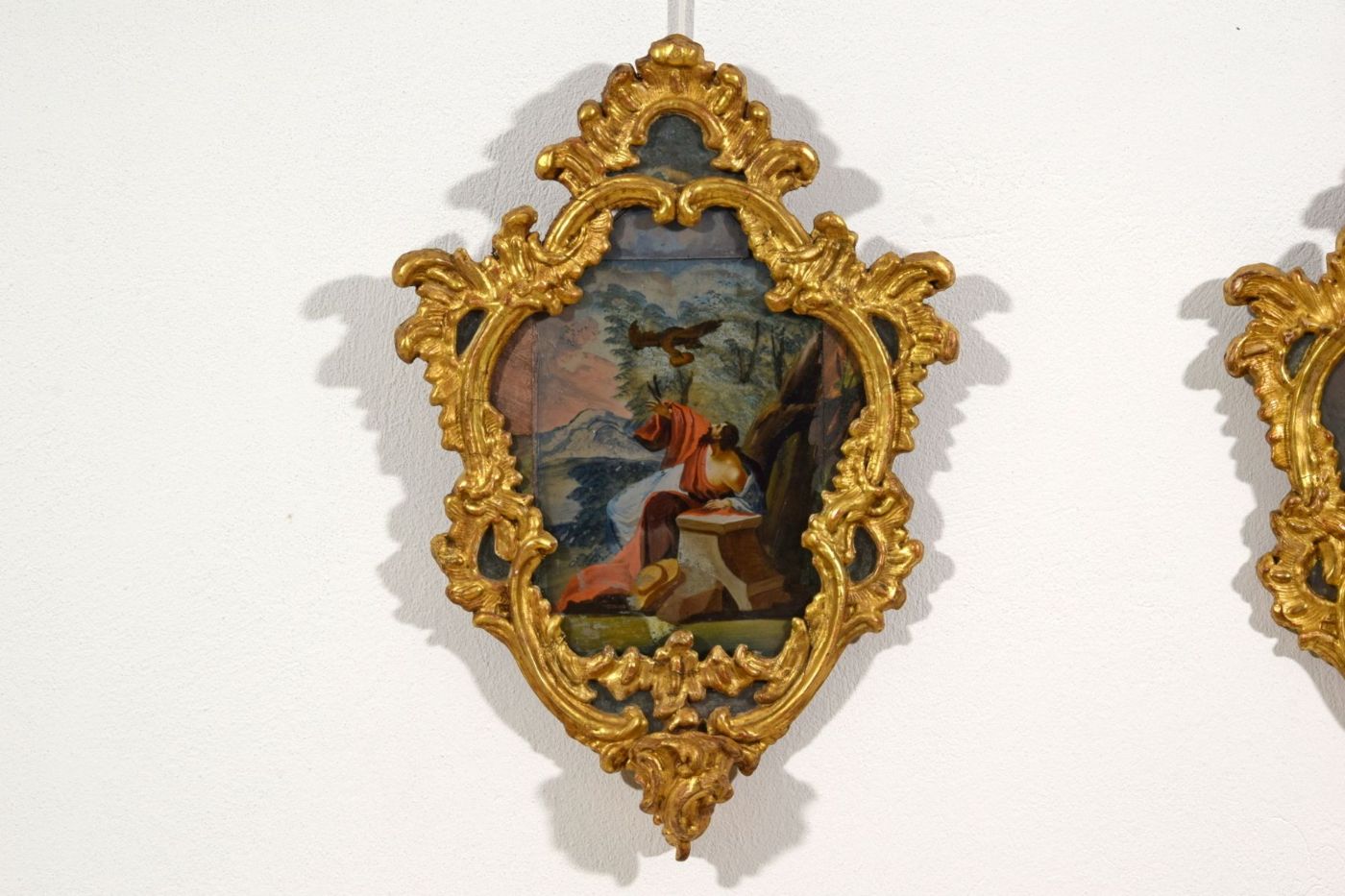
The episode of Elijah Fed by Ravens is narrated in the First Book of Kings, chapter 17, verses 1-7. After announcing a long drought to King Ahab, the prophet Elijah receives orders from God to take refuge by the brook Cherith, east of the Jordan. God promises Elijah that he will drink water from the brook and that ravens, at His command, will bring him food. The prophet obeys and settles by the brook, where he will receive bread and meat from the ravens every day, in the morning and in the evening. In the painting with Elijah, the artist emphasizes the moment of trusting suspension: the prophet, seated on a rock, in a red tunic and a light mantle that reveals a shoulder, raises his arm towards the raven bringing him bread. The mountainous and stylized landscape, with a solitary tree and an open sky, does not aim for precise naturalism but rather for a theatrical desert atmosphere, functional to the narrative. Here, the mediation of an engraving source is clearly felt, finding parallels with the print by Charles Grignion (1721–1810). Milocco interprets it with a softer line, using warm colors with sharp contrasts, and adapting the model to the optical requirements of oil on glass.
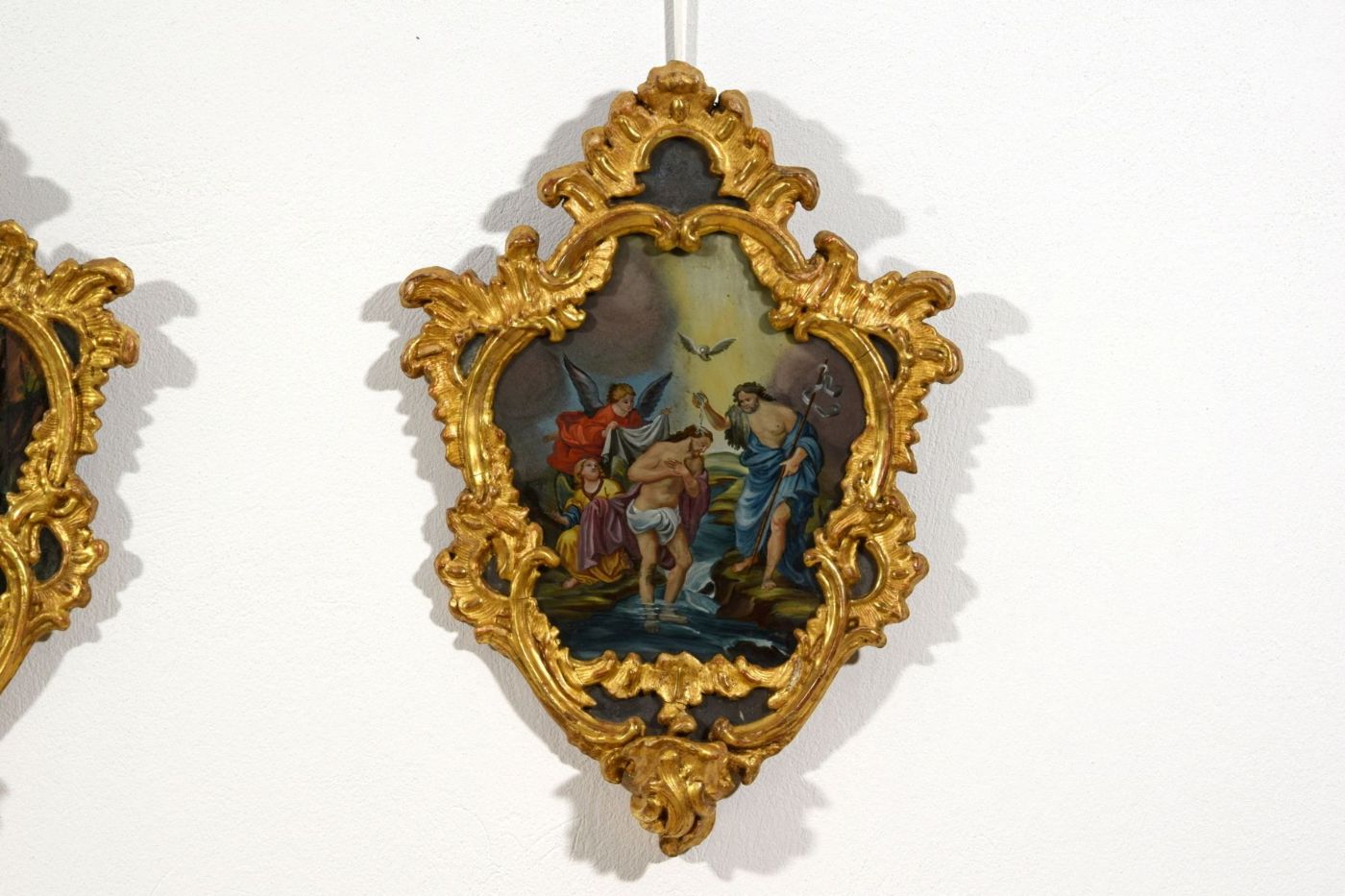
The episode of the Baptism of Christ is narrated in the Synoptic Gospels of Mark (1:9-11), Matthew (3:13-17), and Luke (3:21-22). Jesus went from Galilee to the Jordan River, where John the Baptist was preaching the advent of the Kingdom of God and administering baptism for the remission of sins. As soon as Jesus was baptized and came up out of the water, a manifestation of the Trinity occurred: the heavens opened, the Holy Spirit descended upon him in the form of a dove, and a voice from heaven was heard proclaiming: "You are my beloved Son; with you I am well pleased." This moment represents the public revelation of Jesus as the Son of God.
In Milocco's painting, the inspiration from a model by Pierre Mignard is evident in the pyramidal construction of the scene: Christ in the center of the river, slightly leaning as if receiving water, St. John on the bank with his crossed staff, the group of kneeling angels on the left, and, above, the celestial opening from which the dove of the Holy Spirit descends, enveloped in a cone of light. Pierre Mignard (Troyes 1612 – Paris 1695), a portraitist and history painter, was summoned to Paris in 1657 by Louis XIV, who had him work at Versailles and, upon Le Brun's death in 1690, appointed him First Painter to the King. In 1666, he painted a Baptism of Christ for the majestic high altar of the church of Saint-Jean-au-Marché in Troyes, where he was baptized. In 1667-1668, Mignard created frescoes for the walls of the baptistery chapel of the church of Saint-Eustache in Paris, the most noble and prestigious church in the capital. The painter decorated them with a copy of his first Baptism of Christ and a Circumcision, as a pendant. These wall paintings were unfortunately destroyed around 1750 during the construction of a new portal for the church. However, like many famous works, the Parisian Baptism of Christ was widely reproduced by engravers, including the one offered here, printed by Nicolas Bazin and chosen as a source by Milocco. The comparison of the painting from Troyes with the engravings shows the variations the painter introduced between the two versions: while the postures of John the Baptist on the bank and of Jesus, with his feet in the Jordan, remain similar, in the second version, the second angel waits with a white cloth to wrap Jesus when he comes out of the water. The groups of putti observing the scene, one of which has been significantly altered, are also inverted in the Paris painting. The work for Saint-Eustache, precisely because of its distribution through engraving, is the source for numerous paintings created, which contributed to the dissemination of this iconography based on this model, which would achieve immense success.
Read together, the two subjects outline a theological progression that is not accidental. On one hand, Elijah, the prophet miraculously fed in the desert, an emblem of absolute trust in Providence; on the other, the Baptism, the threshold of new life in Christ, the moment when heaven opens and the divine voice recognizes the beloved Son. The thread that seems to unite the two panels is precisely the action of God: in the bread brought by the raven and in the water of the Jordan that washes and consecrates. In a domestic setting or a small chapel, for which the two paintings were likely intended, this pair could have supported meditation on spiritual nourishment.
From a stylistic point of view, the works, dating to the mid-18th century, show the quality of a sure hand: despite the limitations imposed by the format and the support, the painter controls anatomy and drapery well, balances movement without excess, and maintains a certain elegance of line. Comparisons with the artistic output of Michele Antonio Milocco (Turin, 1690 – Turin, 1772) are significant. The painter is already known for a fresco in Asti, depicting the Baptism of Christ with a completely similar composition, created in collaboration with the Giovannini brothers for the trompe-l'oeil frames. For this painting as well, he appears to have used Mignard's source, although with greater variations, adding some invented details, including God the Father, putti and cherubs, and a lamb. A canvas with a similar subject, dating to around 1730, is preserved in the church of San Giovanni Battista in Racconigi (TO), where Milocco again uses the same composition with further design freedom. Michele Antonio Milocco was one of the leading Piedmontese painters of the 18th century, active mainly for the Savoy court and for churches in the Turin and Moncalieri areas. The son of the court cook Carlo Vercellino, in the service of Prince Emanuele Filiberto Amedeo of Savoy-Carignano, Milocco grew up in the refined environment of the court, which facilitated his early contacts with the art world. From 1710, he is documented in Rome, where he attended the Accademia di San Luca and won first prize in the Clementino Competition for the second class of painting, aligning himself with the classicist climate revolving around Carlo Maratti. In 1719, he is still in Rome as a painter for Prince Doria Odescalchi, before returning permanently to Piedmont. Returning to Turin around 1720, Milocco soon received commissions related to the Savoy environment, working both in royal residences and on important ecclesiastical projects. In 1729, he was prior of the Accademia di San Luca in Turin, a position that attests to the recognition of his leading role in painting in the Kingdom of Sardinia, and which he would hold again in 1760. Between the third and sixth decades of the 18th century, he was engaged in works of various magnitudes for court residences, sometimes completing interventions directed by the first court painter, Claudio Francesco Beaumont. From 1740, he also worked for the Teatro Regio in Turin, decorating the royal box and the curtain in collaboration with Sebastiano Galeotti (replaced in 1756 by work from the brothers Bernardino, Fabrizio, and Giovanni Antonio Galliari). Numerous altarpieces documented and attributed to him are spread throughout the Turin and Cuneo regions. Milocco also distinguished himself as a fresco painter of great scope, active particularly in royal residences and churches in Turin, Asti, Moncalieri, and throughout Piedmont. Among his most significant interventions are the frescoes for the church of San Carlo Borromeo in Turin (from 1732), the vault of the Gabinetto presso il Pregadio della Regina in the Royal Palace, and, above all, the decoration of the Palazzina di Caccia di Stupinigi, where he frescoed the king's chamber with a famous secular subject related to the myth of Diana. He was also active in numerous churches in the Moncalieri area (Annunziata, Santa Croce, Gesù, Santa Maria di Carpice), often in dialogue with quadratura painters, consolidating a late Baroque style updated to Rococo trends but rooted in Roman classicism. To quickly satisfy varied commissions, Milocco developed a consolidated repertoire of compositional solutions that he constantly replicated using the same cartoons, applying only minor variations. He is recorded as being in Asti from around 1731-33 for the frescoes in the chapel of S. Francesco di Sales in the cathedral. Around 1750, he collaborated with the Giovannini on the Annunciation, and in 1760 on the Trinity. Milocco married twice: first to Elisabetta Maria Martini (deceased after 1752) and on April 23, 1766, to the painter Anna Maria Pittetti, known as Palanca. He died in Turin on August 7, 1772.
The works under study testify to a chapter of his "chamber" production, which demonstrates the circulation of French and English models in the Piedmontese sphere and the painter's ability, with easy artistic skill, to translate them into refined devotional objects. The paintings are particularly decorative and pleasing, both for the luminosity and carving of the gilded frames and for the chromatic palette used by the painter, which is saturated and lively.
In good condition, it should be noted that the glass of the work depicting St. Elijah has probably been enlarged to fit the frame's profile and subsequently completed with paint at a later time.
Carlotta Venegoni