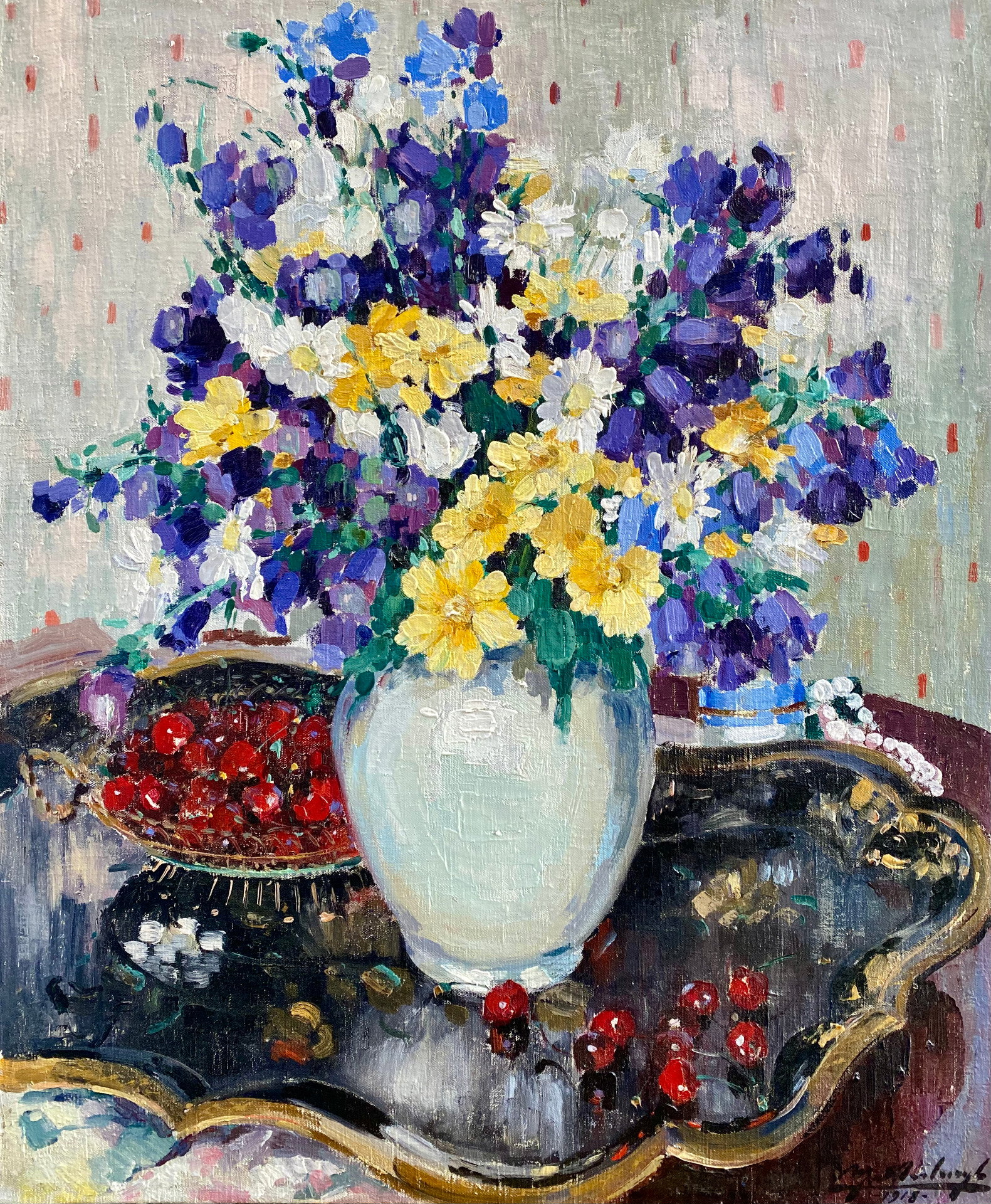
Certificate of authenticity.
Medard Verburgh (Roulers, Belgium 1886 - Uccle, Belgium 1957)
Signed lower right: m. verburgh
Dated 1918
"Vase of flowers with cherries"
oil on canvas (65 x 78 cm)
Heir to the great Flemish painting of the 17th and 18th centuries, Médard Verburgh retained a genius for observation, a joy of color, and a love for matter, offering a realism that was sometimes brutal but powerfully effective!
He knew how to establish himself with a sincere and simple way of painting, an intense expression of the images he perceived of life, considering the rhythm of forms one of the essential elements of his research.
Robert de Bendère wrote:
« In his vast and simple studio, the painter works without haste, by no means seeking to seduce with mass-produced works or experiments of commercial value. Whether it is a nude, a still life, a landscape, or a figure, he remains the vibrant, profound, sincere, and curious colorist capable of giving us moving and real works. »
Painter, watercolorist, draftsman, and engraver, he first trained at the Academy of Roulers under the guidance of G. Pieters and G. Vallays (1905-1907), then at the Academy of Brussels with Constant Montald (1907-1911).
In 1910, at just 24 years old, Verburgh participated in the Belgian Art Exhibition as part of the Brussels Universal Exposition at the "Palais du Cinquantenaire".
During that period, he frequented the "Atelier libre de l'Effort," a vibrant artistic circle where young unconventional painters sought to find a new language to regenerate art. In this context, Verburgh met Auguste Oleffe, who encouraged him to paint freely, following his own instincts. The artist became aware of the autonomous power of color and experimented with the absence of realistic contour.
This path formed the basis of the research of the "Fauvistes brabançons".
Verburgh then moved from a neo-impressionist style that characterized his early works such as "La Gare du Luxembourg sous la neige" to a painting based on plastic forms, the power of line, and the architectural value of color.
Around 1910, after receiving the "Prix Godecharle," Verburgh visited Italy, from which he brought back numerous sketches that clearly demonstrate the artist's strong personality. He painted our beautiful country as a vigorous Fleming, surpassing the mere aesthetic aspect of the landscape to convey paintings with a sensual and profound soul.
His "Impressions d'Italie" were noticed at the 1910 Triennial.
The exhibition of a collection of his works at the "Galeries Barbazanges" in Paris was an occasion to highlight his talent and sensitivity.
French critics warmly welcomed his paintings, particularly appreciating the warm and vibrant color of his landscapes and still lifes.
"We see how skilled the artist is in composition, how he knows how to translate that human side of "still life" and how he often achieves fullness and sometimes a masterpiece, while remaining sincere with his reasoning."
From 1922 to 1927, he stayed in Ostend where he met J. Ensor and C. Permeke.
From 1929 to 1931, he lived in New York, then in Ibiza and the Balearic Islands.
In 1932, the works he created in America and Spain were presented in an exhibition organized by the famous Galerie Georges Giroux in Brussels.
In 1948, he returned definitively to Brussels where he participated in various exhibitions of the Cercle Artistique.
The artist died in 1957 at the age of 71.
The retrospective organized by the Ixelles Museum in 1968 and numerous other tributes to the artist demonstrate the greatness of his art.
The critic Stéphane Rey wrote:
« The artist has always avoided the excesses of imagination and the excesses of matter. He is wise, sensitive, reflective. His tone is measured, simple, without flashy brilliance, and he loves the beautiful, clear light that caresses things. »
Robert de Bendère concluded the artist's monograph by writing:
“Médard Verburgh will remain in the annals of Flemish art as an elite painter, a particularly gifted talent who contributed significantly to the personality of our art in Europe.”
Description:
The painting described here depicts an imposing vase of flowers placed on a tray next to cherries.
The extraordinary expressive power of the still life derives from the color, applied in dense brushstrokes in some areas, and thinly on the canvas in others, through which the artist creates bold juxtapositions that enhance each other reciprocally.
In the center of the painting, the textured white of the vase, echoed by the bright daisies and the pearl necklace, illuminates the entire composition, further strengthening the visual impact of the scene.
Museums and Public Collections:
Royal Museums of Fine Arts of Belgium, Brussels
Crédit Communal de Belgique,
Caisse Générale d’Epargne et de Retraite,
Communal Museum of Fine Arts of Ixelles,
The New York, Buffalo, The Brooklyn Museum – New York,
Indianapolis Museum of Art – Indianapolis,
Consell Insular de Mallorca,
Fundación Bartolomé March Servera, Palma de Majorca.
Bibliography:
Serge Goyens de Heusch
« Médard Verburgh 1886-1957 »
Ed. Lannoo, Tielt, 1994.
Robert de Bendère
« Médard Verburgh »
Les Editions d’Art. Jos Vermaut, Paris. (c.1920)
E. Bénézit
« Dictionnaire des peintres, sculpteurs, dessinateurs et graveurs »
Ed. Grund vol.10 (p.444)
Serge Goyens de Heusch
"L'impressionisme et le Fauvisme en Belgique"
Ed. Fonds Mercator Albin Michel (p.316, 331, 341, 346, 351, 364, 386, 398, 406, 416, 417, 433, 442, 444)
Paul Piron
« Dictionnaire des Artistes Plasticiens de Belgique des XIX et XX siècles »
Ed. Art in Belgium Vol.2 (p.716)
ARTO
"Dictionnaire Biographique Arts Plastiques en Belgique"
(p.442, 445)
Condition:
excellent