Certificate of authenticity.
Rodolphe Paul Wytsman (1860-1927)
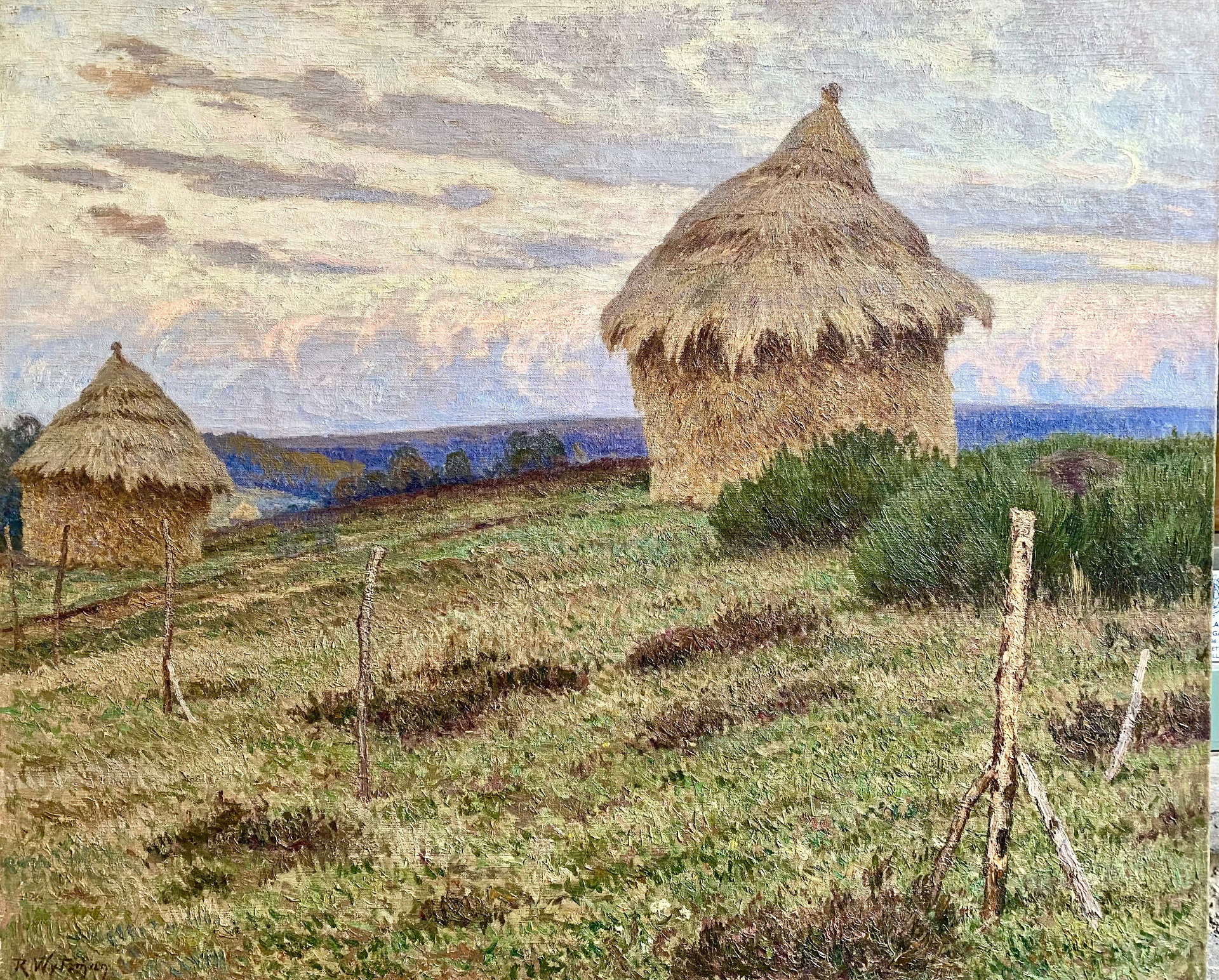
"The Golden Fields (Evening in Brabant)"
Oil on canvas 119.5 x 100.5 cm
Signed lower left: R.Wytsman
Rodolphe Paul Wytsman, painter, pastel artist, draftsman, watercolorist, and etcher, was born in Termonde (East Flanders) on March 11, 1860, and died in Linkebeek (Flemish Brabant) on November 2, 1927.
He was a student of Jean Capeinick, Th. Caneel, and J. De Keghel at the Academy of Fine Arts in Ghent (1873-75), then studied with J. Portaels, J. Stallaert, and J. Van Severdonck at the Royal Academy of Fine Arts in Brussels, where he came into contact with the L'Essor circle attended by Henri Permeke, James Ensor, and many other artists.
In 1883, he was one of the founding members of the avant-garde artistic group: "Les XX." He later became a member of "La Libre Esthétique."
"La Société des Vingt," abbreviated "Les XX" (1883-1888), was an association founded on October 28, 1883, composed of Belgian artists or artists residing in Belgium, including Fernand Khnopff, Théo van Rysselberghe, James Ensor, Rodolphe Wytsman, and the siblings Anna and Eugène Boch.
The group did not have a president. The secretary was the lawyer Octave Maus; his wife Madeleine Octave Maus (1874–1944) assisted him and organized the exhibitions. The objective was to promote new and unconventional art. In addition to concerts and readings, the group organized an annual exhibition in Brussels, to which members invited an equal number of other participants. They did not adhere to a specific aesthetic theory or trend but were open to all innovative currents.
The merit of "XX" lies in its early recognition of the importance of numerous artists who would become famous and in offering them a platform for visibility.
Among the guests at the first exhibition in 1884 were Auguste Rodin, John Singer Sargent, and James McNeill Whistler. In 1887, Georges Seurat, Berthe Morisot, and Camille Pissarro were invited, among others. In the autumn of 1888, Henri de Toulouse-Lautrec, who had never participated in a major exhibition before, as well as Henry van de Velde and Georges Lemmen (1865–1916), joined the group. In 1890, six paintings by Vincent van Gogh were exhibited.
The exchange stimulated by "La Société des Vingt" contributed to making Brussels an important center of modern art during those years.
Despite the invaluable service rendered to new Belgian and foreign artistic movements in painting, sculpture, music, and literature, "La Société des Vingt" dissolved after ten years. With the association's assets, amounting to 50,000 gold francs, the secretary, art critic, and lawyer Octave Maus (1856–1919), inaugurated the annual salon the following year under the new name La Libre Esthétique. Due to World War I, the salon had to close in 1914.
An Impressionist-Luminist painter, he lived and worked in many places: in 1880 he settled in Brussels, and in 1882-1883 he stayed in Italy. Around 1883, he worked in Knokke in the company of A. Verwée, Théodore van Rysselberghe, and G. Vogels.
After his marriage to Juliette Trullemans, also a painter (Juliette Wytsman), in 1886 he moved to La Hulpe and then to Linkebeek (1892). During World War I, the artist lived in the Netherlands.
The artist participated in the "Triennial Salons" of Antwerp, Brussels, and Ghent, considered very important showcases for artists.
These exhibitions of contemporary art were of great public interest and often the scene of heated aesthetic debates.
At the Antwerp Salon, he exhibited:
in 1888: 1037: "Hiver"
in 1898: 623: "Après l'orage"
624: "La bruyère rose"
in 1923: "Automne en Brabant"
At the Antwerp International Exhibition of 1894, he exhibited:
446: "La route du village"
447: "Le matin"
At the "Exposition Générale des Beaux-Arts" in Brussels, he exhibited:
in 1893: 773: "Matinée de juin"
774: "L’abreuvoir"
in 1903: "Temps d'equinoxe"
"La barrière"
in 1907: "La ferme du parc: automne"
"Derniers rayons:ferme en Brabant";
At the Brussels International Exhibition of 1897, he exhibited:
501: "Après l'orage"
502: "La prairie, Brabant"
503: "Matinée d'été"
At the Ghent Salon, he exhibited:
in 1899: 771: "Les meules"
772: "Chemin creux, Brabant"
773: "Impasse à Bruges"
in 1892: 863: "Matinée d'automne, étang de la Hulpe"
864: "Les genêts"
865: "Pommiers en fleurs"
866: "Printemps"
in 1895: 709: "Les grandes ombres, soleil levant"
710: "Printemps"
in 1899: 771: "Les meules"
772: "Chemin creux, Brabant"
773: "Impasse à Bruges"
(lived at Rue du Berceau, Brussels)
At La Libre Esthétique in 1908, he exhibited "Le ruisseau" (217).
Internationally, Wytsman participated in the following exhibitions:
Salon de la Société Nationale des Beaux-Arts
Salon des Artistes Français
Salon d’Automne
Paris Universal Exposition of 1900, where he exhibited "Les Meules"
Venice Biennale (1907 and 1912)
Exhibitions in Munich, Berlin, and Budapest.
(see: List attached)
Retrospective "Rodolphe et Juliette Wytsman" at the Dhondt-Dhaenens Museum in Deurle in 1977.
Member of the "Société des Aquafortistes Belges"
The artist received an Honorable Mention at the Paris Universal Exposition of 1900, was appointed Officer of the Order of the Crown, and Knight of the Order of Leopold (March 19, 1903).
Works Wytsman exhibited at Les XX included:
1884: La Ferme du Moulin (Flanders), Les Fleurs (West Flanders) & La mare (The Dunes Knocke)
1885: Le Moulin de Knocke, La Neige, at Melle, Fin d'automne, at Boitsfort & La Prairie
1886: La Neige, Pavot et coquelicots, Crepuscule, at Boitsfort, Le Bois, Pluvieux Temps, La mare, Ixelles, Coin d'Etang, Soir, Fin d'automne and further: Serie d'impressions and Pastel
1887: Automne, Coin de jardin, Fin Novembre, Le Moulin à eau, Le canal de Delft, Soir and A Delft.
Description:
The label on the back shows that the painting titled "Les champs d'or (Soir en Brabant)" was presented in the Belgian Painting section at the Salon d'Automne of 1907 (October 1-22).
A particularly important Salon during which four retrospectives of Jean-Baptiste Carpeaux, Cézanne, Berthe Morisot, and Eva Gonzales were presented.
Also in 1907, the painting was exhibited at the "Zacheta Room" (Museum of Contemporary Art) in Warsaw (Poland) with the title:
"Wieczòr w Brabancji" (Evening in Brabant) n° 9787
(see: label on the back of the frame)
The painting described here depicts a rural scene of Brabant at dusk. The dense and vibrant painting seems to breathe with the earth itself.
The haystacks, the true silent protagonists of the scene, emerge as archaic and solemn presences: guardians of human labor, elevated to ephemeral monuments under the twilight sky. Their compact and rustic form is sculpted by the thick impasto, which layers touches and mixtures like woven straw, making the rough texture of the material almost tangible.
The evening light glides over the fields with discreet poetry. It is a muted glow, vibrating between tired greens, warm ochres, and distant blues, dissolving into the air like a sigh. Each brushstroke seems to capture a fleeting moment, a suspended beat of time, according to the most authentic Impressionist sensibility.
The irregular posts dotting the ground guide the gaze into the depth, as the landscape unfolds naturally, faithful to the artist's immediate and sensitive vision.
"Summer Evening in Brabant" does not merely describe a place but a feeling: that of a nature that is both humble and majestic, caught at the moment when the light recedes and the world, enveloped in a quiet melancholy, surrenders to silence.
Works in the following museums:
Brussels: Royal Museums of Fine Arts of Belgium: "La ferme Saint-Eloi," "L’hiver en Brabant";
Antwerp: Museum of Fine Arts; "Temps d'equinoxe"
Ghent, Liège: Museum of Fine Arts: "L'hiver à la Hulpe, Termonde, Saint-Josse-ten-Noode (Charlier), Tokyo, Amsterdam, Ostend,…
Bibliography:
E.Bénézit
"Dictionnaire des peintres, sculpteurs, dessinateurs et graveurs"
Ed. Grund vol.10 (p.826)
Paul Piron
"PIRON: Dictionnaire des Artistes Plasticiens de Belgique des XIX et XX siècles"
Ed. Art in Belgium (p.814)
Andrée Dessert -Corvol
"ARTO: Dictionnaire Biographique Arts Plastiques en Belgique"
(pp. 536-537)
Paul Piron
"Deux siècles de signatures d'artistes de Belgique"
Ed. Art in Belgium (p.697)
Serge Goyens de Heusch
"L'impressionisme et le fauvisme en Belgique"
Fonds Mercator Albin Michel (pp.69, 78, 95, 221, 278, 281, 462)
Lucien Jottrand
“Rodolphe Wytsman”
Brussels 1930
Condition:
Excellent