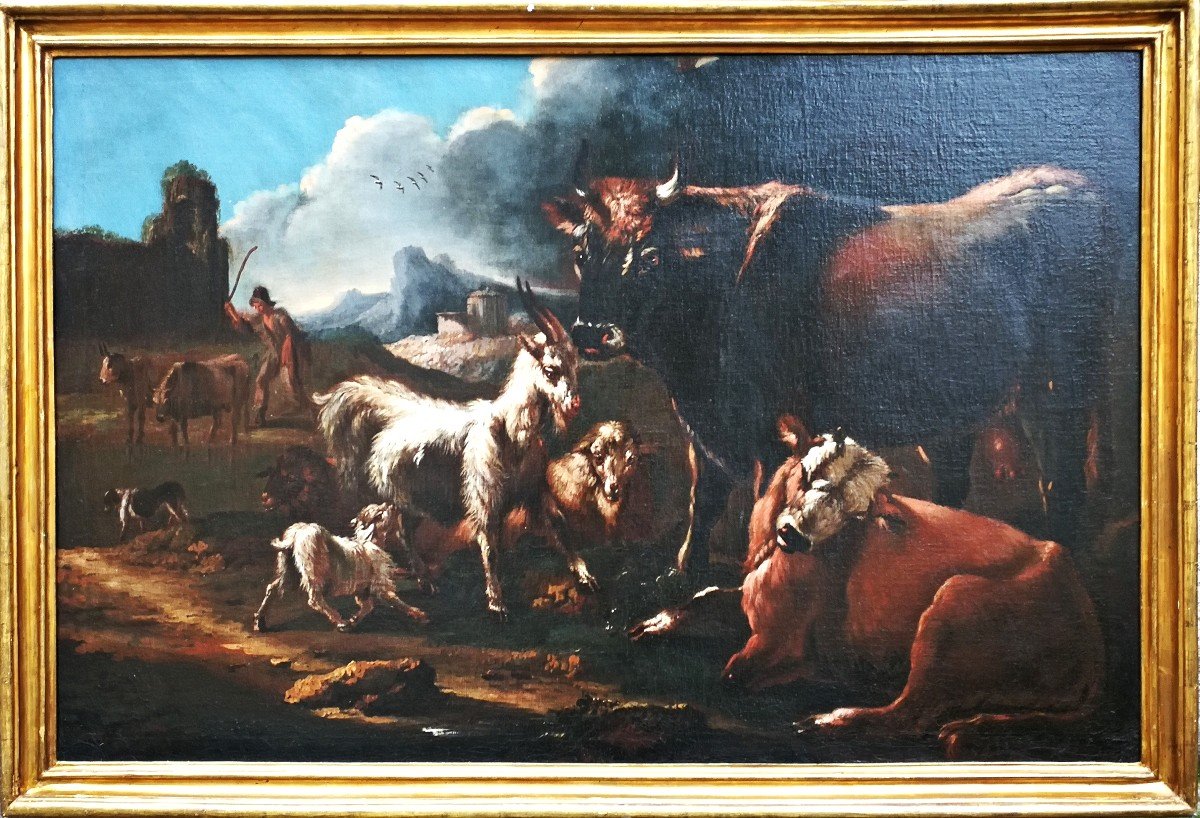
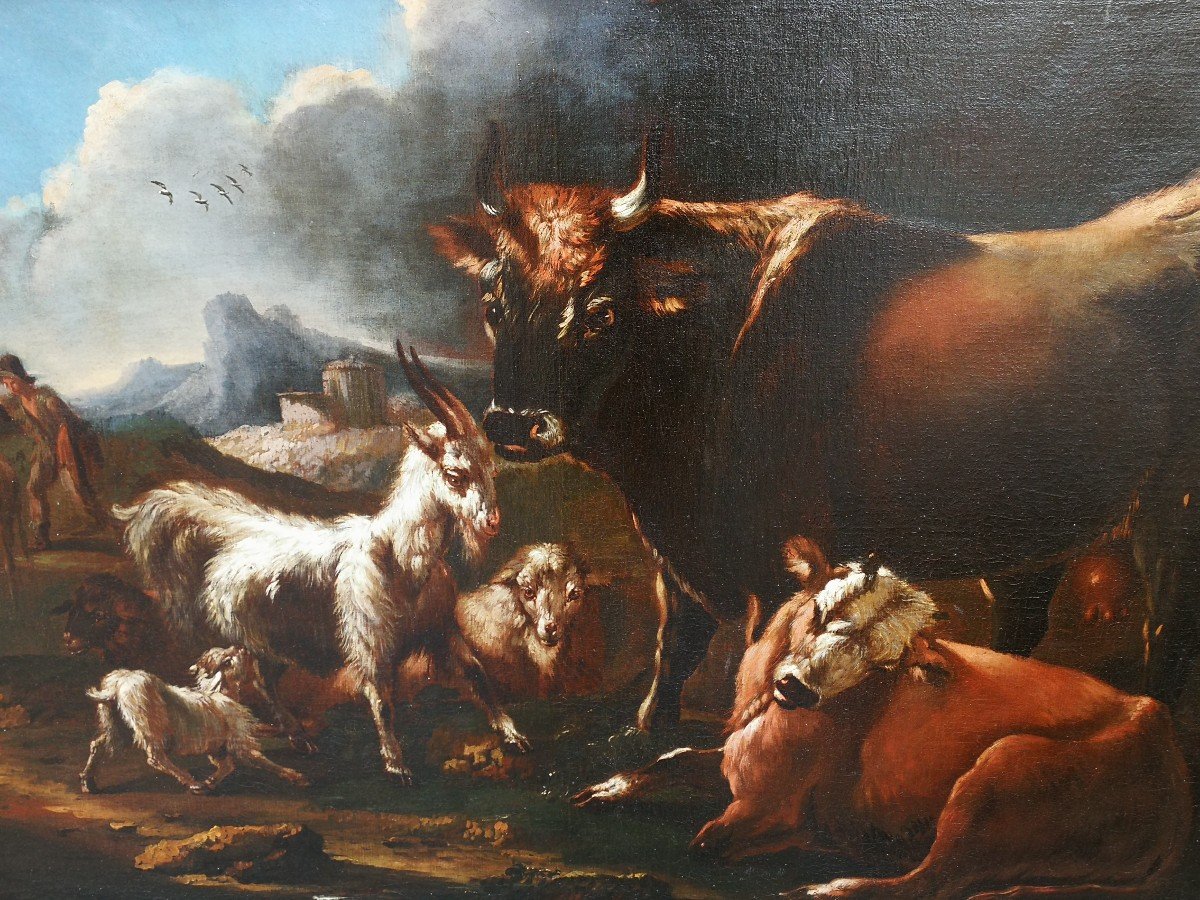
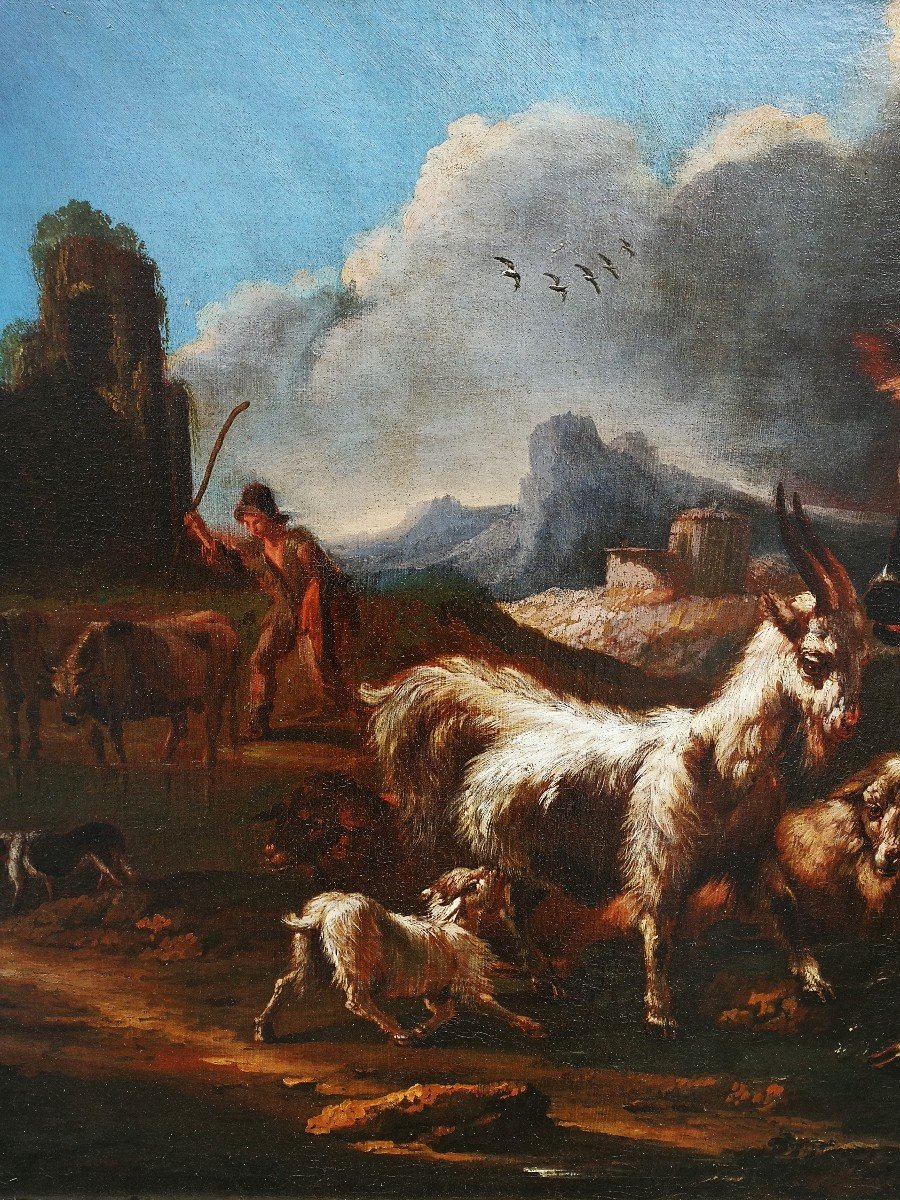
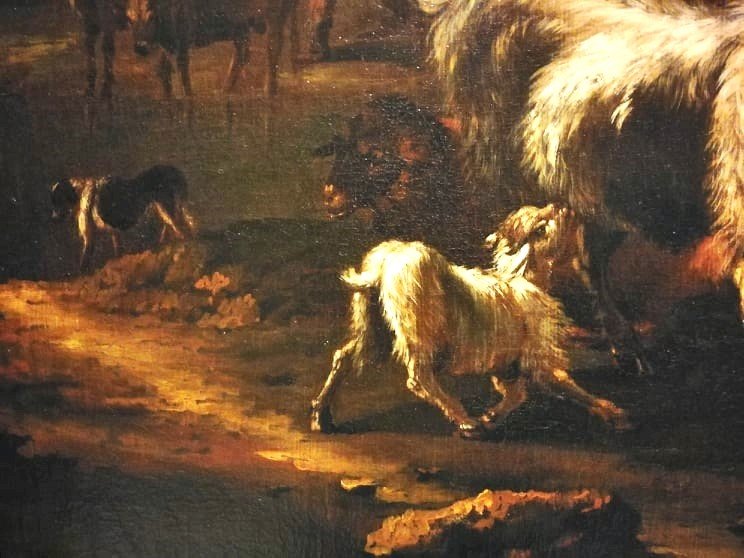
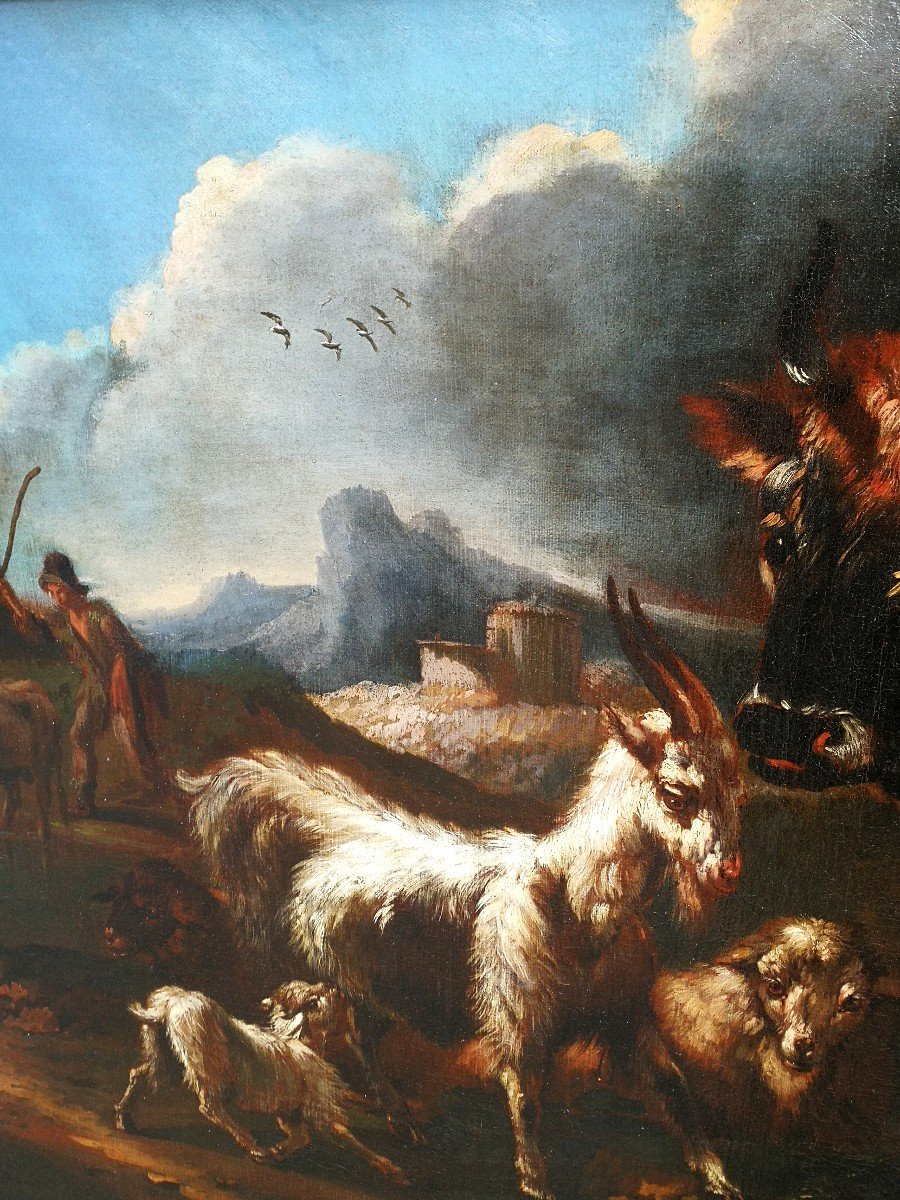
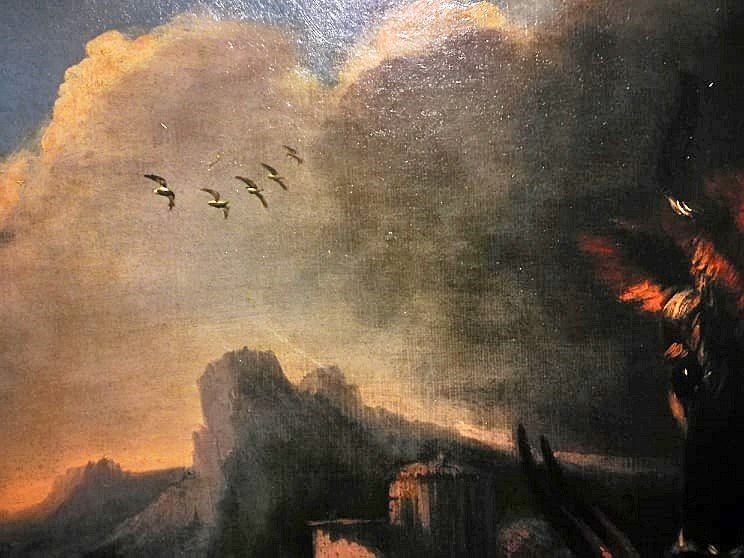
Oil painting on canvas depicting a rural scene and attributed to the hand of the most famous animal painter of his time, Peter Roos, known as Monsù Rosa or Rosa da Tivoli (Sankt Goar, August 30, 1657 - Rome, January 17, 1706).
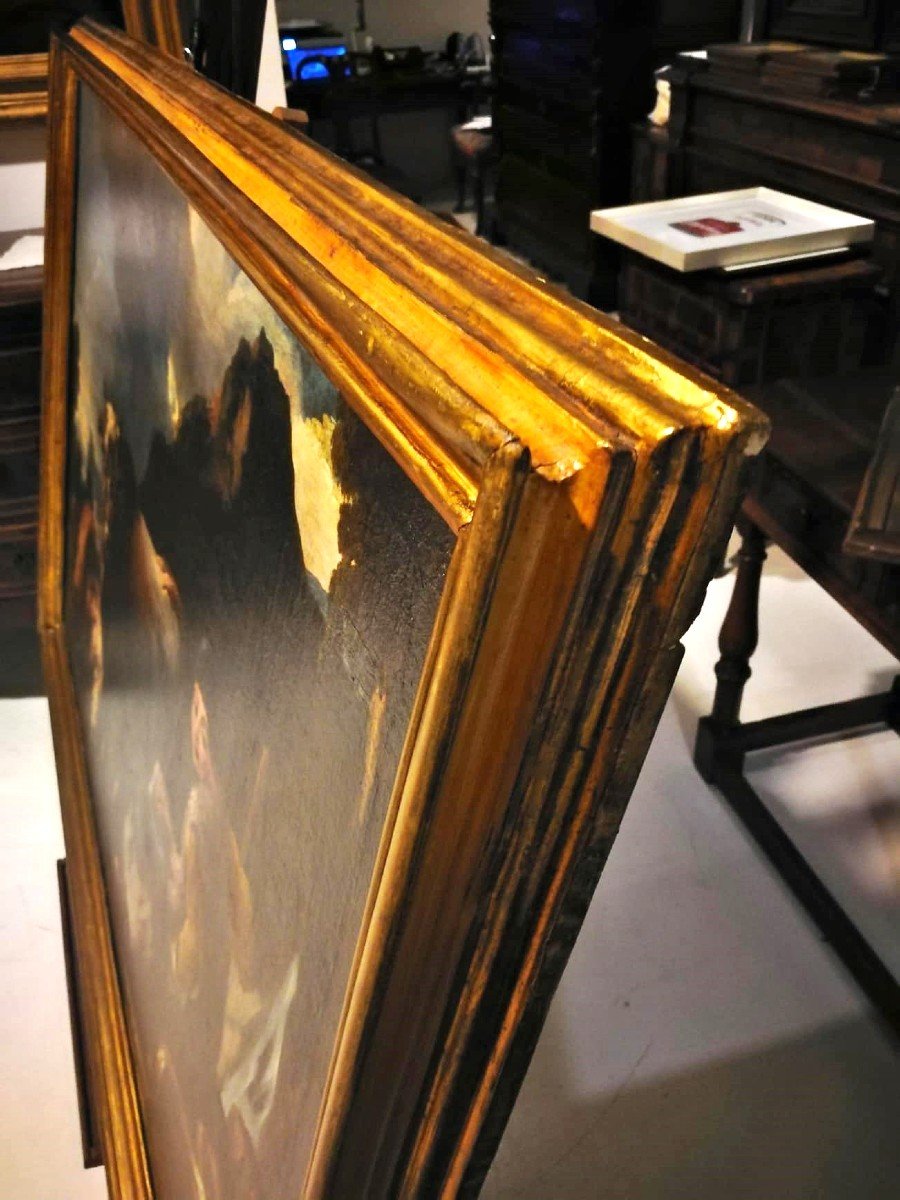
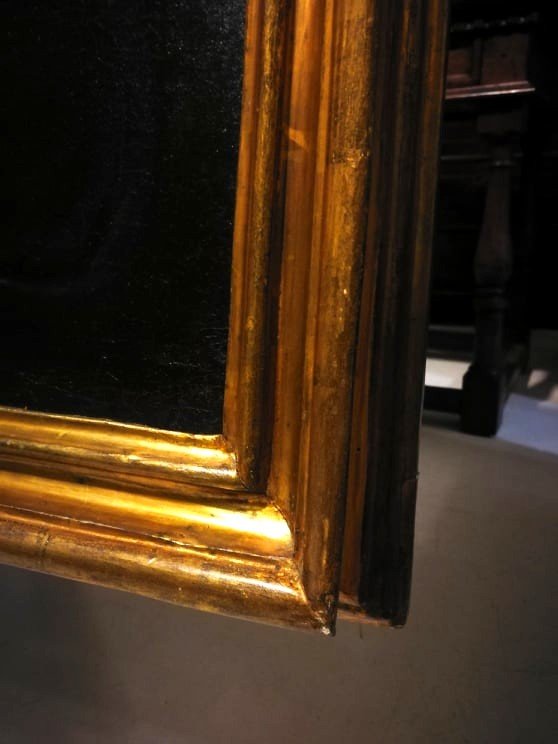
Within their original gilded "Salvador Rosa" frames, with a section measuring 15-16 cm. The canvases measure 145 x 96cm.
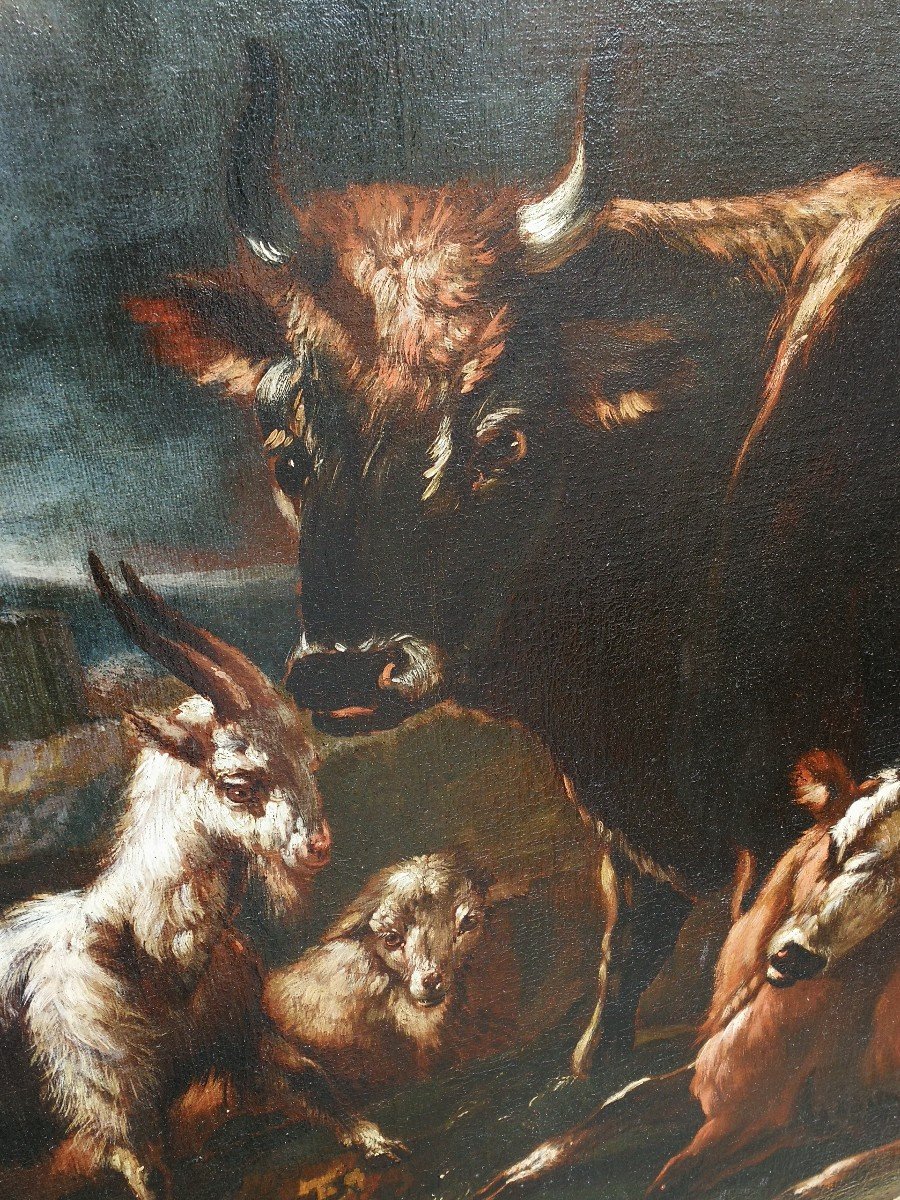
In this scene, the pictorial peculiarity of the Italo-German master is perfectly expressed; the animals are rendered with graphic and luministic effectiveness through intense, pastose brushstrokes. The particular Caravaggesque chiaroscuro effects and the compositional balance give us sensations of calm during the execution and respect for subjects so dear to the painter.
We can make a very valid comparison with the two large canvases attributed to Rosa da Tivoli, exhibited in the section dedicated to 17th-century painters at the Galleria Nazionale di Parma within the Palazzo della Pillotta. In these, we see very similar representations in terms of scenic and figurative composition, although some characters vary. The style, pictorial quality, and luminosity are entirely similar, which leads us to believe that this is a version of the same representation exhibited at the Palazzo della Pillotta.
Roos was a German painter and engraver of the Baroque period. He belonged to a renowned family of German painters and engravers; his father was Johann Heinrich Roos, the most important German animal painter of the 17th century. He came to Italy in 1677 on a scholarship from the Landgrave of Hesse, on the condition that he return to his court. However, disregarding the Landgrave's terms, he never returned to Germany. He studied in Rome with Giacinto Brandi, whose daughter Maria Isabella he married in 1681, after converting to Catholicism. In 1684-1685, he bought a house near Tivoli, which earned him the nickname Rosa da Tivoli. Roos bred animals and painted them in this dilapidated house, which was thus called Noah's Ark. From 1691 onwards, he lived primarily in Rome, where he became a member of the Schildersbent, with the nickname Mercurius, due to the speed with which he executed his paintings and the ease with which he painted.
This speed of execution was particularly useful to him: often without money, he would paint one or two pictures and have his servant sell them at any price to pay the inn bill. He lived a dissolute life and died in poverty.
Regarding his style, most of his works depict domestic animals with their shepherds in the Roman countryside. The animals are generally painted in the foreground and dominate the scene, while landscapes with characteristics of the Lazio countryside are seen in the distance. Roos applied his paint thickly, rendering his subjects, the position, and movements of each species with great talent through highly effective luministic compositions. In the years around 1680, the artist generally portrayed small groups of animals (sheep and goats, often led by a ram with curved horns), with shepherds on the side in rough clothing, next to the animals. In the distance, wild valleys alternated with steep walls, illuminated by a yellowish-brown light; distant mountains were rendered in shades of blue. Ancient ruins were often painted in the background. Around the 1690s, Roos primarily painted landscapes.
Overall, his paintings are characterized by a spectral, somber, and wild tone. Furthermore, Roos managed to transform natural landscape motifs into unusual and dynamic visions. Although this artist generally painted landscapes and animals, he was nevertheless capable of creating more complex compositions, as evidenced by the drawing "Deposition from the Cross," now at the Jean Paul Getty Museum. Roos's style reflected his working method. It was characterized by the use of intense, sometimes almost rough brushstrokes and a strong contrast between light and shadow. This personal manner was quite popular and attracted many imitators. For this reason, works by other animal painters were mistakenly attributed to Roos. Moreover, the artist's brothers and sons also painted similar subjects, contributing to increased confusion.
The canvas is in perfect state of conservation. The same applies to the "Salvador Rosa" gilded frames.
The painting is visible in our antique gallery located in Foligno (PG), Piazza E. Giacomini, 42.
We are attaching a historical guarantee certificate attesting to the authenticity and period of the paintings, accompanied by photographic documentation.
The item is visible in our antique gallery in Foligno (PG), in the heart of Umbria. Come and visit us!
We are ready to welcome you to our 180 sqm exhibition space, boasting an incredible assortment of antique and original furniture, paintings, and objects ranging from the 15th to the 19th century.
If you are looking for furnishings for renovations of local businesses, apartments, hotels, country houses, we are available to show you our large warehouses where you can find every type of antique furniture and satisfy any type of search.
Our experience in the sector allows us to guide you in your furnishing choices, when you have the desire and taste to opt for antique and original furnishings for your spaces, perhaps in harmony with more modern elements of the house.
Piazzetta E. GIacomini, 42.
Info: Tel./What's app - 0039/3356925388 - 00393208015489 - Mail:
[email protected]
OPEN EVERY DAY FROM 9 AM TO 1 PM AND FROM 4 PM TO 7 PM (Advance booking by phone is recommended, especially on Saturdays and Sundays).