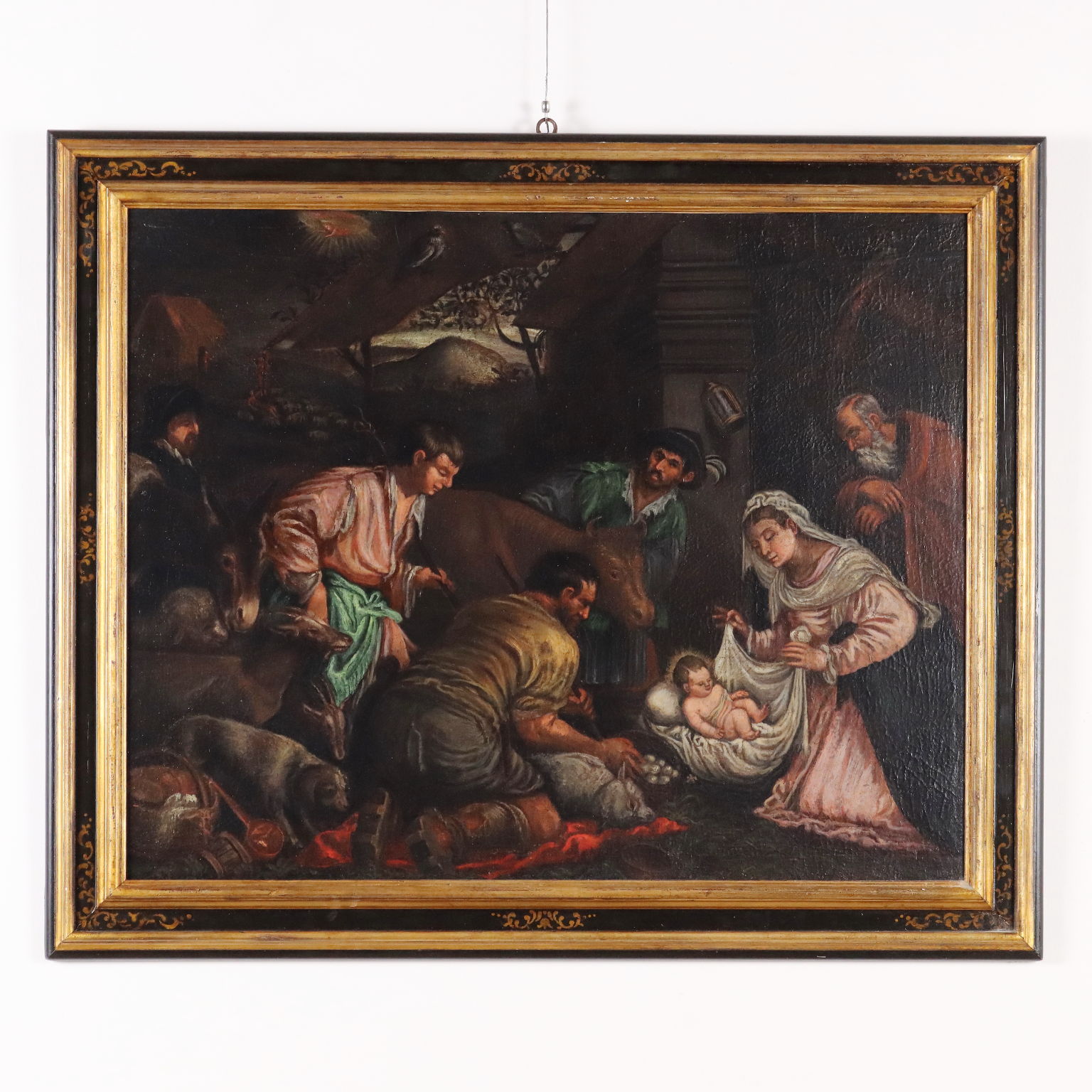
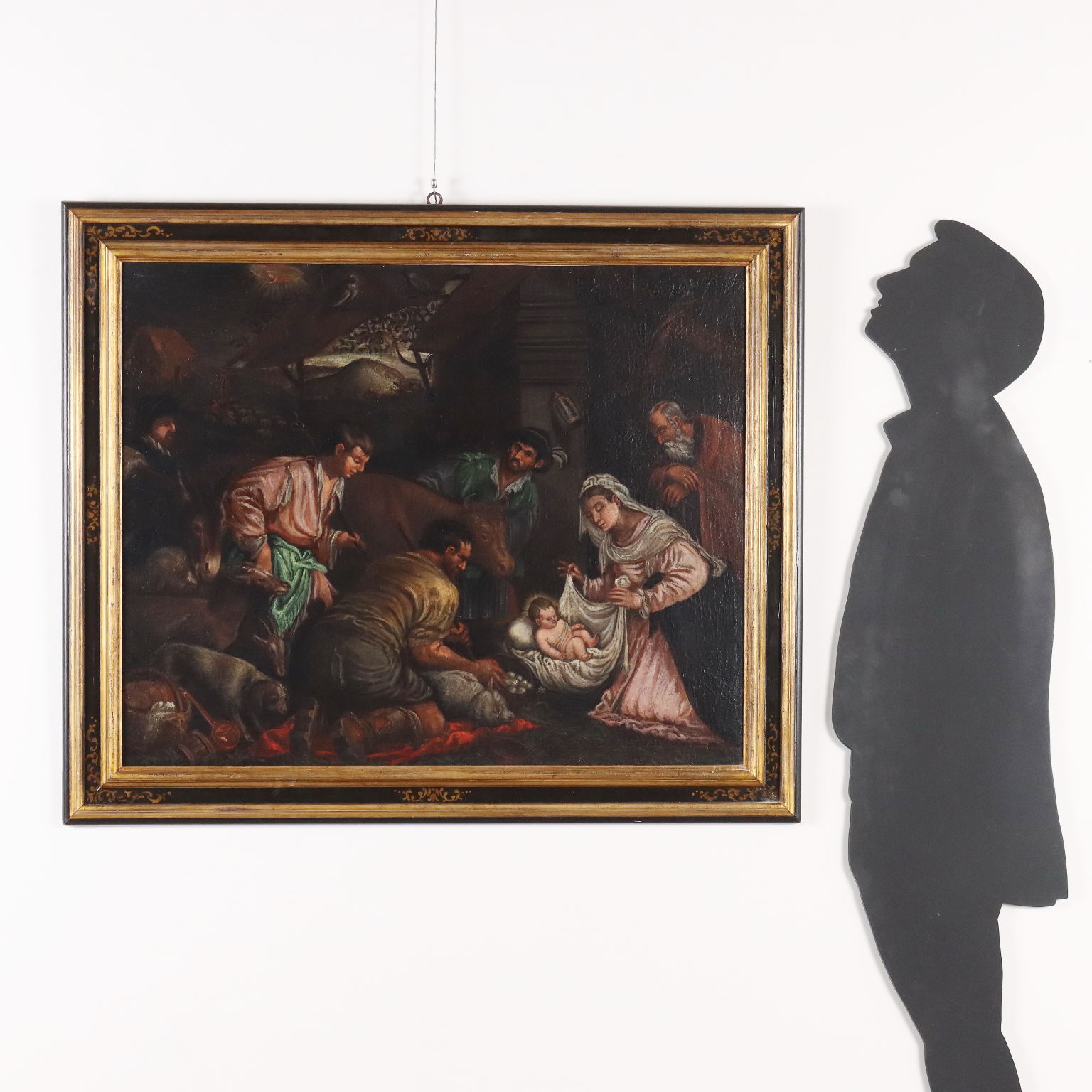
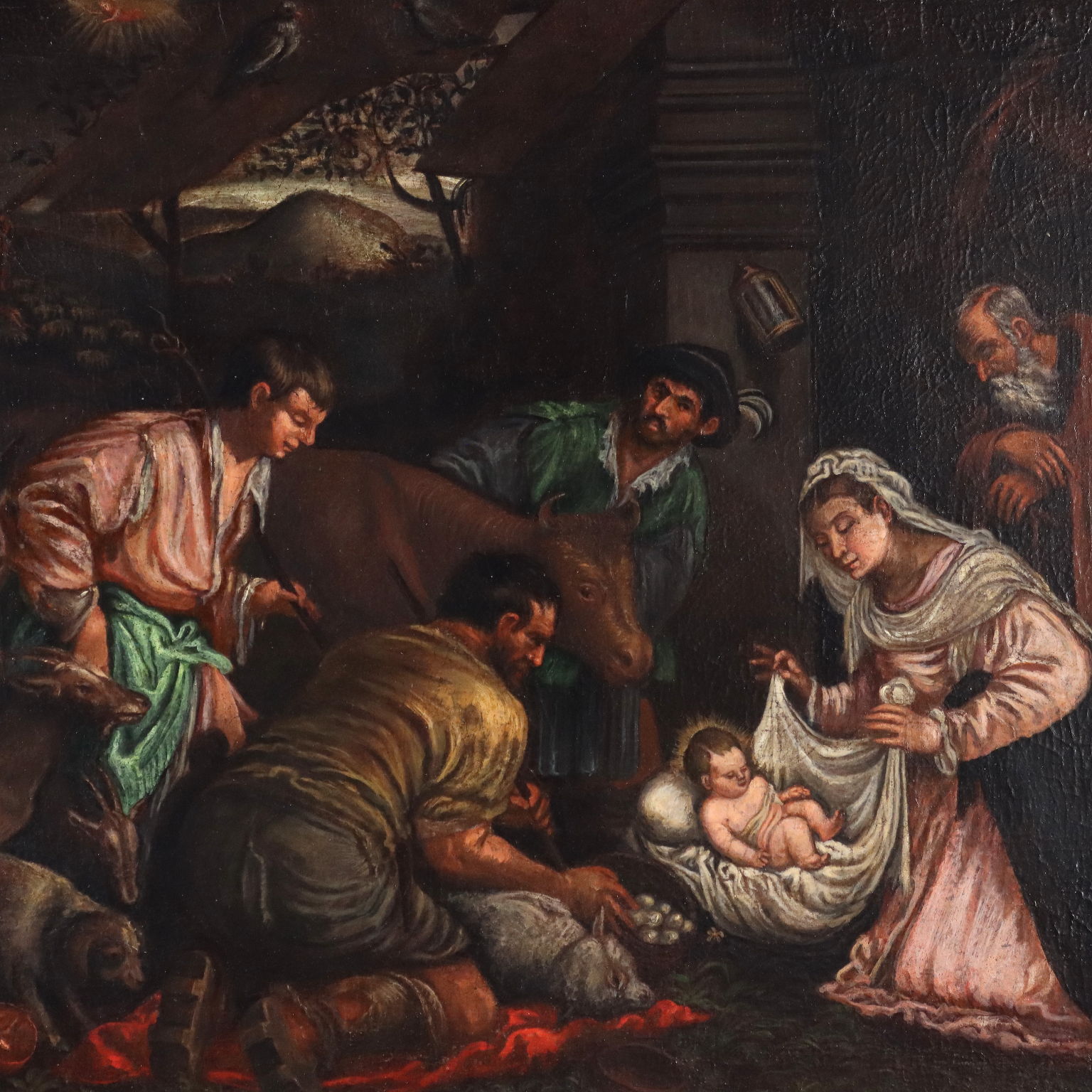
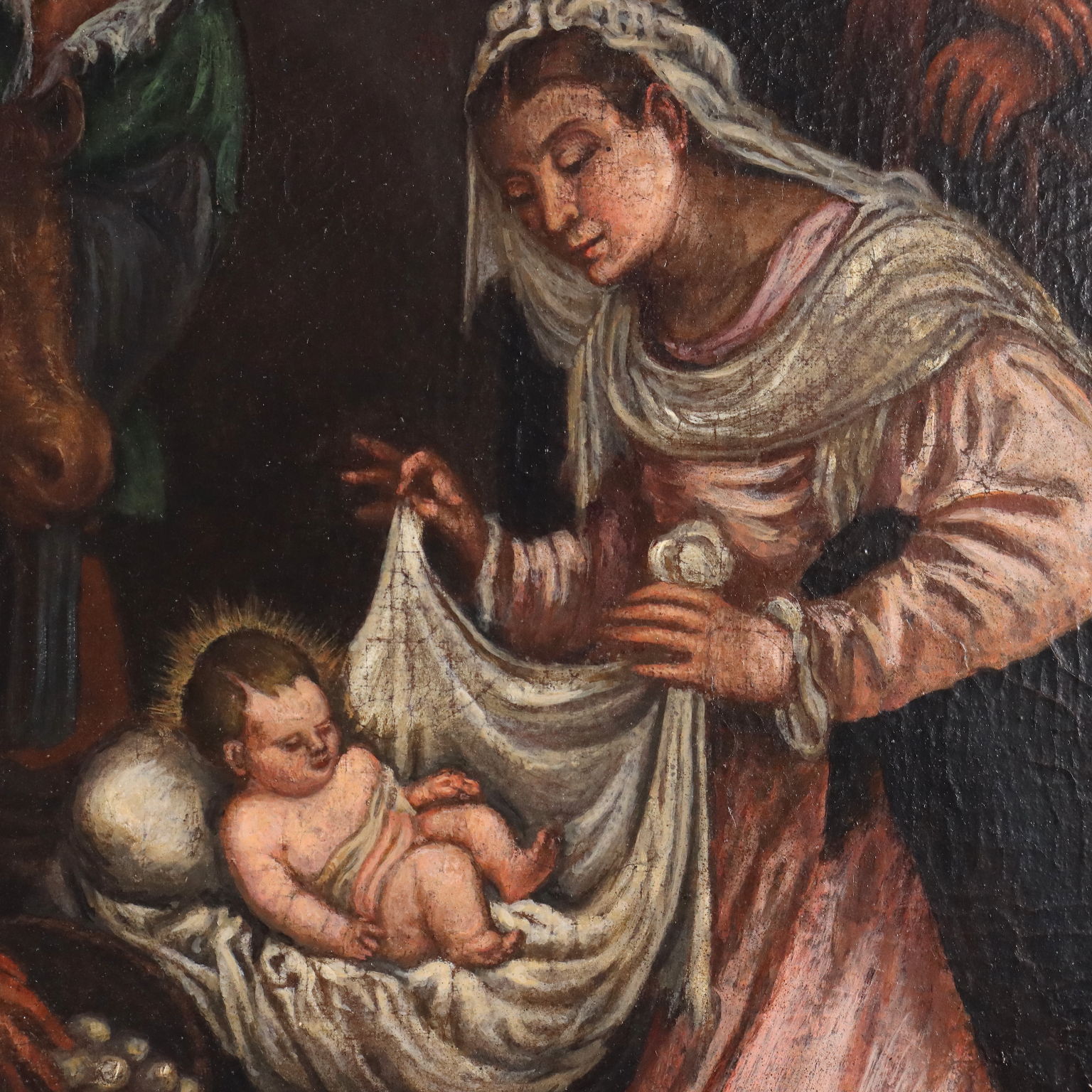
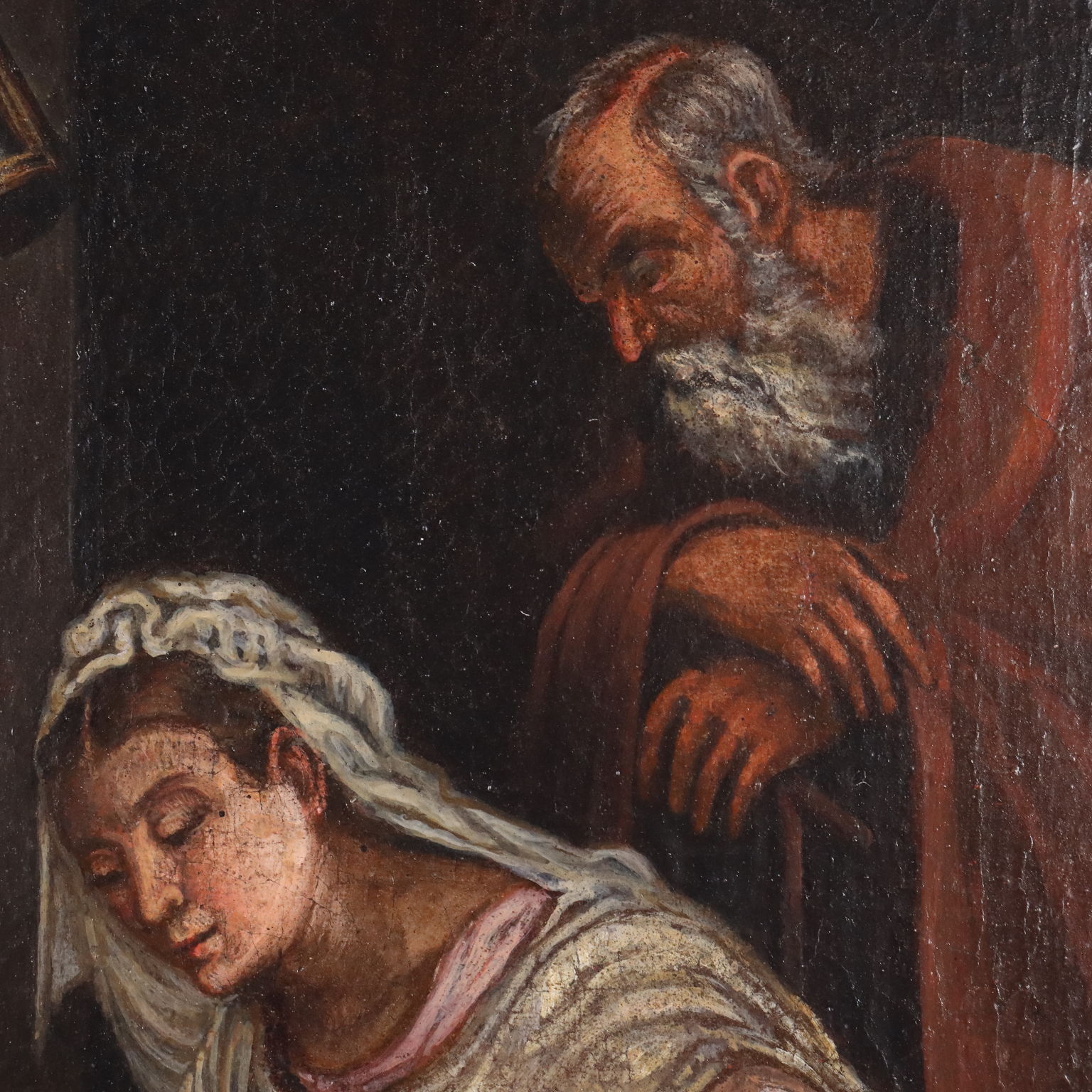
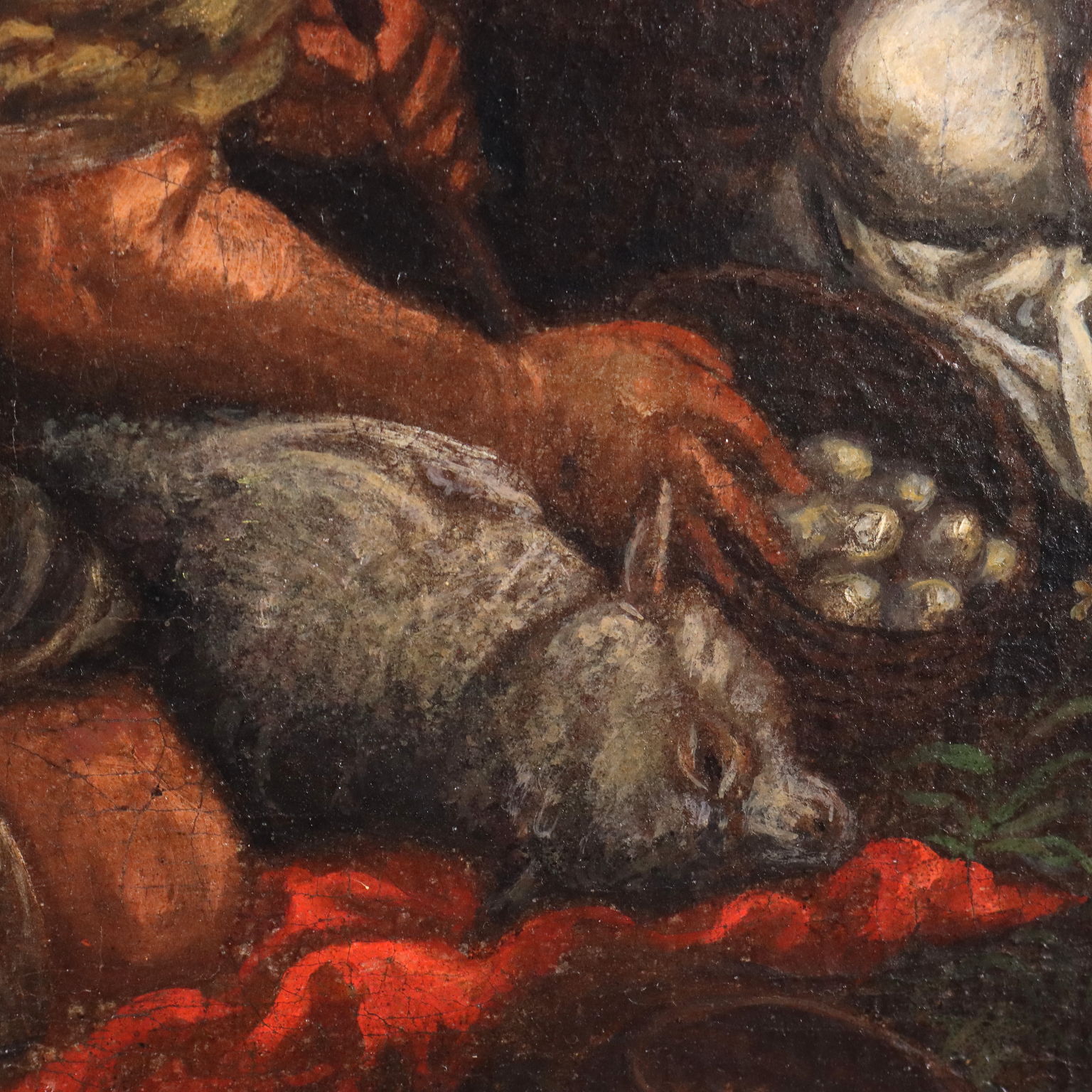
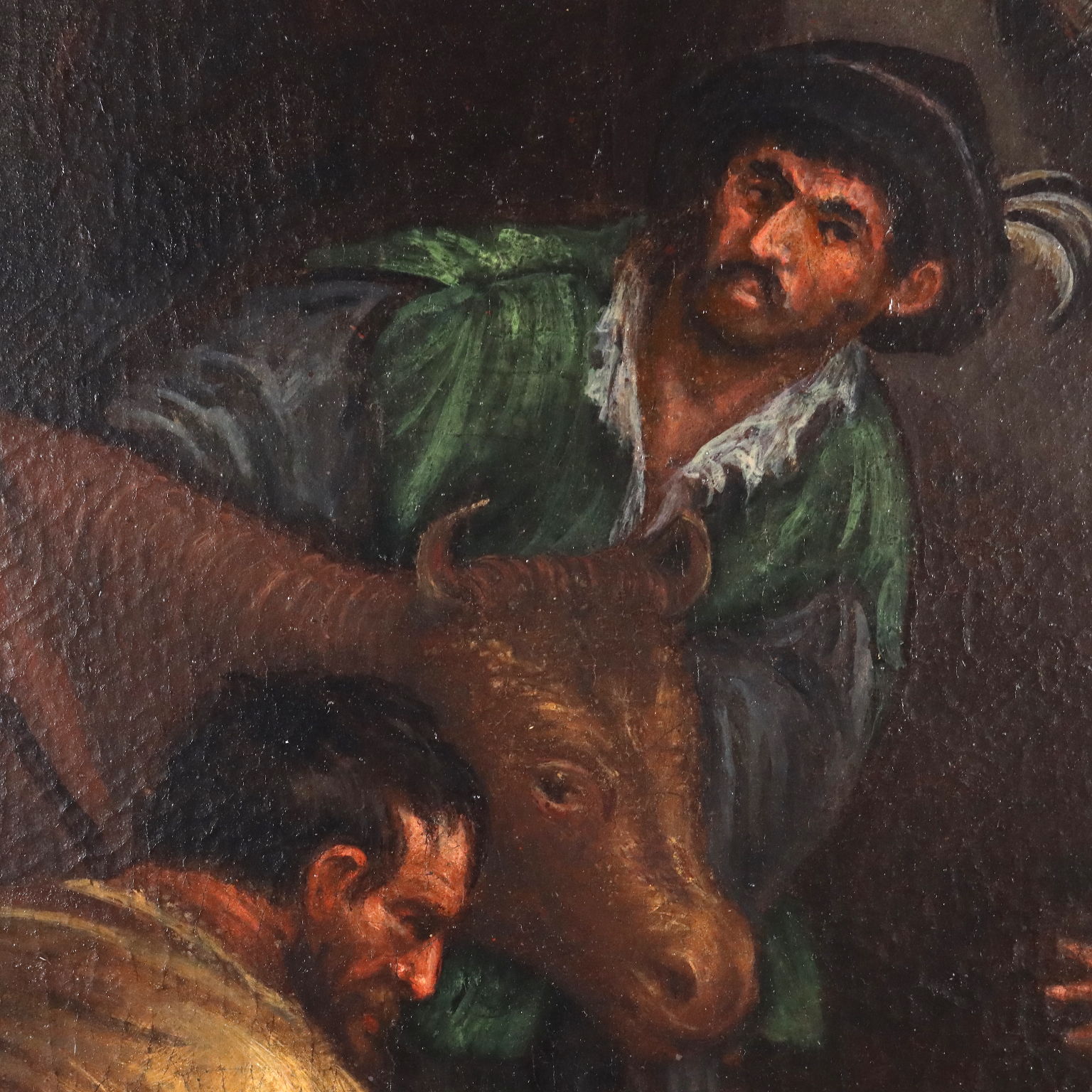
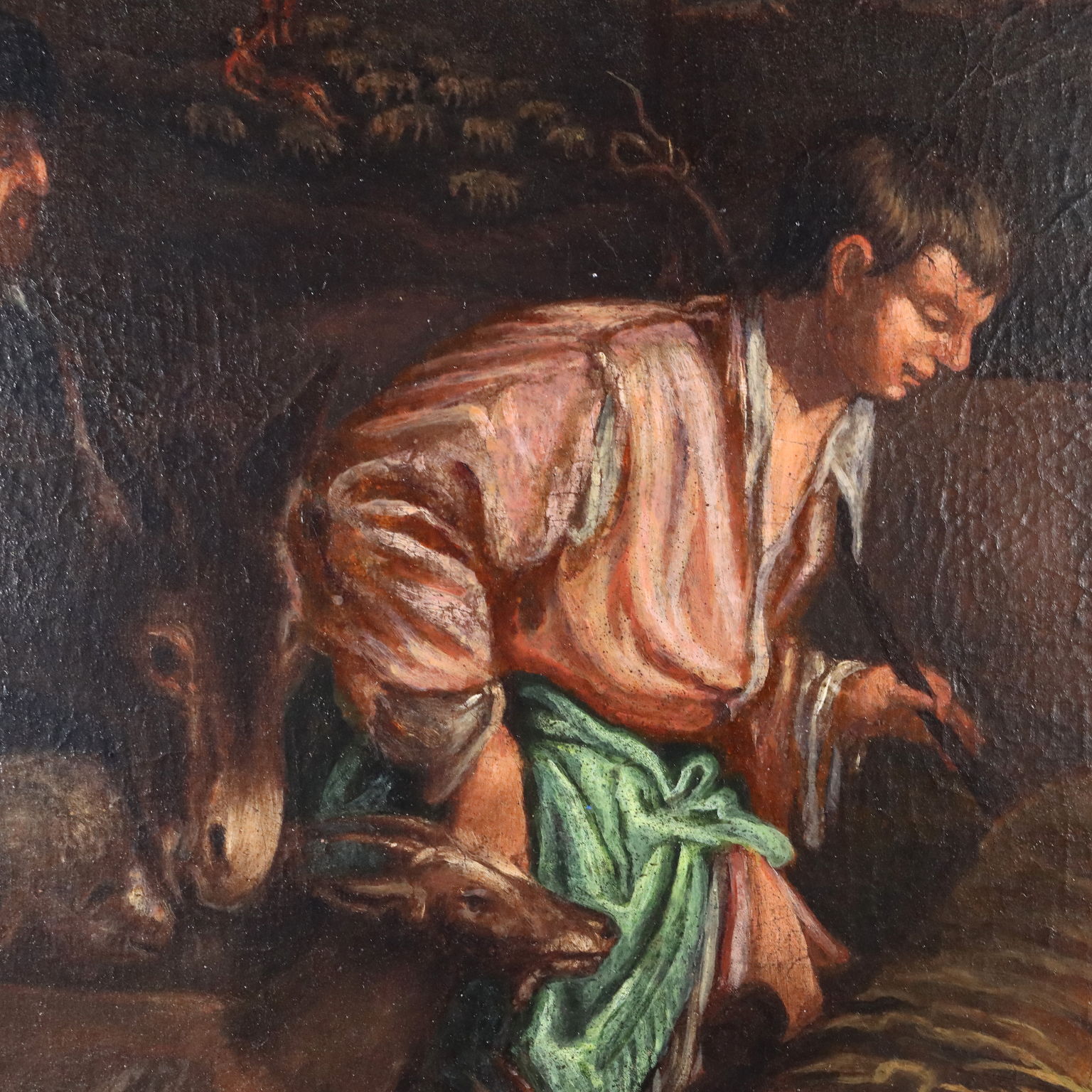
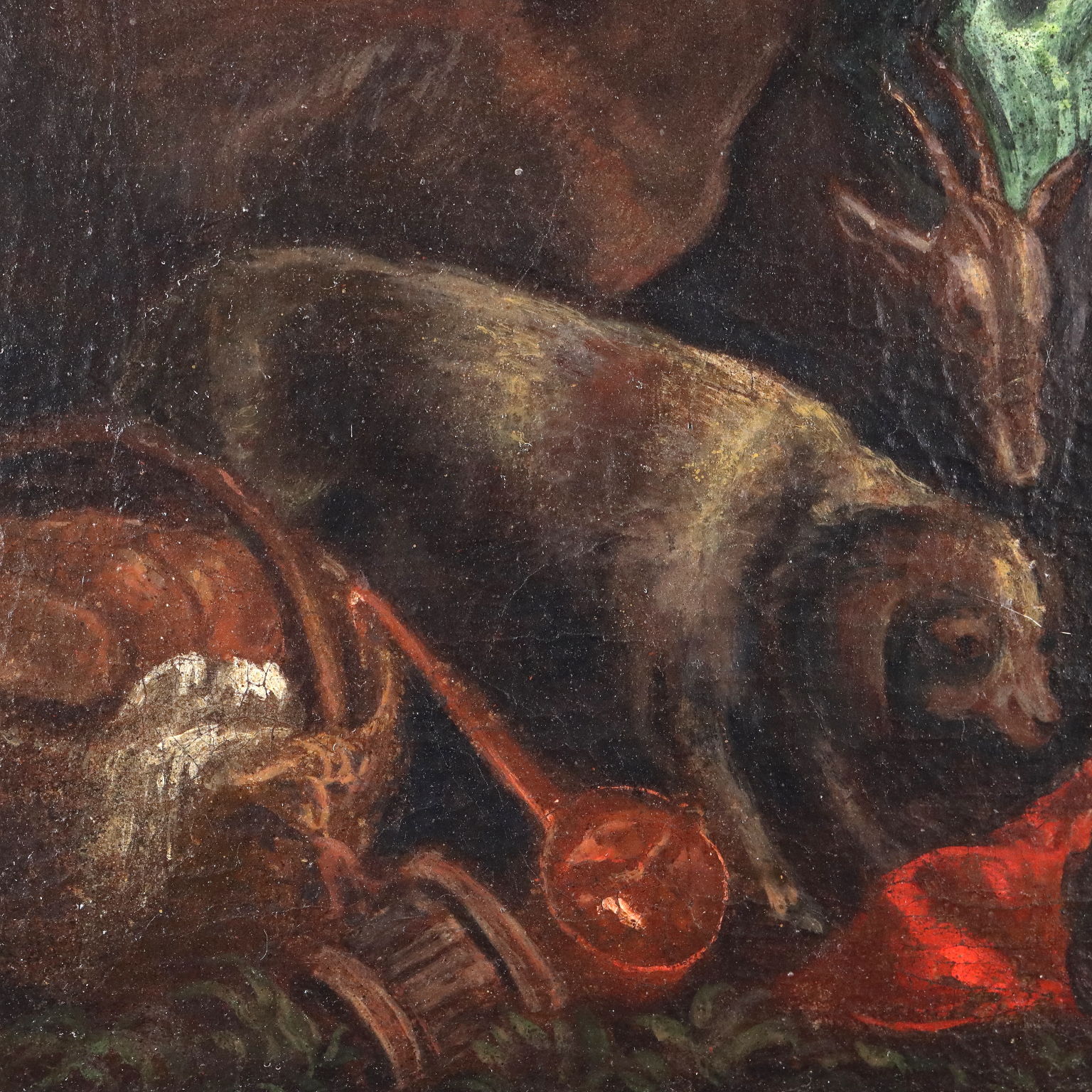
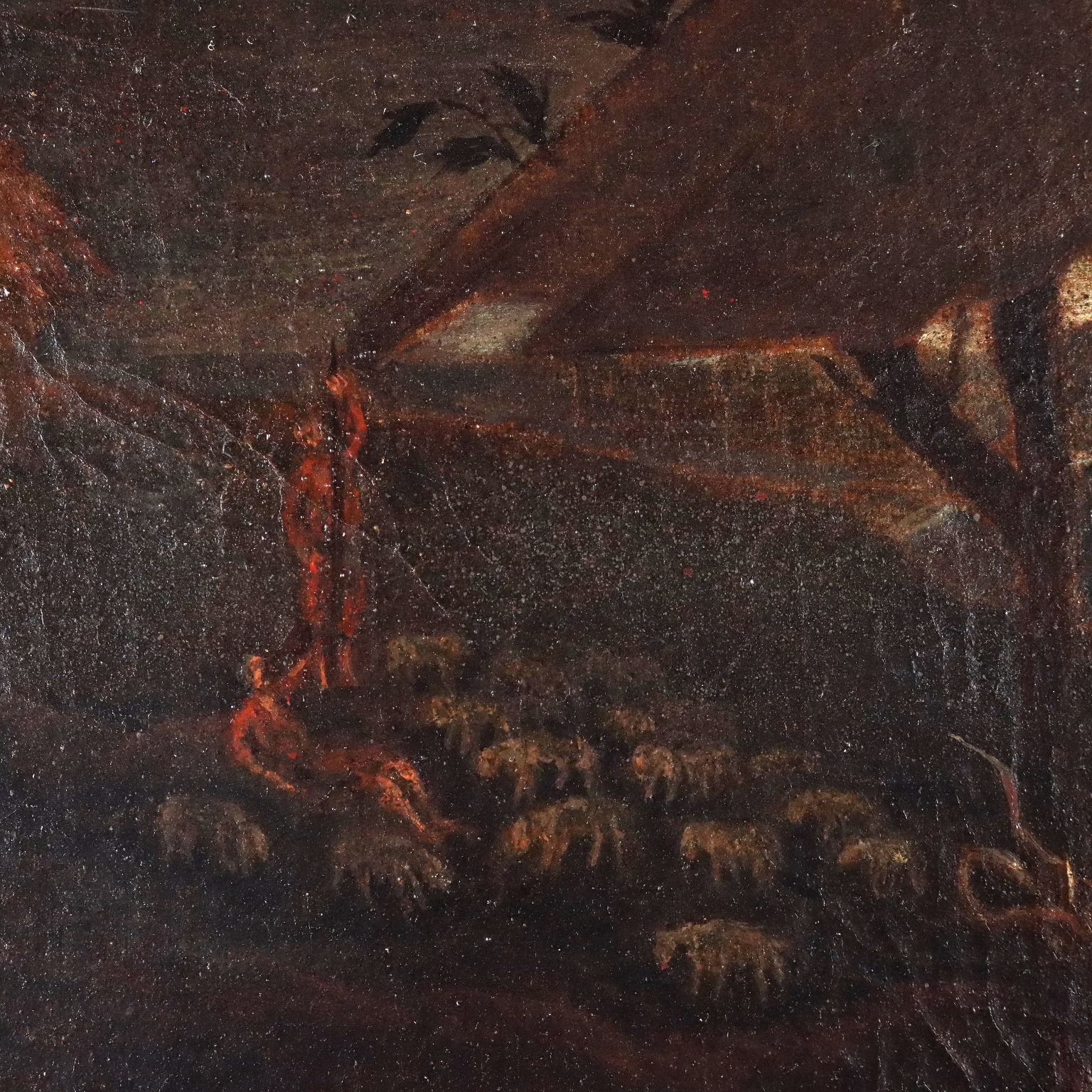
Oil on canvas. Second half of the 16th century. The painting comes from the historical family collection of Count Castracane, as documented by the original handwritten paper receipt from Francesco Bassano (attached to the work) which reads: "V. S. Ill.ma Conte Castracane. Recipio de so messo sua somma de quinquaginta ducati per lo dipinto de mano mia de Nativitas Domini Nostri come Ella mhavea ordenato. Dev.mo Obb.mo Servo suo Franciscus da Ponte de Bassano. Il die 12 decembre 1589". On the back of the frame there is also an inventory label at the top and the inscription "proprietà Castracane" (Castracane property) at the bottom. The mentioned Count Castracane belongs to the noble family of the Castracani degli Altelminelli of Fano, of origins from Lucca. Francesco Dal Ponte da Bassano, known as Il Giovane (The Younger), worked for many years in the important workshop of his father Jacopo, known as Bassano il Vecchio (The Elder), before moving to Venice in 1578 where he opened his personal atelier, while still collaborating with the workshop of Bassano, managed in the meantime by his brother Leandro after the death of their father; towards the end of the eighties, however, a crisis manifested itself in Francesco which was also reflected in the allegorical production: in a progressive approach to the taste of his brother Leandro, the color became lighter, losing strength, the forms became dilated and simplified, the composition became fragmented. The production of the Bassano family was distinguished above all for sacred subjects, inserted in rural scenarios, which lead to defining them as biblical-pastoral. Also in this painting the Holy Family does not characterize the centrality of the scene, but is one of the two groups of very human figures that occupies the right part of the scene, while on the left stands the group of shepherds with the animals of the countryside and the simple objects of daily life. The rural context is well defined also by the surrounding objects, despite the fact that the birth hut is replaced by an architectural structure with marble columns, but of a color that blends with the other surrounding structures. The only spiritual elements are the angel - lonely! - which appears to the shepherds for the announcement, relegated to the top, small and barely hinted at; and the halo that surrounds the head of the Baby Jesus, who is also depicted peacefully asleep, unaware of what is happening around him and what awaits him. Characteristic in the production of the paternal Bassano workshop were the richness and chromatic vivacity and the luminous contrasts, which however softened in Francesco, translating into more tenuous chromatic choices and simplified forms, partially losing their strength. This can also be seen in this work, placed in the last years of the artist's life, especially in the clothes of the characters; note in particular how the dress of Mary is no longer red as tradition dictates, a strongly symbolic color of human pain, but is of the same rosy tone as the jacket of the central shepherd, almost to underline the belonging of the Madonna to humble and simple humanity. Furthermore, Francesco Bassano in the last period, due to his health condition compromised by severe hypochondria (he died a suicide in 1592), had commissions of works that were only partially executed by him, but delegated at least partially, to his assistants. This implies a work commissioned to him and coming from his workshop, as his handwritten declaration declares, but probably not created directly by the master, but rather by one of his collaborators. The painting has been restored and relined. It is presented in an antique wooden frame from the late 1700s - early 1800s.
Product condition:
Product in good condition, shows small signs of wear. We try to present the real state as completely as possible with the photos. If some details are not clear from the photos, what is stated in the description applies.
Frame dimensions (cm):
Height: 91
Width: 11
Depth: 4
Artwork dimensions (cm):
Height: 75
Width: 93.5
ARARPI0278456