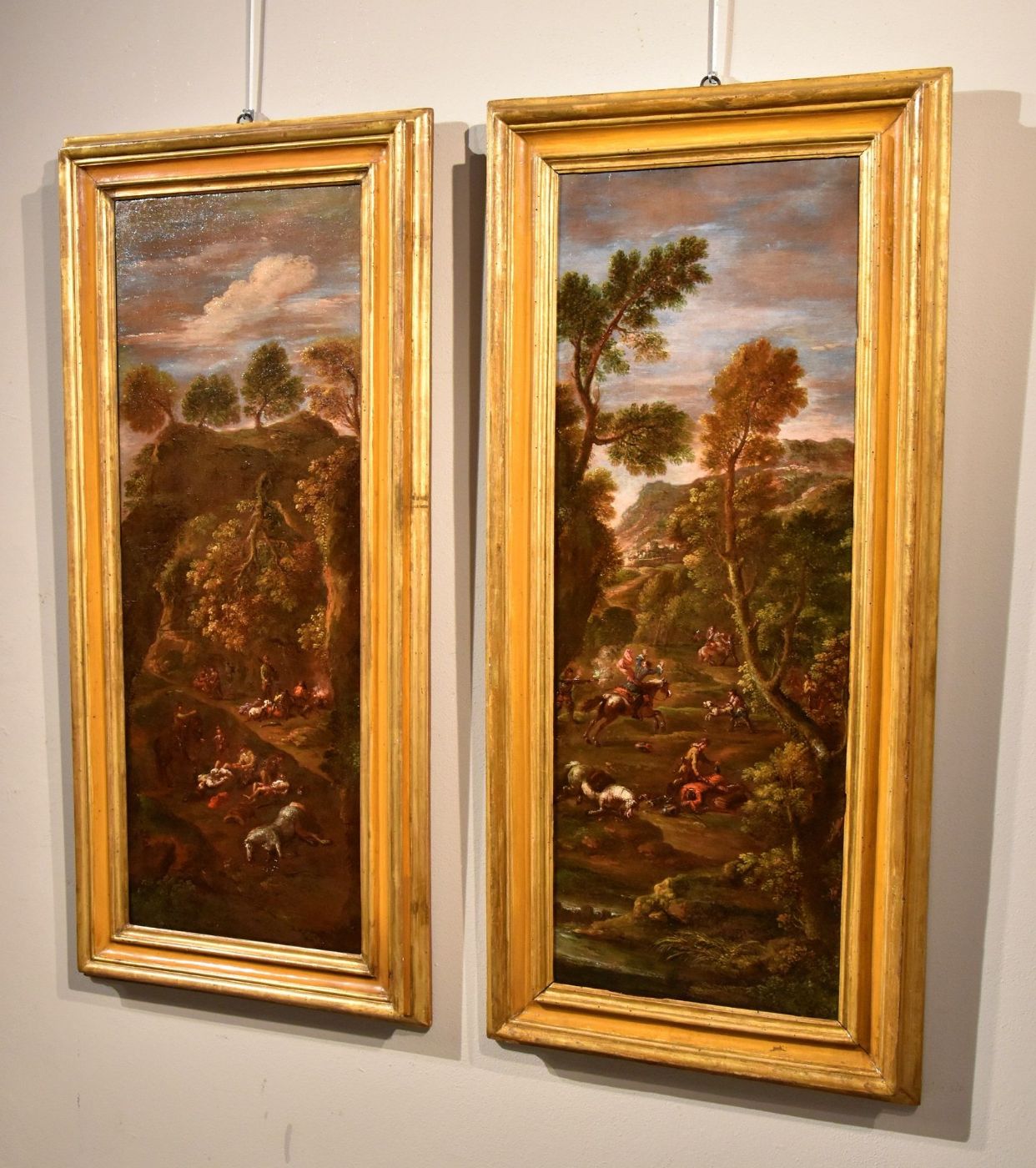
Giuseppe Zais (Canale d'Agordo, Belluno 1709 - Treviso 1781)
Pendant of paintings
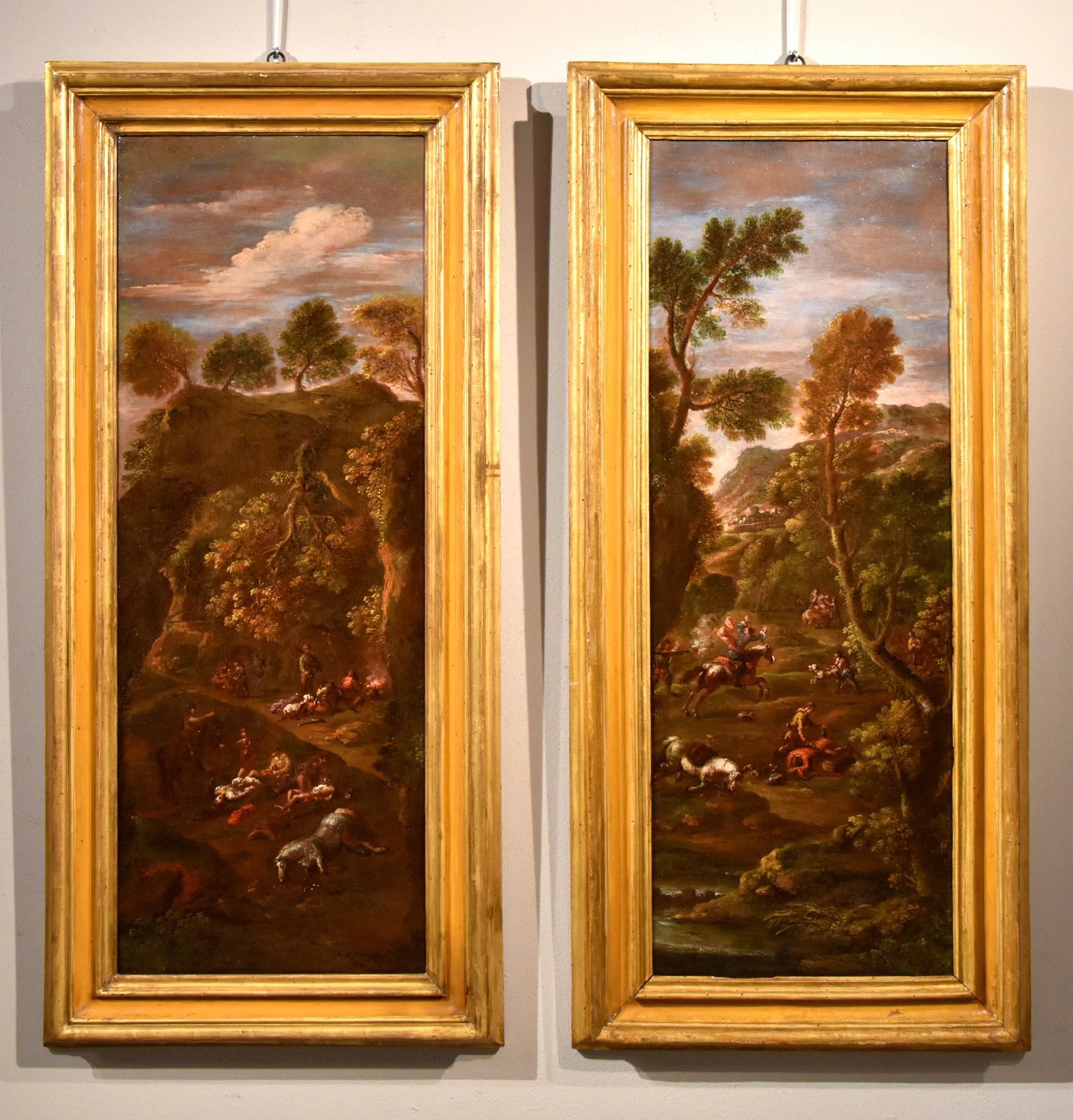
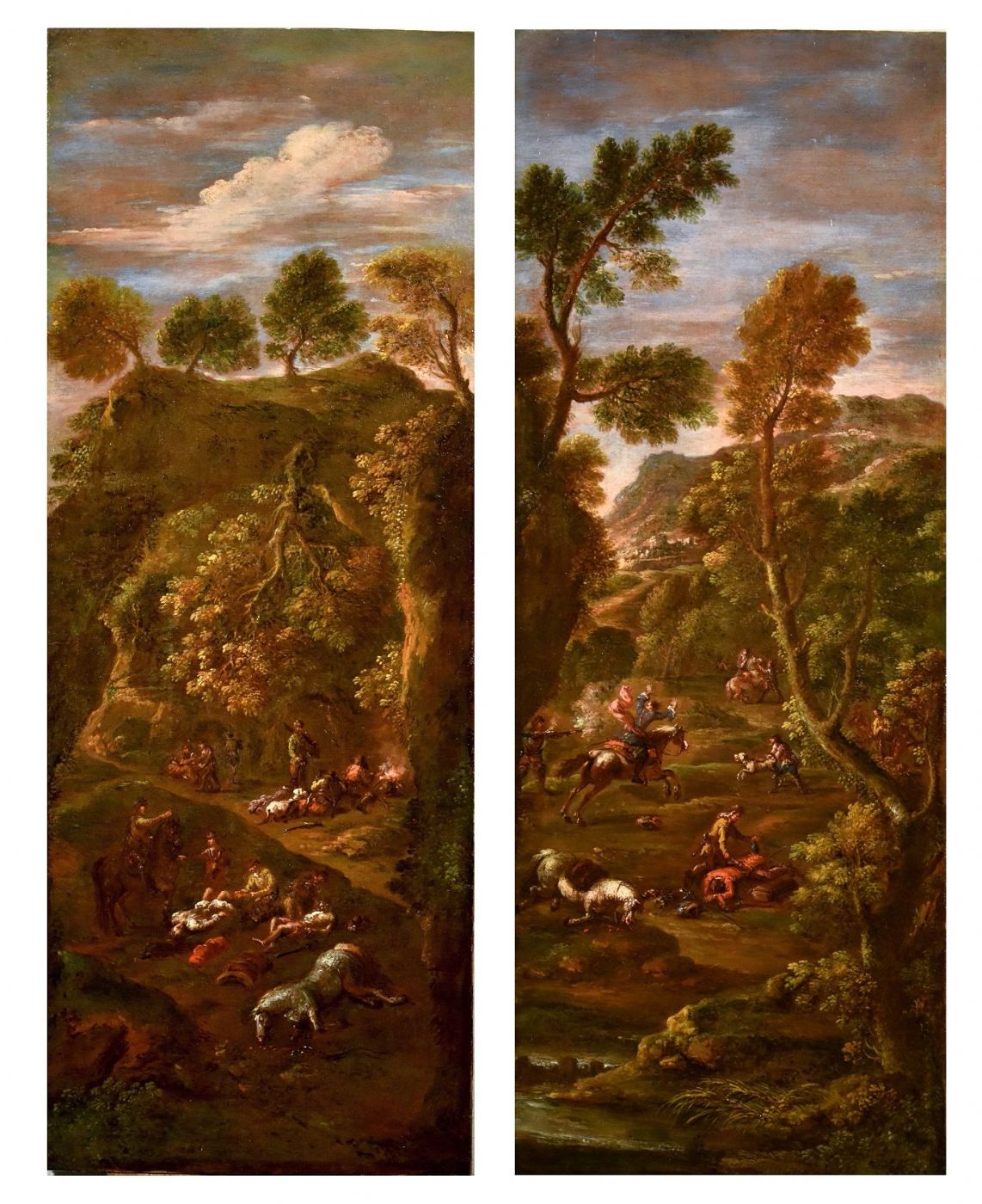
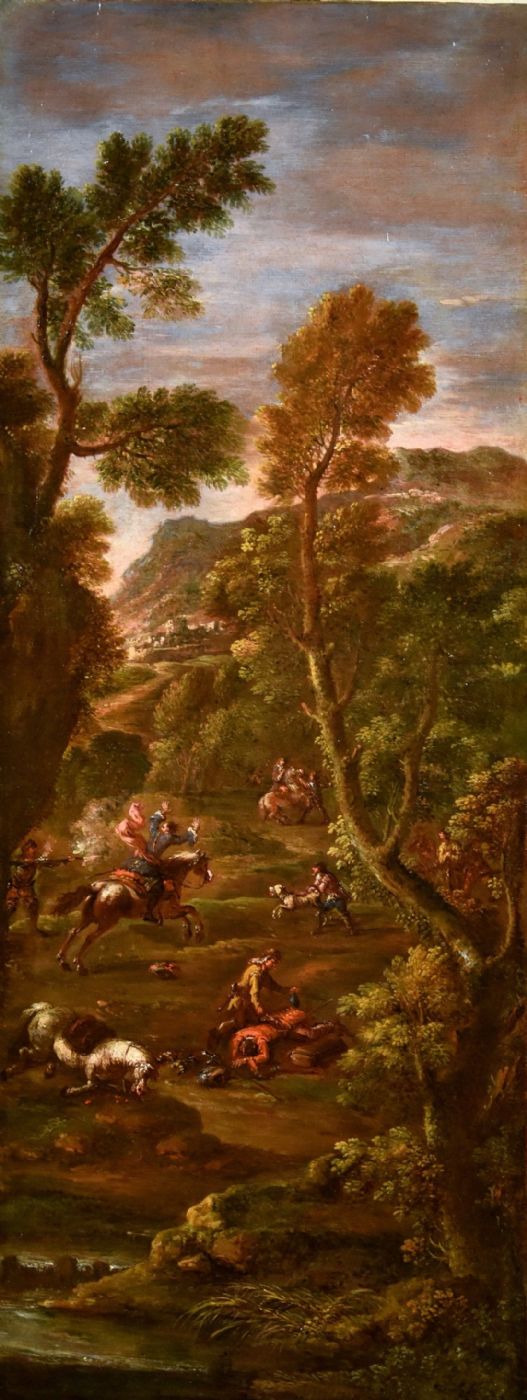
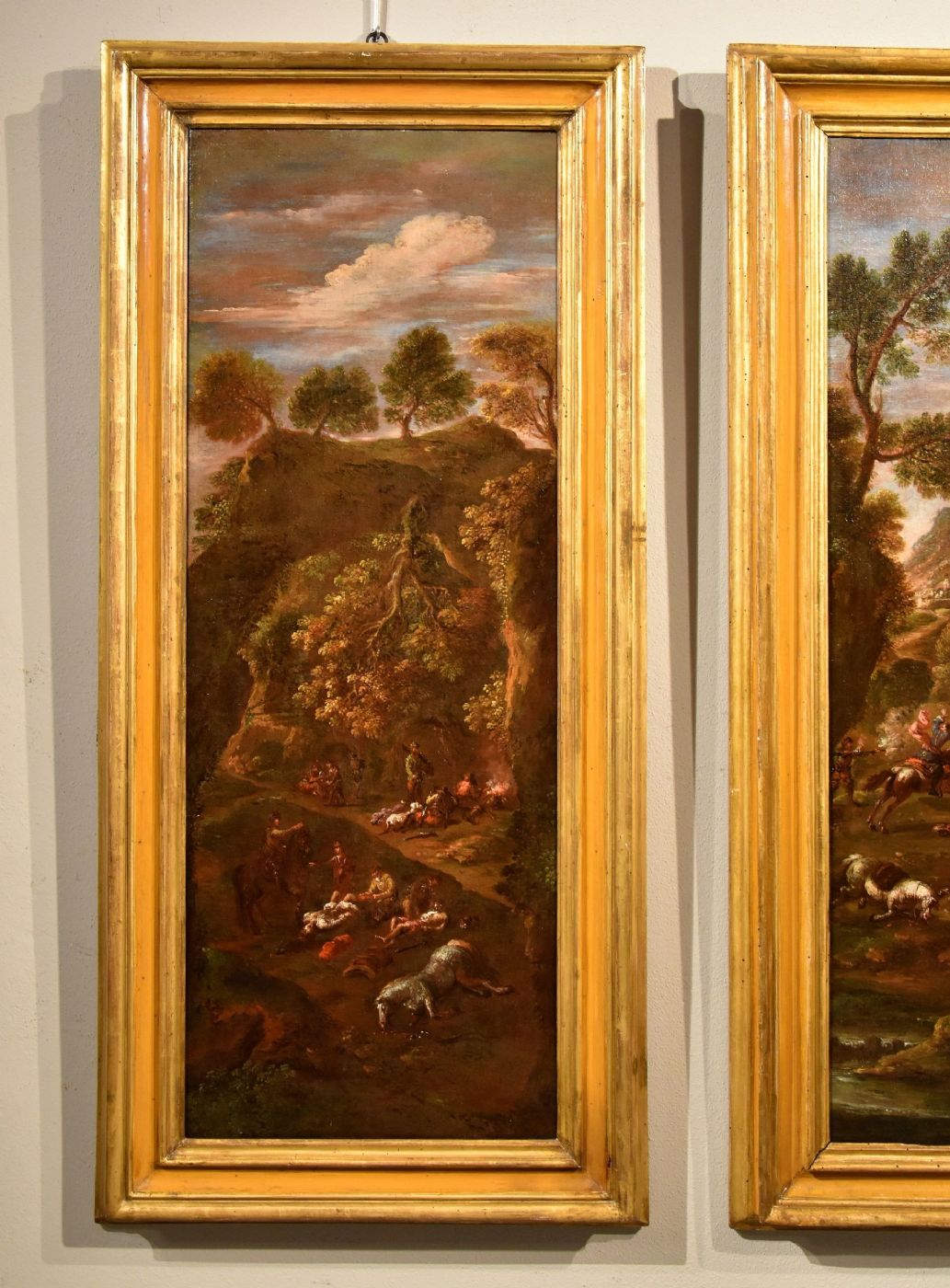
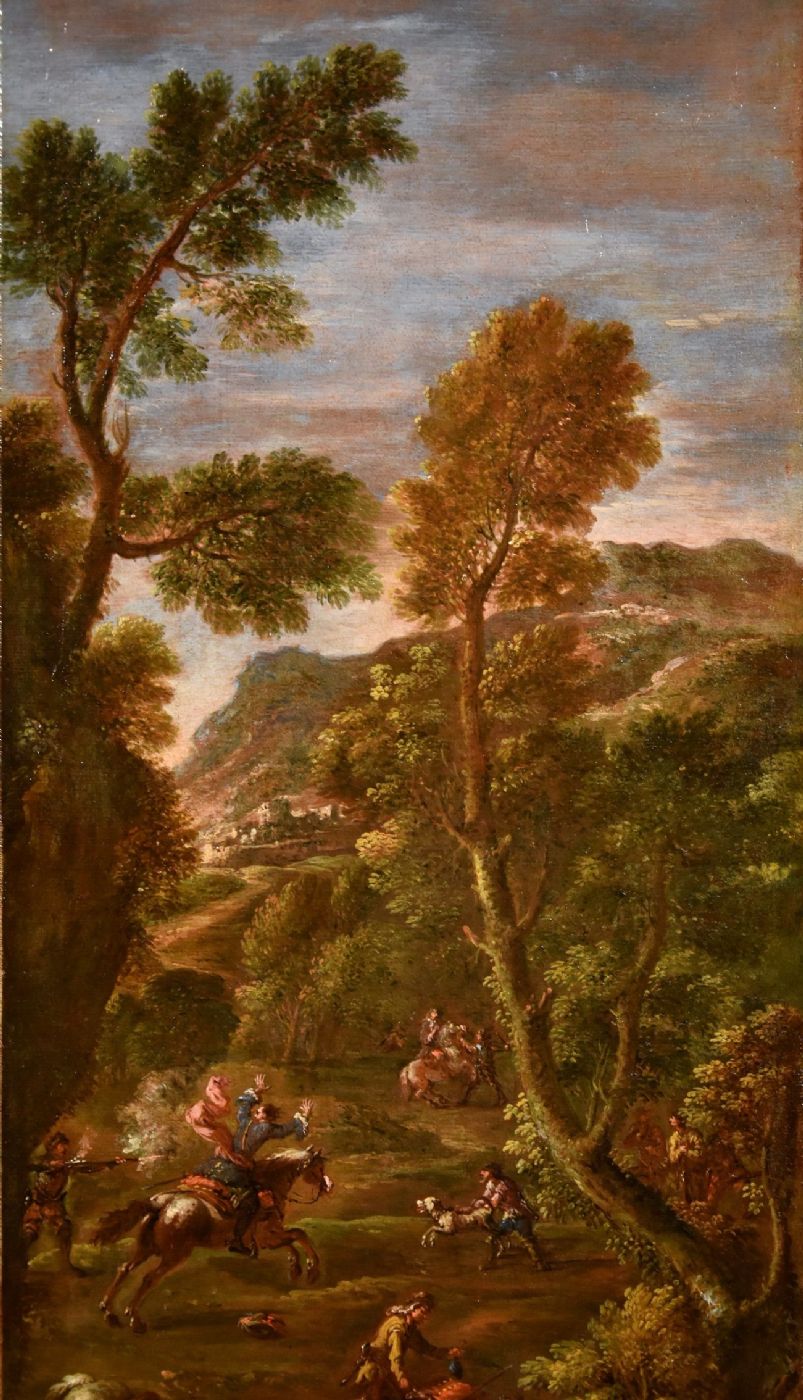
The attack of the brigands
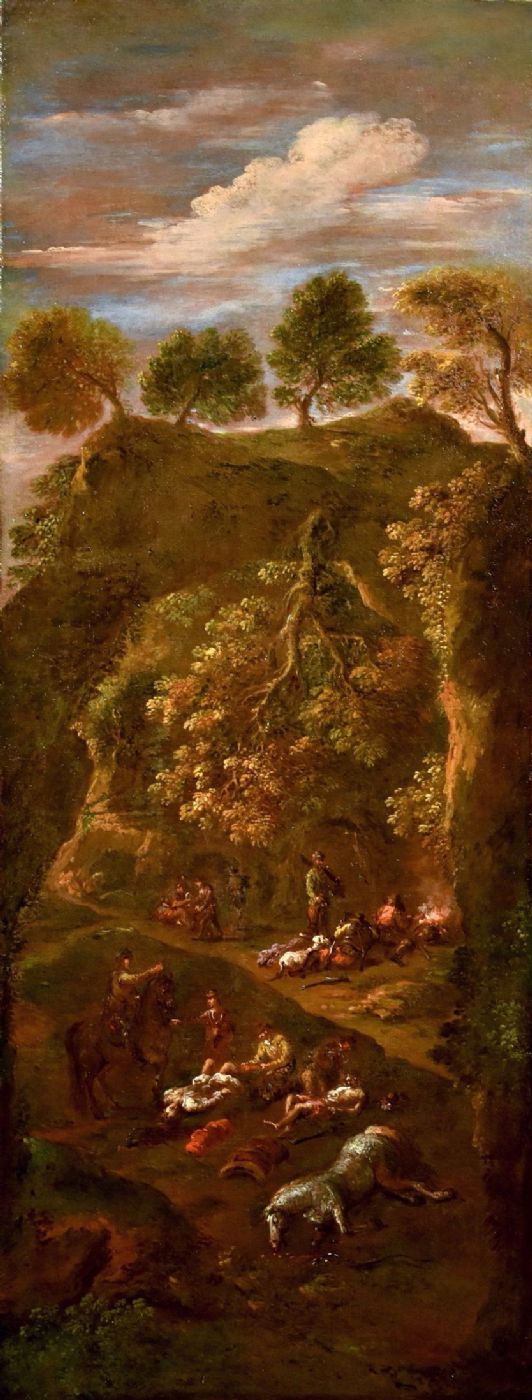
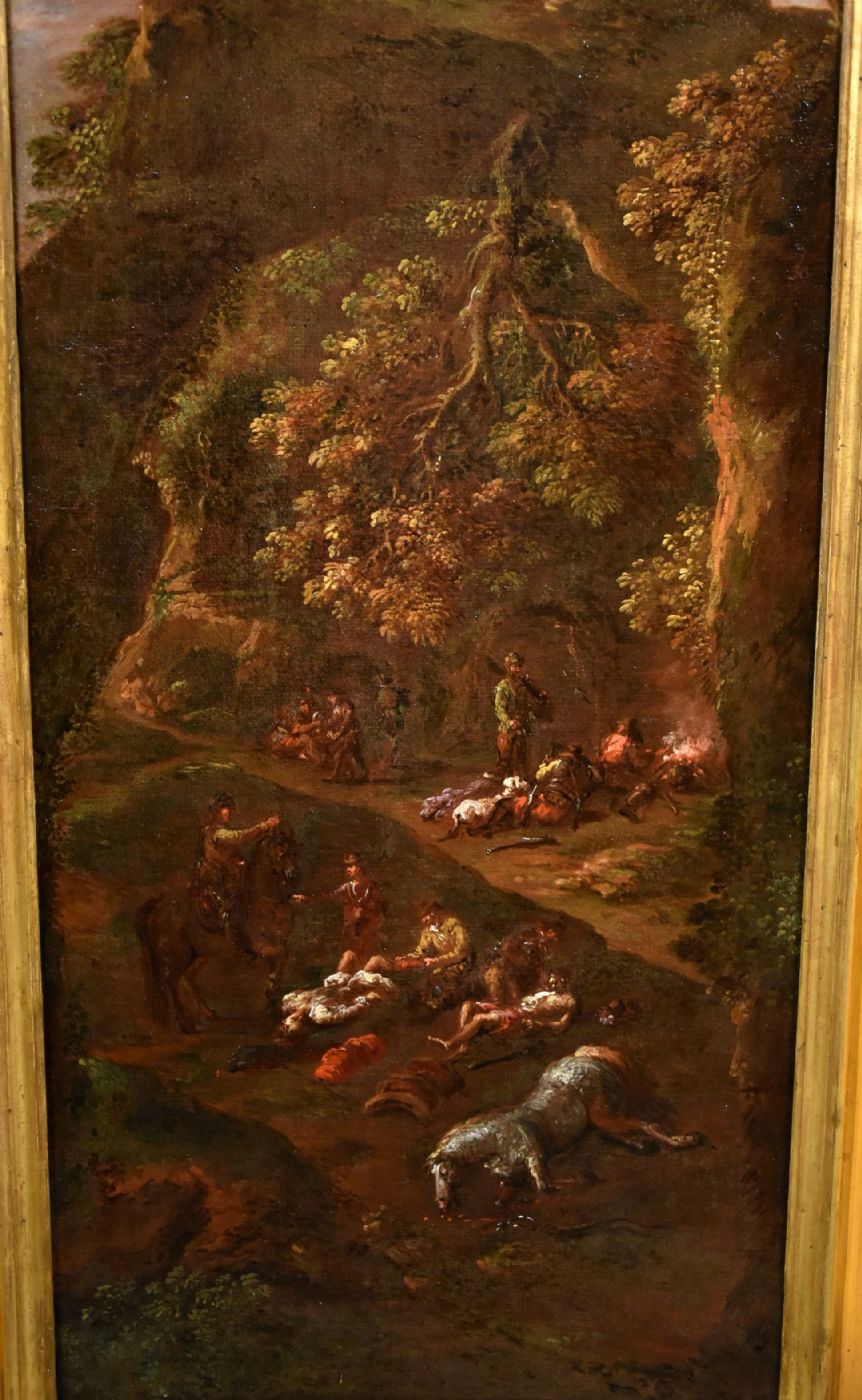
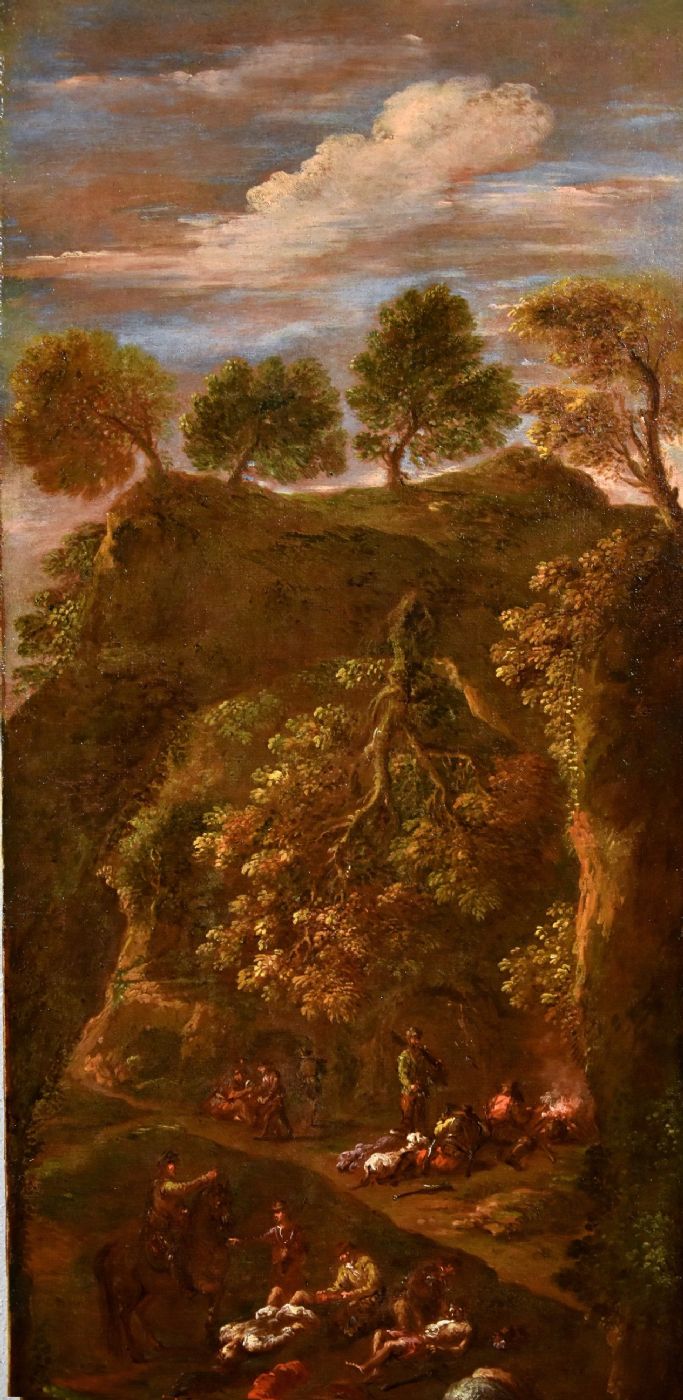
After the attack
Oil on canvas, 108 x 42 cm. each
Framed 128 x 62 cm.
We thank Dr. Federica Spadotto for having studied and traced the present pendant of paintings back to Giuseppe Zais' catalog. Below we propose the in-depth critical study.
Details: link https://www.antichitacastelbarco.it/it/prodotto/giuseppe-zais--pendant-di-dipinti
The Venetian landscape of the Golden Age has by now accustomed the public and scholars to extraordinary - as well as unexpected - contaminations between genres, sealing an artistic stage that is highly permeable to international suggestions. This undoubtedly occurs by virtue of the «foreign» origin linked to the rural repertoire, which registers the fundamental contribution of transalpine referents (Spadotto, 2014) with regard to the inspiration and the expressive alphabet of local artists.
Among the latter, the experience of Giuseppe Zais (Belluno 1709 - Treviso 1781) is fundamental, a painter who emigrated to the city of the lion probably between the 1730s and 1740s, where he would have carried out his apprenticeship with the battaglista (battle painter) Francesco Simonini (Parma, 1686- Venice or Florence, post 1755). It was, in fact, an established practice for any painter who aspired to an official role - that is, registration with the Fraglia (guild) -, to practice alongside an established character, such as the Parmesan master. Rather than a real apprenticeship, we must imagine the young painter active as a boy grappling with the war themes that had made Simonini famous in the Lagoon, where commissions were plentiful with the consequent need to entrust part of the work to a valid assistant (namely, our Giuseppe).
Only recently, thanks to the pictorial essays made known by Egidio Martini, has a nucleus of paintings executed by Giuseppe (fig.1) in close adherence to his master's repertoire been identified, and which for a long time were believed to be Simonini's autographs.
The analysis of these specimens highlights close affinities of form and style compared to those of Francesco, on which Zais grafts some guide characters that will become typical of his manner, among which the round tower and the characteristic physiognomy of the faces stand out.
Over the years, our artist will archive this experience in favor of Zuccarelli-inspired sunny afternoons, as well as collaborating with his son Gaetano (documented between 1765 and 1798) in his genre of choice. And precisely a landscape confectioned by the latter and made known by the writer (Spadotto, op.cit., 2014, fig.284, table XLV; fig.2) offers an important documentary piece to shed light on the extreme creative season of Our artist, passed over in silence by the sources and devoid of autograph works.
In the Ideal landscape with figures, statues and animals at the watering place (fig.2), Zais junior hands down a compendium of his father's production, expressed through a rather dense ductus and a chromatic grammar played on «earthy» tones, in line with the revival of Marco Ricci (Belluno, 1676-Venice, 1730) very much in vogue in the second half of the 18th century. Zuccarelli (Pitigliano, 1702-Florence, 1788) himself had also succumbed to the seduction of the Bellunese, creating the Bull Hunt (fig.3) now at the Gallerie dell'Accademia in Venice, a real exemplum with respect to the theme, where the same pictorial ingredients mentioned above emerge.
The remarkable pendant under examination is set in this horizon, which «displays» like a true testament to Giuseppe's long artistic career, from his beginnings as a specialist in battles to the extreme synthesis of the late eighteenth century.
Simonini's soldiers become knights at the mercy of an attack by brigands, who kill them and strip them of all possessions, as happens in After the assault, in which the compositional layout of the post-battle camp hosts the outcome of the fatal crime, perpetrated by characters in which we recognize the clothes and physiognomy of the peasants immortalized by Giuseppe in the famous rural passages.
The taste for detail, of clear Zuccarelli origin, merges with a fast, immediate style, which, however, does not betray the definition of the foliage in the typical, large trees called to frame the scenes, where the inspiration of the aforementioned Ricci merges with the northern European «fashion» common in Venetian figurative culture in the late eighteenth century.
Despite what the public's taste has expressed for most of the Golden Age, electing languid Arcadian poetry as the territory of its aesthetic ideals, the decline of the Serenissima brings back the echoes of that «stepmother nature» frequented by the first generation of landscape painters, which returns, very current, as a metaphor for a world destined to become extinct a decade after his death.