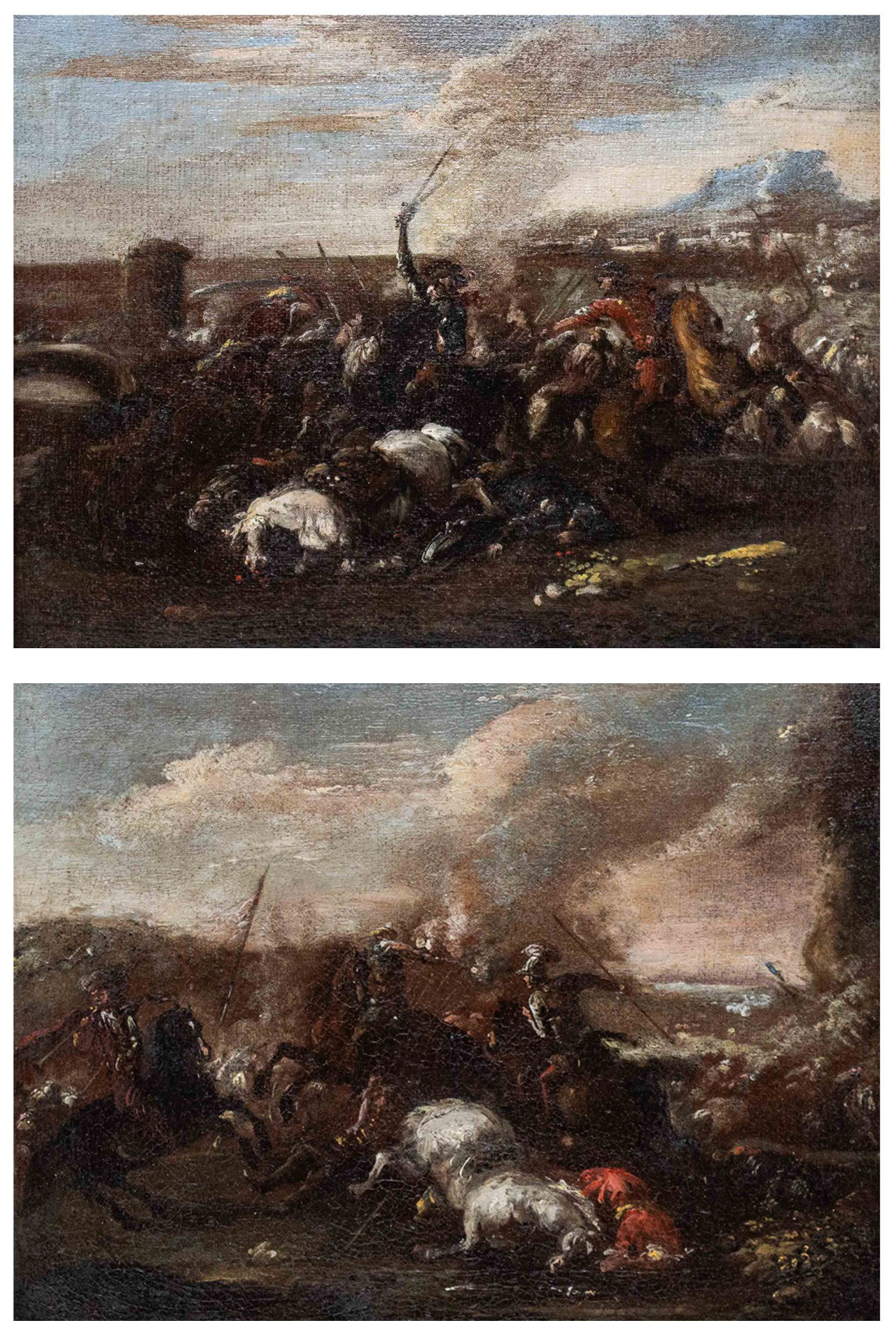
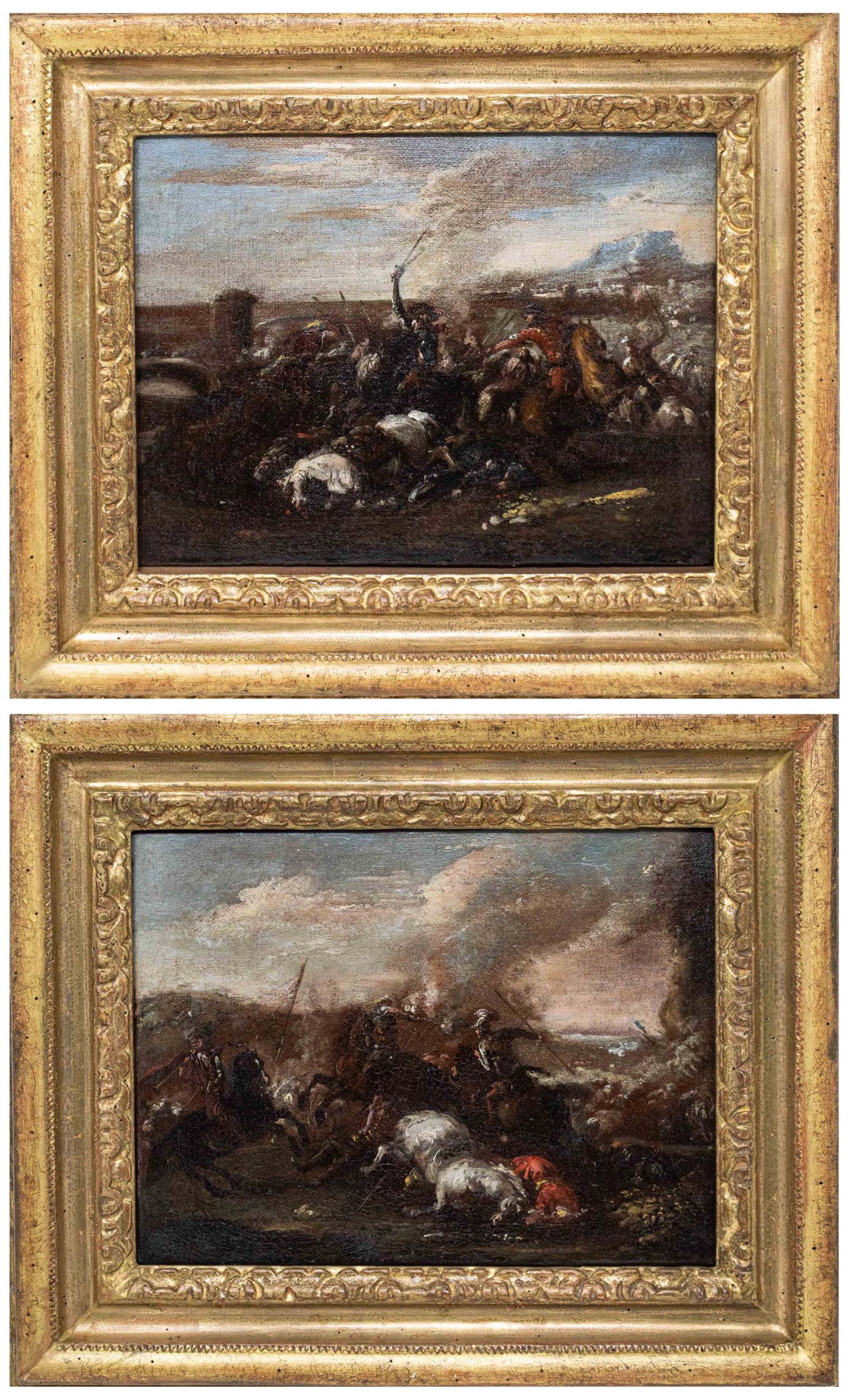
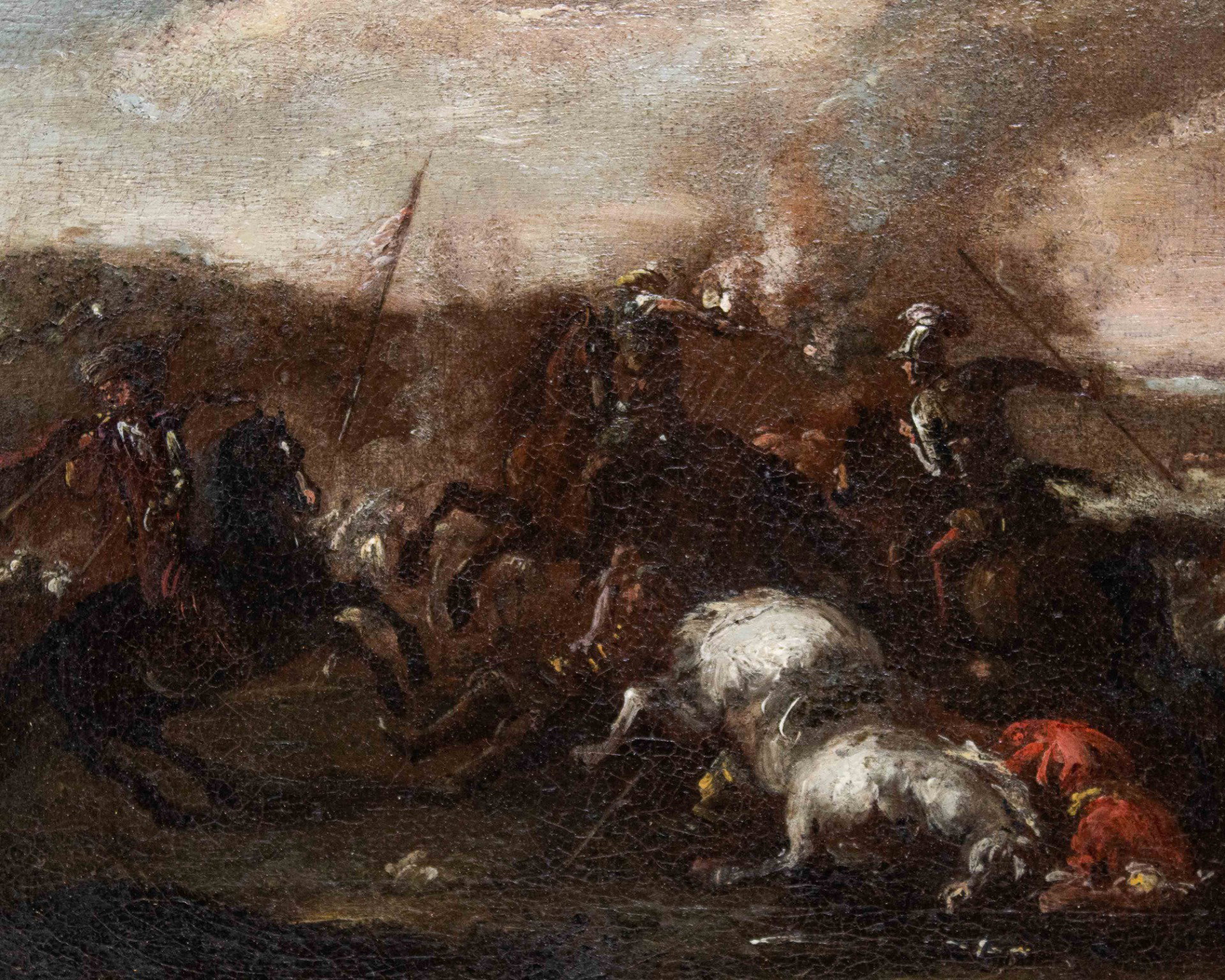
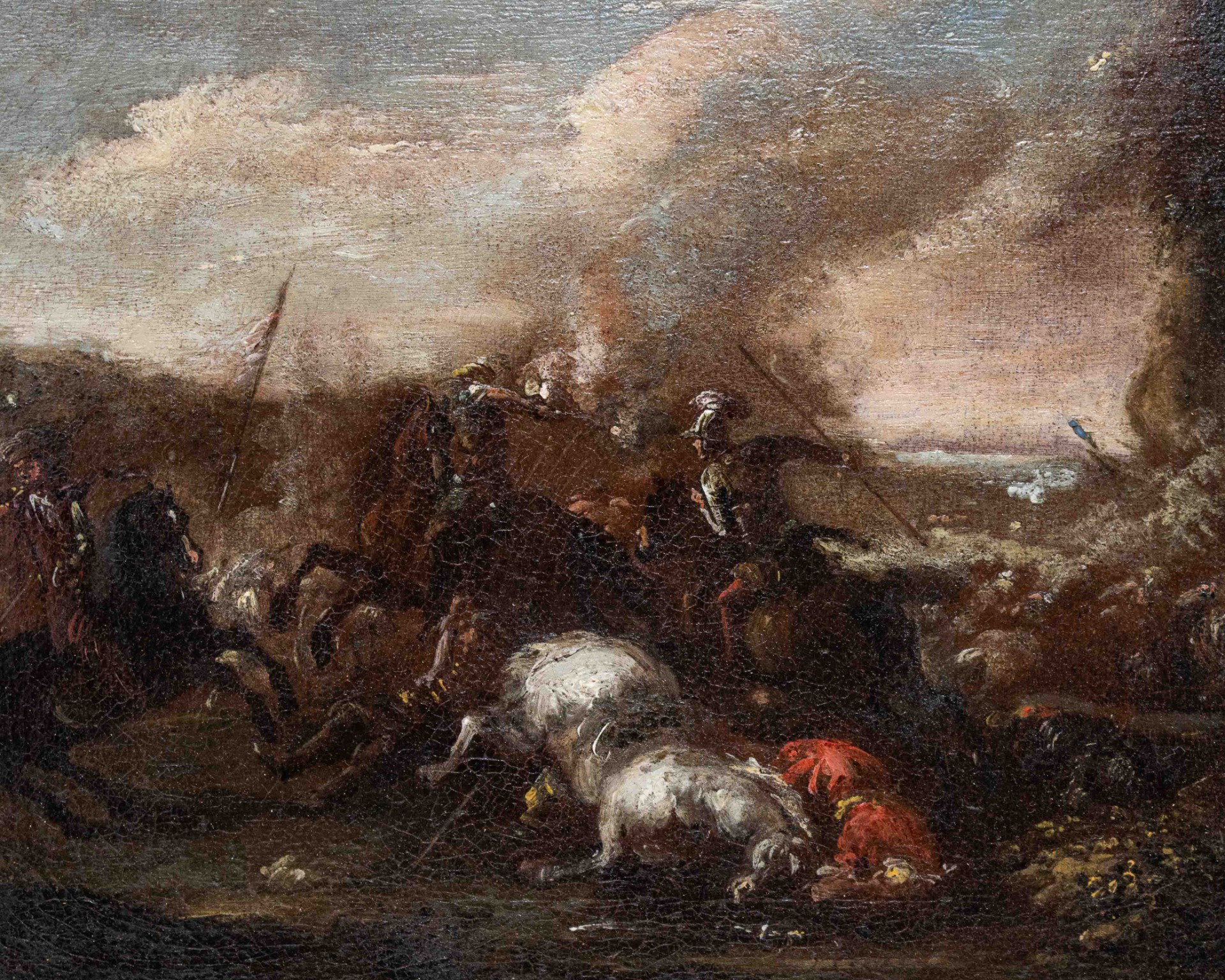
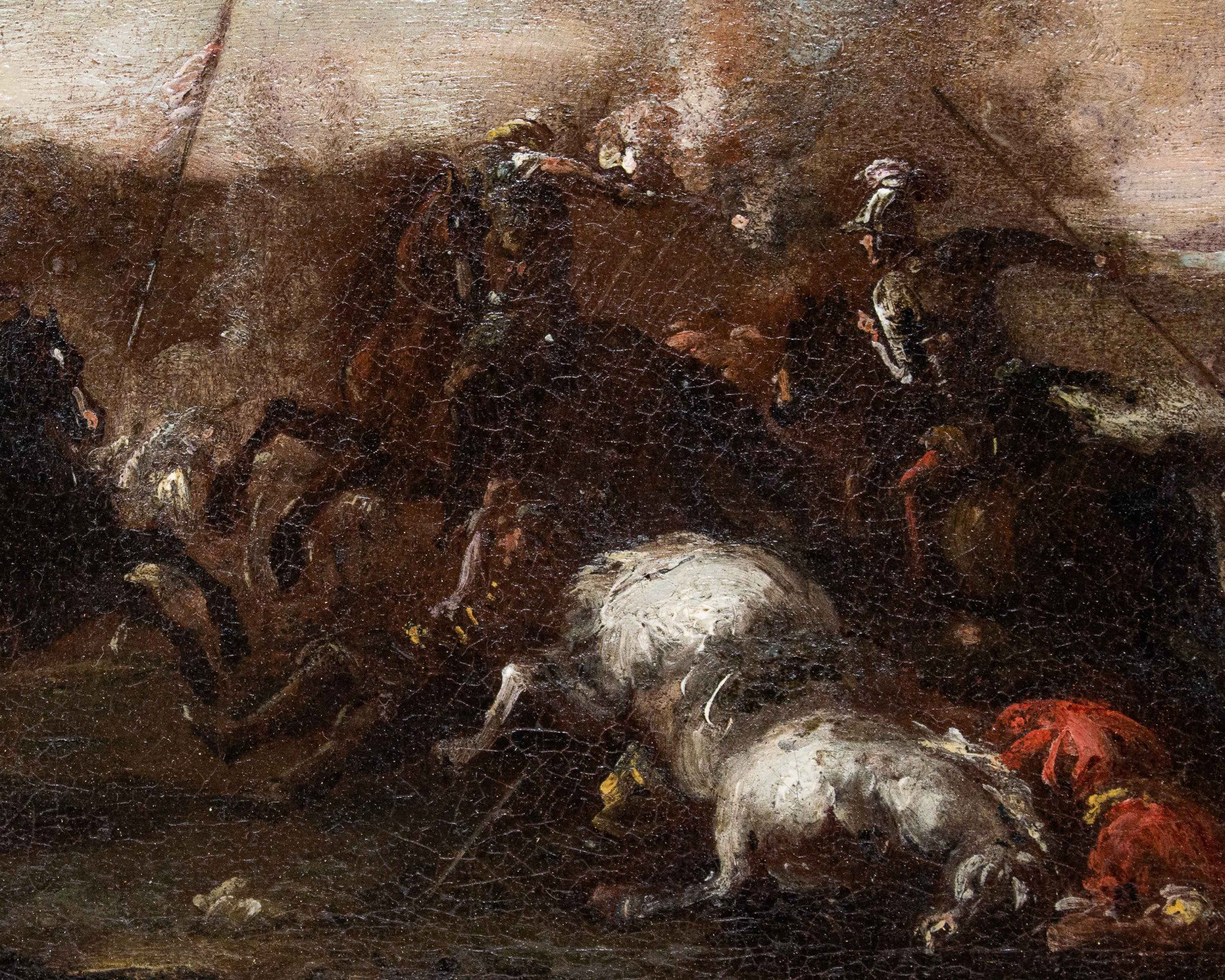
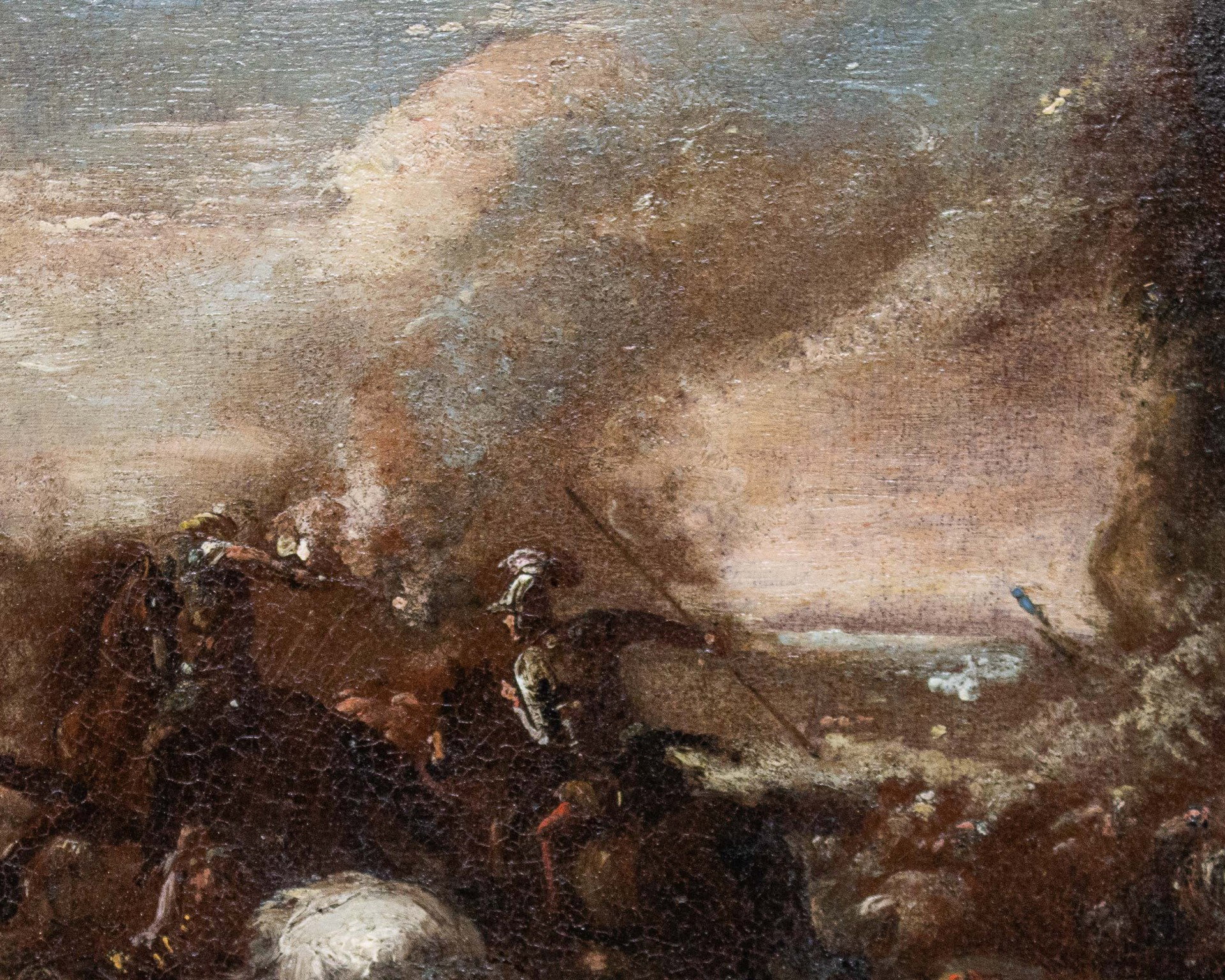
Francesco Graziani (active in the second half of the 17th century)
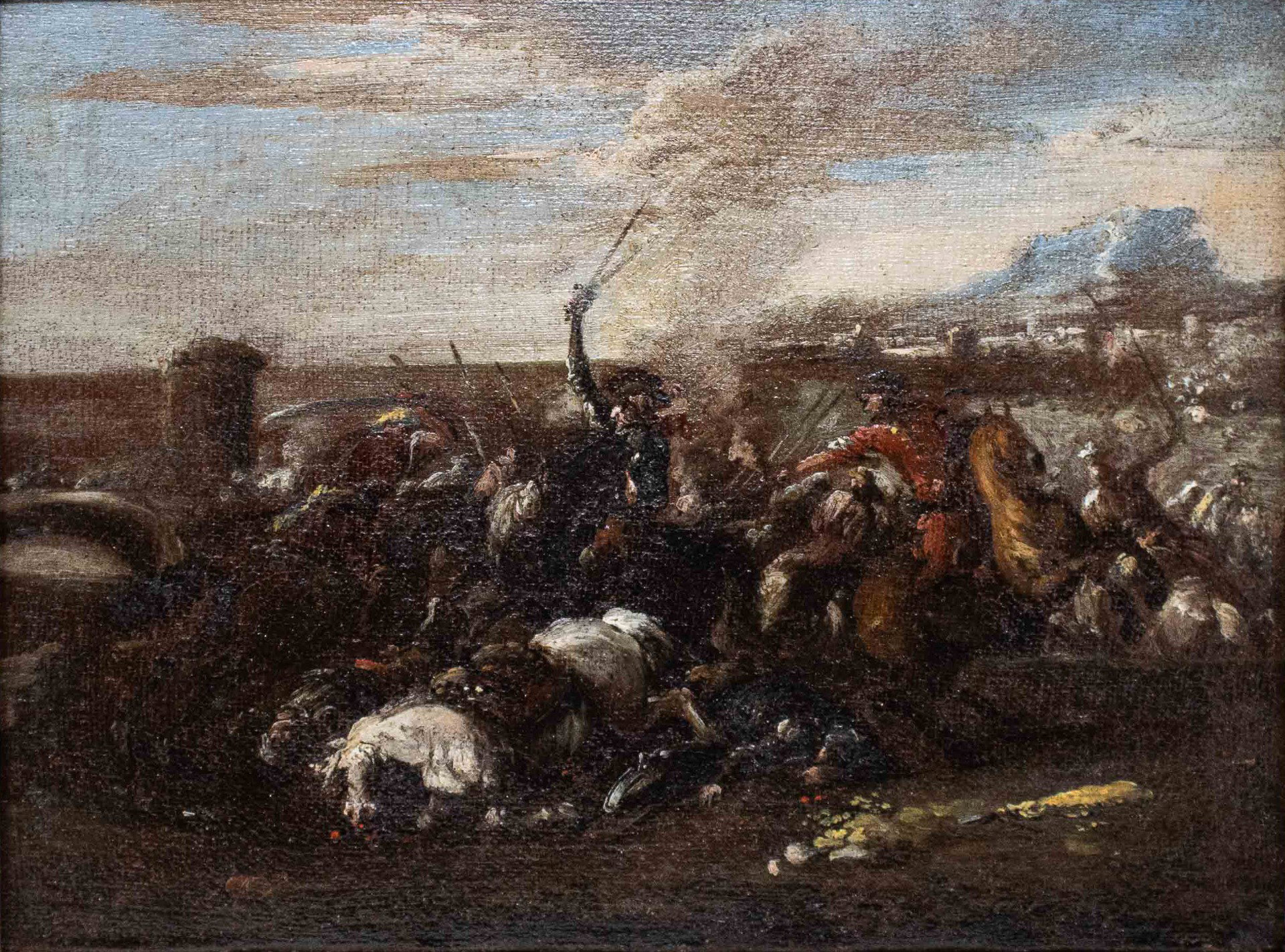
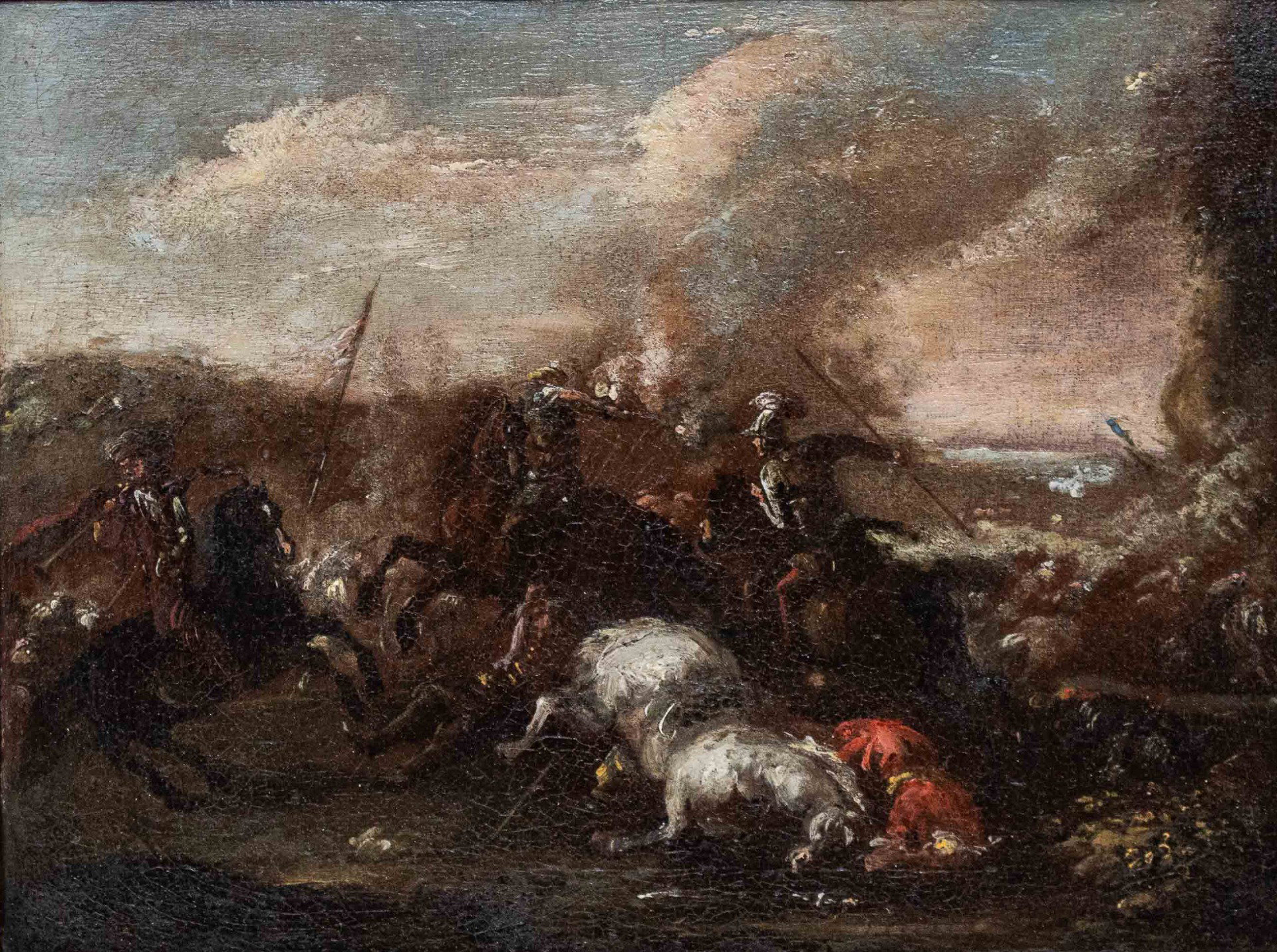
Battle Scenes
(2) Oil on canvas, 22 x 29 cm
With frame, 35.5 x 42.5 cm
Published in the volume "La battaglia nella pittura del XVII e XVIII secolo" (The Battle in the Painting of the 17th and 18th Centuries), edited by Patrizia Consigli Valente, 1986
The two small canvases depicting two cavalry clashes, and published in the volume "La battaglia nella pittura del XVII e XVIII secolo" (edited by Patrizia Conigli Valente, Banca Emilia, 1986) are attributed to the painter Francesco Graziani, also known as "Ciccio Graziani" or "Ciccio Napoletano". Probably born in Capua, as he is also mentioned in some inventories as "Ciccio da Capua", he lived and worked between Rome and Naples around the second half of the 17th century. In reality, the Grazianis mentioned in the sources as "battaglisti" (battle painters) are two; De Dominici in (1742) briefly writes about a Pietro, stating he does not know if he was related to or the son of Ciccio Graziani, who left works in Rome. The two personalities have often been confused and merged by modern criticism, with a large group of battles attributed to either Pietro or Francesco alone. In reality, the more lively aspect and the fluidity of the touch characteristic of 18th-century painting allow some compositions to be linked to the younger of the two. The art of Francesco, certainly influenced by Salvator Rosa and not distant in its results from Jan de Momper, has a curled and broken brushstroke. The decorative character, derived from the works of Borgognone and Salvator Rosa, is tempered in him by an illustrative sensibility that still finds an evident point of contact in the canvases of early naturalism. Nevertheless, the execution, with its speed and atmospheric sensitivity, not only suggests their full belonging to the Baroque era but also indicates a date of execution that approaches the 18th century. The general character of the works presents that synthesis of rapid touches and vigorous emphasis attributable to Graziani's catalog, who composed his scenes with crowded movements where the figures are outlined with a quick and nervous stroke, invigorated by effective luminous touches. The color palette, set on silvery and gray-blue tones, is also characteristic.
Biographical information about the painter is scarce. Lanzi (1808) recalls among the pupils of Jacques Courtois, known as Borgognone, a certain Graziani, who could be identified with Francesco. As early as the 1970s, Francesco had most likely moved to Rome; starting from 1671, he painted a series of canvases (now lost) with Stories from the Old and New Testaments, placed in the central nave and choir of the Basilica of Ss. Apostoli in Rome. Not only battles; in Rome, he also proved to be a figure painter, as evidenced by an oil canvas with the Preaching of the Baptist in the Cimini Chapel in S. Antonio dei Portoghesi, dated around 1683, still preserved in situ, and another with Mary Magdalene the Penitent for the church of S. Croce della Penitenza (or delle Scalette) alla Lungara, identified with the Crucifixion and St. Mary Magdalene, now in the parish church of Ardea. Despite this, as testified by Titi and De Dominici (1743), the artist owes his fame to his battle scenes, highly appreciated also by important Roman families such as the Barberini; in 1686, Barberini inventories listed his paintings, not yet identified, of horses, seascapes, and especially battles. Some of his compositions are preserved in important museums and collections: the two Battles in the Galleria Pallavicini, mentioned in the inventory as "by the Neapolitan" and "Gratiani", those in the Galleria Doria Pamphili, the Musée d'art et d'histoire in Geneva, and the Walters Art Gallery. It is worth mentioning the series of large tempera Landscapes preserved in the Galleria Doria Pamphilj, once attributed to Gaspard Dughet and now largely considered to be by Crescenzo Onofri, but of which at least three are by Graziani: Landscape with a Scene of Banditry, Coastal Landscape with a Farmer Felling a Fence, Coastal Landscape with a Boat. Luigi Salerno, in the catalog of the exhibition on the "Civiltà del Seicento a Napoli" (The 17th Century Civilization in Naples), attributes some certain works to him, such as the two battles from the Civic Museum of Pistoia and the four from the Civic Museum of Deruta, on the back of one of which is a note by Pascoli, "by Graziani, excellent painter".
With Ars Antiqua, it is possible to pay for all amounts up to a maximum of €7,500 at ZERO INTEREST, for a total of 15 INSTALLMENTS.
E.g. Total €4,500 = Monthly installment €300 for 15 months.
E.g. Total €3,600 = Monthly installment €720 for 5 months.
For amounts exceeding €7,500 or for longer payment terms (beyond 15 months), we can provide a personalized payment plan.
Contact us directly for the best quote.
LIVE TV
– SUNDAY 5:00 PM – 9:00 PM Terrestrial Digital 126 - Sky 824
– Streaming on our website www.arsantiquasrl.com and on our social media Facebook and Youtube
All works offered by Ars Antiqua are sold with a certificate of authenticity in accordance with the law and an accurate in-depth fact sheet.
It is possible to view the works directly at the gallery showroom in Milan, at via Pisacane 55 and 57.
We personally organize transport and delivery of the works, both for Italy and abroad.