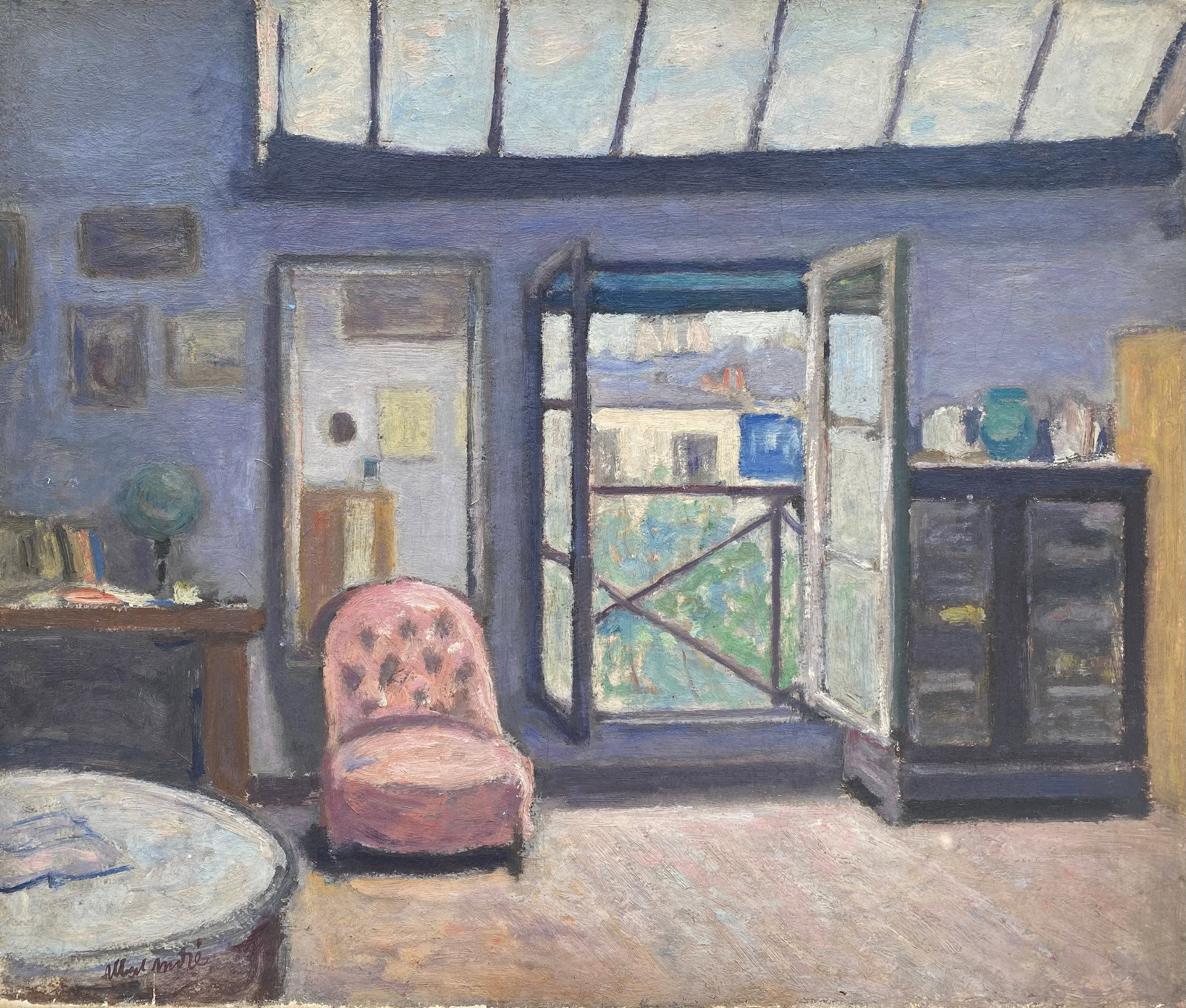
Certificate of Authenticity:
Albert André
(Lyon 1869-Avignon 1954)
"Artist's Studio"
Oil on canvas 46 x 55 cm
Signed lower left Albert André
On the back there is a label showing participation in an exhibition.
Albert André, painter of landscapes, still lifes and interior scenes, particularly linked to Renoir and a friend of Vuillard, Vallotton, Bonnard, Valtat, Marquet, Maufra, Monet, of whom he made numerous portraits: “Claude Monet in his garden” (1913) is now kept at the Art Institute of Chicago.
André was born in Lyon on May 24, 1869 and died in Avignon in 1954.
Arriving in Paris in 1889, at just 20 years old, he entered the Académie Julian where he met Ranson, Valtat and Henri Bataille.
In that period the “Salon des Indépendants” was born, where in 1894 he exhibited 5 paintings:
Bateaux sur la Seine; Place St. Jacques, autumn; Place St. Jacques, winter; La Seine dans Paris; Maturity, sketch;
all purchased by the famous dealer Paul Durand-Ruel.
On this occasion, André was noticed by Renoir, of whom he became a close friend. As proof of this friendship, André not only depicted the great impressionist master in numerous paintings, he also published an essay considered an authentic journey into Renoir's intimacy:
“Reading transports us to Renoir, like a witness present at his gestures and words. We see him, we hear him.”
(Marius Mermillon)
He first worked in Paris and London before moving to the south of France.
He exhibited at the Salon d'Automne from 1904 and at the Salon in Mulhouse.
(see attached list)
He exhibited at the Salon des Tuileries in 1923, 1924 and 1926.
In 1908 André exhibited three paintings (Fruits, Guéridon and Artichaut) within the important avant-garde artistic movement “La Libre Esthétique” alongside Claude Monet, Auguste Renoir, Paul Signac, Emile Claus,…
In 1924 he exhibited in New York and Buenos Aires.
He participated in numerous other international exhibitions. (see attached list)
André knew how to interpret the lesson of the Impressionists in search of the exact light in order to maintain the balance between what is and what appears.
The art critic E.Faure wrote:
“A curious witness of his time, he persisted in making painting and not paintings”
In 1917, André became the curator of the Bagnols-sur-Cèze Museum (now the Albert André Museum) in which he helped include the works of his friends Matisse, Bonnard, Vuillard, Angrand, Van Risselberghe, d’Espagnat transforming it into one of the most important museums of avant-garde painting of his era.
Description:
In this interior imbued with natural elegance, each element depicted seems to silently tell the story of the master's studio.
“Albert André's work is a loyal and confident conversation with the beings and things of which he was always the best comrade.”
(Marius Mermillon)
The wide-open window through which the light penetrates suggests the artist's hidden presence.
In particular, the pink armchair stands out from the composition, an object to which André was probably linked as it was represented in other paintings.
(see attached drawing)
Works present in the following museums:
France: Paris: Musée d’Art Moderne, Musée d’Orsay;
Musée d’art et d’histoire of Saint-Denis; Musée Albert André of Bagnols-sur-Cèze: “La femme en rouge”, “Portrait de Renoir”; Musée “Regards de Provence” of Marseille;
The Art Institute of Chicago holds the painting: “Claude Monet in his garden” (1913);
Switzerland: Petit Palais of Geneva
Bibliography:
“DICTIONNAIRE DES PEINTRES SCULPTEURS DESSINATEURS ET GRAVEURS”
E.Benezit Vol.1 (pp 173-174)
“DICTIONNAIRE DES PETITS MAITRES DE LA PEINTURE 1820-1920”
Schurr & Cabanne. Les Editions de l’Amateur (pp. 30-31)
“ALBERT ANDRE”
Marius Mermillon
Les Ed.G.Crès & C.
State of conservation: excellent.