17th century, Flemish School
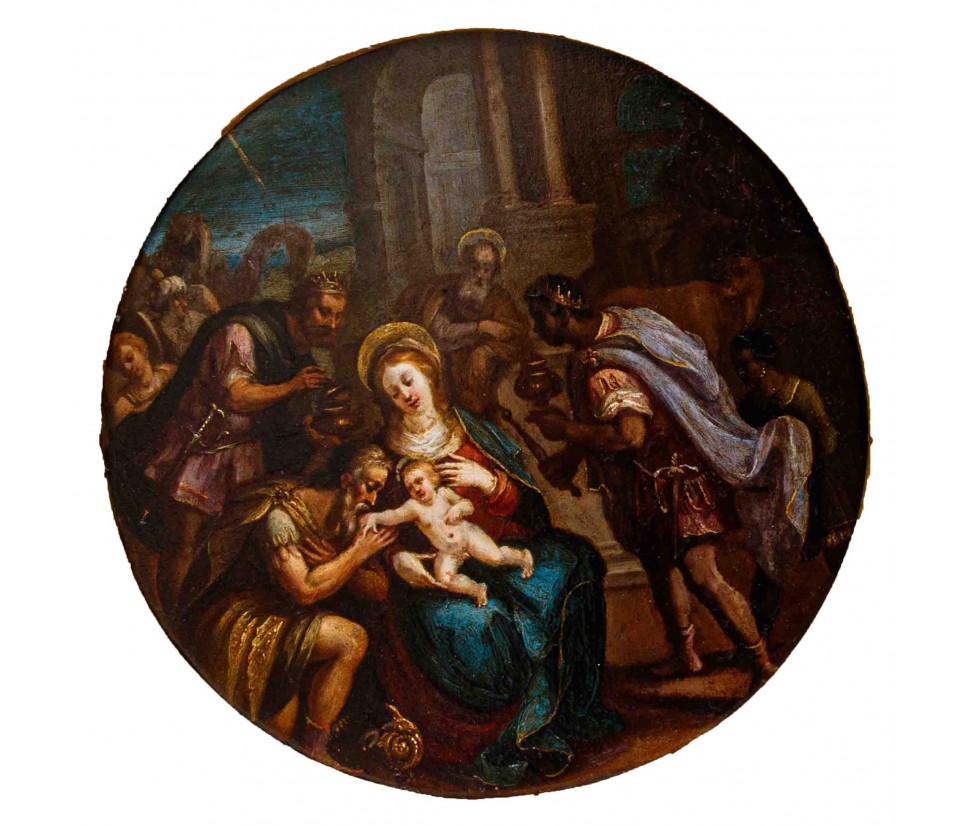
Adoration of the Magi
Oil on copper, diam. 19.5 cm
With frame 35.3 x 35.3 cm
Engraved on the back in 17th-century calligraphy "Fiamingo"
Vivid adoration scene, brilliant with the most symphonic colors. The particular copper support allows the artist's inspiration to express itself to the fullest expressive vein, highlighting through a splendidly vibrant color iridescence a composition that is both choral and of intimate devotion. The procession of the Magi is depicted, consisting of the traditional trio of exotic rulers, although the canonical Gospels do not mention the number on any occasion. The figural specification of the three, defined according to a crescendo of maturity, is a metaphor for the total participation, by humankind, in the birth of Christ, both of the young and of the more mature. The candor of the Virgin and Child, combined with the cobalt blue of the Mother's maphorion robe, stands out exceptionally against the gold and claret of the Magi's robes; a soft fluttering of cloaks renders the palpitation of the moment, in which the three ambassadors reach out simultaneously toward the Son, in a joyful and uncontainable homage. In the background, Joseph observes the scene peacefully; the addition of ox, donkey and camels, as well as the superb tail of the comet, completes the delicate picture, infinitely precious in the pearly touches of light that illuminate the crowns and hilts of the Magi, happily touching in the nocturne that veils the sky in the distance.
As recalled in the engraving on the back of the copper, which identifies the artist of the present one as "Fiamingo," it is possible to compare the painting to the contemporary examples made by artists of the caliber of the eclectic Frans Francken the Younger (1581-1642) and Simon de Vos (1603-1676). Francken's gentle and luminous world, reprised in the lucid shapes of the painting under examination, also recurs in the Adoration of the Magi executed by the Flemish artist and now held at the Courtier Lodgings of the Royal Castle in Warsaw, as well as in the National Museum of the same city. Dean of the pictorial Corporation of St. Luke of the southern Netherlands school from 1614, Francken specialised in small-format paintings, rising to become the main model among Flemish artists; he excelled in many areas, and placed himself at the head of a thriving workshop which was later joined by his son Frans Francken III (1607-1667). A replica of the copper presented here recently passed on the antiquarian market, not of superb workmanship as the present one. The progenitor of the Francken influenced the works of contemporaries Pieter Paul Rubens, Jan Brueghel the Elder and David Teniers the Younger. Simon de Vos is comparable to the present, in addition to obvious formal assonance, for the repetition of the exotic and darting camel on the left side of the painting, in works now preserved in private collections. Note the figurative derivation of the present camel with the one executed in the volume Historiae animalium published in Zurich in two stages, first between 1551-58, then in 1587, a revolutionary encyclopedia of zoology edited by Conrad Gesner, professor of the Carolinum, then an ancestor of the University of Zurich.


.jpg)
.jpg)
.jpg)