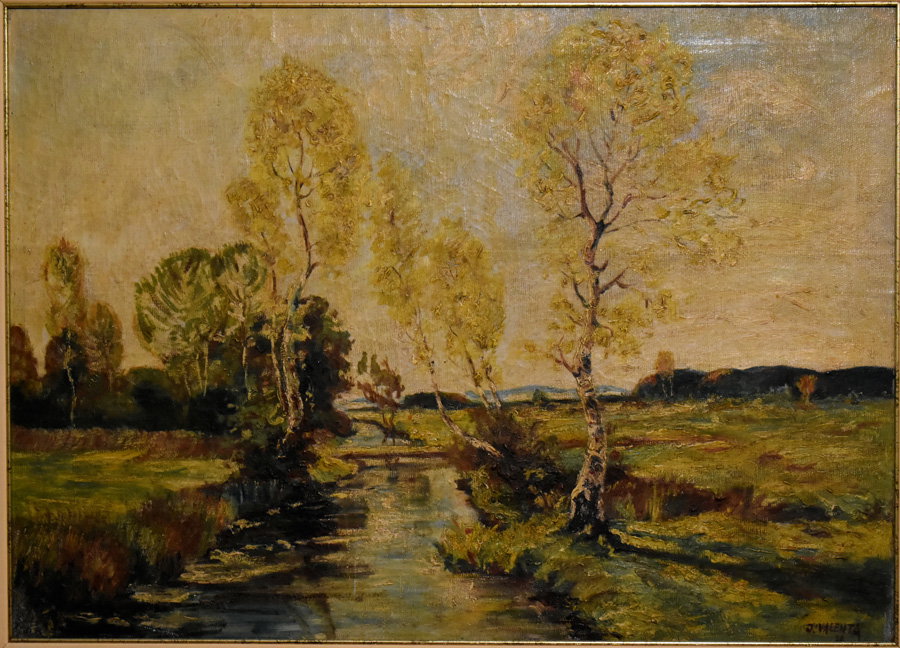
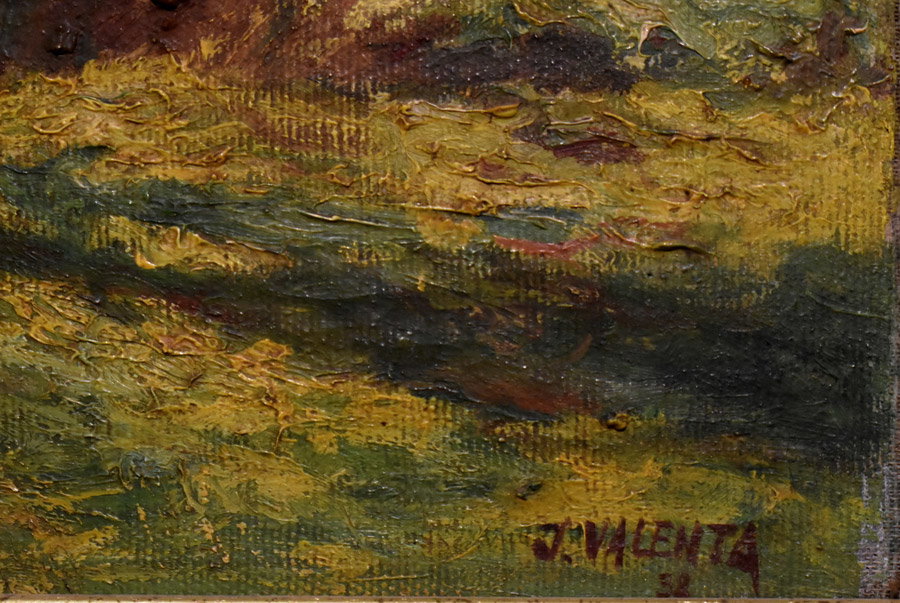
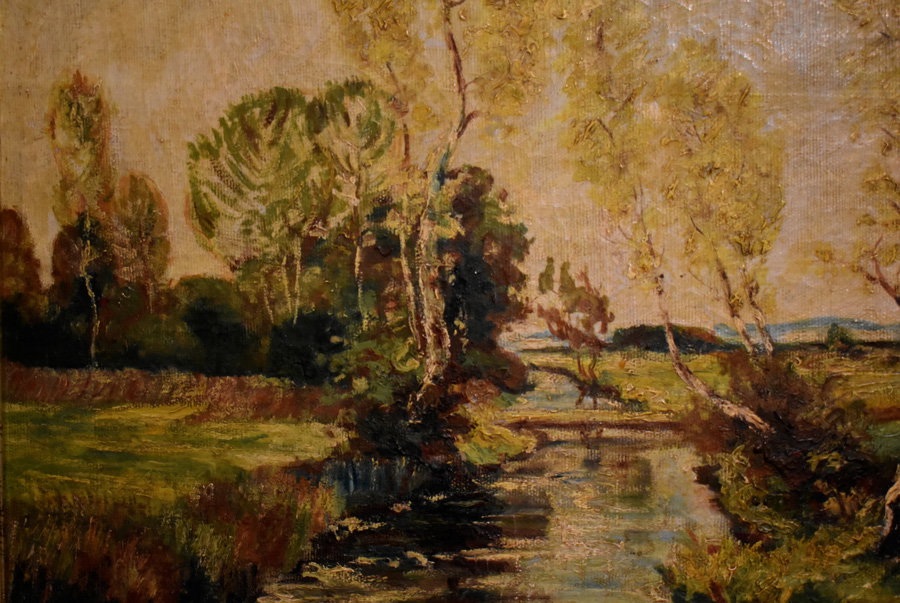
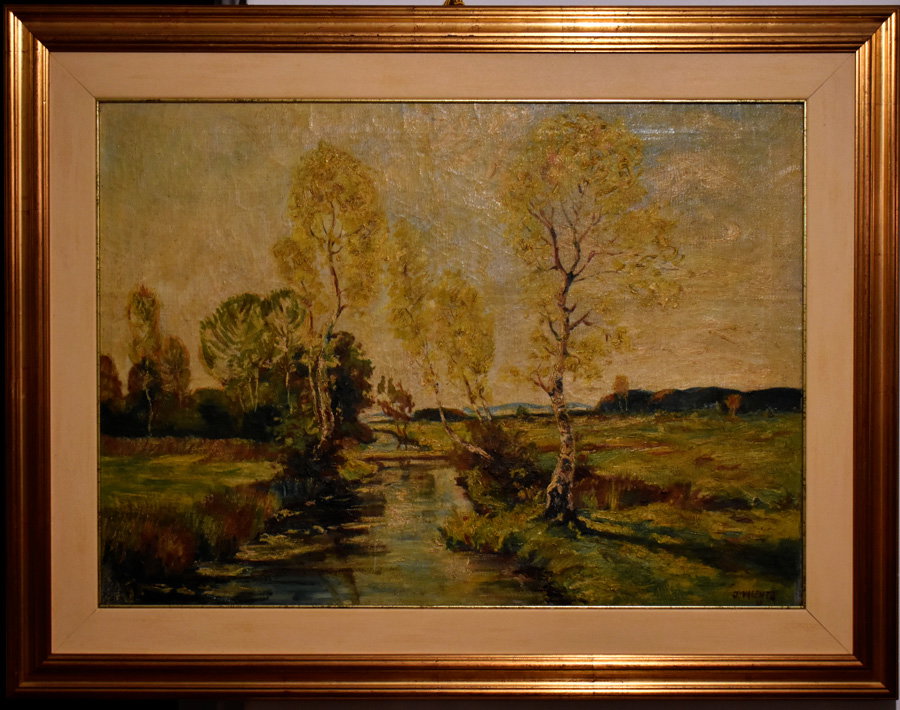
Oil on canvas, autumnal landscape by the well-known and highly appreciated Bohemian painter Jiri Valenta. Signed, dated 1958. Dimensions: 65 x 83 cm with frame, 67.5 x 48.5 cm canvas. In good condition, with very slight paint losses in the center of the painting (see detailed photo). Not restored.
Jirí Valenta (Prague, August 6, 1936 – Cologne, July 11, 1991) was a Czech painter, engraver, and photographer. Following the invasion of Czechoslovakia by the Warsaw Pact, he emigrated to Germany. From 1972 until his death, he lived in Cologne. Biographies and works: From 1951 to 1953, he attended the Higher School of Fine Arts in Prague. In his second year, he received an exemption as an exceptional talent and at the age of seventeen was admitted to the Academy of Fine Arts in Prague without a diploma. From 1953 to 1959, he studied with Prof. Miloslav Holý and Prof. Karel Soucek. In 1963, he held his first solo exhibition of drawings at the Mánes Club, and in 1965, he exhibited his paintings and drawings in Brno. In the same year, he was selected along with five other young European artists for an exhibition at the Galerie Lambert in Paris (Cinq jeunes peintres d’Europe de l’Est). He participated in the IV. Biennale at the Musée d'Art Moderne de la Ville de Paris, where the jury intentionally chose Czechoslovak artists who presented a distinct and authentic expression capable of holding its own against international competition (J. Valenta, B. Dlouhý, A. Veselý, K. Nepraš, A. Kucerová, R. Fila). In the following years, he exhibited at the Mánes Gallery in Prague and the Regional Gallery of the Highlands in Jihlava, and in 1967, he was accepted into the Czechoslovak Art Union. Together with the architect M. Hrubý, Valenta prepared the reconstruction of the Chapel of St. John of Nepomuk in the village of Stáj, but after the invasion of Czechoslovakia by the Warsaw Pact, the reconstruction was never carried out. After the invasion of Czechoslovakia by the Warsaw Pact, he traveled first to Vienna and then to Germany. In 1969, he settled in Hof Dodau near Eutin, in the studio of the Berlin gallery owner J. Kilian. From there, he moved to Plön. He exhibited in Toronto, Bochum, and Sweden. In 1971, thanks to a one-year scholarship from the Emil Nolde Foundation, he worked in his house in northern Germany in Seebull. In 1972, he moved from Plön to Brühl and then to Cologne, where from 1973 he was hired by the local municipality as a technical draughtsman and participated in the preparation of the zoning plan of Cologne. In the 1980s, he traveled extensively (France, England, Italy, Holland, Africa). At the end of the 1980s, he was diagnosed with a malignant tumor. In 1990 and 1991, he visited Prague and met his mother and friends. He died in Cologne and is buried in the Brevnov Cemetery in Prague. Valenta's school paintings are dominated by silvery still lifes and gray-green landscapes. The painter's private work expresses the challenge and existential skepticism common to an entire generation of artists studying at the Academy in the 1950s (The Ghost of the Killed, 1959). Already during his studies he found inspiration in the art brut of Jean Dubuffet, in the material compositions of A. Tàpies or in the collages of Burri made of canvas (Sacks), but the essence of his work is spiritual and founded on theoretical considerations. At the beginning of his career, he fleetingly touched on figuration in paintings that deliberately evoked raw primitive art or children's drawings (Girl with Ball, 1959, Venus, 1959). In the late 1950s and early 1960s, he turned to structural painting. The relief structure and color of his paintings, reduced to natural light ochre, sand, cream, and greenish tones, are directly inspired by the rocks of the Kokorín valley, where they had taken trips together as students (Collage VIII, 1961). To create a relief surface, he mixed sand first into the paint and then into the Acronex synthetic resin. Pieces of fabric glued onto the canvas as rectangular and circular fields in the abstract Collage series testify to Valenta's "nostalgia for order" and his need to bring geometric elements to the informal image that surpassed the randomness of structural confusion. Valenta's artistic expression tends towards contemplation, which is also affirmed through color, first as a luminous background in the Triptych series (1959) and then as colored and luminous opalescent circular centers in the Portraits of Slowly Growing Processes series (1962-1963). The portraits were recordings of various situations, concrete things, or even a conversation. The striated lines of the circular motifs on the surface of the relief paint suggest movement and internal tension, but the imperfect shapes and forms are only phases of an open process. The change of the lava texture of the painting towards an opaque and slightly pinkish synthetic paste is related to the transition to organic structures in the subsequent cycle of Synthetic Fabrics (1963-1964), where the formations become isolated as white circles surrounded by a dilapidated structural painting. Valenta's pictorial development has an internal logic from which he does not deviate, even in the mid-1960s, when many of his generational peers returned to figuration. Valenta continued his cycle of abstract portraits until his emigration in 1968 (Portrait of a Situation III, 1965, Portrait of a Black Egg, 1965, Portrait of a Young Blind Man (1965-1966), Portrait of the Annunciation, 1966, Small Portrait of a Voice II, 1966-67). Immediately after his involuntary emigration, during his stay in Dodau (October-November 1968), Valenta created a cycle of nine paintings, Homage to Master Theodoric, subtitled Nine Attempts to Suspend Man in Space. It was a reaction to his departure from the country to which he was bound by his roots and an expression of his personal bond with the leading Czech medieval master, who became for him at that time an important emotional security and a necessary clue in the vastness of an unknown world. The depressing awareness of not being able to influence the events that take place outside him and without his contribution is expressed in the paintings of 1970 (Votive Tablet for Saint Krapp, Votive Tablet for Saint Lala, 1970), whose titles refer to the absurd play Krapp's Last Tape by Samuel Beckett. They draw a space with a central perspective, the indifferent contours of circular sections suggest fragments of bodies. The metallic golden surface as a symbol of divine presence and the rich blue and red colors may suggest an association with medieval paintings.
In 1978, Jirí Valenta felt that he was no longer able to express himself through painting, so he stopped painting and devoted himself to photography for the rest of his life.
Present in the following collections
Gallery of the Central Bohemian Region in Kutná Hora (GASK) Gallery of Modern Art in Roudnice nad Labem Museum of Art of Olomouc Aleš Gallery of Southern Bohemia in Hluboká nad Vltavou Karlovy Vary Art Gallery Modern Art Gallery in Hradec Králové Fine Arts Gallery in Ostrava Regional Gallery of Liberec
Exhibitions: 1963 Jirí Valenta: Drawings 1959-1962, Artists' Club, Mánes Prague 1965 Jirí Valenta: Paintings from 1959 to 1965, House of the Lords of Kunštát, Brno 1966 Jirí Valenta: Paintings on Board, Youth Gallery, Mánes, Prague 1968 - Jirí valenta: Malerei-graphik-objekte, Neue Universitätsbibliothek, Kiel 1969 Jirí Valenta, Jan Koblasa, bbk Galerie, Hannover 1969 Jirí Valenta, Galerie Matou, Hamburg 1969 - Jirí Valenta, Jan Koblasa 1970 - Jirí Valenta, Jan Koblasa, Städtische Kunstgalerie Bochum 1972 Jirí Valenta: Bilder, Zeichnungen, Graphik, Galerie Die Goldschmiede, Bochum 1995/1996 Jirí Valenta (1936 - 1991): Collective works / Gesamtwerk, Wallenstein Riding School, Prague, House of the Arts, Ostrava, Bochum Museum 1998 Jirí Valenta: Photographs / Fotografien, Gallery of Modern Art of Roudnice nad Labem 2002 Jirí Valenta: Works from 1967 to 1977, Ztichlá klika Gallery, Prague 2004 Jirí Valenta: Collages, Galerie Litera, Prague 2009 Jirí Valenta: Anthropometric meditations, Galerie Brno 2015 Jirí Valenta: Malír fotografem, Becherova vila Interactive Gallery, Karlovy Vary 2016/2017 Jirí Valenta a mysterium umeleckého znovzrození: Informelní tendence v 50. a 60. letech 20. století / Jirí Valenta and the Mystery of Artistic Rebirth: Informal Tendencies in the 1950s and 1960s, Kampa Museum - Jana and Meda Mládkovy Foundation, Prague
International Exhibitions : 1962 IV. Biennale des Jeunes, Musée d'Art moderne, Paris 1965 IV. Paris Biennale, Musée d'Art Moderne de la Ville de Paris (ARC), Paris 1965 - Cinq jeunes peintres d'Europe de l'est, Galerie Lambert, Paris 1965 - Malarstwo a rzezba z Pragi, Kraków, Kraków 1967 - Moderne Kunst aus Prag, Caroline-Mathilde-Räume im Celler Schloß, Celle, Wilhelm-Morgner-Haus, Soest, Kunsthalle zu Kiel, Kiel 1968 - Künstlergruppe arche mit 10 Malern aus Prag, Kunstkreis Hameln, Fritz-Henßler-Haus, Dortmund 1969 Jan Koblasa, Jirí Valenta, Schloß Celle, Celle 1970 Konstgruppen Grupp, Galleri 54, Göteborg, Alingsås konsthall, Alingsås 1970 Guderna, Hovadík, Koblasa, Valenta, Merton Gallery, Toronto 1974 Tschechische Künstler, Galerie Ursula Wendtorf + Franz Swetec, Düsseldorf 1980 - Die Kunst Osteuropas im 20. Jahrhundert, Garmisch-Partenkirchen 1985 Schmerzende Wunde, Galerie Rafay, Kronberg im Taunus (Hochtaunuskreis) 1987/1988 Berlin - Tendenz - astukt: Brenneisen, Fuchs-Heidelberg, Lehmann, Matsuo, Valenta, Kunsthaus, Nuremberg 1991 - Czeska sztuka 2. polowy XX wieku ze zbiorów Galerii Sztuk Plastycznych w Ostrawie, Muzeum Górnoslaskie w Bytomiu, Bytom 1996 Eine Promenade der Romantiker, Stadtmuseum Göhre, Jena 1998 Jan Koblasa, Jirí Valenta, Botschaft der Tschechischen Republik, Bonn 2005 - Argumenta z kolekcji Gerharda Jürgena Bluma-Kwiatkovskiego, Atlas Sztuki, Lódz