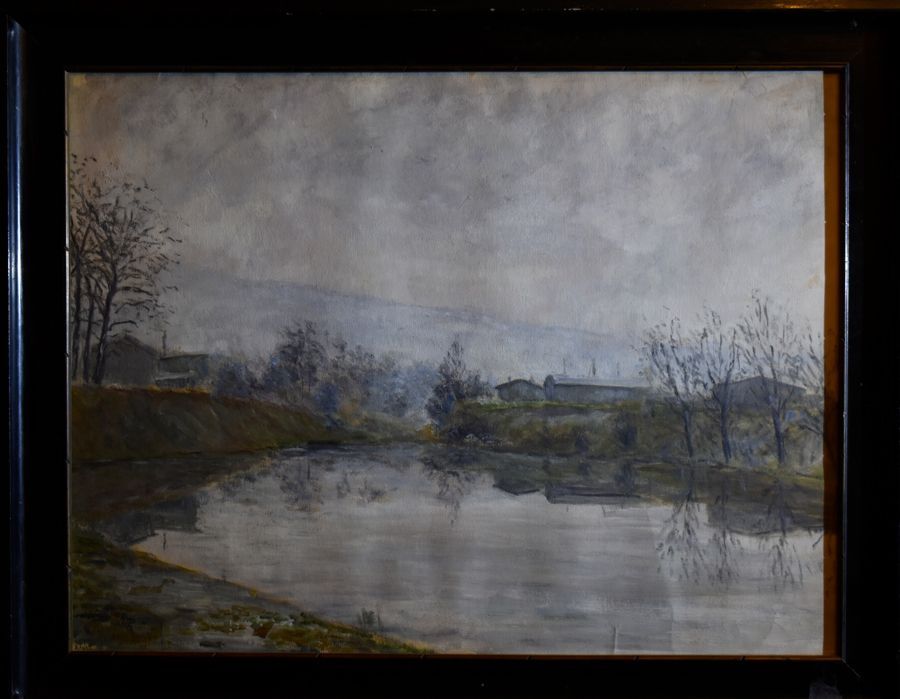
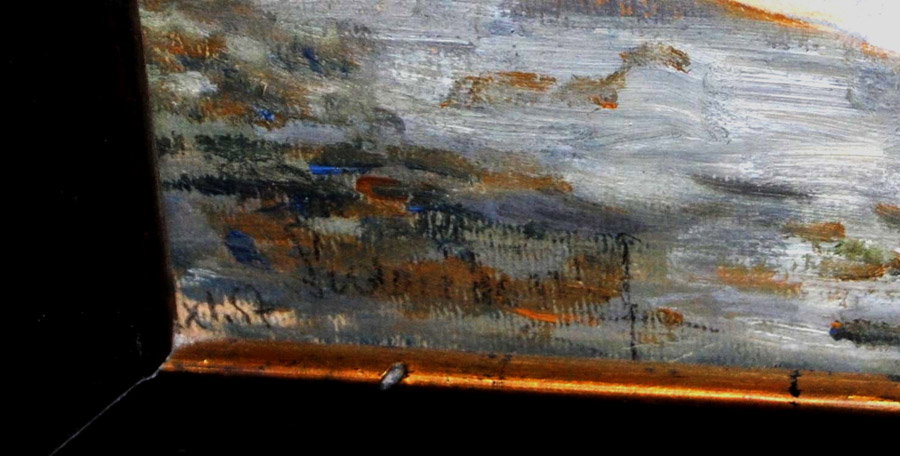
Painter from Otto Modersohn's circle, Worpswede school, Germany 1947, oil on paper, dated and signed. Rural lake landscape. Unfortunately, the signature is illegible. Dimensions: 58x45 cm.
Worpswede School. In 1889, following in the footsteps of travel writer Johann Georg Kohl, three artists no longer satisfied with the canons of formal painting decided to establish a group in Worpswede, a village not far from Bremen, in northern Germany. Their names were Fritz Mackensen, Hans am Ende, and Otto Modersohn. The group's goal was to claim their independence from the large art academies. Most of them were former students of the Düsseldorf Academy of Fine Arts. Like many young artists from 19th-century painting academies, they considered these official institutions and their teachers and teaching methods obsolete. By forming the Worpswede group, they aspired to create a space similar to that previously created by Théodore Rousseau with the Barbizon school. As in France, the purpose was twofold: to work "en plein air," revolutionizing painting technique, and to reflect their work in the rural population, deemed pure and not yet corrupted by civilization. A great help for the group's survival came from the commissions of industrialist Ludwig Stollwerck, who used the group of artists' work for advertising his chocolate factory in Cologne.
The Reichstag elections on March 5, 1933, determined the triumph of the Nazi Party in Worpswede, and as a result, the group split into two factions: Fritz Mackensen and Carl Emil Uphoff jumped on the bandwagon, while others such as Heinrich Vogeler (who in his circle of Barkenhoff wanted to put into practice the utopia of a classless society) were forced to emigrate.
In accordance with the provisions of the New Code of Cultural Heritage, the selling company provides, simultaneously with the sale, a detailed written photographic guarantee of authenticity and provenance of the works sold. The data with which the works are described and then contained in the written guarantees are expressed determinations resulting from accurate, thorough, and documented technical/historical/artistic investigations.