Ferraù Fenzoni
(Faenza 1562 – 1645)
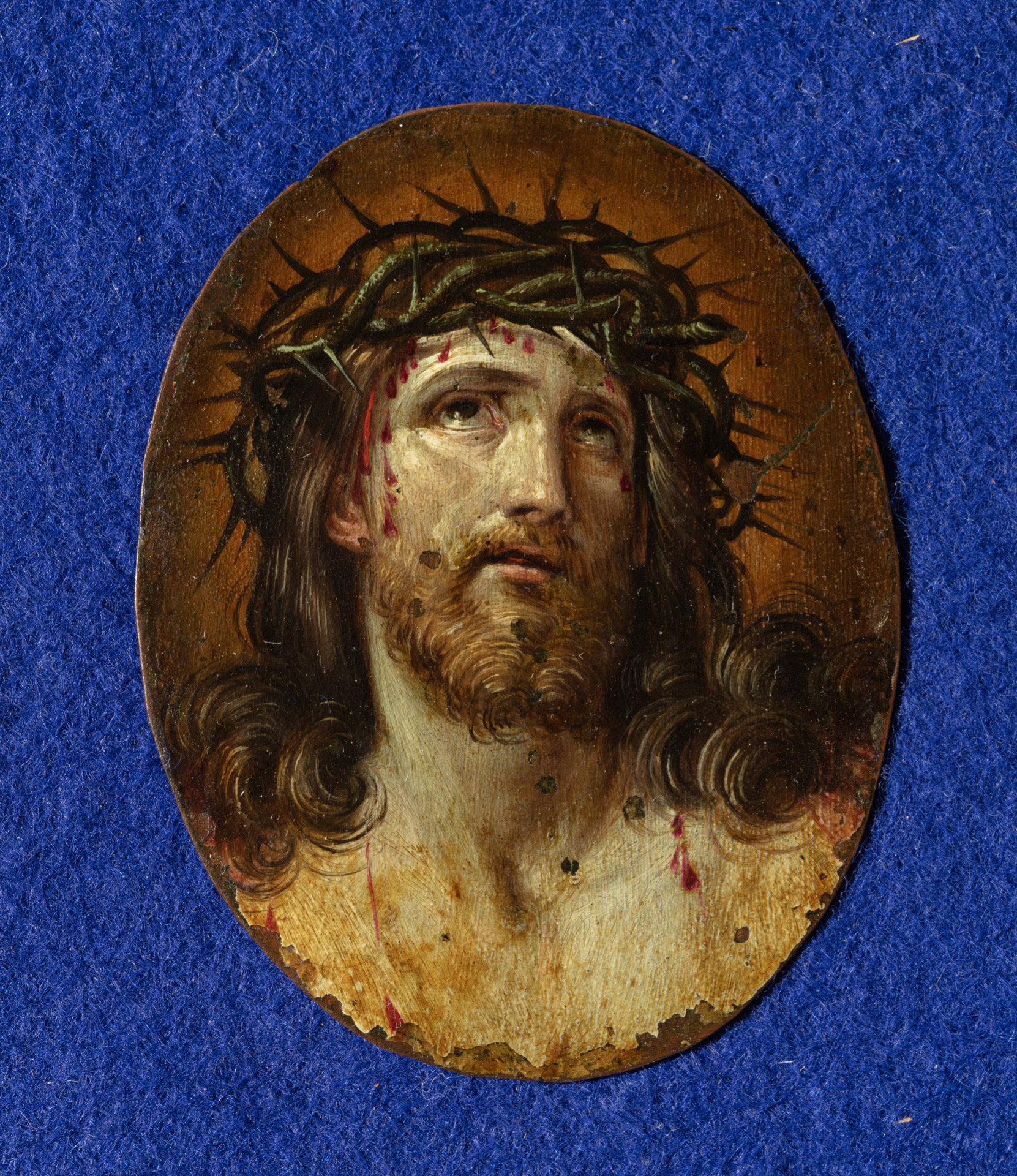
Head of Christ Crowned with Thorns
Oil on oval copper, cm 6.2 x 4.9
The head of Christ, encircled by a large crown of thorns, is reclined slightly towards the left shoulder, while the gaze directed towards the sky corrects the lack of frontality, pointing towards a precise vertical axis. The eyeballs seem to enlarge in this rotation, which however leaves the rest of the face unchanged. Thick locks of hair fall over the shoulders, forming enormous swirling curls. A curvilinear register is also applied to the beard, divided into two almost cylindrical sections. The drops of blood are also oversized, descending and channeling into a purple sequence.
The small painting on copper is undoubtedly based on one of the famous prototypes by Guido Reni, specifically the one executed around 1622-23, whose two autograph versions are found one in Canada, at the Art Gallery of Ontario, and the other in London, at the National Gallery. However, I believe that it cannot be classified among the countless copies of students or followers of the great artist from Bologna.
It is in fact an interpretation which, while drawing inspiration from that noble model, manages to take it towards a different destination, which is autonomous, despite having remained anonymous until now.
The painter who, in my opinion, created this tribute with a graphic intonation, was in a more than mature age; he was already an artist known and esteemed for many decades.
I am referring to Ferraù Fenzoni from Faenza, born even a dozen years before Reni and who, at least since the 1580s, had received prestigious work commissions for the many decorative construction sites promoted by Pope Sixtus V.
The youthful Roman season, which placed him among the protagonists of the late Mannerism, was then followed by a long stay in Umbria, in Todi, where, under the dependence of Cardinal Cesi, he painted numerous altarpieces, also frescoing the entire counter-façade of the cathedral with a gigantic Last Judgment.
The miniature in question preserves the echo of his training, based on a robust drawing that reinforces the perimeters of the forms. The graft with the icon of Guido Reni finds its own harmony, like a 'standard' musical piece arranged with another style.
The pictorial layout also confirms the attribution proposal, characterized by clear contrasts of light and volumetric shadows that swell parts of the complexion and transform the hair into a wicker weave.
Several physiognomic correspondences can be gathered by browsing the catalog of the works of Ferraù Fenzoni, but among all, the Ascent to Calvary of the Pallavicini Gallery in Rome can be chosen for comparison, where Christ follows the same effort of gaze present in the twig. (fig.2) This unpublished piece is a small yet important discovery that shows us how communicative even artistic figures that manuals classify as opposed to each other were.
Bibliography: unpublished
Massimo Pulini