17th century, Roman School
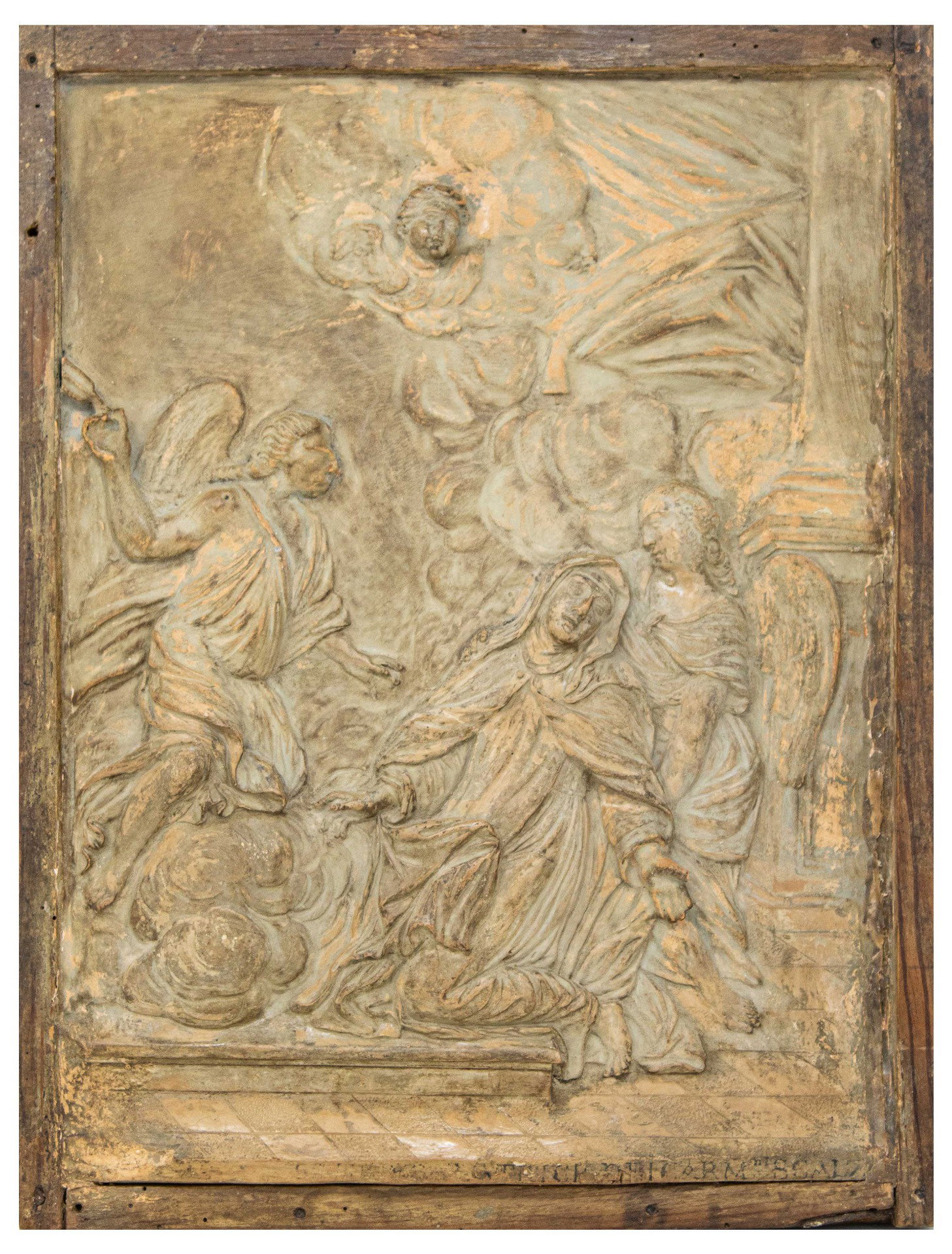
Transverberation of Saint Teresa of Avila
Terracotta finished with a tool, 40 x 30 cm
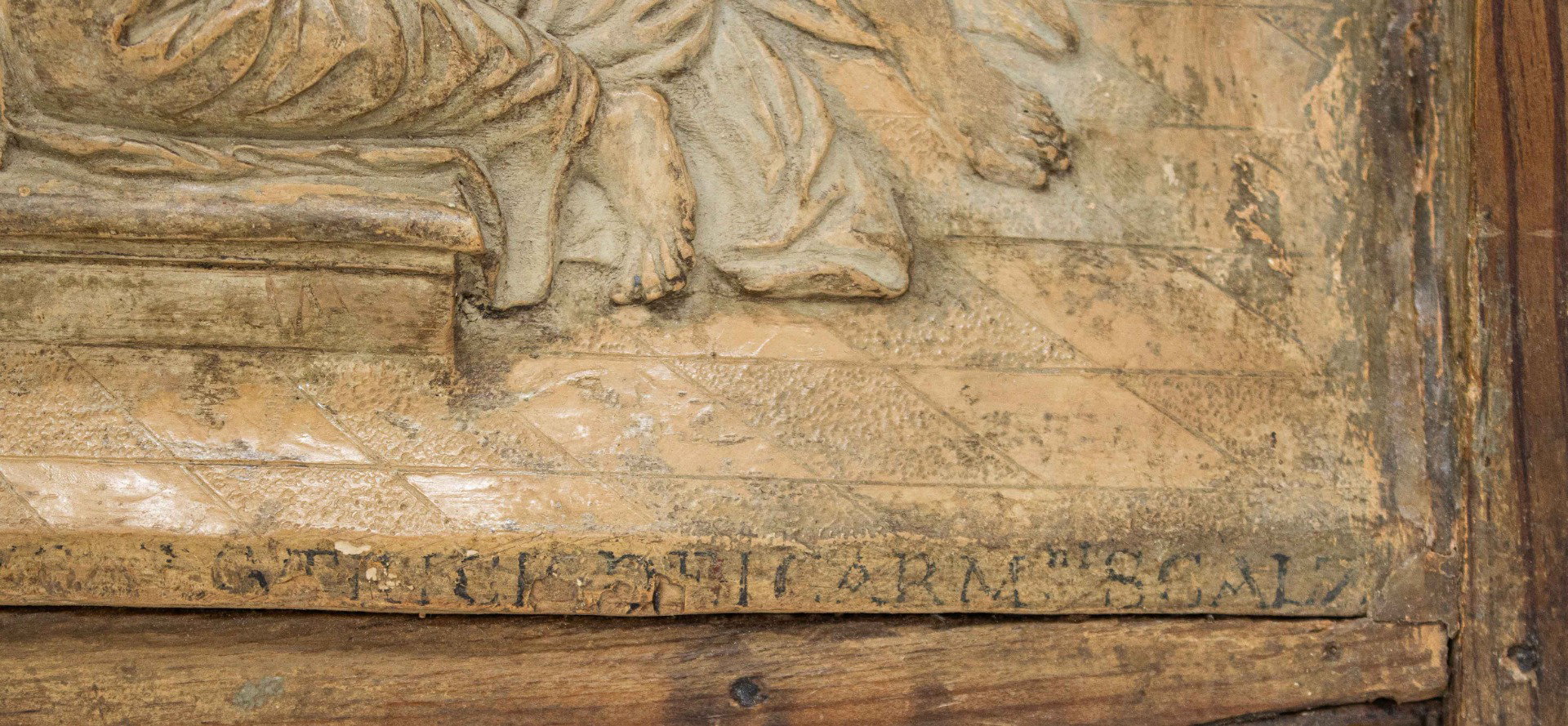
Inscription at the bottom right “…Carm. Scalz…”
The Catholic mystic describes transverberation as the piercing of the heart by means of a dart, arrow, or lance, carried out by Christ or one of his angel emissaries; the Latin transverberare, “to pierce through”, explains its sudden and impetuous modality, so much so that the event has also been taken by Christian literature as an assault by the Seraphim, already in itself a being ardent in love for Christ, or a wound of love. An emblematic episode is the one narrated by Saint Teresa of Avila within her own memoirs, elevated in artistic iconography to a primary model for the representation of such an intimately and spiritually unfathomable moment; among all, the image invented by Gian Lorenzo Bernini for the Cornaro chapel in Santa Maria della Vittoria in Rome (1645) gained maximum honor. The work was translated into marble and gilded bronze, limited to the divine rays radiating from the sky, and conceived as the fulcrum of the shrine that houses it, as if it were a theatrical proscenium, and the praying portraits of the Cornaro family members were located in the boxes of an operatic barcaccia. This perspective conception served to better direct the viewer's attention, increasing the emotional scope of the sculpture, in line with the spectacular baroque dictates of the Rome of Urban VIII Barberini (1623-44), Innocent X Pamphilj (1644-55) and Alexander VII Chigi (1655-66).
Native of the city of Avila, in Spain, the life of Saint Teresa unfolded just a century before the Berninian group – perhaps deriving from the Apparition of Christ to Saint Margaret of Cortona by Giovanni Lanfranco (1622), commissioned by Ferdinando II for the church of Santa Maria Nuova in Cortona and today in the collections of Palazzo Pitti. The early reading, in the company of her brother Rodrigo, of the Acta Martyrum led the young Teresa to reject the pomp that ensured the nobility of her family and to dangerously seek death in the ranks of the Infidel Moors, so as to immediately meet Jesus. Having escaped thanks to the intervention of her family, she decided to withdraw to live in the garden of her house, in a small cell that already foreshadowed her dedication to hermit life. Once grown up, Teresa retired to the Monastery of the Incarnation on Mount Carmel (Avila), thus entering the Spanish Carmelite Order; subsequently a serious illness confined her to bed in her father's house. A timely vision made her recover, convincing her to reform the Carmelite monasteries both male and female; she approached John of the Cross and founded San Giuseppe in 1562, the first reformed monastery. Teresa was elected “mother of the spirituals”, that is, of those who were seeking union with God, then proclaimed saint (1622) and doctor of the Church (1970).
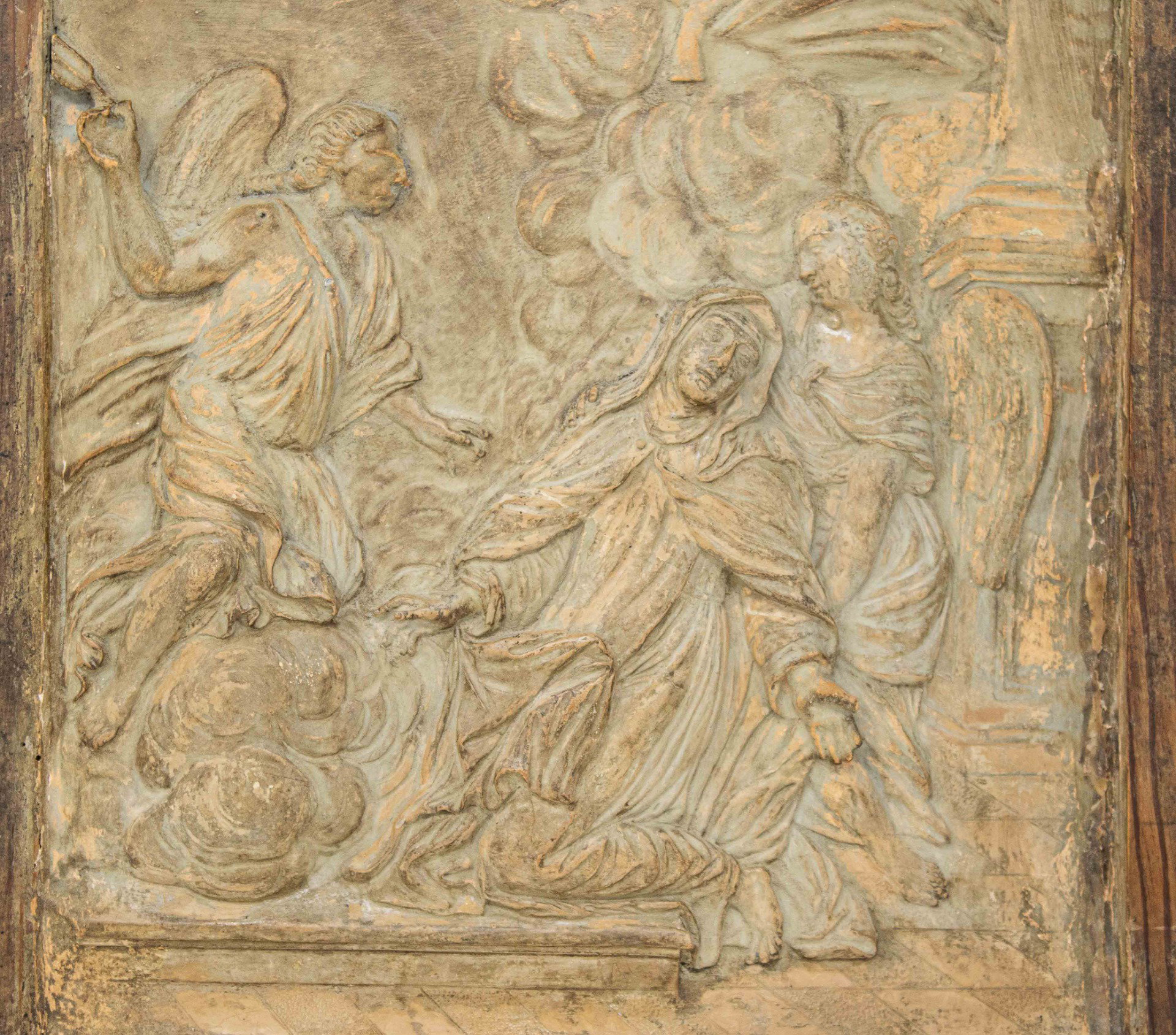
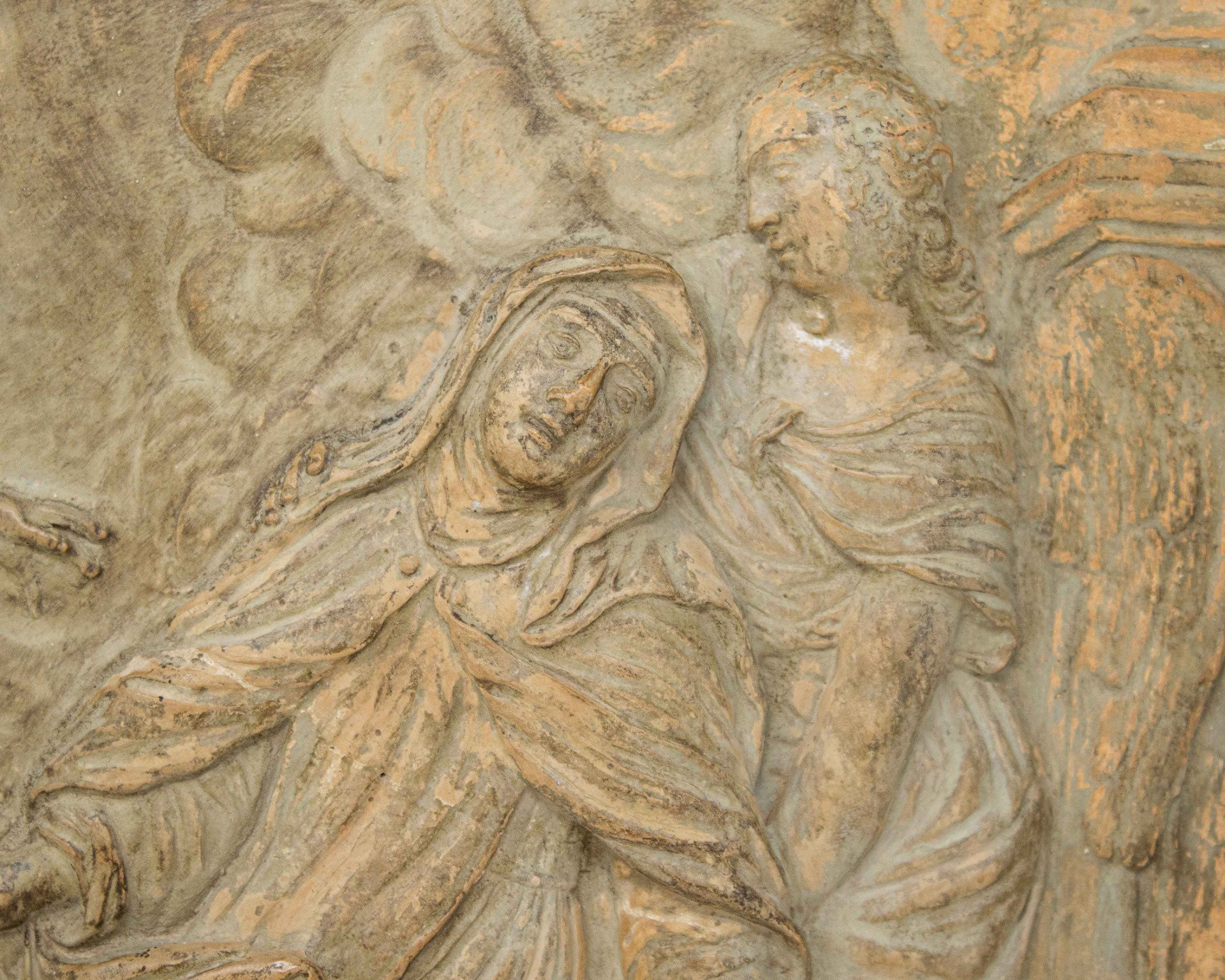
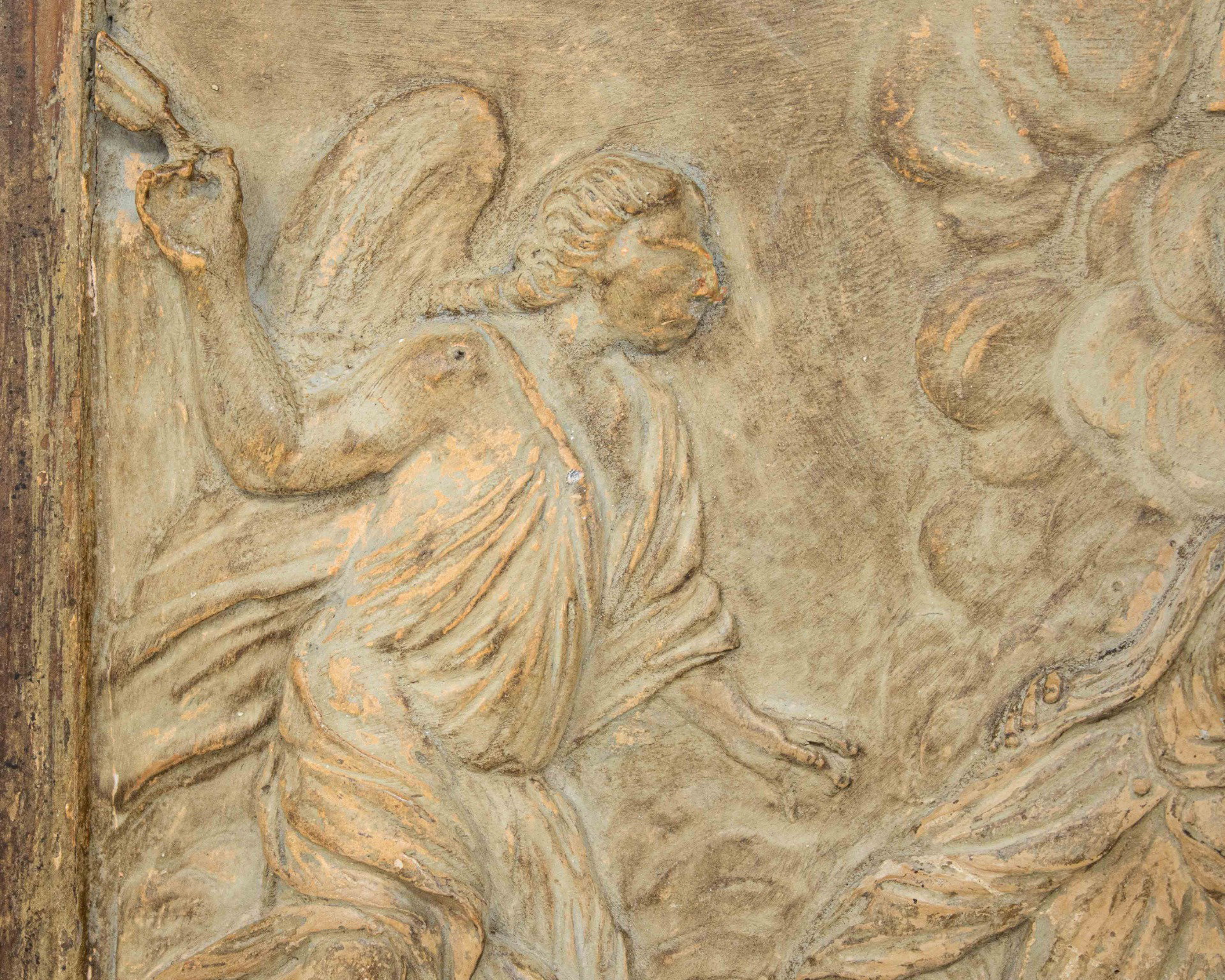
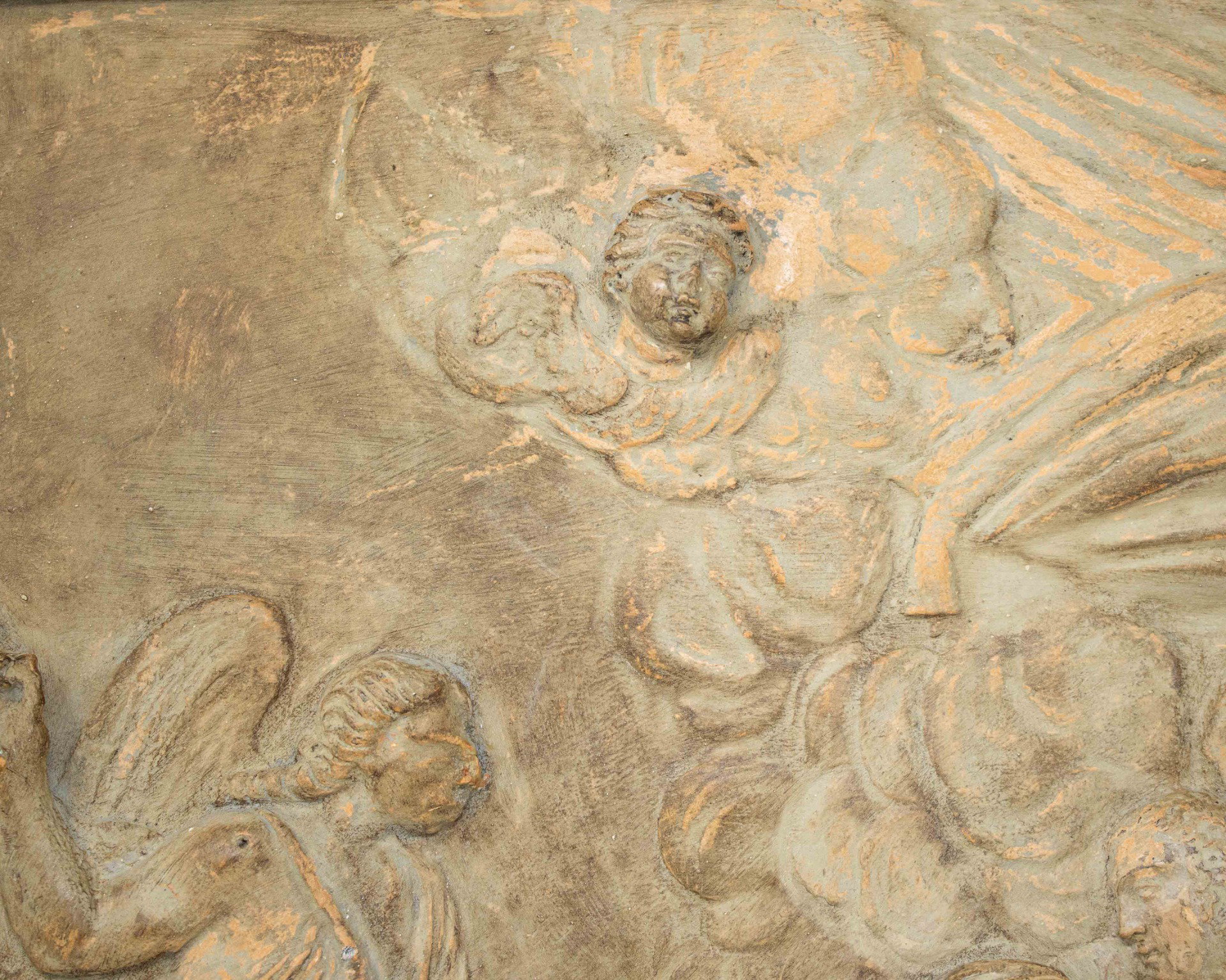
In the terracotta, patiently finished with a tool in the deep drapery of the mantles of the figures and in the swirling clouds that bring the angels to earth, two divine angels are figured who have come for the touch of the dart as well as the head of a small cherub on the still high clouds. The figured instant can be doubly understood as the instant immediately preceding the piercing, in which the saint ecstatically welcomes the divine gift, aided by the second angel who perceives the emotion, following Bernini's example, or the subsequent moment, in which the arrow is retreating and the saint cannot bear the otherworldly majesty. The work presents an inscription on the lower right edge, which with the words CARM. SCAL refers to the Order of Discalced Carmelite Friars, derived from the aforementioned reform of the Carmelite order (1562) promoted by Saint Teresa herself.
Jacopo Palma the Younger (1549-1628) had executed for the Roman Church of San Pancrazio outside the walls a Santa Teresa in which there appear, like in the present one, two angels with adult features and Christ himself, from which the divine rays unfold. Later the Fleming Guglielmo Borremans (1672-1744) will renew this iconography, painting a hectic Santa Teresa in 1772 for the Church of Santa Teresa alla Kalsa.
With Ars Antiqua it is possible to defer all amounts up to € 5,000 at ZERO RATE, for a total of 12 INSTALLMENTS.
Ex. Tot. € 4,500 = Monthly installment € 375 for 12 months.
Ex. Tot. € 3,600 = Monthly installment € 720 for 5 months.
For amounts exceeding € 5,000 or for a longer deferral over time (over 12 installments), we can provide a personalized payment.
Contact us directly to get the best quote.
LIVE TV
– SUNDAY 17.00 – 21.00 Dig.terr. 126 – Sky 861
– Streaming on our website www.arsantiquasrl.com and on our social networks Facebook and Youtube