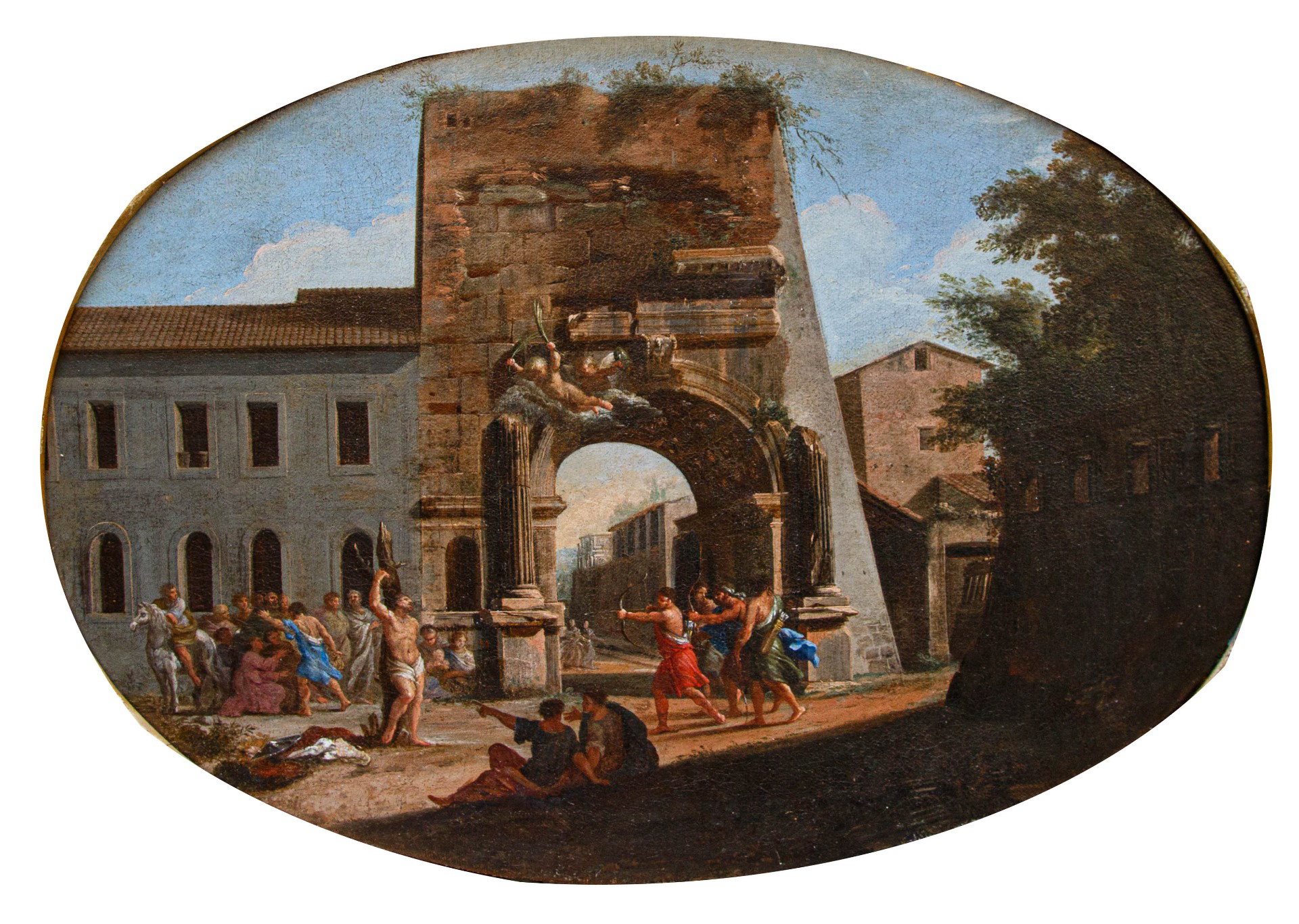
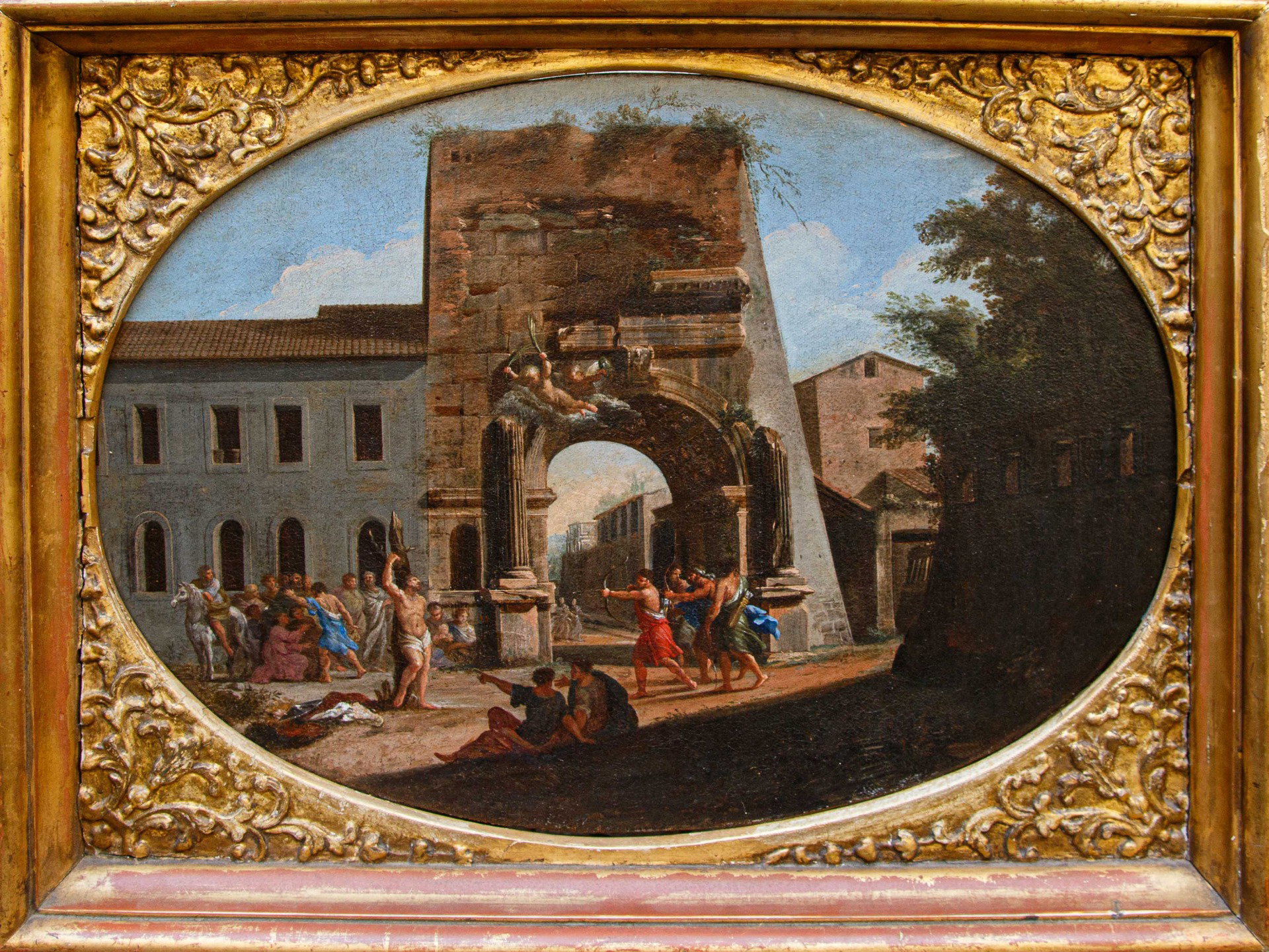
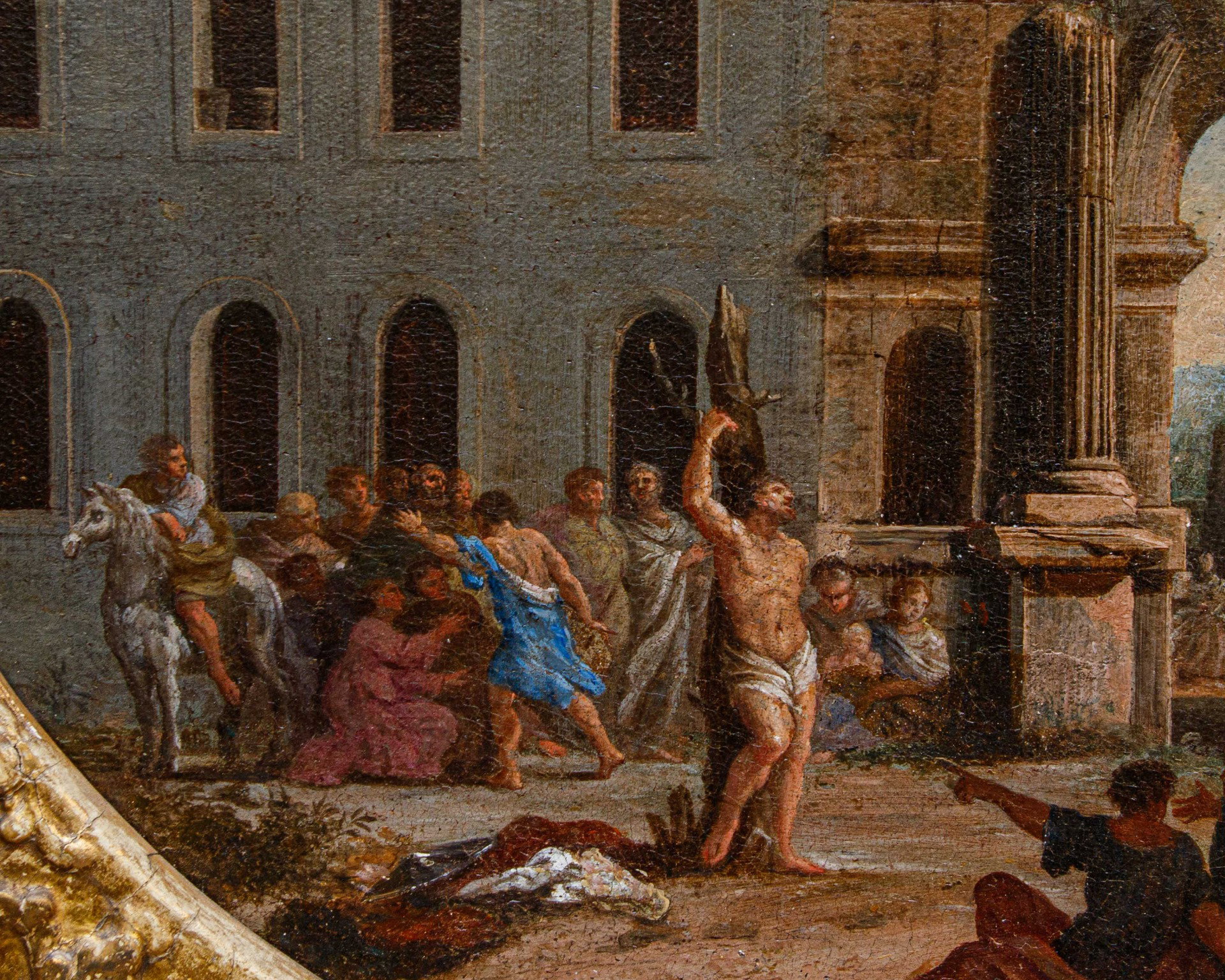
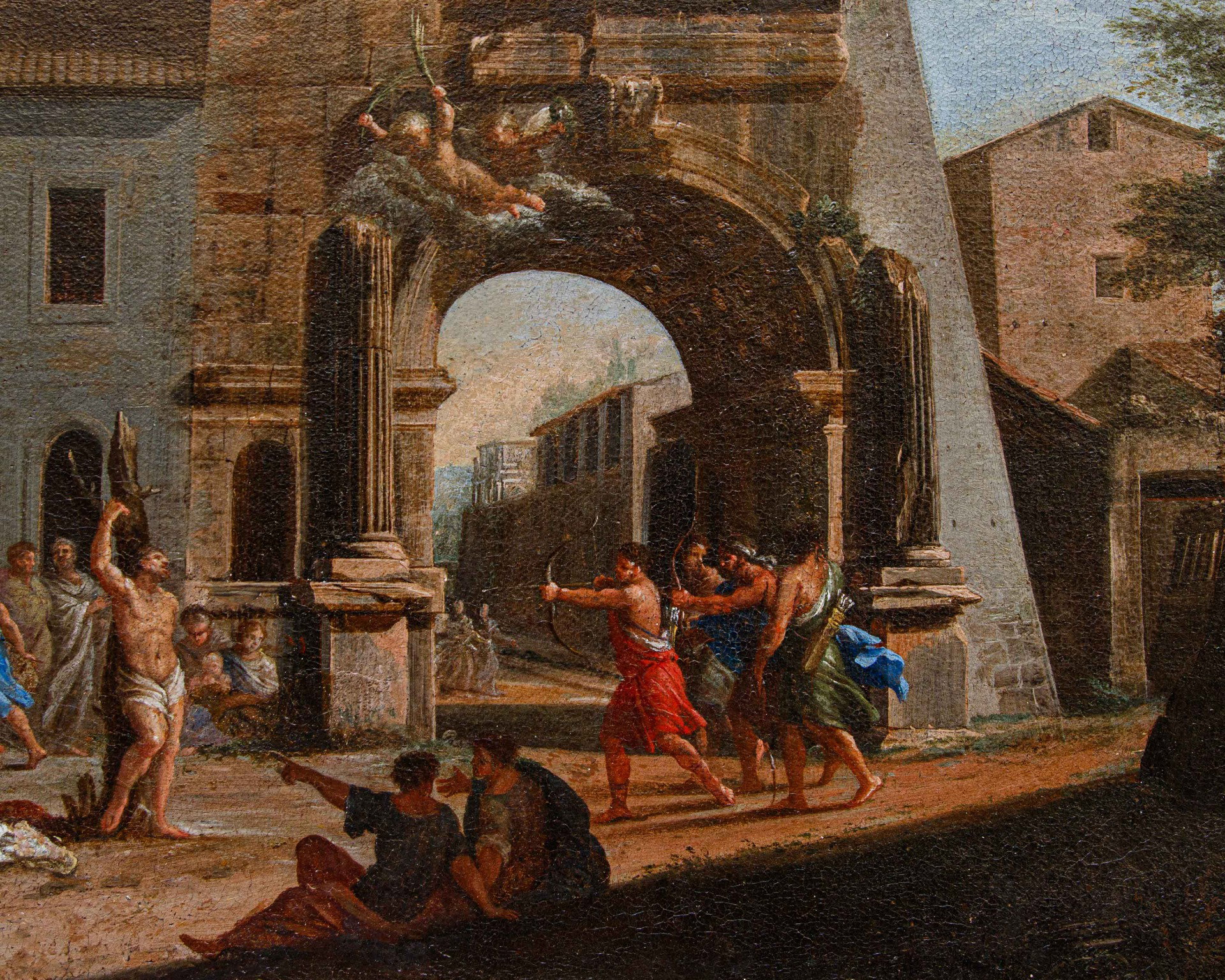
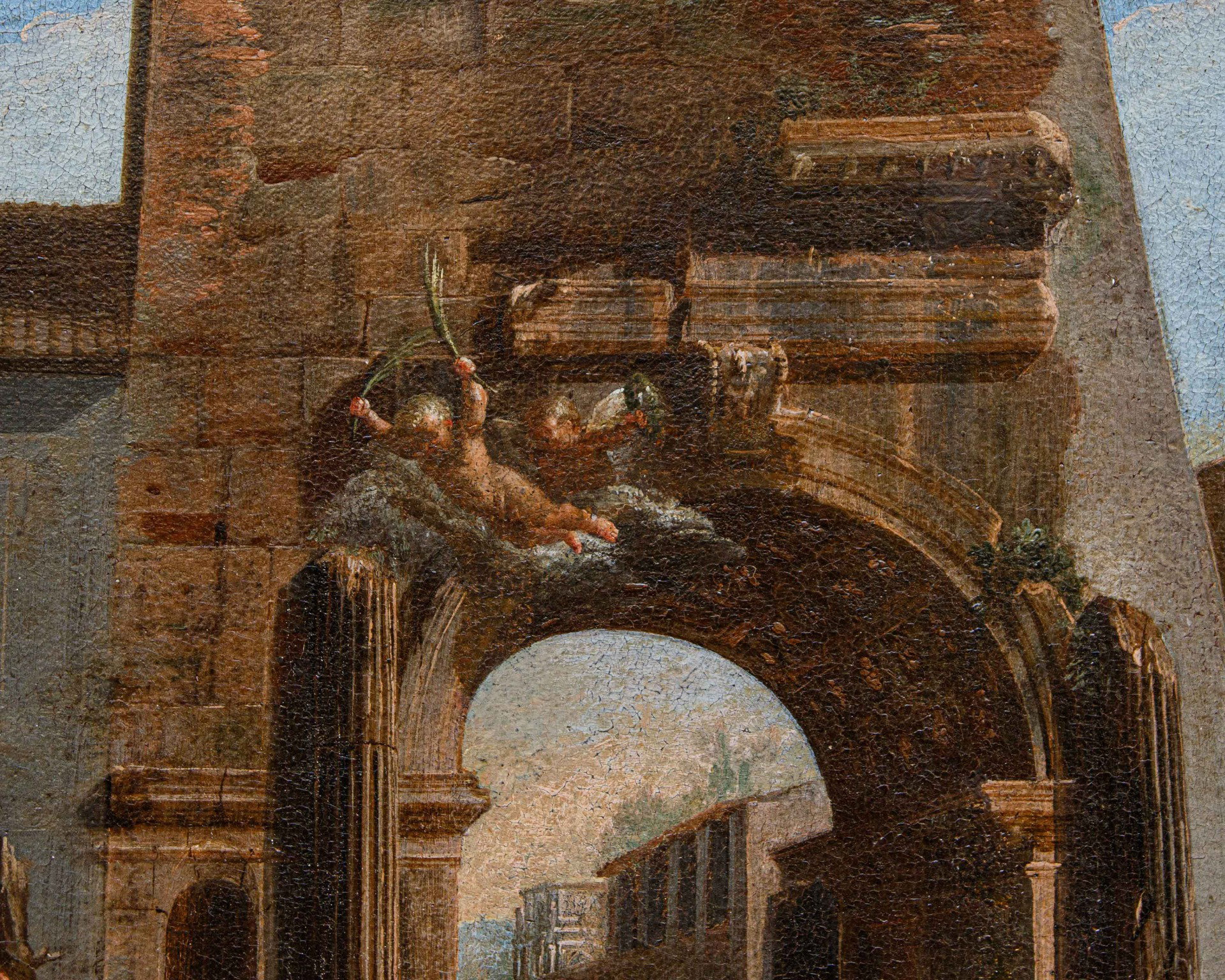
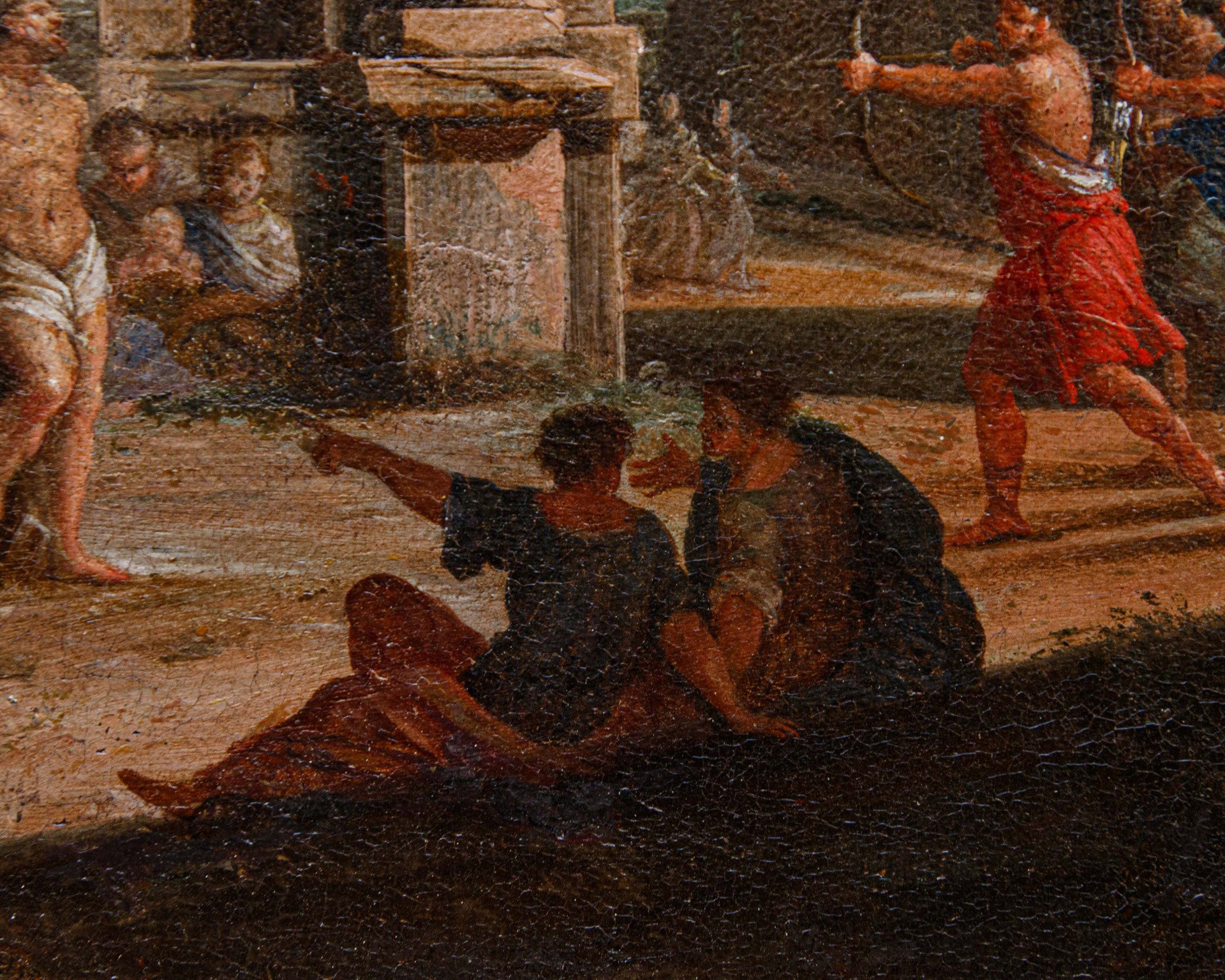
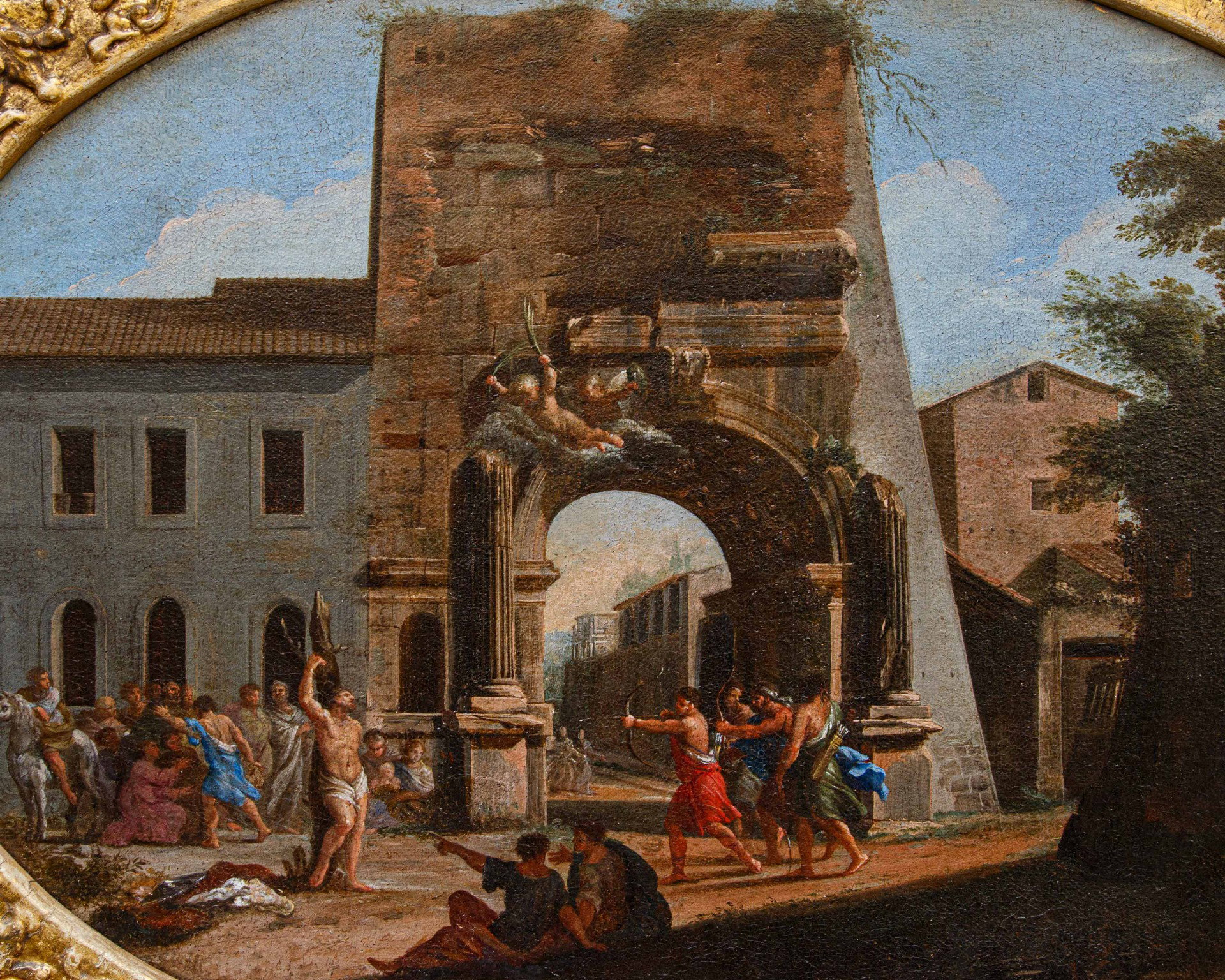
Niccolò Codazzi (Naples, 1642 - Genoa, 1693) and Filippo Lauri (Rome, 1623 - 1694) Martyrdom of St. Sebastian at the Arch of Titus Oil on oval canvas, 45.5 x 65 cm With frame, 60 x 75 cm Bibliography: E. Martini, Filippo Lauri (1623-1694) and painting in miniature. Complete works, Rome, L'Erma di Bretschneider, in press. The work in question, depicting the episode of the Martyrdom of St. Sebastian in front of the famous Arch of Titus in Rome, is a significant testament to the artistic synergy between Niccolò Codazzi (Naples, 1642 - Genoa, 1693), the eldest son of the master Viviano Codazzi, and Filippo Lauri (Rome, 1623 – 1694). A "son of artists" initially trained in Naples in his father's workshop, Niccolò carried on the tradition of architectural perspectives, becoming one of the most famous quadraturisti and vedutisti of the 17th century active in Rome, France, and Genoa. Documented in the capital around 1675 for works at Palazzo Altieri, he then moved to France where, thanks to Charles Lebrun, he entered the Académie Royale in Paris (1682) and collaborated on the decorations of Versailles for Louis XIV. Upon his return to Italy, he settled in Genoa in 1688, creating important quadratures at Palazzo Rosso with the help of Paolo Gerolamo Piola and Gregorio De Ferrari. Following his father's example, from whom he inherited mastery in architectural perspective but by whom he distinguished himself for a more open composition, Niccolò chose to employ numerous collaborators for the complex realization of the human protagonists who populated his scenes, preferring to focus his talent on the monumental rendering of ruins, palaces, and urban perspectives. Among all the collaborations that punctuated his career, including, in addition to Piola and De Ferrari, Theodor Helmbreker, Jacob de Heusch, Giovanni Ghisolfi, Pieter van Bloemen, Adrien van der Cabel, Vincent Giner, and Luigi Gentile, the one with Filippo Lauri (Rome, 1623 – 1694) undoubtedly represented the qualitative and poetic peak of his production, marking a fundamental transition towards a more decorative and pre-eighteenth-century taste. The relationship between Codazzi and Lauri was not limited to a simple technical division of labor, but was characterized by a true fusion of artistic visions. While Niccolò constructed vast spaces, often characterized by a geometric rigor that recalled his father's legacy while allowing for greater Baroque freedom, Lauri intervened by populating those settings with figures of extraordinary elegance. Known for his ability to synthesize the influence of Pietro da Cortona with a chromatic sensibility of Venetian origin, mediated by the style of Pier Francesco Mola, Lauri's production was also influenced by Poussin's purist classicism and the Bamboccianti, which led him to excel in small-format figures set in landscape and architectural contexts. Lauri, in fact, introduced a vibrant vitality into the canvases of both Niccolò and Viviano Codazzi, where the characters were not mere scale elements to give proportion to the buildings, but true protagonists of mythological, biblical, or literary scenes that transformed architectural views into theatrical settings. In these works, the contrast between Codazzi's gray stone or ancient marbles and the shimmering draperies, rich in red lacquers and deep blues painted by Lauri, created a dynamic and sophisticated visual balance. The canvas shown here, whose attribution of the figures to the Roman artist has also been confirmed by Dr. Elisa Martini, is a remarkable example of the partnership between Niccolò's architectural precision and the Baroque sensibility of his most trusted collaborator. The Martyrdom of St. Sebastian set among the majestic ruins of the Arch of Titus and the structures of Palazzo Frangipane was a subject that Codazzi had already tackled previously in France; moreover, this specific location appears several times in the artist's catalog; a significant example is the pendant conserved at the Musée des Beaux-Arts de Nantes. Niccolò Codazzi's production cannot be separated from that of his father: it was Viviano himself who codified this system of collaborations, relying steadily on masters of the caliber of Domenico Gargiulo, Michelangelo Cerquozzi, and Lauri himself, who actually represented the generational link between father and son; one can see, for example, The Massacre of the Innocents at the Bayerische Staatsgemaldesammlungen in Munich or the Adoration of the Magi with the Basilica of Constantine preserved in Chateauroux at the Musée Bertrand. Niccolò too was an artist who profoundly understood the value of specialization, transforming the necessity of collaboration into a trademark that defined the prestige of his works. He managed to weave a network of artistic relationships that touched the key centers of European painting, adapting his style from time to time to satisfy different commissions.