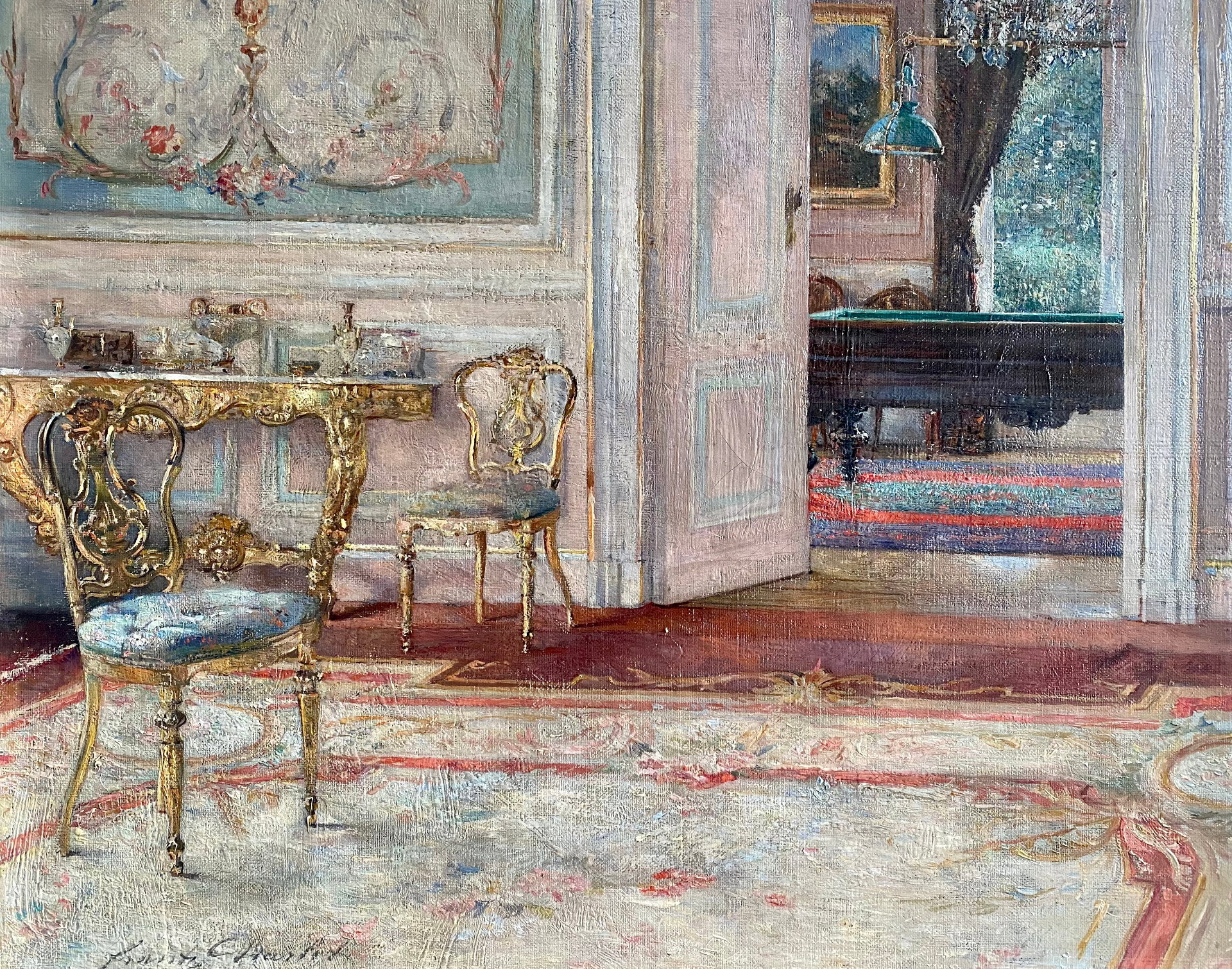
Interior with Billiards, Frantz Charlet, Oil on canvas
Description:
Certificate of Authenticity.
Frantz Charlet (1862-1928)
"Interior with Billiards"
oil on canvas (46 x 38 cm)
(73 x 65 cm with 19th-century gilt frame)
Signed lower left: Frantz Charlet
On the back, there is a trace of an old exhibition label.
Frantz Charlet (1862-1928)
Impressionist painter and watercolorist of portraits, landscapes, and genre scenes, born in Brussels in 1862 and died in Paris in 1928.
Charlet was a pupil of J. Portaels at the Academy of Fine Arts in Brussels. Later, having moved to Paris, he followed the teachings of Jules Lefebvre, Carolus Duran, and Jean-Léon Gérôme, who passed on his love for the Orient to him, encouraging him to visit Africa.
In 1883, he embarked on a long journey to Morocco, where he joined his friend Théodore Van Rysselberghe. Fascinated by the warmth and light of the place, he devoted himself to painting orientalist subjects.
Upon his return to France in September of the same year, he organized an exhibition at the Palais des Beaux-Arts in Brussels, where he presented ten orientalist paintings that were praised by critics and highly appreciated by the public.
After another two-year stay in Morocco, Charlet visited Holland, where he encountered the typical "brumeuse atmosphere" of the North, which he described with great emotion, especially in his seascapes.
In 1890, the artist returned to Brussels, where he mainly painted local landscapes and seascapes. He was one of the first painters in Belgium to experiment in his works with brighter tones and a free, vibrant touch, thus approaching French Impressionism.
In 1884, with Ensor and Rysselberghe, he founded the group: "Les XX", an avant-garde artistic movement that promoted modern art through meetings and exhibitions to which important foreign artists were also invited.
Among the guests of the first exhibition in 1884, where Charlet exhibited three paintings (“Départ pour le marché”, “Portrait de Mlle d’H”, “L’enterrement qui passe”), were Auguste Rodin, John Singer Sargent, and James McNeill Whistler.
In 1887, Georges Seurat, Berthe Morisot, and Camille Pissarro were invited, among others. In the autumn of 1888, Henri de Toulouse-Lautrec, who had never participated in a major exhibition before, as well as Henry van de Velde and Georges Lemmen (1865–1916), joined the group. In 1890, six paintings by Vincent van Gogh were exhibited.
The group consisted of twenty artists in constant search of a new, proud, and free art form. The magazine «L’art moderne» was the voice of the group.
The merit of the “Les XX” circle lies in having recognized early on the importance of numerous artists destined to become famous and in having offered them a platform for visibility.
The exchange stimulated by the “Société des Vingt” contributed to making Brussels an important center of modern art in those years.
At the VI° Exposition des XX in 1889 Charlet exhibited «Portrait»
In Paris, where the famous Galerie Georges Petit organized two solo exhibitions (1906 and 1908), Charlet revealed himself as a virtuoso chronicler of high society life with particular attention to horse races.
Considered one of the most important painters of the New Belgian School, Charlet participated in numerous exhibitions:
The artist participated in the “Salons Triennaux” of Ghent, Antwerp, and Brussels, considered a very important international showcase.
These contemporary art exhibitions attracted great public interest and were often the scene of heated aesthetic discussions.
He debuted at the Salon in Ghent in 1877, at only 15 years old, exhibiting a still life, then presented:
in 1883: 140: “Les faucheurs, Ardennes”
141: “L’enterrement qui passe” where he won a gold medal.
in 1892: 130: “Dimanche”
131: “Bebé”
in 1899: 90: “Le pêcheur”
At the «Exposition Universelle et Internationale» in Ghent in 1913 he exhibited
«Le Bourgmestre et sa famille»
At the «Salon d’Anvers» in 1891 he exhibited:
“Jeune mère arabe berçant son enfant” and “Ciseleur arabe”
At the «Exposition Générale des Beaux-Arts» in Brussels he exhibited:
in 1881: «Fugitifs Gaulois”;
in 1887: «Soleil couchant»;
in 1893: «Jeunes Arabes;
in 1897: «Noces d’or» and “Portrait” (Exposition Internationale de Bruxelles);
in 1900: «Le marché aux fromage à Alkmar Hollande”;
in 1903: «La famille ”;
in 1914: «Au poteau», «Au pesage», «A la pelouse»
The artist participated in the exhibition of the “Libre Esthétique” in 1908, “Salon Jubilaire” exhibiting alongside Renoir, Monet, Degas, Bonnard, Claus, Signac,…
During a group exhibition of the “Cercle Artistique et Littéraire di Bruxelles” (end of 1904-1905) he exhibited several works under the title "Souvenirs du Littoral”.
Internationally, Charlet exhibited in
Paris: «Salon des Artistes Français» from 1881 to 1896, obtaining an Honorable Mention in 1884 and a third-class medal in 1885 with «Les fileuses: Maroc» and at the exhibitions
of the Société Nationale des Beaux-Arts from 1897 to 1914.
(cfr. attached list)
Individual exhibition at the prestigious Galleria Georges Giroux in 1925.
Ostend: Salon of 1894 with «Cabaret flamand»
Berlin: Ausstellung Belgischer Kunst of 1908 with «L’orologio d’oro» (27)
Venice: VIII International Art Exhibition of the City of Venice of 1909 with «Raggio di sole» and «La culla»
Founding member of the "Cercle des Beaux-Arts d'Ostende" in 1894 and of the movement "L'Essor"
Member of the Société Nationale des Beaux-Arts since 1903.
In 1906, with Khnopff and Stacquet, he founded "La Société Internationale de la Peinture à l'eau".
Description:
The painting described here depicts an interior of extraordinary elegance, where each element contributes to building an atmosphere of sophisticated bourgeois intimacy.
In the room in the foreground, the wood paneling with floral motifs, the precious carpet, and the golden furnishings, in particular, a finely carved console and two small chairs with sinuous lines, are treated with pastel tones through a brushstroke with small touches that creates skillful luminous vibrations.
While in the room beyond the half-open door, the observer's attention is captured by the suggestive presence of a billiard table.
Its bright green top constitutes a chromatic focal point, balanced by the suspended lamp. The contrast between the diffuse luminosity of the first environment and the more collected lighting of the billiard room generates spatial depth and a refined perspective articulation.
Works in the following museums:
Paris: Musée d'Orsay: «La vieille armoire», Cabinet des Estampes.
Brussels: Royal Museum of Fine Arts of Belgium: «La femme du pêcheur» (watercolor), «Terrasse au Jardin des Tuileries»
Ixelles Museum: «La plage d’Ostende»
Ghent: Museum of Fine Arts: «Place Rogier à Bruxelles», «Case dorate nel borgo di Bruges»
Antwerp: Royal Museum of Fine Arts: «Veuf»
Art Institute of Chicago
Georgia: Oglethorpe University Museum: «Bambini che giocano» .
Bibliography:
Serge Goyens de Heusch
"L'impressionnisme et le fauvisme en Belgique"
Fonds Mercator Albin Michel (pp. 59,69,75-90,93-97,102-106,166, 190,191,217.)
E.Bénézit
«Dictionnaire des peintres,sculpteurs, dessinateurs et graveurs»
Ed.Grund vol.2 (p.674)
Paul Piron
«PIRON: Dictionnaire des Artistes Plasticiens de Belgique des XIX et XX siècles»
Ed. Art in Belgium (p.209)
Andrée Dessert -Corvol
«ARTO: Dictionnaire Biographique Arts Plastiques en Belgique»
(p.172-173)
State of conservation: Excellent