Description
Bartolomeo Barbiani
Montepulciano 1596 - Montepulciano 1645
Saint Jerome Praying
1622
Oil on canvas
cm 135.5x205.5
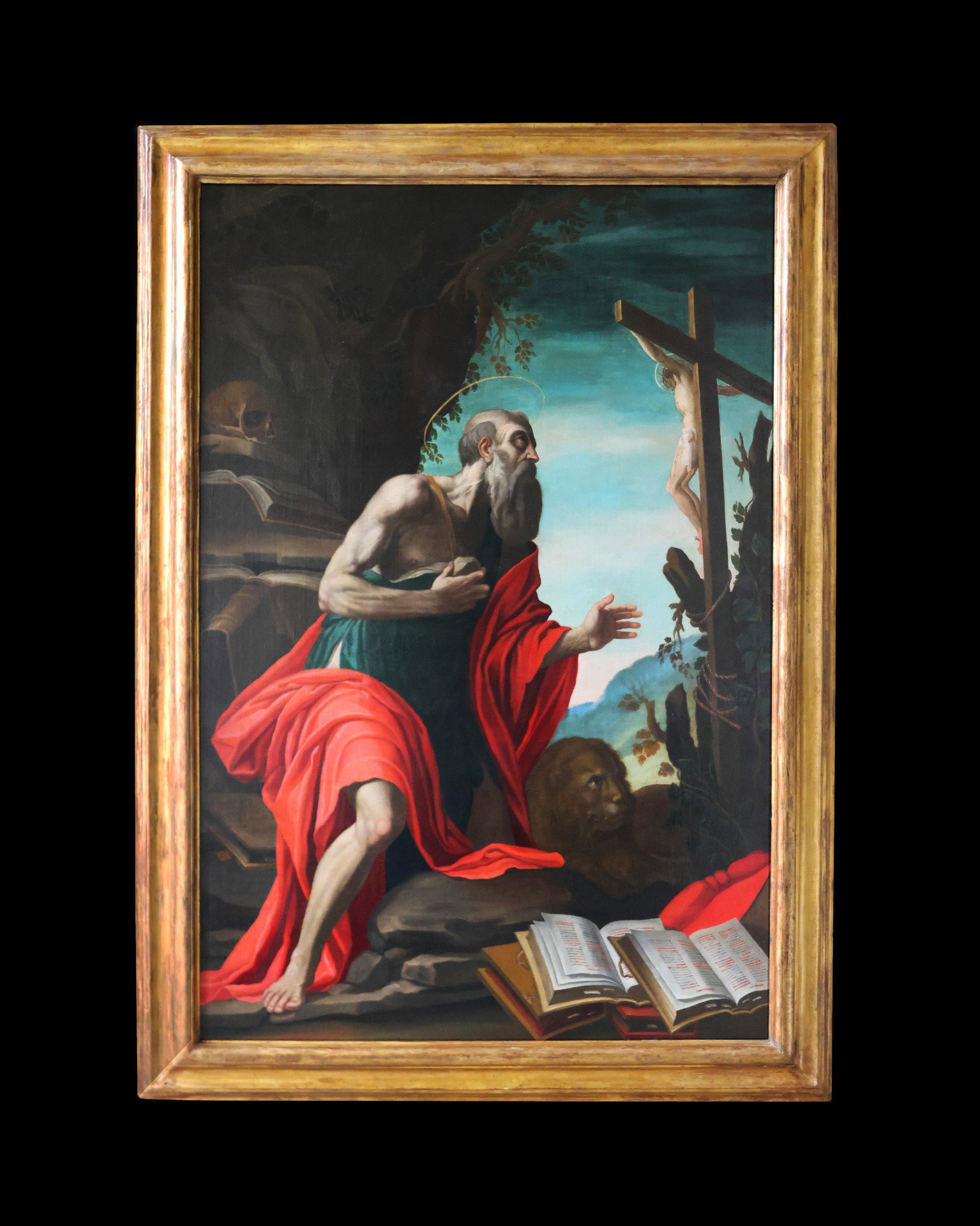
Authentic signature of the present work: "Bartholom.s/Barbianus / Politianus/Pingebat / a. Dom./MDCXXII". The figure of Jerome, Father and Doctor of the Church, belongs to that group of Saints who, throughout the centuries, have always aroused admiration and devotion. Living between the mid-4th and early 5th centuries, Saint Jerome came into contact with the great personalities of that era... Among the works he composed, the greatest attention should certainly be paid to his studies on the Bible, of which he was a translator and profound commentator. Jerome is credited with having transmitted the richness of the Greek and Hebrew libraries to the West. He is also the author of monastic texts such as the lives of Paul, Malchus and Hilarion composed on the model of the life of Anthony, written by Athanasius of Alexandria... Jerome was proclaimed Doctor of the Church by Boniface XVIII, along with Saints Gregory the Great, Ambrose and Augustine. The iconography of Jerome, in addition to presenting episodes related to his hagiographic events, such as when he tame the lion, substantially follows two major schemes, which refer to each other: he is a penitent in the desert, depicted in that cave which he had chosen as a hermitage, or he is portrayed in his study, bent over books, immersed in reflection... As in the canvas here under study, Jerome as a penitent in the desert is depicted as a solitary old man, still vigorous despite the repeated penances to which his body was subjected. He is presented half-naked, with a red cloth to cover himself summarily: the red color evokes the tradition that recognized him as a cardinal of the Church. Among the iconographic attributes, a skull often appears next to him, indicating how the vanity of this world is destined to pass. His gaze, on the contrary, is constantly turned towards the cross of Christ, a recurring iconographic element because only the cross is wisdom, as Saint Paul affirms. The landscape in which the scene of Jerome as a penitent is set is usually arid, barren, recalling the desert in which the Saint had taken refuge and which he had well represented in his writings.
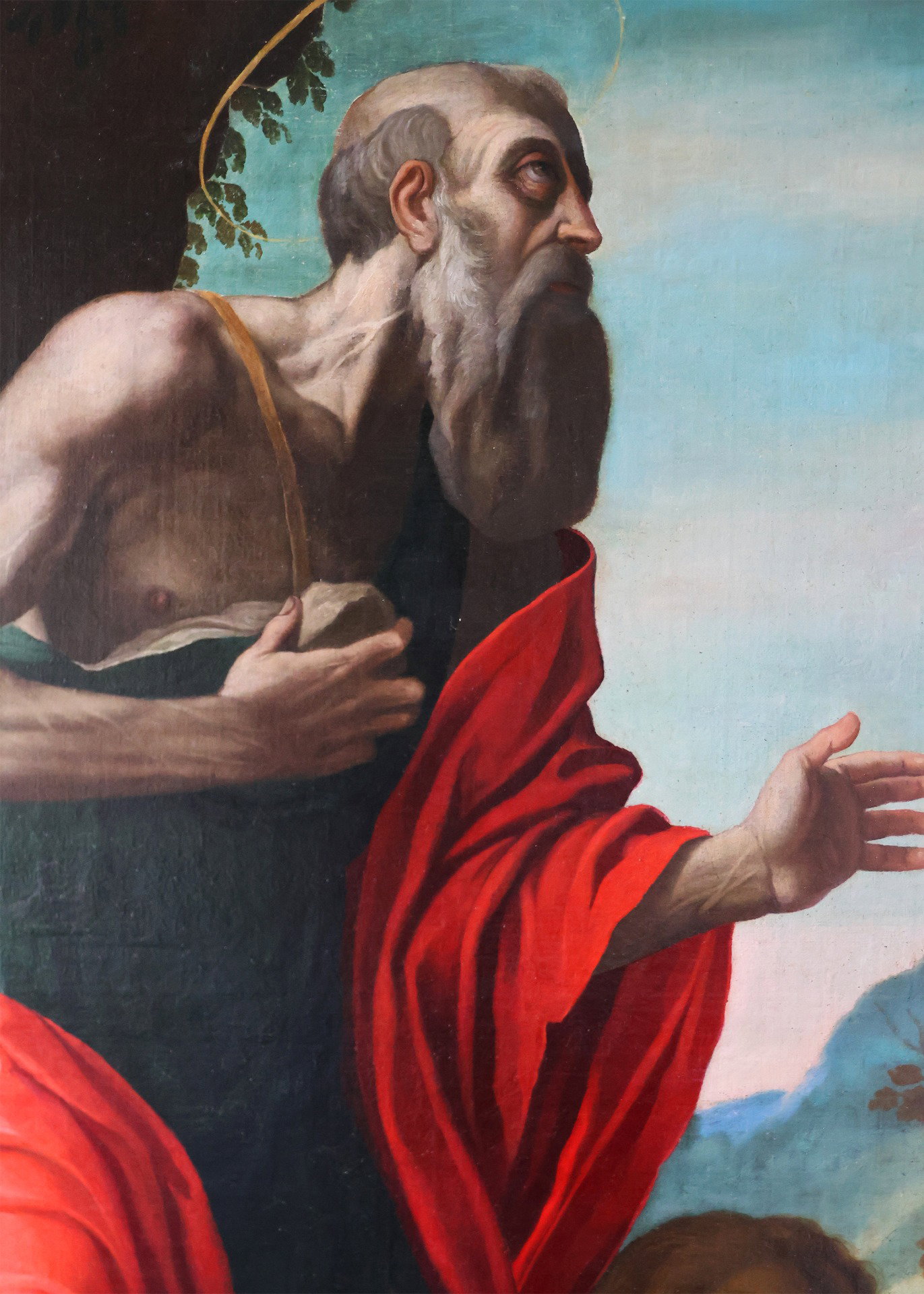
The canvas with Saint Jerome is therefore sober, devoid of frills and elements that could distract from the figure of the Saint. Jerome is kneeling, contemplating the crucifix sorrowfully, and in front of him, in the foreground, are some books, one closed and the others leafed through and worn, books that testify to his assiduous study. A cardinal's hat is also overturned among the books. The Saint beats his chest with a stone, as penance.
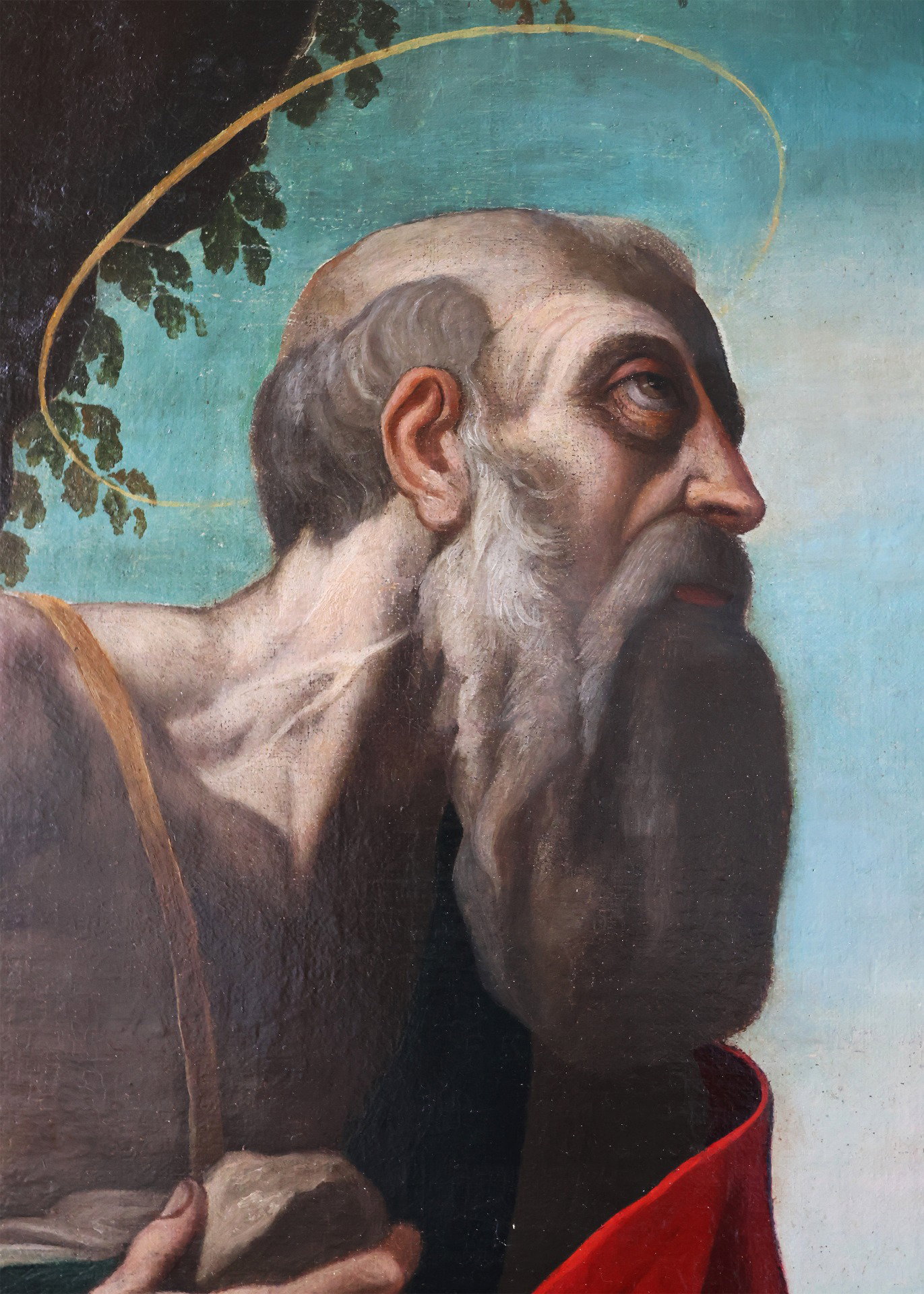
Jerome has a thick, long beard and is bald on the top of his head. At his feet lies a lion.
The painting is painted with vigorous brushstrokes and great compositional skill and is signed on the stone at the bottom left "Bartholom.s/Barbianus / Politianus/Pingebat / a. Dom./MDCXXII". This is a rare and precious work by the painter from Montepulciano Bartolomeo Barbiani born in 1596 and died in 1645.
From the critical sheet by Dr. Arabella Cifani
The painting is accompanied by:
Expertise Dr. Arabella Cifani
Dimensions
cm 135.5x205.5
Provenance
Private collection
Conditions
Defects and restorations.