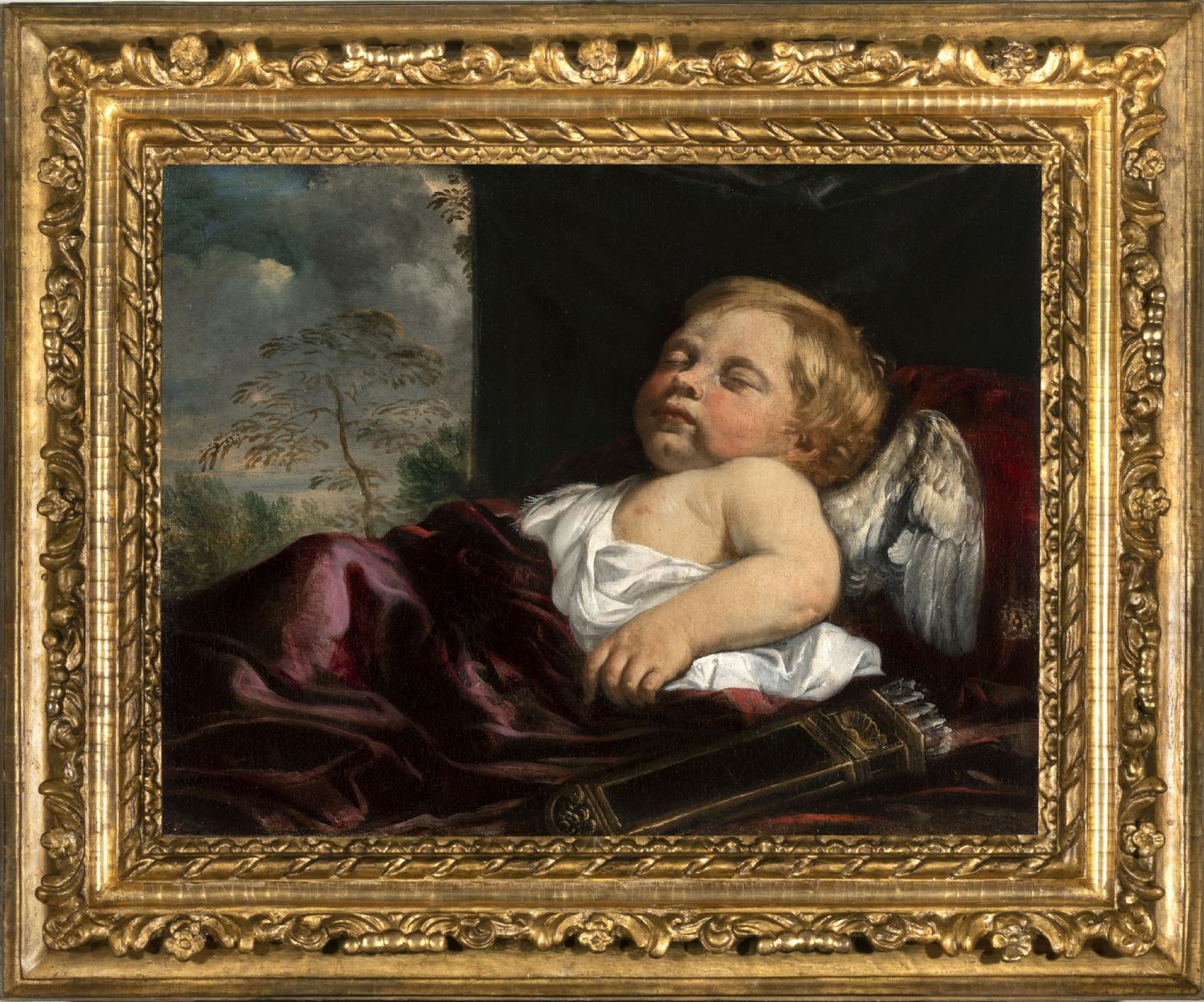
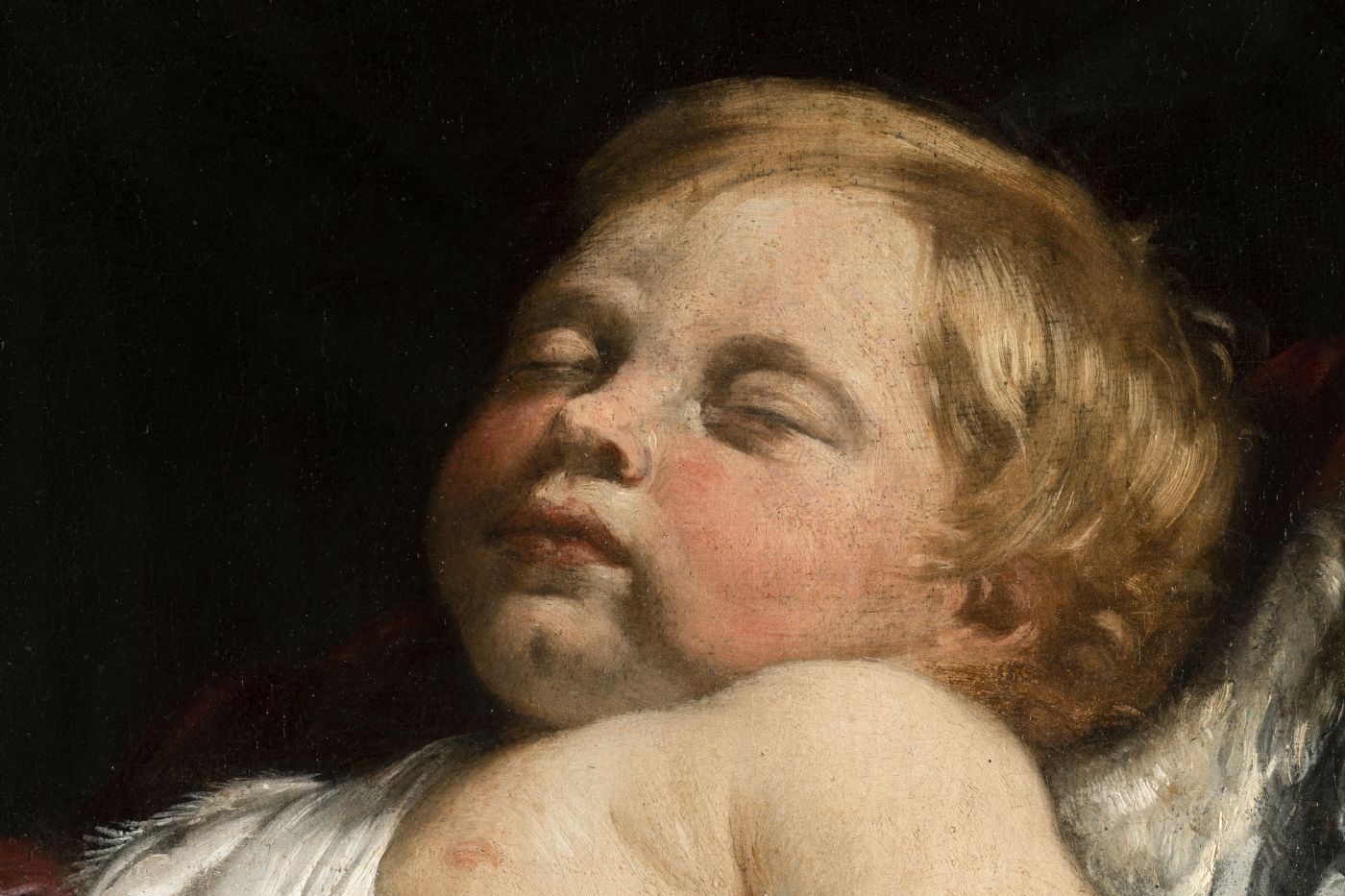
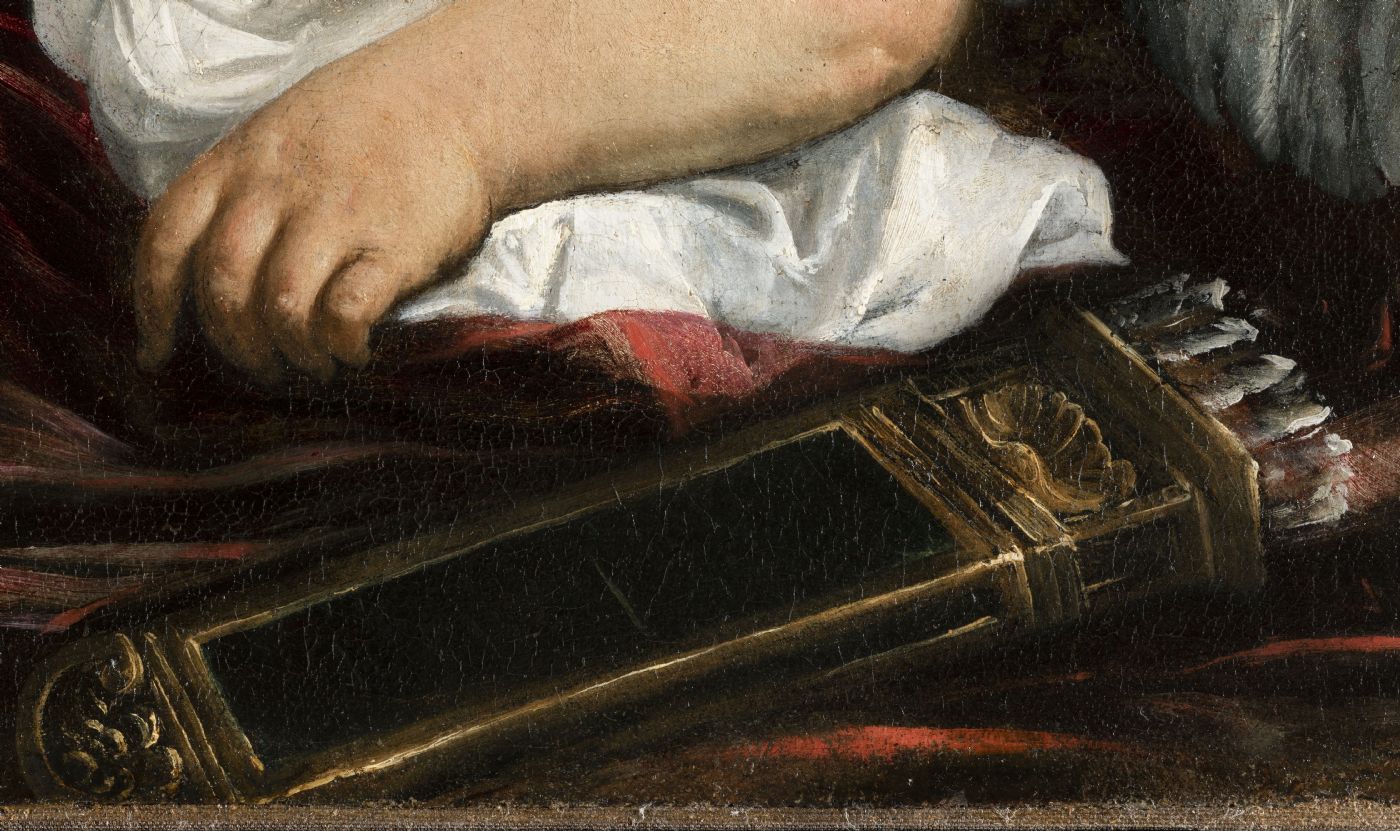
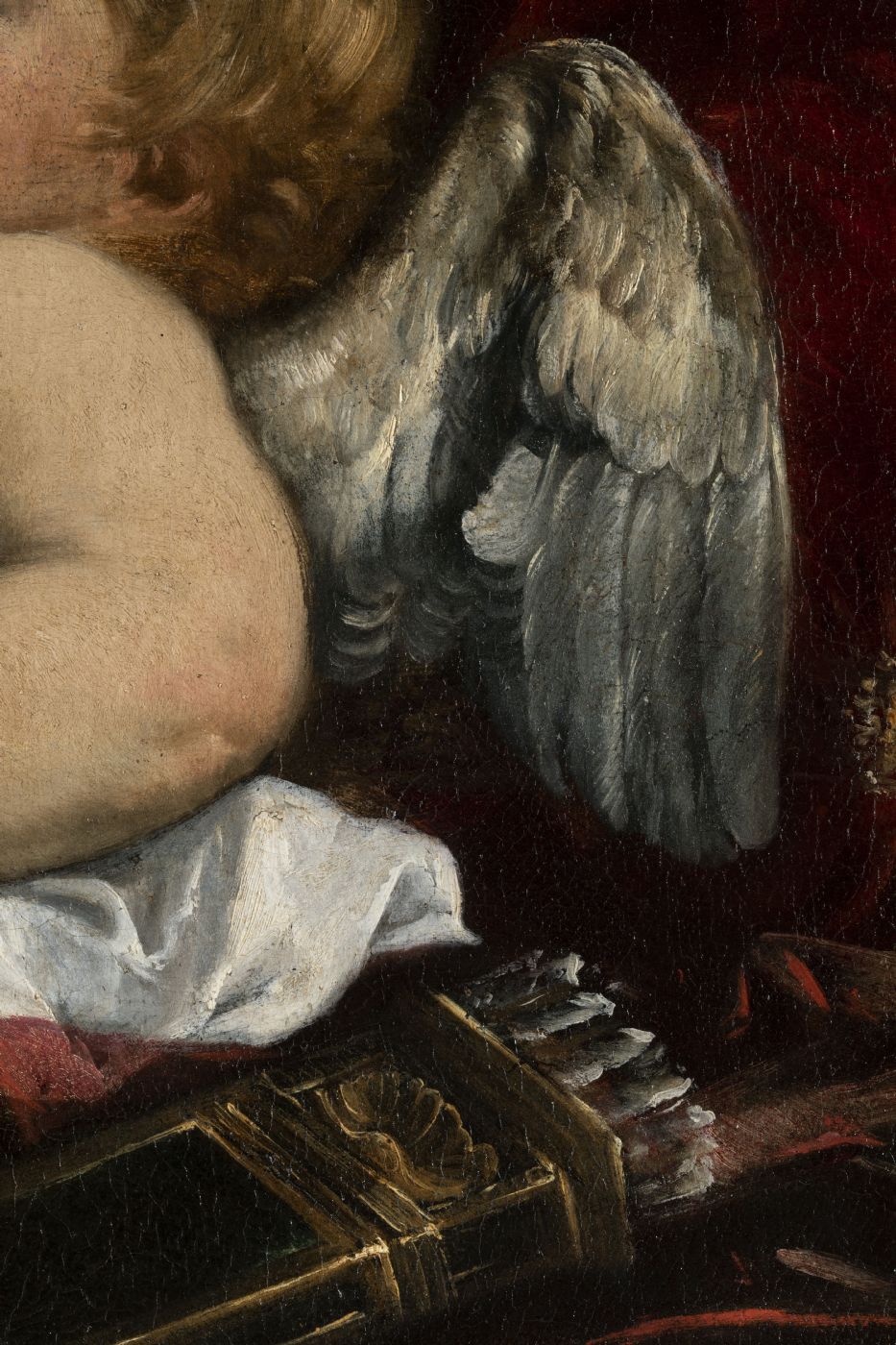
A winged child sleeps peacefully, naked under candid linen sheets, wrapped in a precious velvet blanket. That child is Cupid: the crimson cushion and the quiver full of arrows, abandoned in the foreground, suit him. The iconography of his sleep, codified in classical times and rehabilitated in the Renaissance, had enjoyed renewed fortune among the Caravaggesque group and among the various interpreters of the seventeenth-century Baroque, in order to celebrate that suspended moment of melancholy idyll during which the fatal power of that fickle little boy cannot act. The peculiar physionomic characteristics of his face, together with the luxuriant landscape in the background, of vague 'Molesca' origin, allow us to attribute the painting to the brush of Antonio Gherardi from Rieti: one of the most original artists of the Roman Baroque, whose critical re-evaluation, after the pioneering opening by Hermann Voss in 1924, is mainly due to the exhibition held in Rieti in 2003 and a recent monographic article by Francesco Petrucci (Voss 1924, pp.562/564; Antonio Gherardi 2003; Petrucci 2022).
Painter, architect and inventor, Gherardi was a universal artist who established himself in the most disparate sectors: from drawing to engraving, from stucco modeling to the direction of complex ephemeral apparatuses, up to the design of sophisticated sacred and profane furnishings. The work in question, datable to the seventh decade of the seventeenth century due to the marked neo-Venetian intonation, constitutes a very early proof of Gherardi's pictorial journey, still being defined, being a response to the solicitations received by the artist during his study trip to northern Italy (Bologna, Milan and Venice), carried out between the end of 1667 and the beginning of 1669 in search of "the taste, the manner and the beautiful Lombard colorito" (Pascoli, in Vite de pittori 1730/1736, 1736, ed.1992, p. 726).
The figure of Cupid shows analogies with other putti painted by Gherardi several years later in some altarpieces, such as the "Madonna with Child and Saint Andrew" in Gubbio or the "Education of the Virgin" in the Poggio Mirteto cathedral, qualified by more clear and compact forms, peculiar to his mature language, now better known. Furthermore, the diagnostic investigations carried out for the occasion allow us to penetrate the calibrated genesis of the painting's composition: in addition to the slight adjustments in the position of Cupid's face, a conspicuous pentimento is visible in the position of the left leg under X-rays, initially painted naked and bent, then lowered by the artist during work to allow more space for the landscape.
[YURI PRIMAROSA]
-Excerpt from the catalog: "Galleria Giamblanco thirty years of activity"