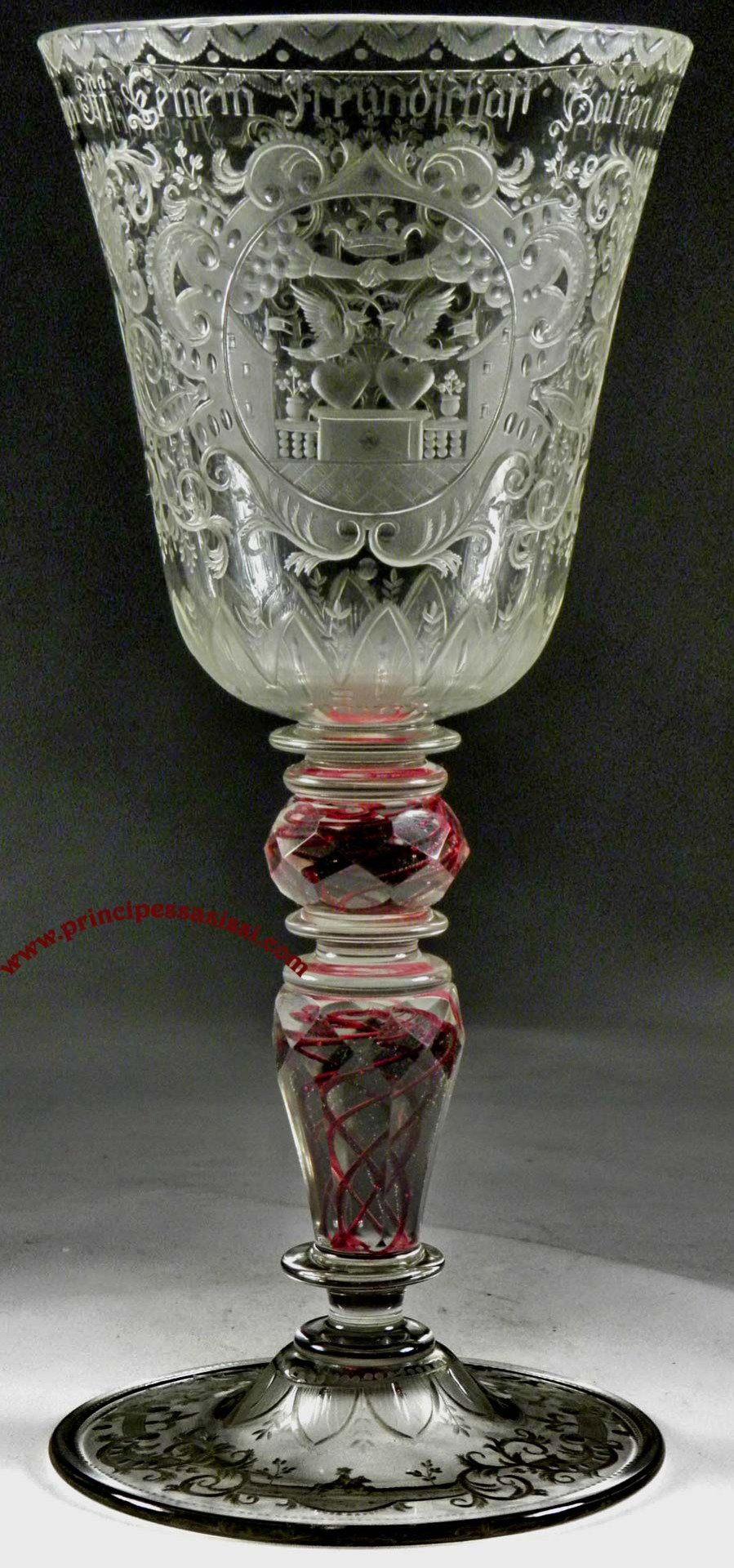
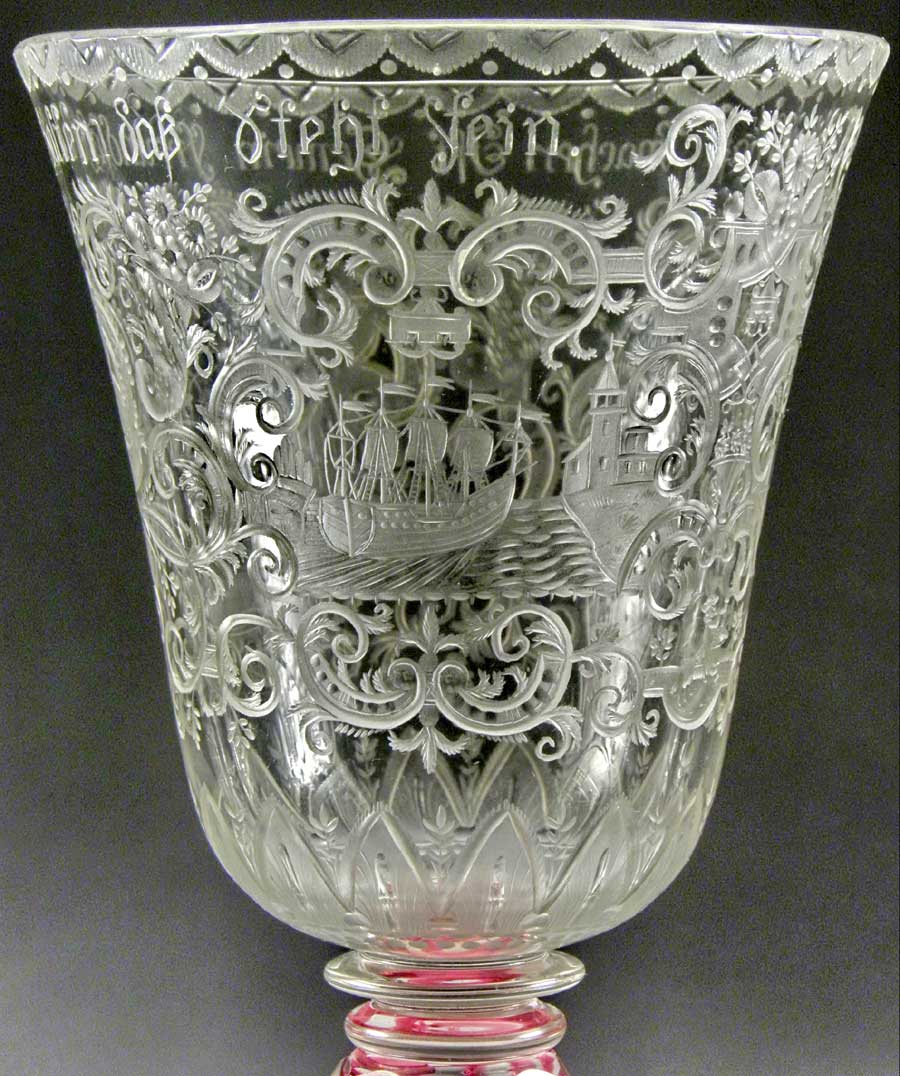
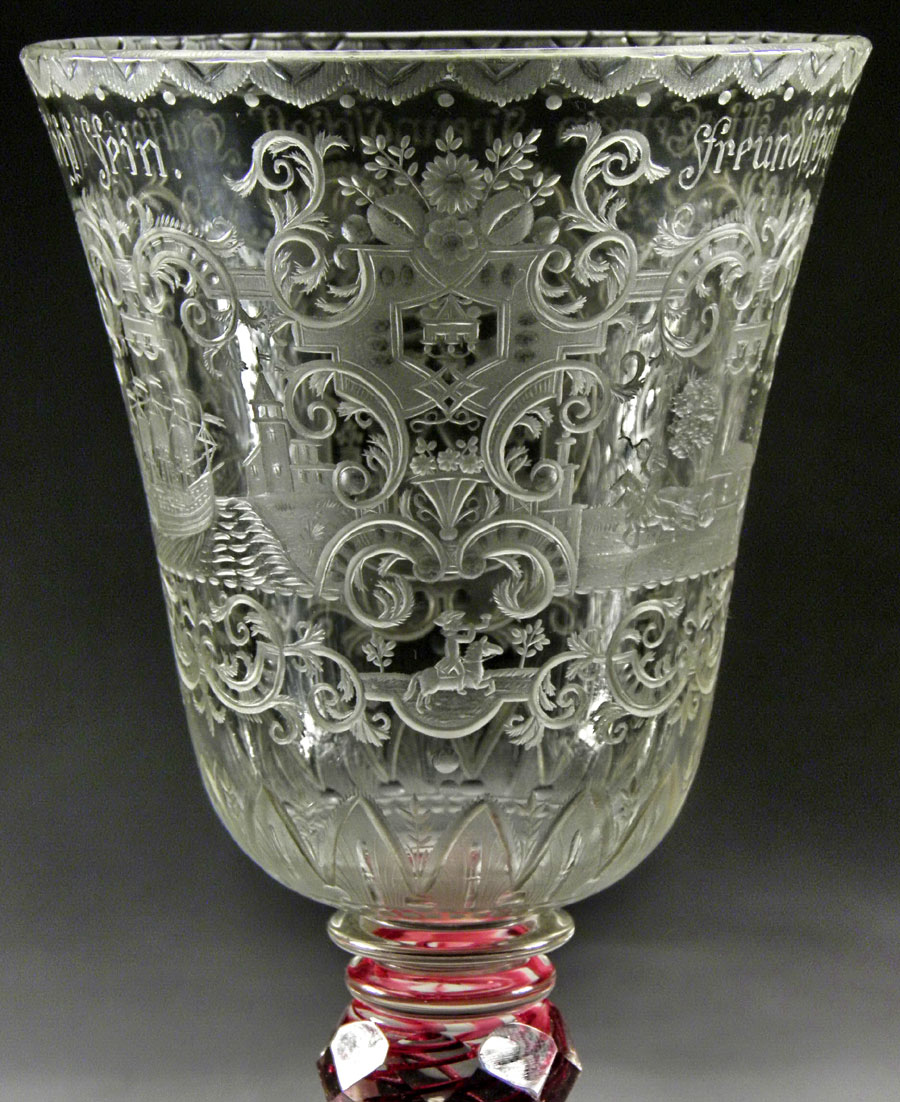
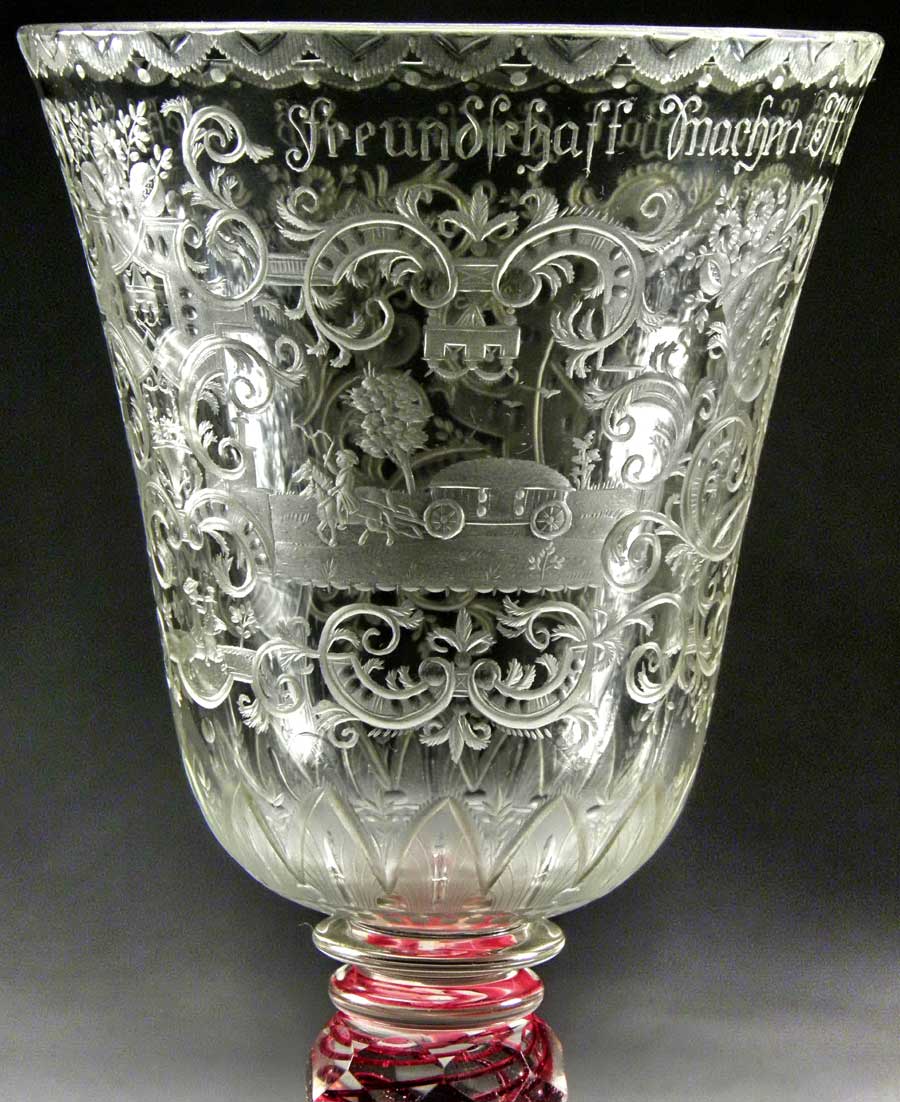
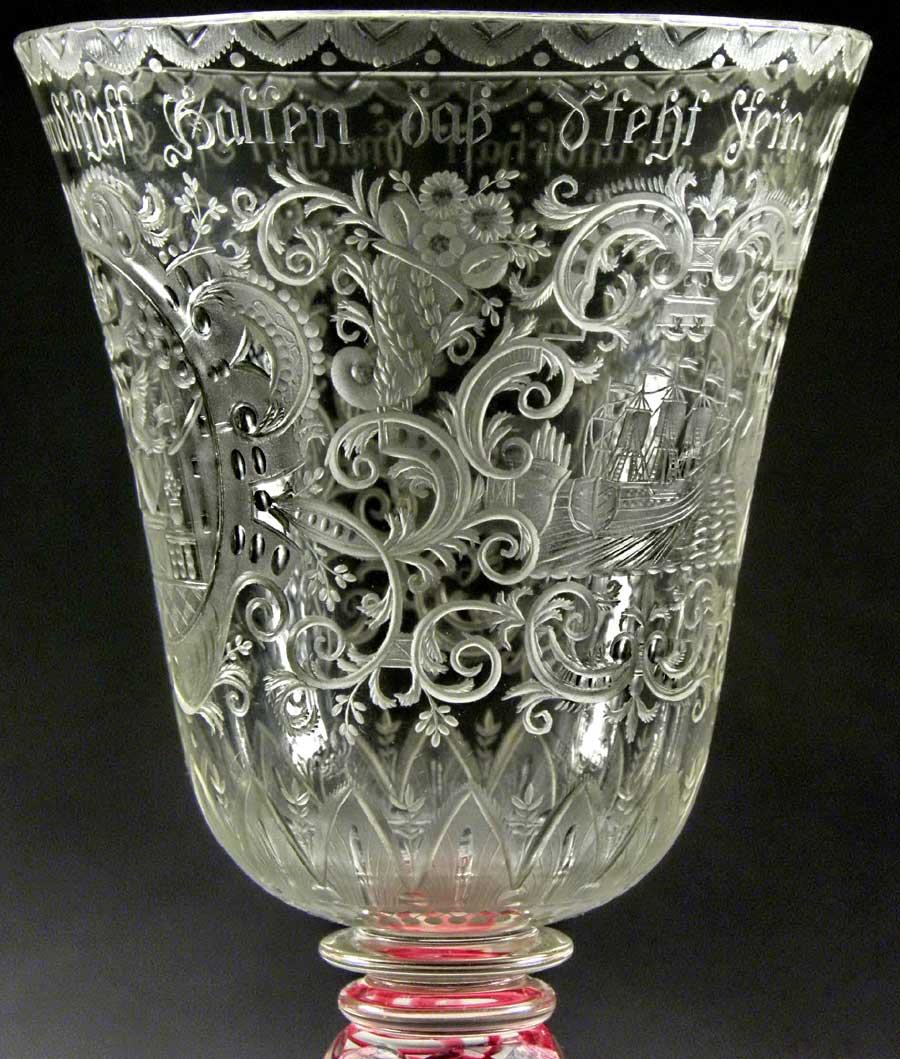
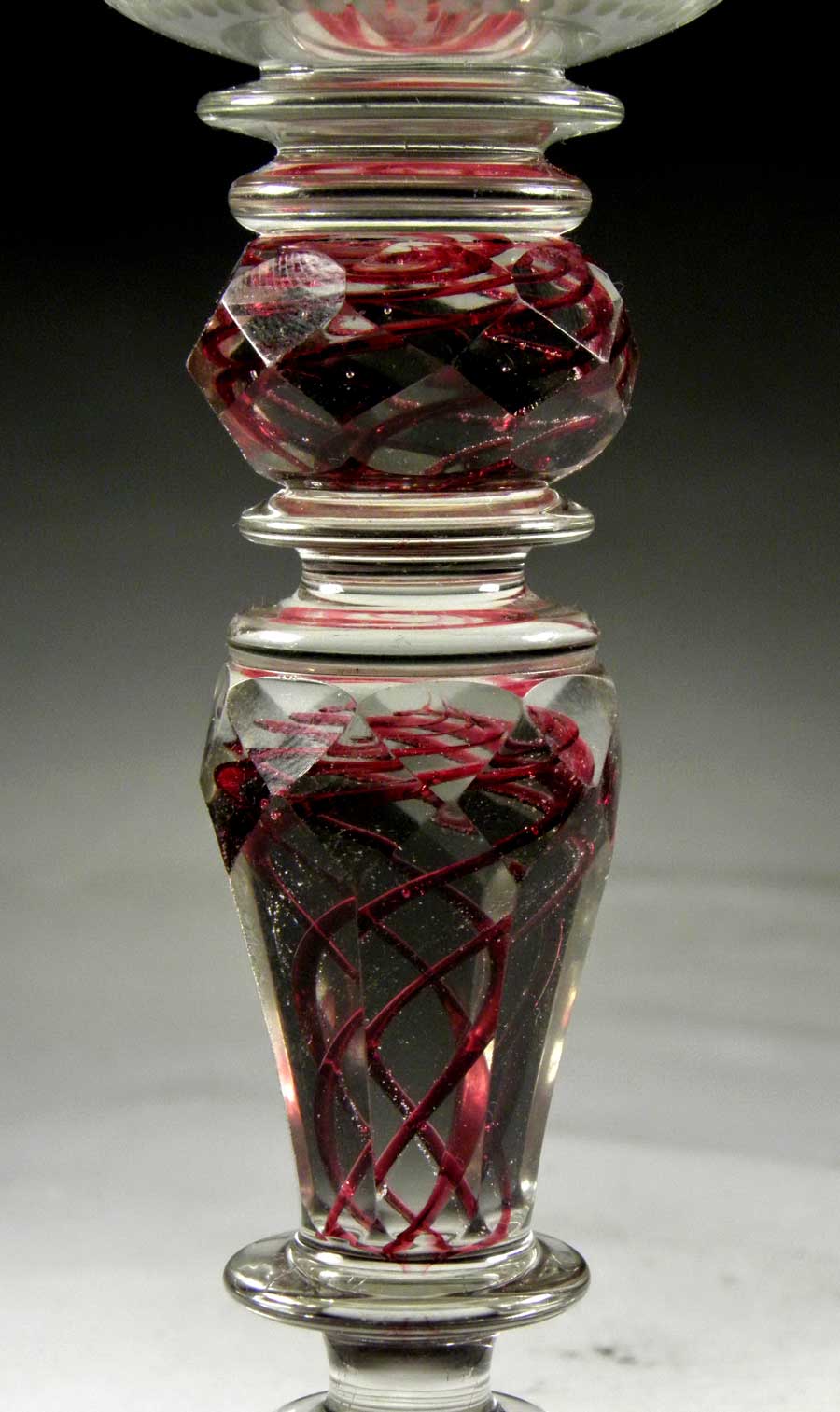
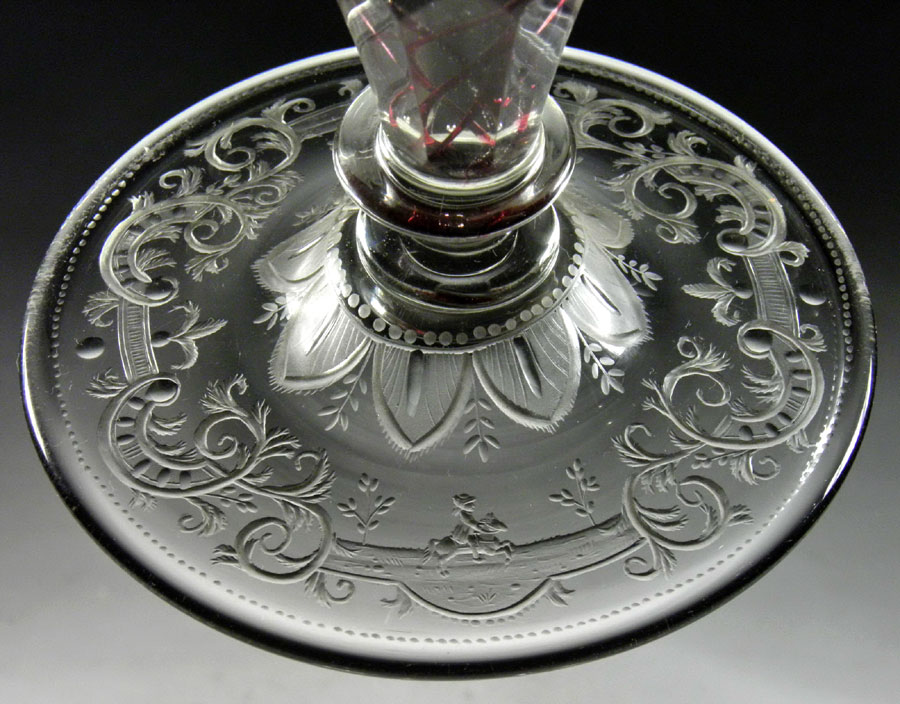
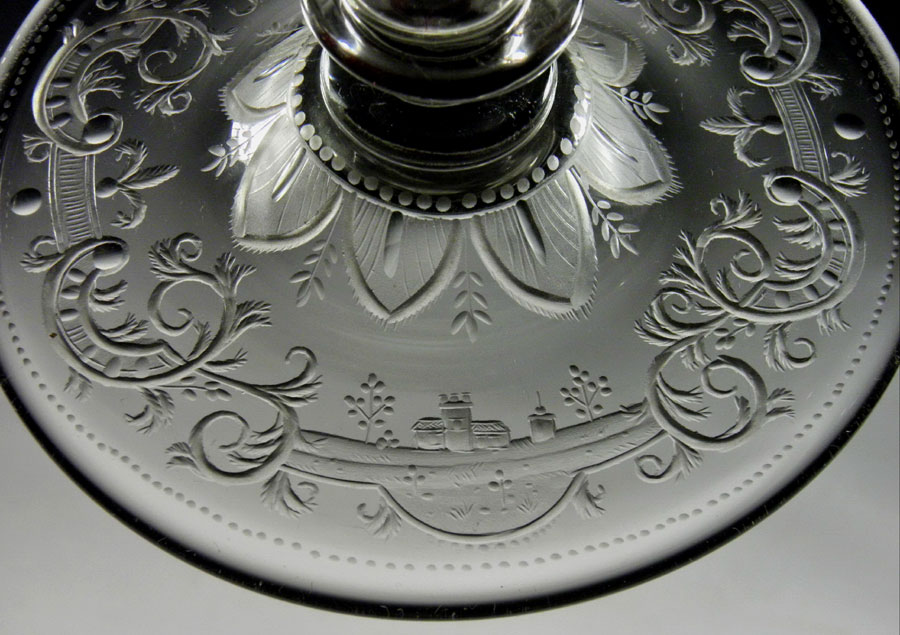
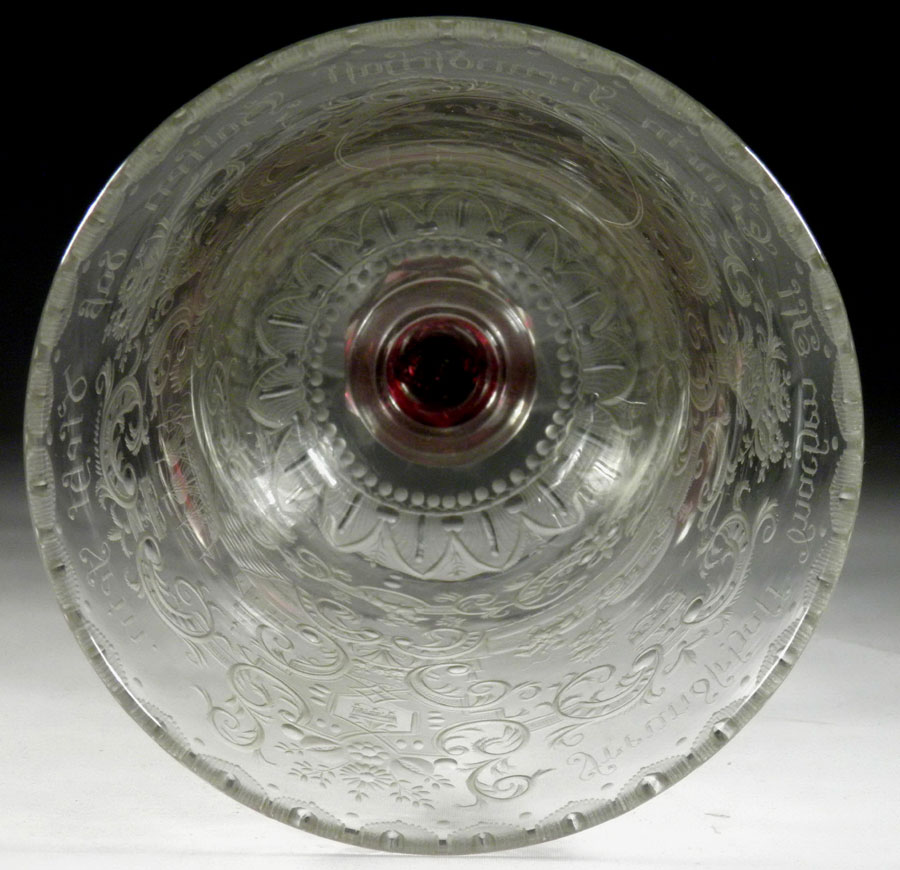
North Bohemia, 1700-1730, probably Georg Franz Kreybich, a refined and extremely rare goblet blown and cut on the wheel with floral motifs, baroque scrolls, acanthus leaves, figures, and hunting knights. Refined interwoven ruby-colored glass threads in the base, typical of its origin. At the top, the inscription "Freunschaft machen ist gemein, freundschaft halten dass steht fein" = friendship is a common good, maintaining friendship remains a good. It celebrates a friendship of princely rank (Freundschaftbecher with crown and two hands clasping from the clouds). This symbolism, originating from the biblical myth of David and Jonathan, was popular at the time. Other visible symbols include peace (two doves with an olive branch in their beaks) and trust, represented by two hearts. The two houses with flags represent the two friendly noble houses. Similar works are in the museums of applied arts in Bremen (published on page 93 of Dietmar Zoedler's Schlesisches Glas), Vienna, Prague, Passau, London, and New York. Height 22.5 cm, width 10 cm. Another extremely similar work, but not cut with the quality of the goblet we are offering, was published in 1990 by Michael Kovacek in Glas aus 5 Jahrunderten, p. 74. In perfect condition with no restorations.
Jonathan (from Hebrew Yonathàn or Yehonathàn, meaning "YHWH has given") is a biblical figure, the eldest and favorite son of King Saul, by Ahinoam, daughter of Ahimaaz. During his father's reign, he distinguished himself for his indomitable courage both in the defeat of the Philistine garrison at Gabaa and in the new victory at Micmas. He is best known for the profound friendship that bound him to the future King David and for the help he gave him in the most dangerous circumstances. Jonathan's special friendship for David began shortly after the latter killed Goliath. That intrepid action in defense of his people must have moved Jonathan. Hearing about it from David himself, "the very soul of Jonathan became bound up with the soul of David, and Jonathan loved him as his own soul" (1Sam 18:1). The two warriors "made a covenant of friendship." The Bible uses some very strong expressions to describe the bond that united Jonathan and David (for example, on the lips of David: "Jonathan, you were very dear to me, and your love for me was more wonderful than the love of women," 2Sam 1:26). For this reason, the story of David and Jonathan (like that of Ruth and Naomi, that of the centurion and his young servant healed by Jesus, and a few others) has suggested to some commentators that two different languages on the subject of homosexuality find a place in the Bible.
Georg Franz Kreybich (1662 - 1736) was one of the best Bohemian engravers who lived in the Baroque period, an artist, and entrepreneur. His refined creations were highly appreciated by the European nobility of the time; in fact, he traveled extensively and was a guest of the courts of Germany, England, Scandinavia, Russia, and Hungary. He worked in the town of Kamenicky Senov (Steinschonau) in the Sudetenland, in the immediate vicinity of the German border with his son. Literature: Licht und Farbe, Rudolf von Strasser, Vienna Museum of Art History. Brigitte Klesse, Glassammlung Helfried Krug (1965), Schlesisches Glas, Dietmar Zoedler, BohmischesGlas Band I, Glasmuseum Passau, The Legend of Bohemian glass Antonin Langhamer. Glas aus 5 Jahrhunderen, Kovacek Wien 2001, opera 11.
In accordance with the provisions of the New Code of Cultural Heritage, the selling company provides, at the time of sale, a detailed written photographic guarantee of the authenticity and provenance of the works sold. The data with which the works are described and then contained in the written guarantees are expressed determinations resulting from accurate, in-depth and documented technical/historical/artistic investigations.