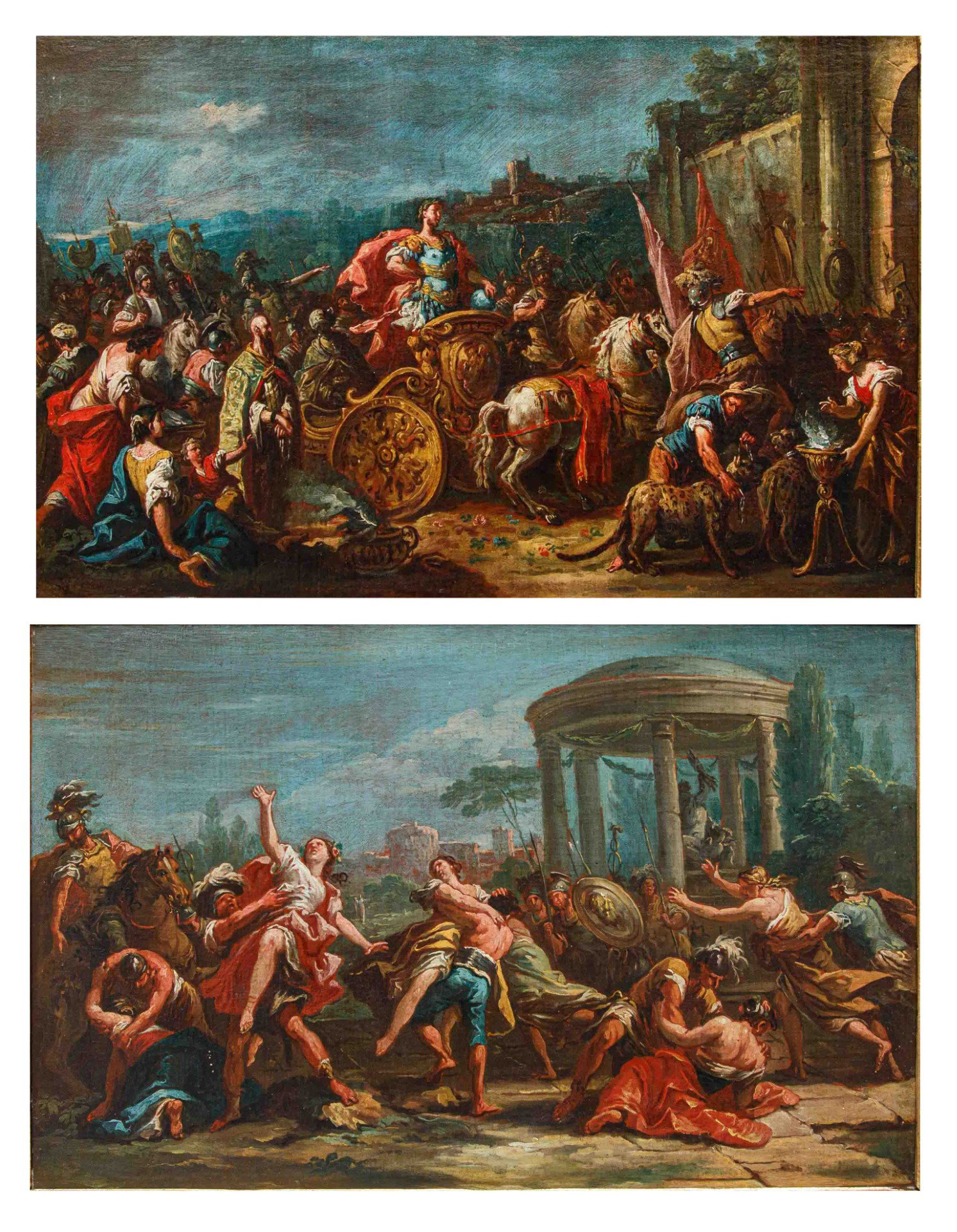
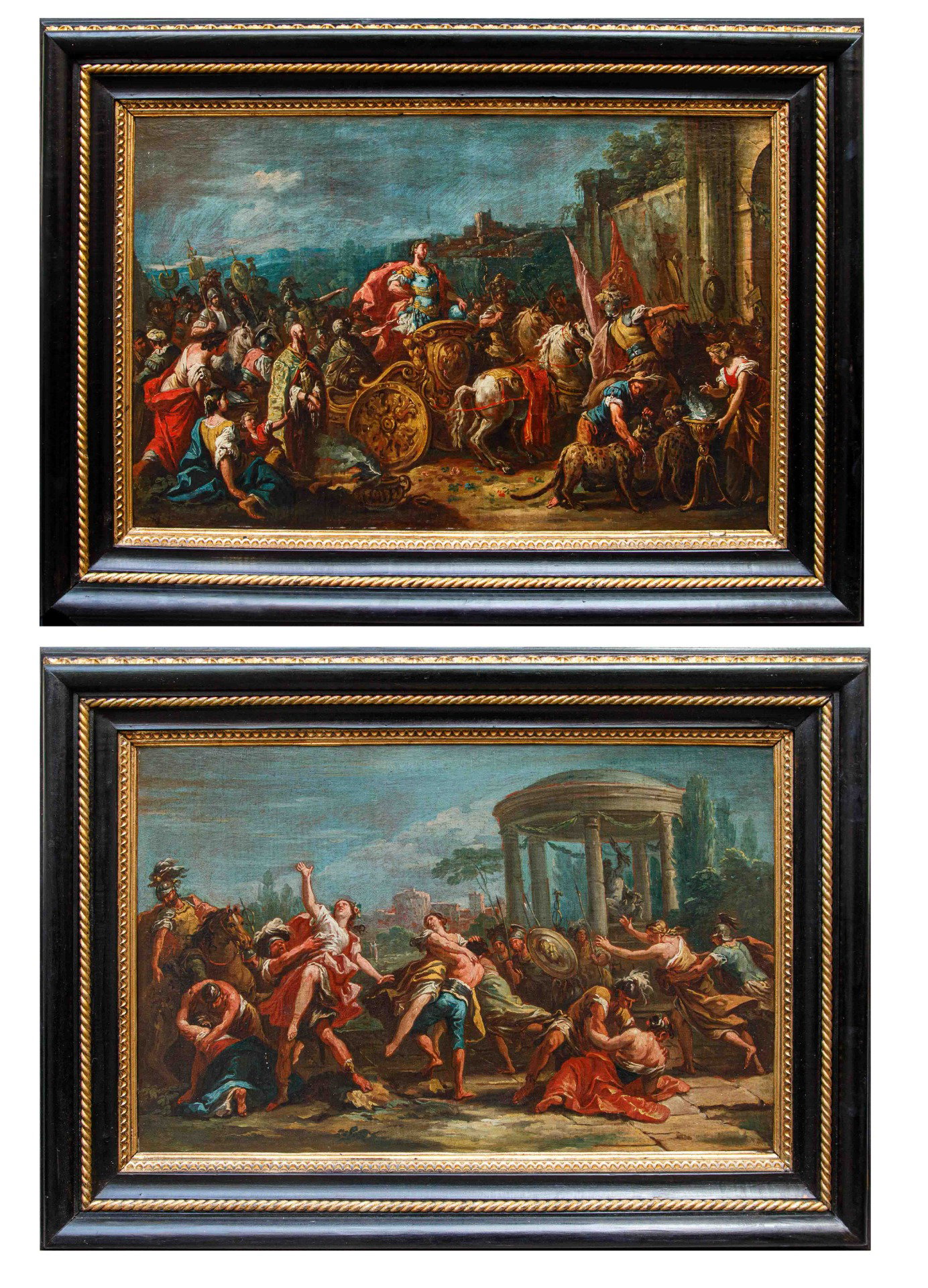
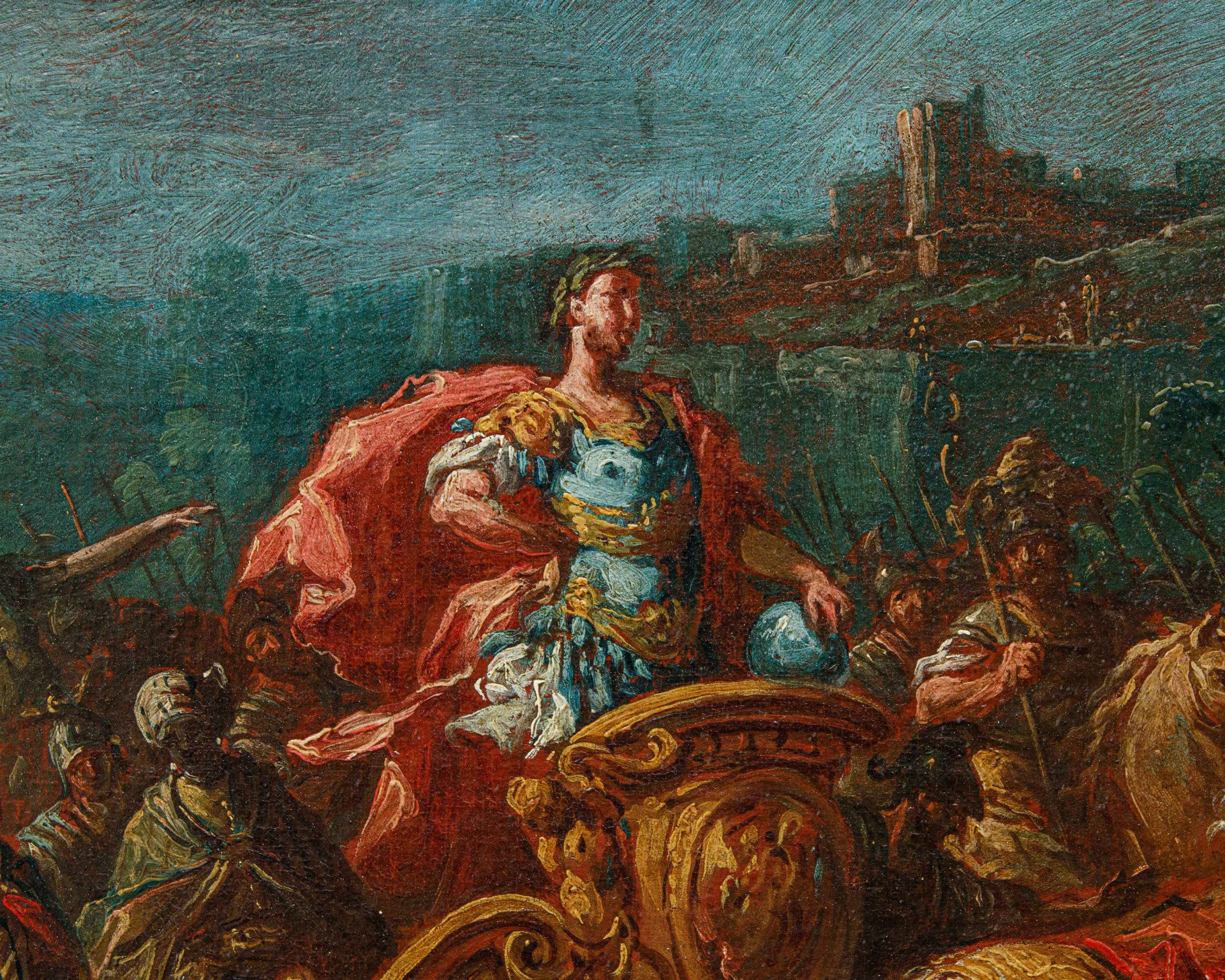
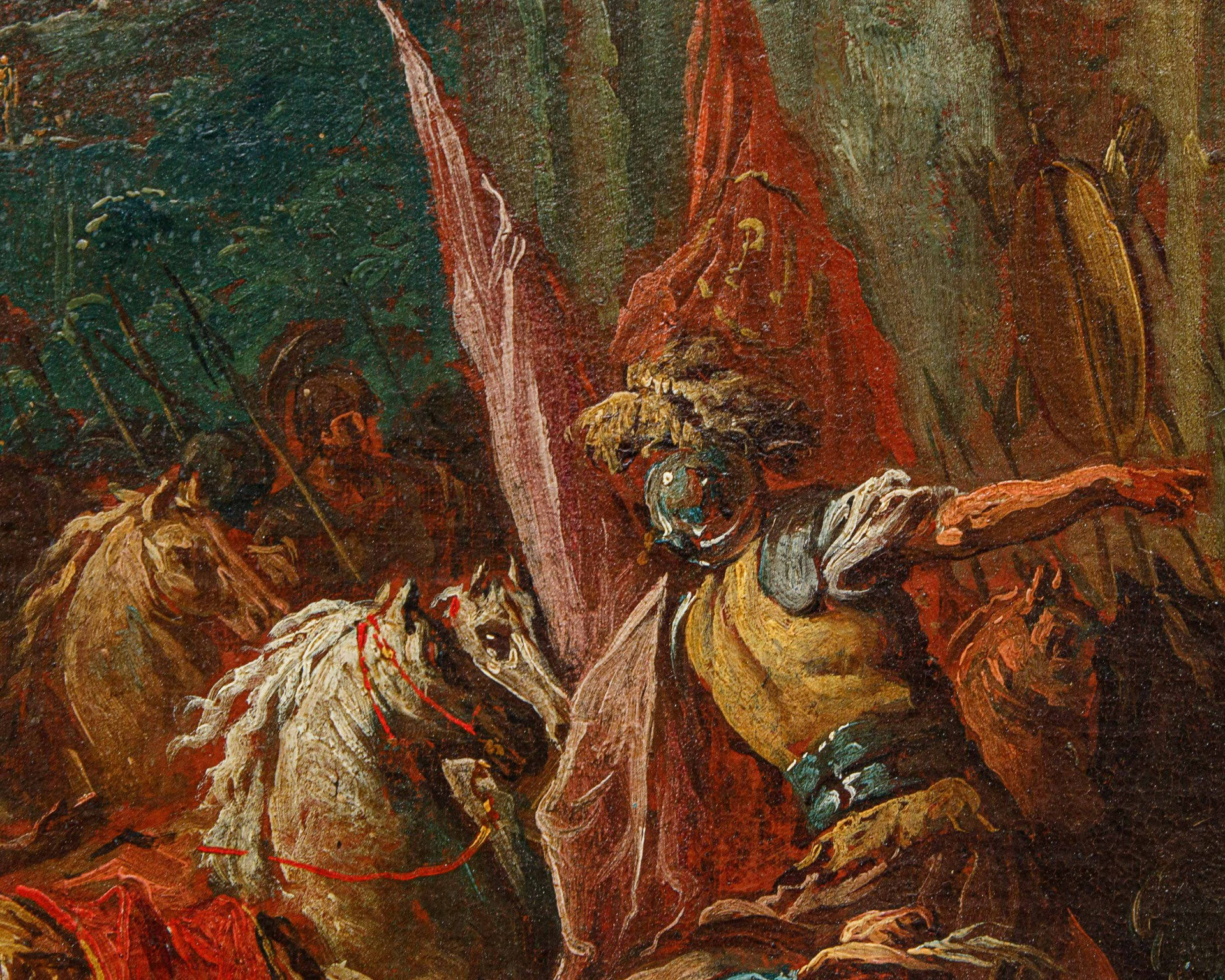
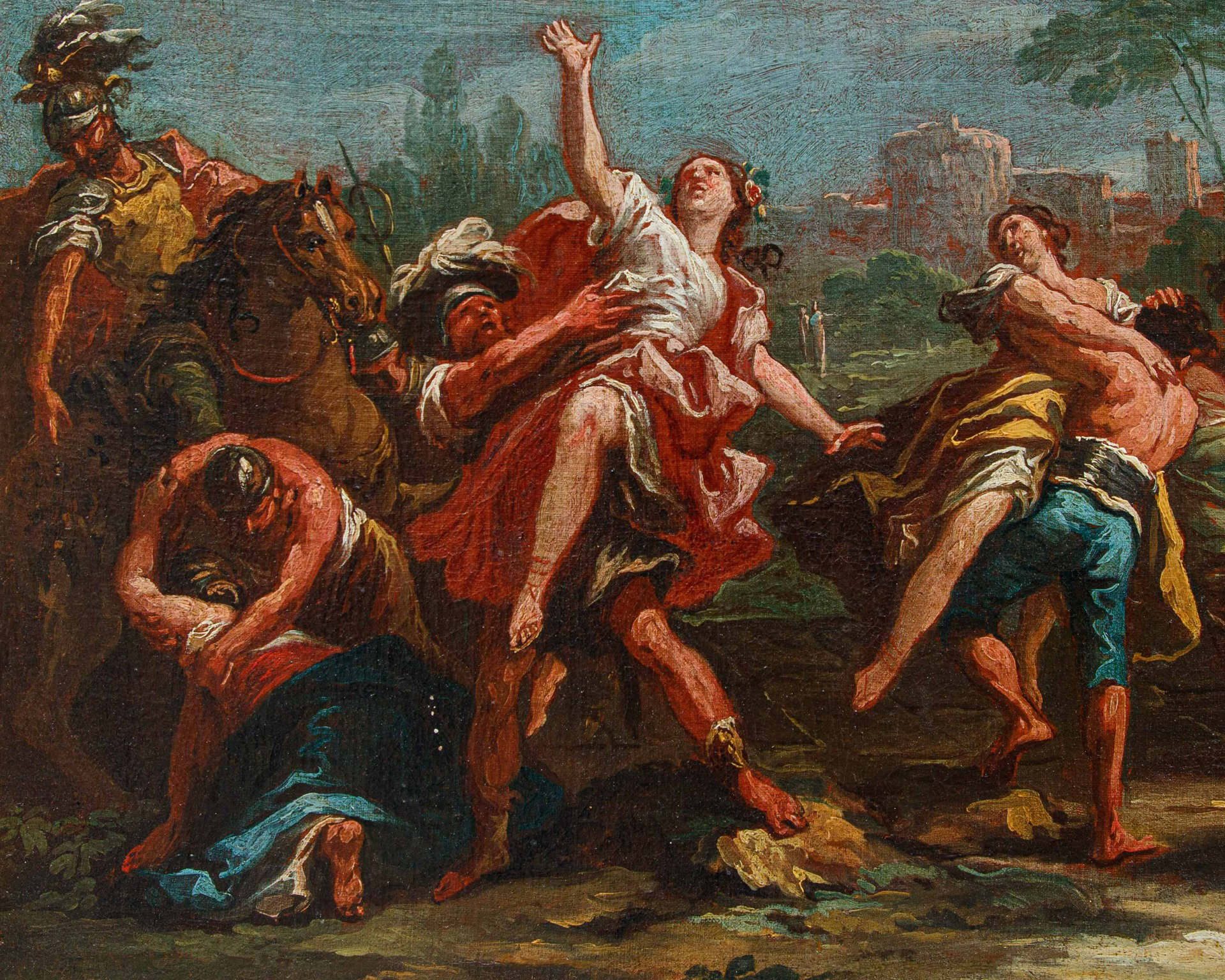
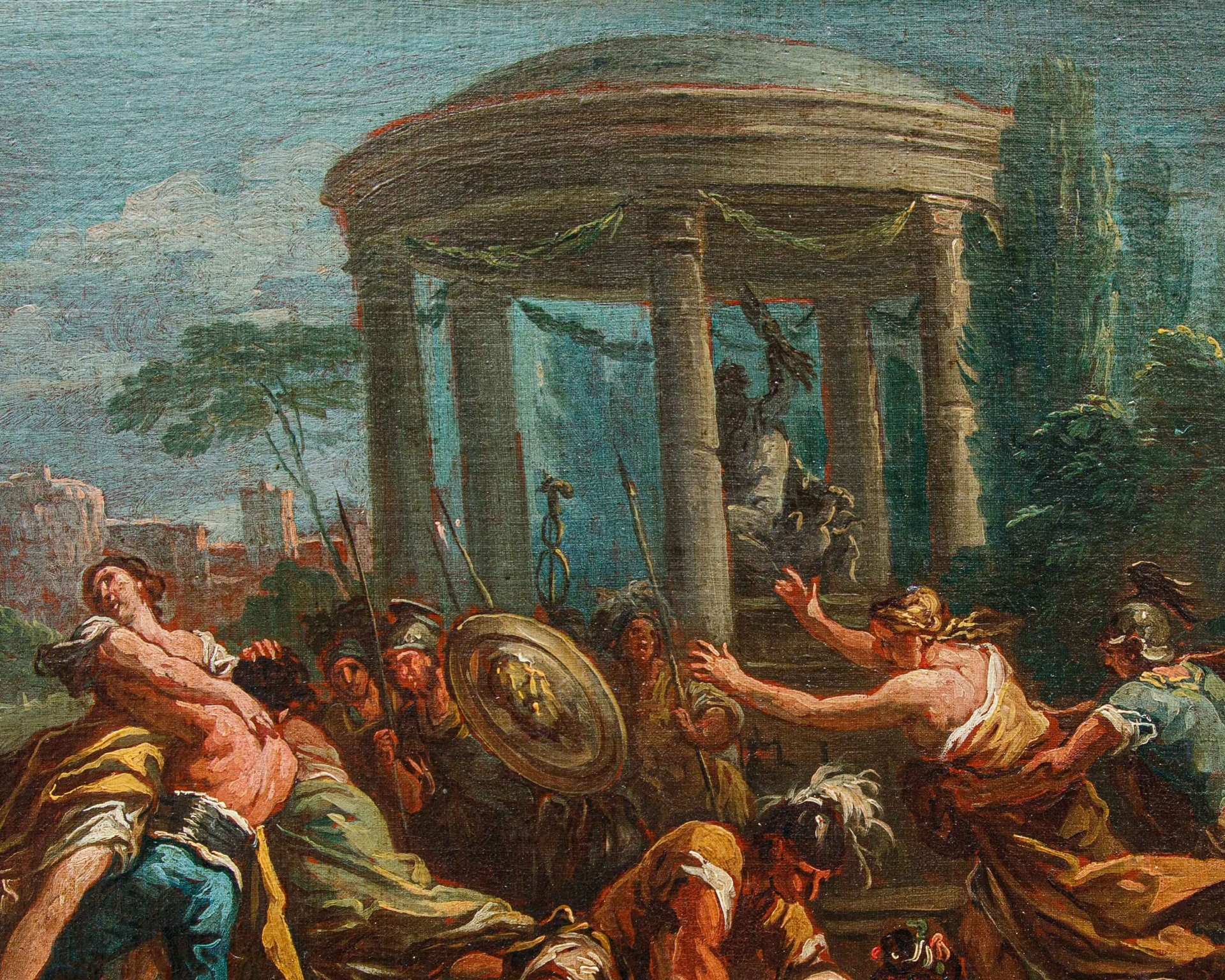
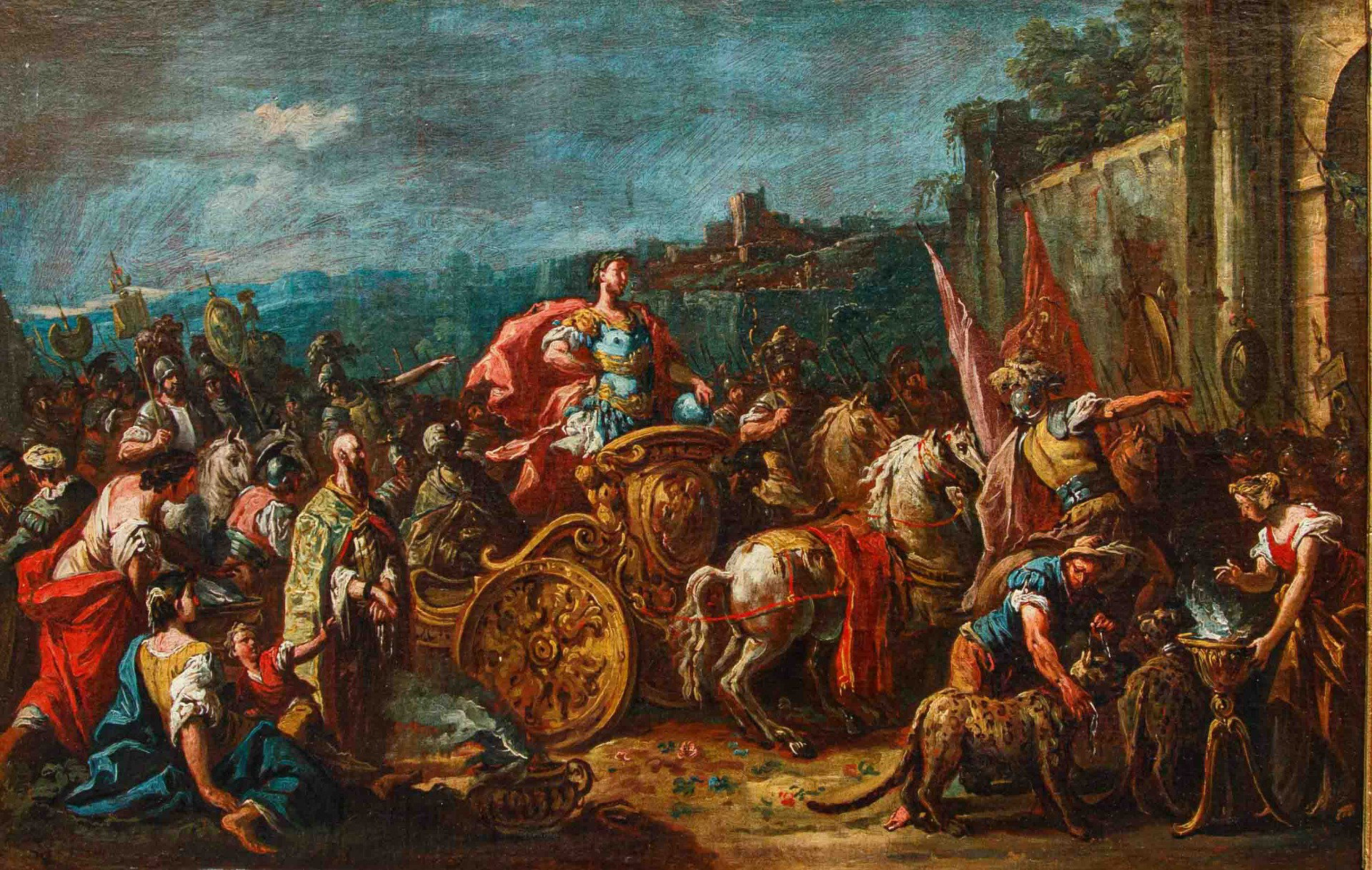
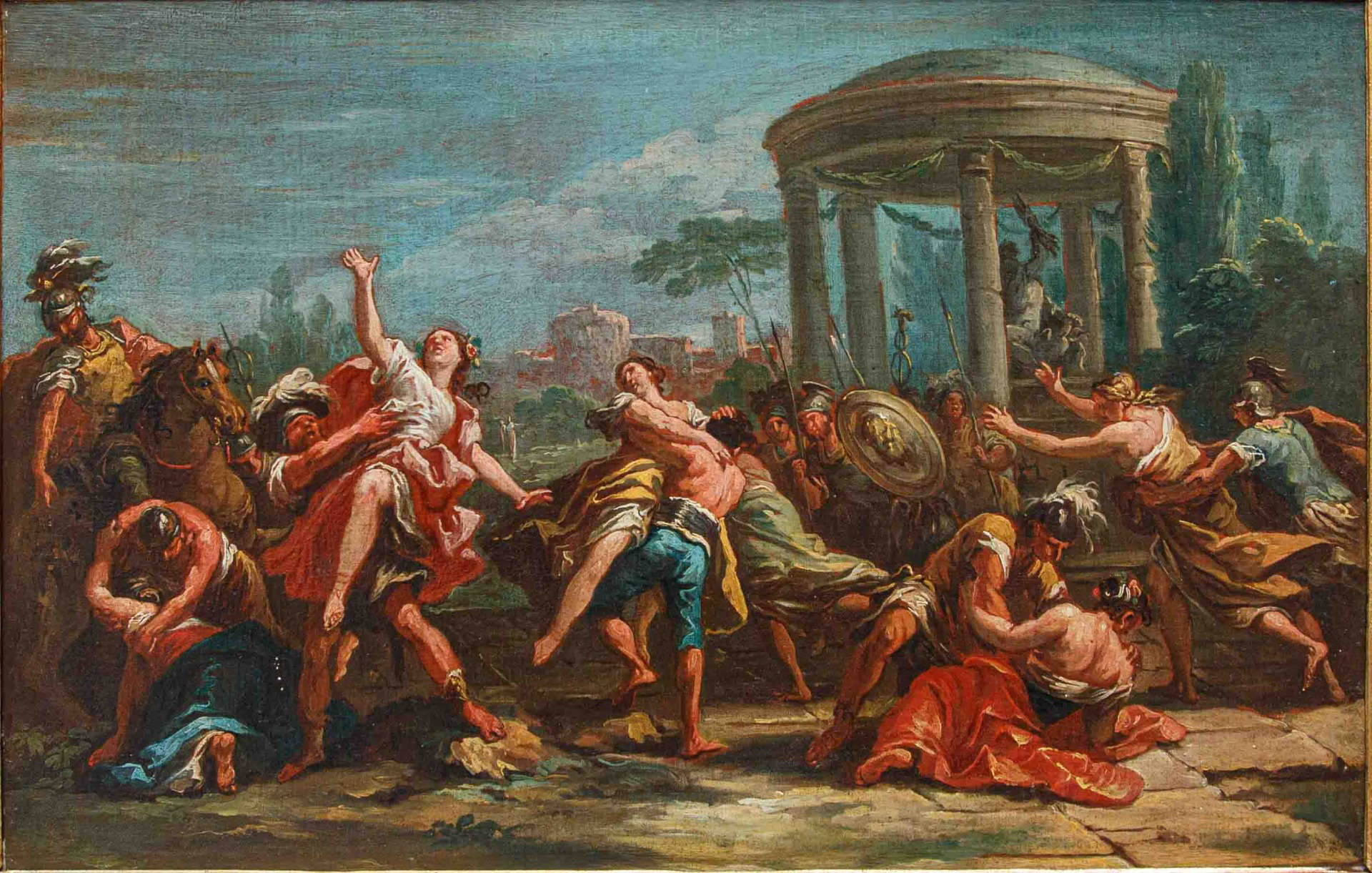
Gaspare Diziani (Belluno, January 24, 1689 – Venice, August 17, 1767) The Triumph of Alexander the Great – The Rape of the Sabine Women Oil on canvas, 47.5 x 73 cm Gaspare Diziani - whose original surname was De Cian, Italianized during his lifetime - was born in Belluno on January 24, 1689, to Giuseppe and Giustina Lina. His training began in his hometown, under the guidance of Antonio Lazzarini, the last provincial interpreter of Baroque tenebrism, a painter of modest stature but capable of imparting the fundamentals of the trade to the young student. However, the true artistic turning point came with his move to Venice, which occurred around 1709-1711, when Diziani first entered Gregorio Lazzarini's workshop and then, with much greater profit, that of his compatriot Sebastiano Ricci. It was the latter who decisively marked his pictorial vision: Diziani was familiar with Ricci's Belluno works from 1704 in the Fulcis palace, in the chapel of the same name in San Pietro, and in the Vedana Charterhouse, and around 1718 Ricci was still active in Belluno, frescoing the Villa del Belvedere. Rapid fame, supported by uncommon execution skill, brought Diziani to Munich, Bavaria, as early as 1717, where he executed a series of decorations for the Residenz palace depicting the Four Parts of the World, unfortunately destroyed during World War II. In the same year, he was already in Dresden, at the Saxon court, accompanying the set designer Alessandro Mauro. In 1720, he returned to Venice, where he was registered with the painters' guild, and from there he departed for Rome to serve the Venetian Cardinal Pietro Ottoboni. From that moment on, Diziani remained stably in the territories of the Serenissima, with his workshop in Merceria in Venice, from where he shipped works throughout the continent. The Triumph of Alexander the Great presented here is part of a pictorial reflection that Diziani conducted on the exploits of the Macedonian commander, a subject to which he returned on several occasions with outcomes of considerable scenic intensity. Versions of the same theme are preserved at the Alte Pinakothek in Munich, the Nationalmuseum in Stockholm, and in various private collections. In the painting under examination, the Macedonian general is depicted standing on a richly adorned triumphal chariot, with a wheel decorated with golden volutes that occupies a prominent formal position in the composition. Compared to the versions preserved in the major European pinacotheques, this painting shows the same compositional arrangement with the chariot as the supporting axis, but with a more intense concentration of narrative details in the foreground, indicating a destination probably intended for private enjoyment. The palette is that characteristic of the Belluno painter: deep reddish tones, metallic blues, warm yellows, bright whites that animate the soldiers' robes and the horses' manes. The brushwork is rapid, lending the entire scene an almost theatrical tremor, consistent with the artist's scenic training. The Rape of the Sabine Women is the other thematic peak of this pair of paintings, united by the choice of subjects drawn from ancient history, interpreted through the filter of the great Venetian pictorial tradition and European Baroque culture. The myth of the Sabine women - with which Romulus solved the problem of the lack of women in nascent Rome by organizing a kidnapping during the games in honor of Neptune - a subject widely explored in 17th and 18th-century painting, especially in the Venetian area, for its possibilities of orchestrating figures in agitated motion. The comparison with another version of the same subject by Diziani, preserved in a private collection, allows us to grasp the painter's coherence in addressing this theme. In both versions, the compositional structure favors the distribution of groups along an implicit diagonal that crosses the canvas from left to right, with intertwined figures creating a syncopated rhythm of tense bodies. In both cases, however, Diziani's stylistic signature is immediately recognizable in the use of color and the loose brushwork that constructs bodies through pictorial masses rather than defined contours, following that lagoon tradition that reached from Titian's legacy to Ricci and from Ricci to his Belluno student.