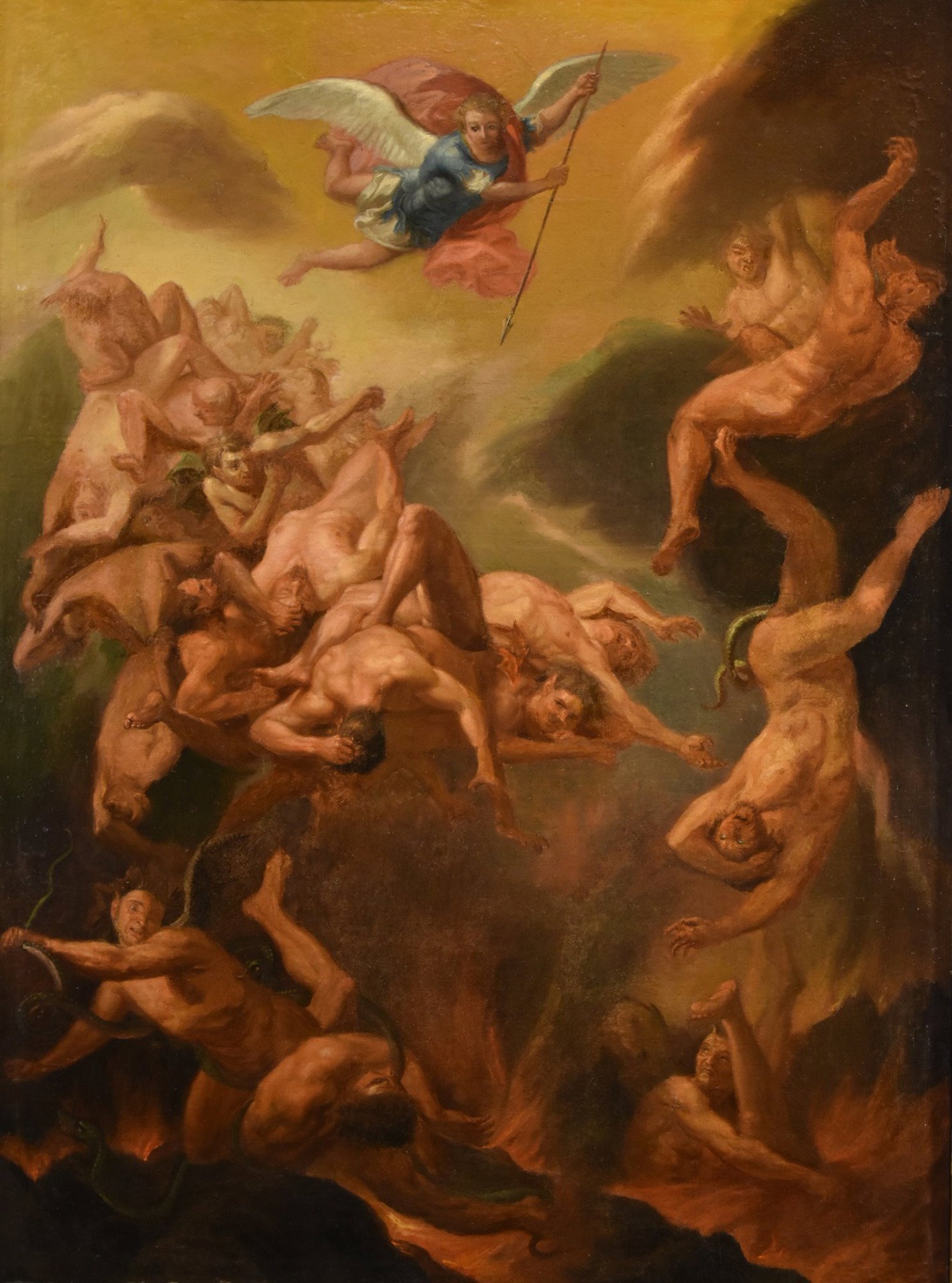
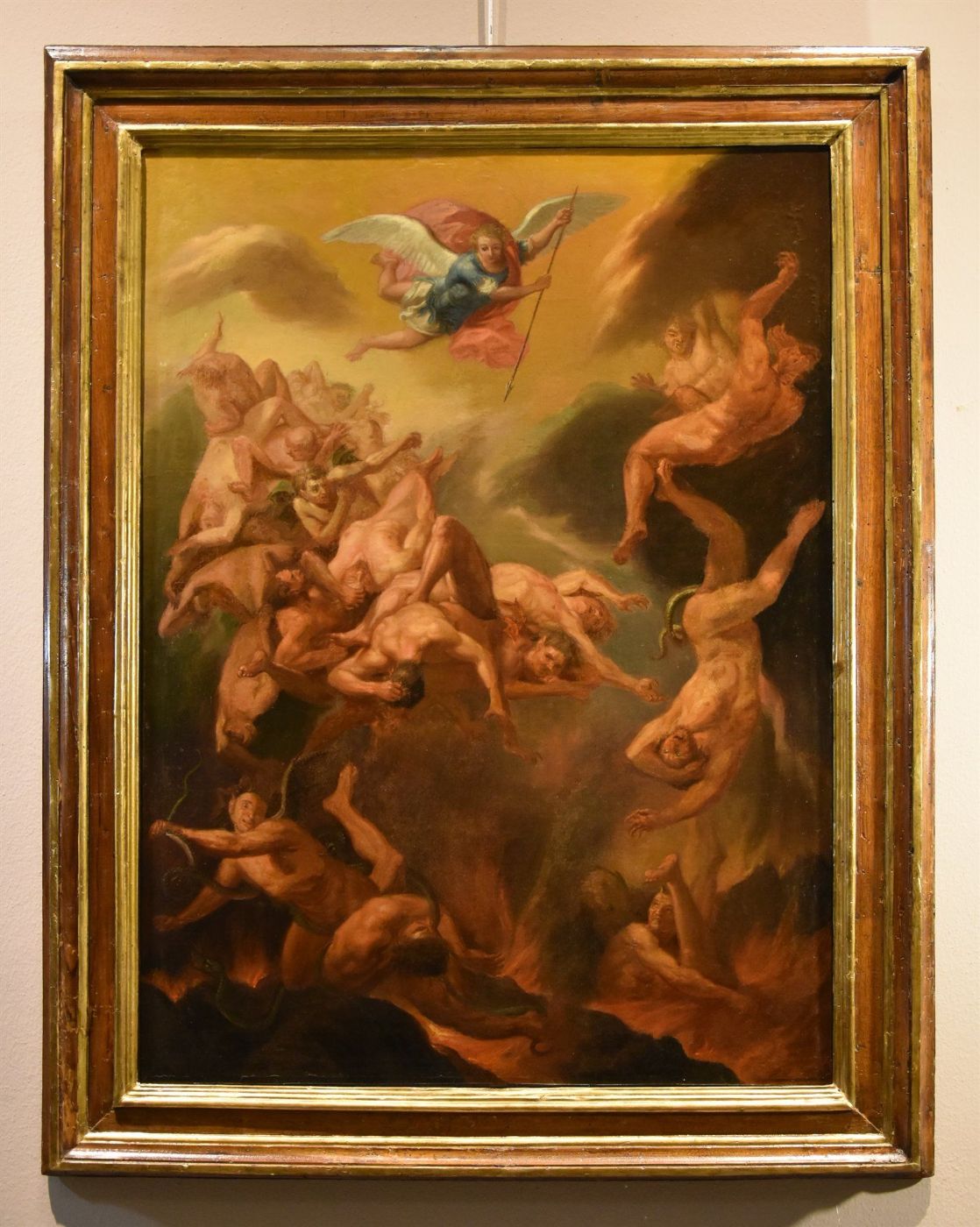
Saint Michael the Archangel expelling the rebel angels from paradise
(probable preparatory sketch)
Roman school of the 17th/18th century
Oil on canvas (99 x 73 cm. - Framed 119 x 94 cm.)
Full details of the painting (click HERE)
The subject of this fascinating canvas is taken from the Last Judgment, an extremely rare and always particularly favored theme in painting, as it allowed artists to tackle contorted poses, convulsive and sudden movements, pathos, and drama in compositions animated by sumptuous theatricality.
Specifically, we see here the expulsion of the rebel angels by Saint Michael the warrior: the Archangel is depicted in his armor with spread wings, forcefully striking the damned, who gradually transform into demons as they fall into hell.
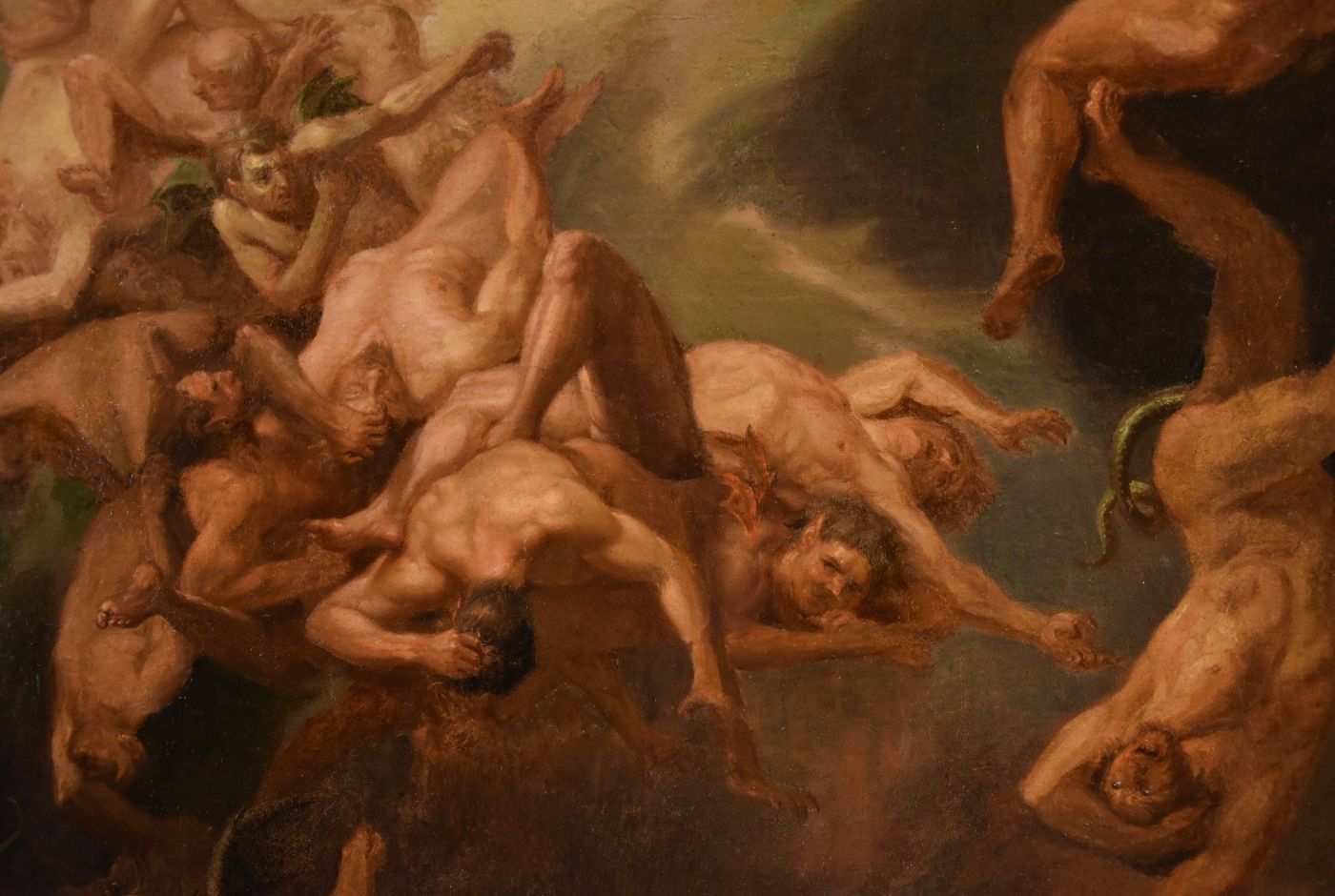
The Archangel Michael dominates the scene, enveloped in divine light and surrounded by celestial clouds symbolizing the separation between the heavenly realm and hell. Beneath him, a tangle of naked bodies plummets, arranged in various falling positions: they writhe, collide, overlap, trying to find their place in the stream of flesh flowing from top to bottom. Some fall on their backs, others headfirst, still others have reached hell, wrapped in the coils of infernal serpents and taking on the appearance of demons.
Baroque painting favored these types of subjects, with religious scenes characterized by great emotional tension, treated with great pathos and immediacy. To achieve drama, artists used powerful contrasts of light and shadow (chiaroscuro), diagonal compositions, and swirling lines, immersing the viewer in a theatrical and engaging visual experience.
This painting is not just a work of art, but a manifesto of the struggle between good and evil, a recurring theme in the history of art that continues to inspire artists and enthusiasts.
The fascinating canvas follows a descriptive structure that identifies it as a precious preparatory sketch, a study for a larger altarpiece, or even more likely for a more complex fresco; this would therefore suggest that the final work was intended for the decoration of the main bay of a private chapel.
This work reflects the characteristics of the Roman school between the seventeenth and eighteenth centuries: the colors are warm and bright, the chromatic range is clear and soft, and the quick but precise brushstrokes are typical elements of this period, with strong influences from Flemish artists who populated the papal city.
The rendering of the drapery and the musculature of the bodies are typical characteristics of Flemish art of this period, indicating the expert hand of a highly skilled painter, although it is difficult to identify the author precisely. However, it is clearly influenced by the illustrative models typical of this period, drawing from the Mannerist tradition of artists such as Cavalier d'Arpino, Andrea Commodi, or Scipione Compagno, who tackled this subject on numerous occasions.
Very interesting, and certainly an inspiration for our author, is the famous engraving by Philippe Thomassin (1562-1622) depicting the battle between Saint Michael the Archangel and the demons, derived from a painting by Giovanni Battista Ricci (1537-1627), in which details of our painting seem to be revisited.
https://www.britishmuseum.org/collection/object/P_1860-1110-249
Conservation status: the painting is in good conservative condition with restorations and repainting on the surface.
ADDITIONAL INFORMATION:
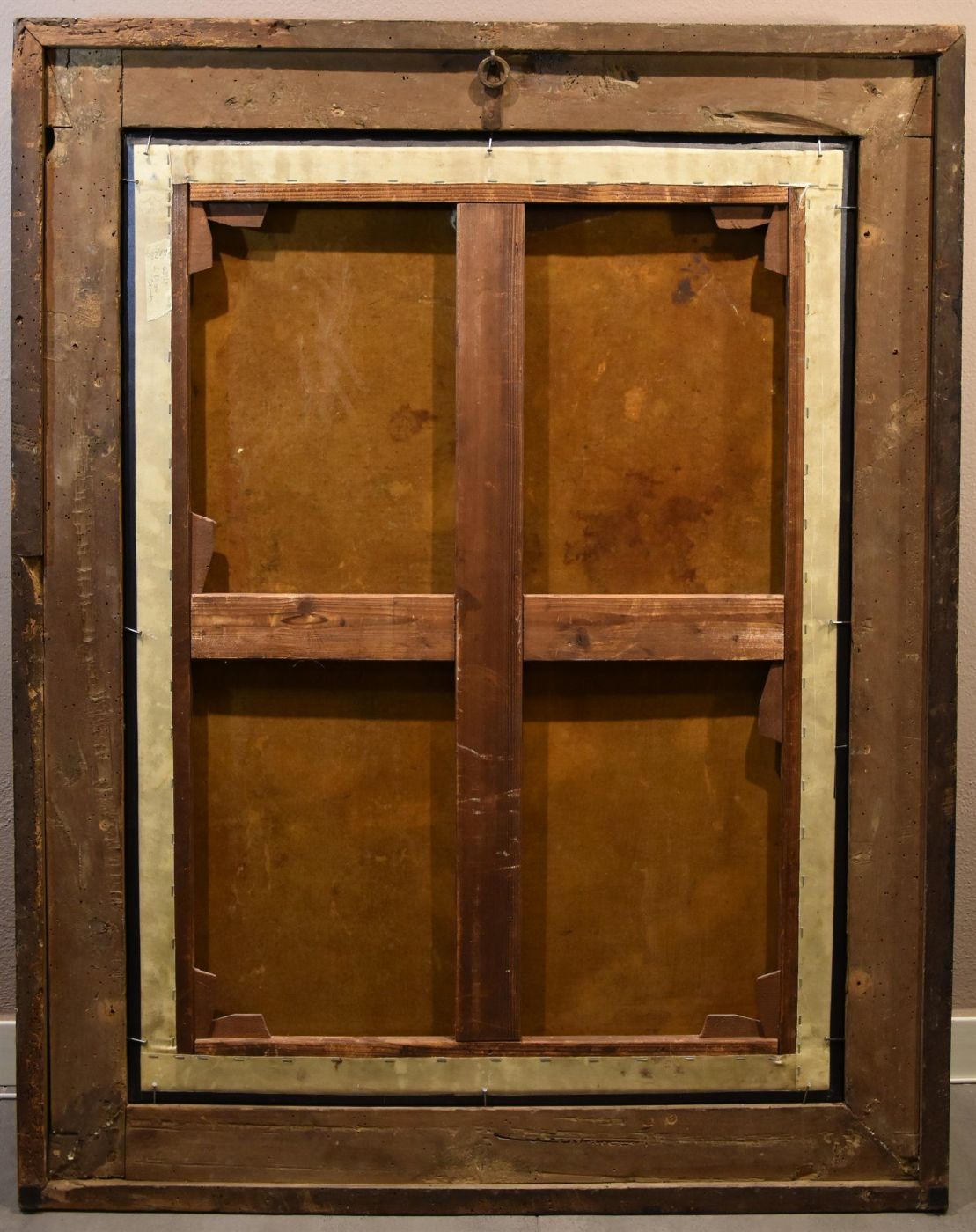
The work is sold complete with an antique frame and is accompanied by a certificate of authenticity and a descriptive iconographic sheet.
We handle and organize the transport of purchased works, both within Italy and abroad, through professional and insured carriers.
Should you wish to view this or other works in person, we will be pleased to welcome you to our new gallery in Riva del Garda, at Viale Giuseppe Canella 18. We look forward to seeing you!
Contact us, without obligation, for any additional information.
Follow us also on:
https://www.instagram.com/galleriacastelbarco/?hl=it
https://www.facebook.com/galleriacastelbarco/