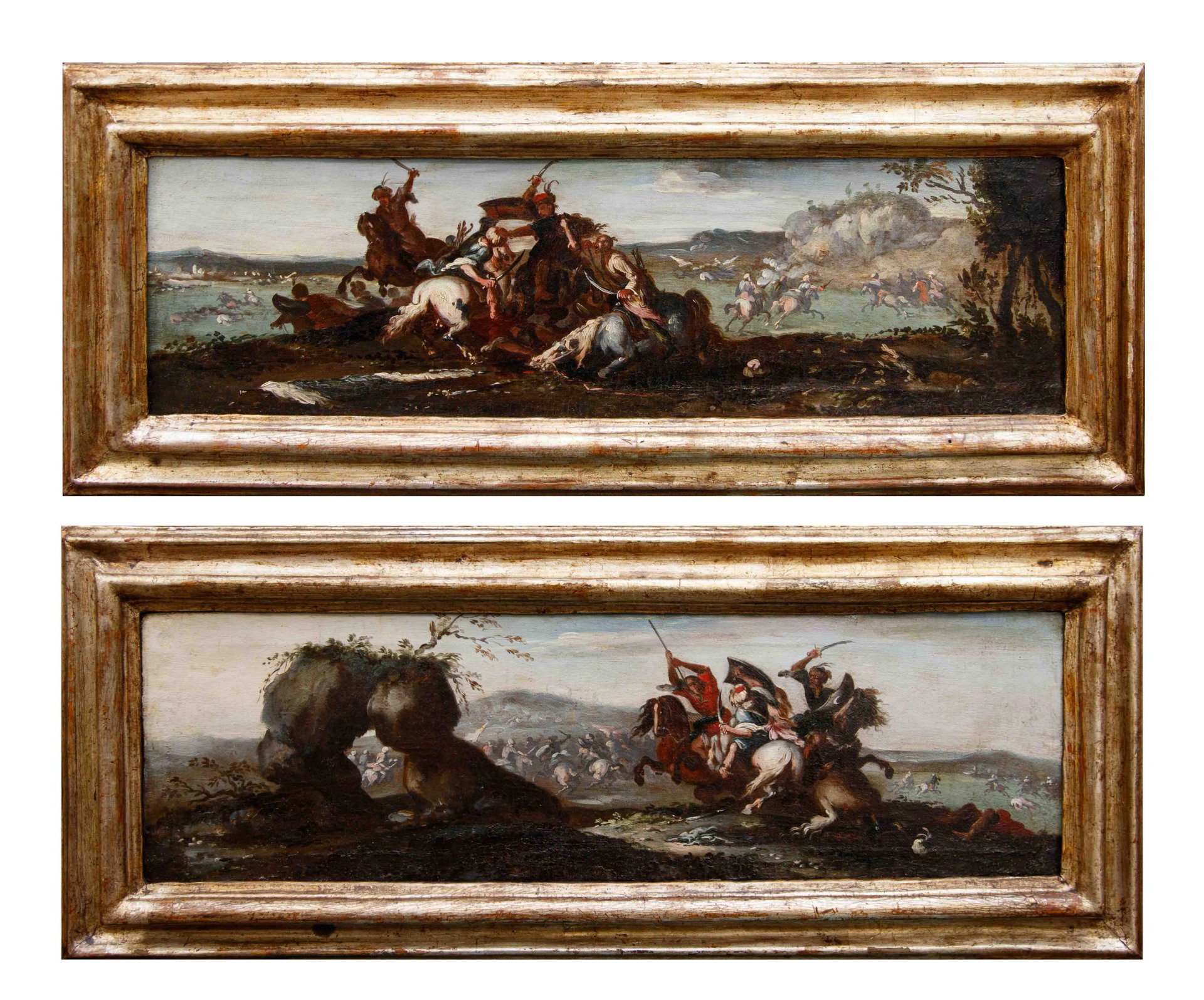
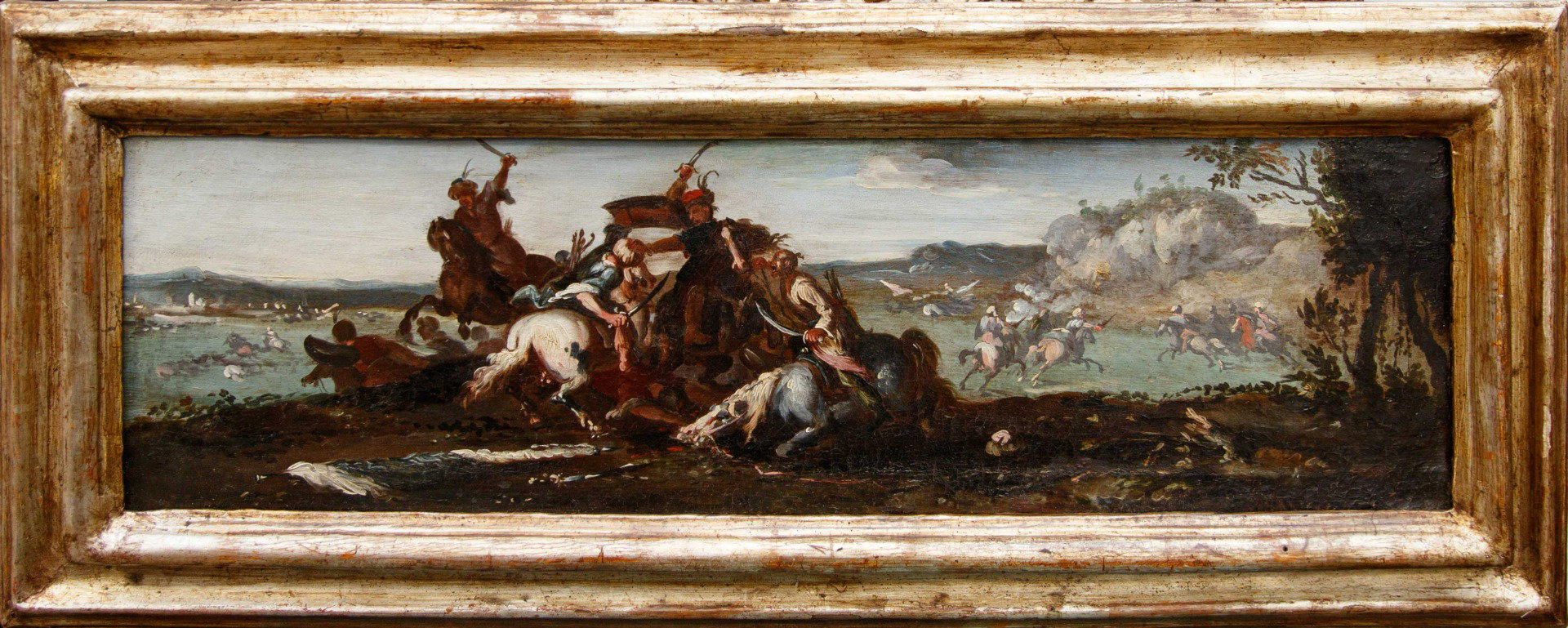
Jacques Courtois, known as Borgognone (Saint-Hyppolite, February 12, 1621 – Rome, November 14, 1676), attributed.
Battles with the Turks
Oil on canvas, 19 x 64.5 cm – with frame, 31 x 76 cm
Gian Lorenzo Bernini said: "Among the painters of that time in Europe, no one has equaled Courtois in the graphic expression of the horror of battle."
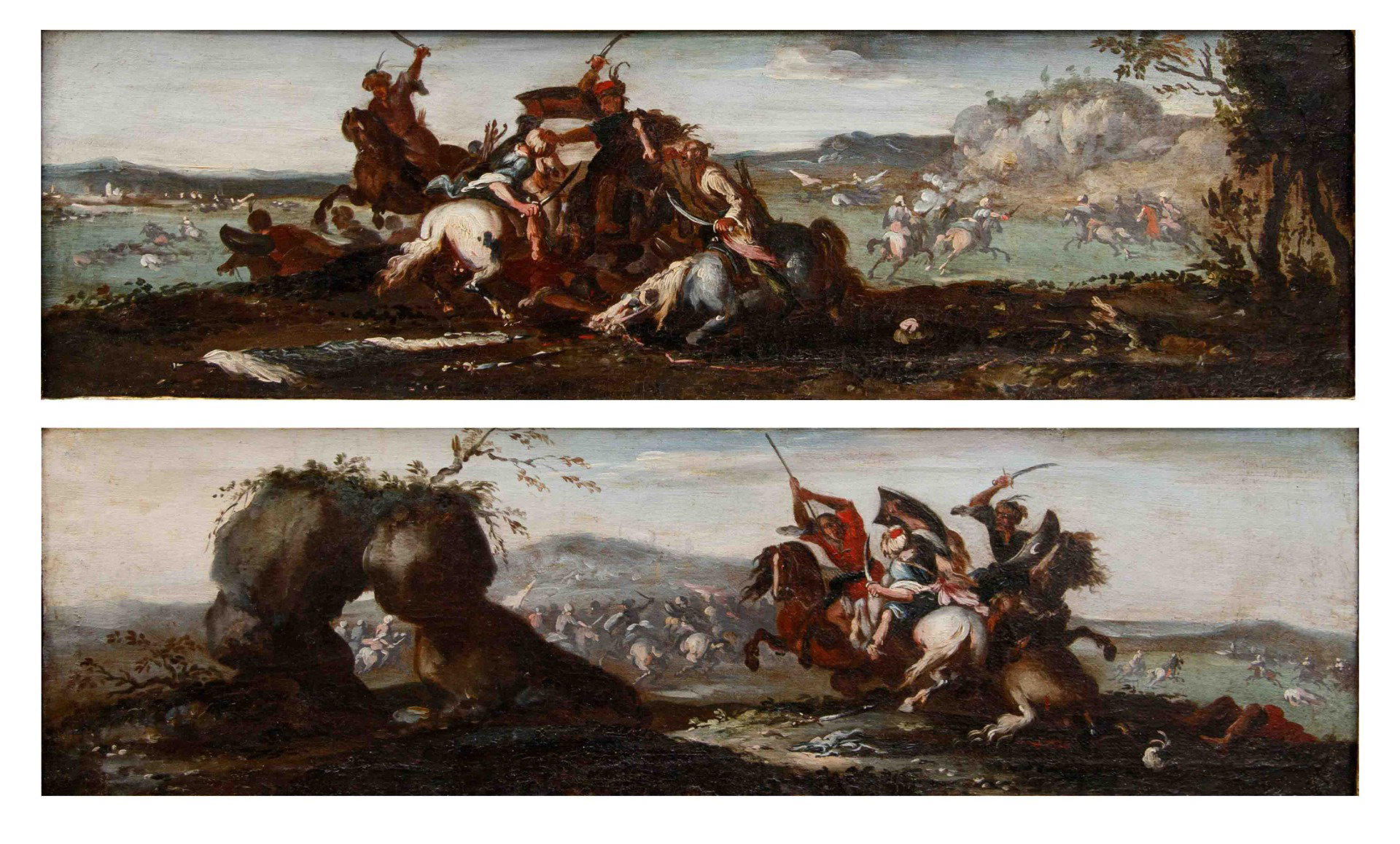
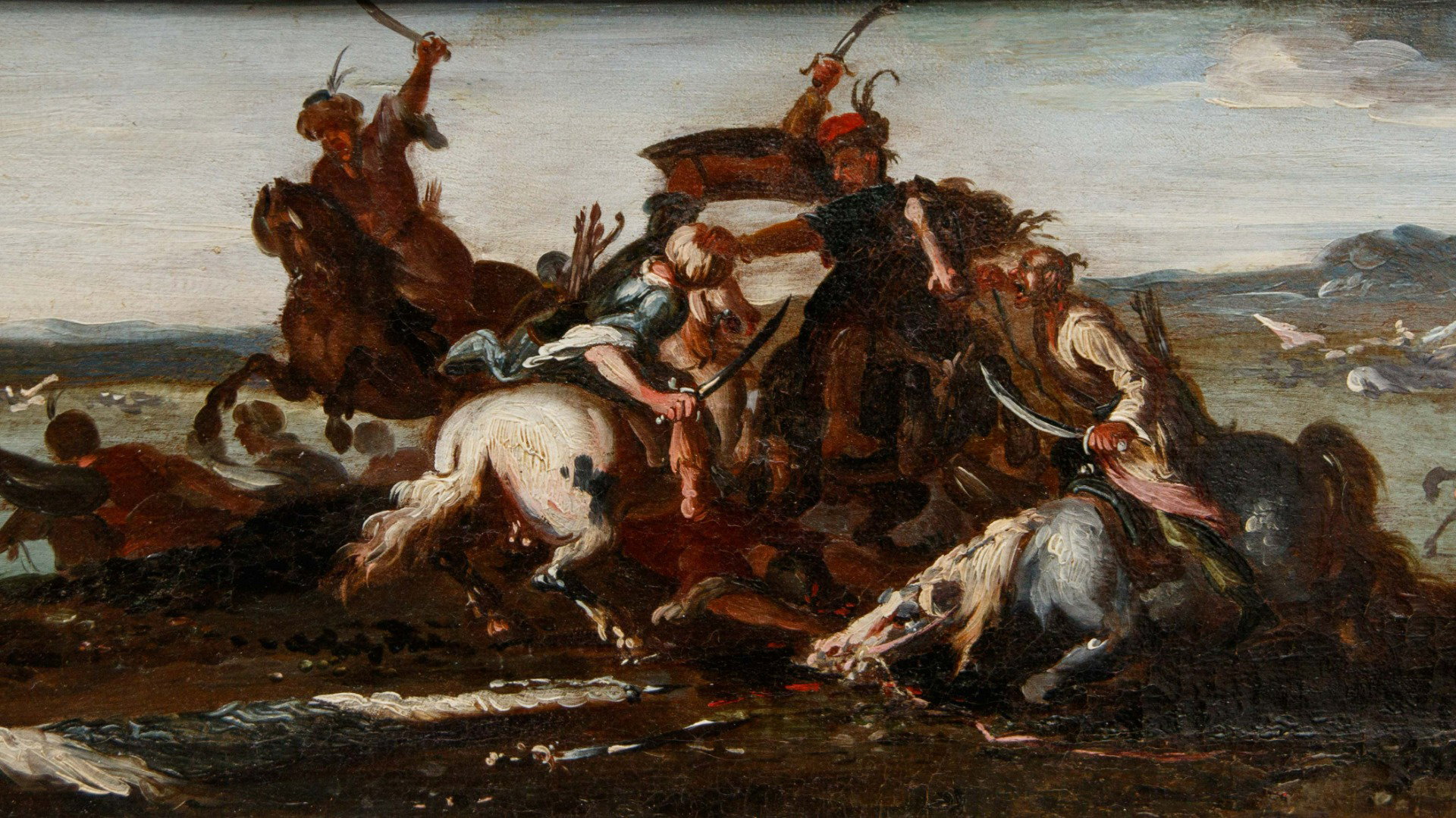
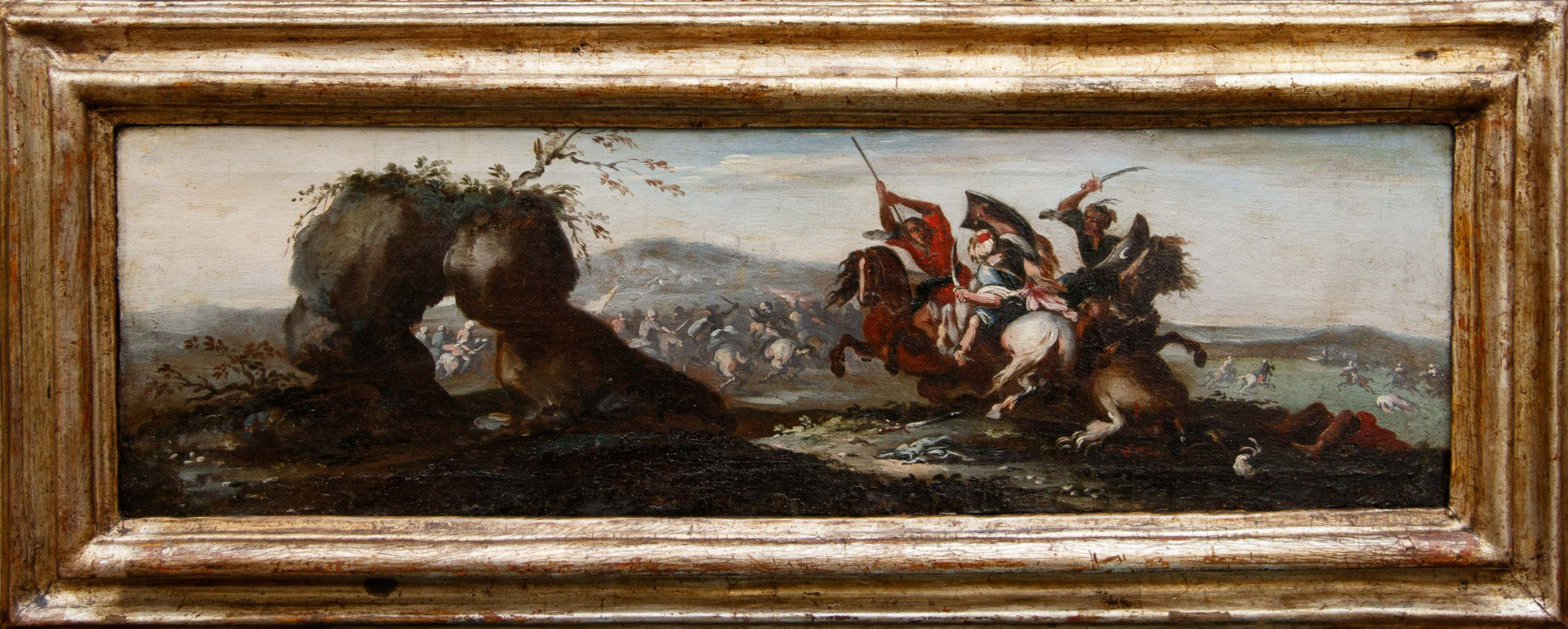
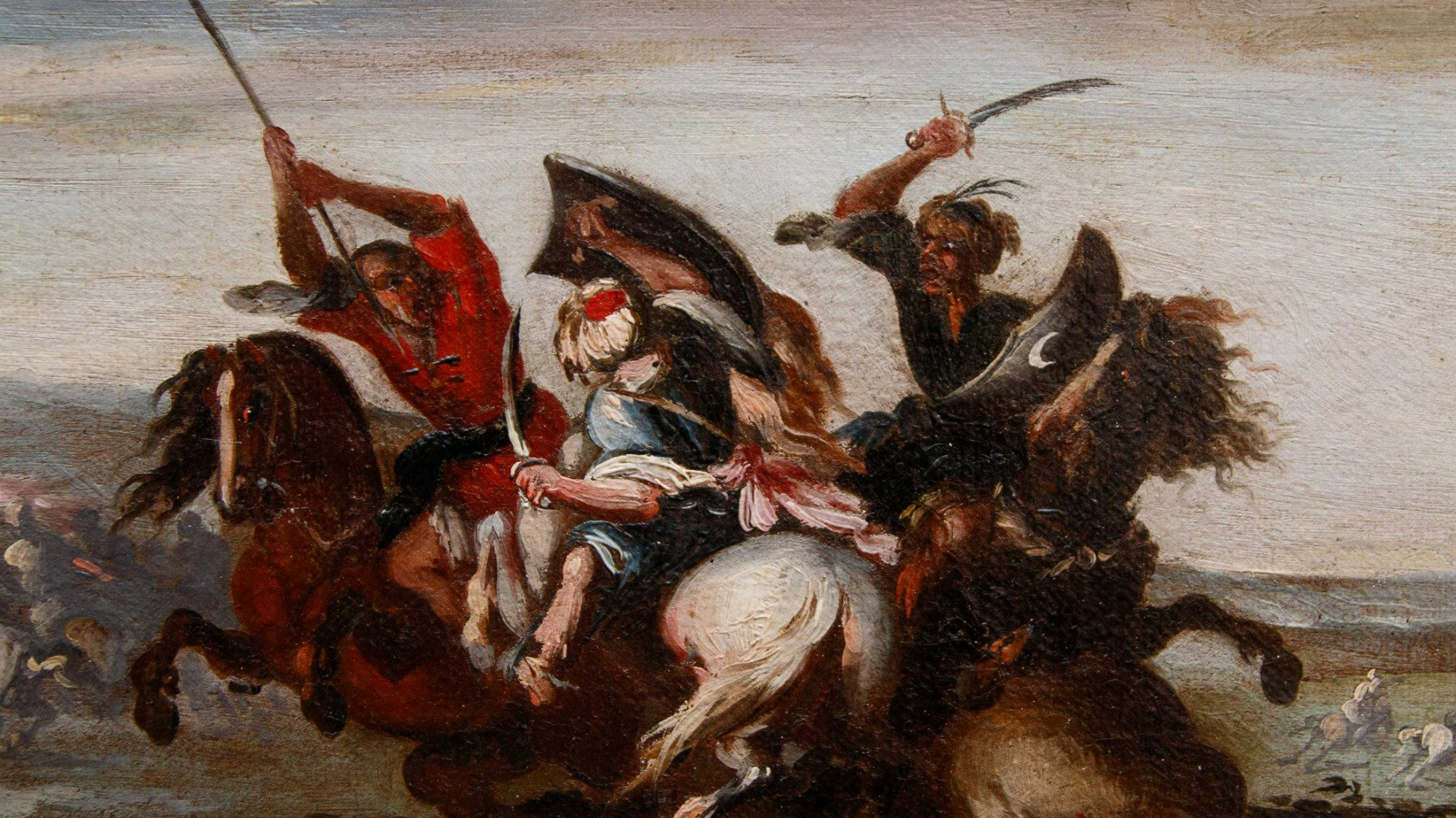
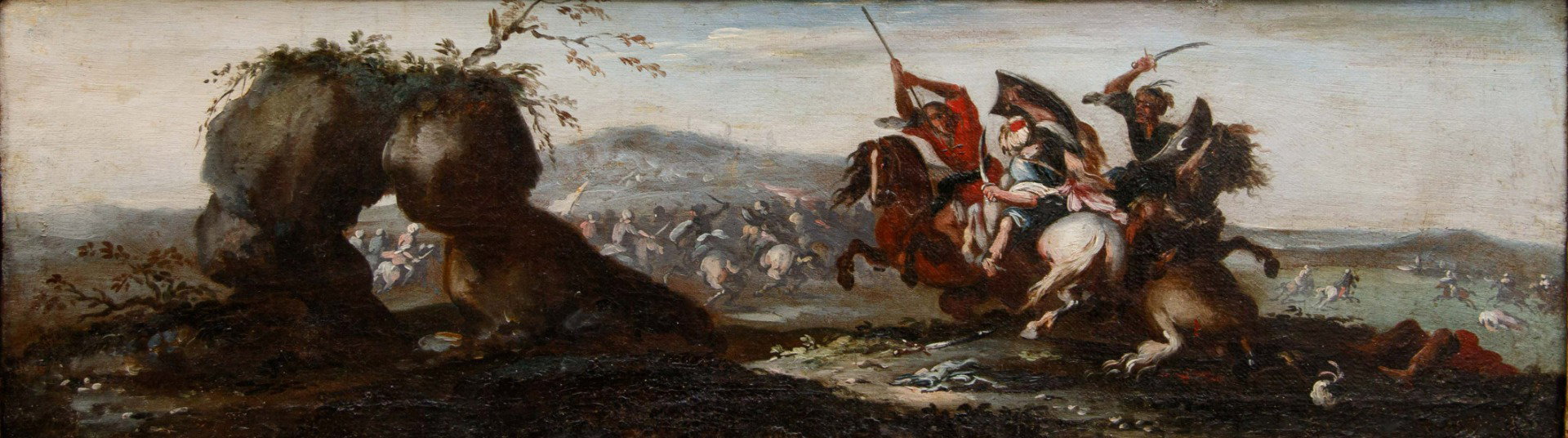
The two canvases considered here, both relating to the theme of battle between Christians and Turks, show the distinctive characteristics of Jacques Courtois, known as Borgognone's work with considerable stylistic and compositional coherence. In the first painting, recognizable by the presence of a small rocky formation topped with vegetation on the left, the scene opens with an effective contrast between the foreground and the background. On the right, a group of knights engages in violent combat: the figures, dynamically intertwined, are caught in the midst of action, with rearing horses and raised weapons. The painter constructs the scene through a diagonal that leads the gaze towards the central melee, while a larger theater of battle unfolds in the background, rendered with rapid and synthetic brushstrokes. The rock in the foreground, almost a theatrical backdrop, introduces an element of stability that contrasts with the tumult of the scene.
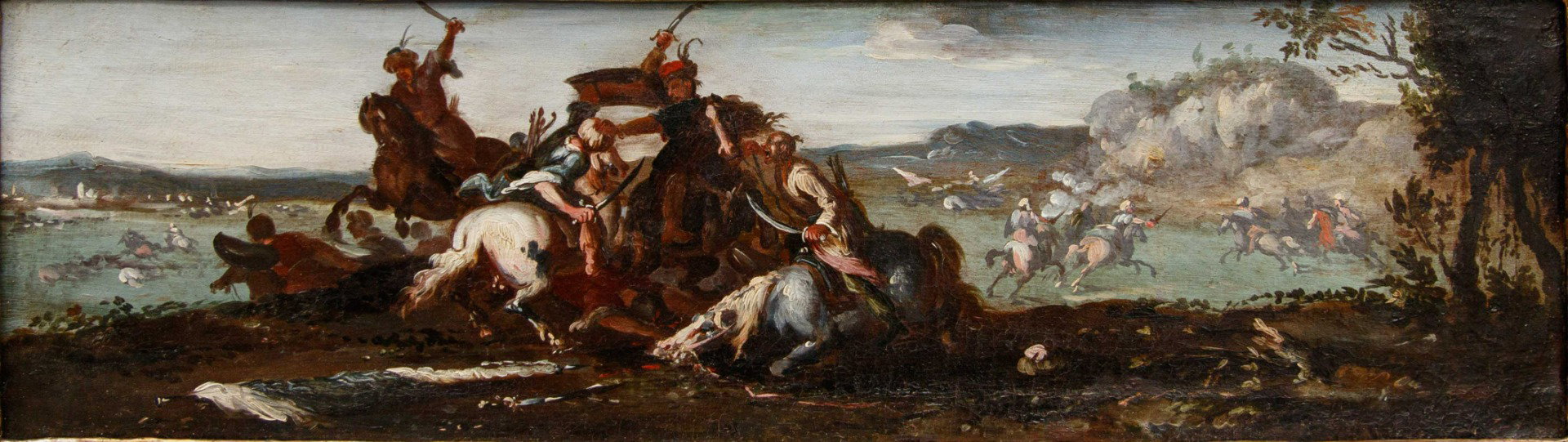
In the second painting, the composition becomes even tighter and more dramatic. The combat is concentrated in a central knot of figures crowding and clashing violently, while the horses, rendered with great anatomical skill, contribute to conveying a sense of controlled chaos. The background landscape, with secondary episodes of flight and pursuit, expands the narrative but remains subordinate to the tension of the foreground. The diffused and atmospheric light models the figures without rigidity, accentuating the sense of movement and spatial continuity.
Jacques Courtois was born in February 1621 in Saint-Hippolyte, in Franche-Comté, then under the dominion of the Spanish Habsburgs. Initially trained in his father's workshop with his brothers, he moved to Milan at a very young age, where he served in the Spanish army, an experience that proved fundamental for his direct knowledge of warfare. He then settled in Bologna, frequented the circles of Guido Reni and Francesco Albani, assimilating a more cultured and classicist figurative culture. After stays in Florence and Rome, he came into contact with artists specializing in battle painting, including Michelangelo Cerquozzi and especially Aniello Falcone, who exerted a decisive influence on him. In 1657 he joined the Society of Jesus, continuing his painting activity until his death, which occurred in Rome in 1676.
In the context of the 17th century, battle painting emerged as an autonomous genre, particularly appreciated for its ability to combine spectacularity, narrative, and technical virtuosity. Artists such as Falcone, Salvator Rosa, and Courtois himself developed a pictorial language based on dynamic compositions, loose brushwork, and an immediate rendering of action. In this area, Borgognone distinguished himself by his expressive intensity and his ability to depict the disorder of battle without sacrificing a solid compositional structure.
The two canvases in question find close comparisons with certain works by the artist housed in important museums. The Battle Scene at the Detroit Institute of Arts presents analogous solutions in the diagonal construction and the synthetic rendering of figures in the background. The Battle between Christians and Muslims at the Museo del Prado shows similar narrative density and a comparable typology of knights and armaments. Likewise, the Battle Scene preserved at the National Trust in England and the National Gallery of Edinburgh confirms the use of rapid and vibrant brushwork, as well as a predilection for compact groups of fighters in the foreground. These comparisons strengthen the attribution of the two works to Borgognone, highlighting a full stylistic coherence with his known catalog.