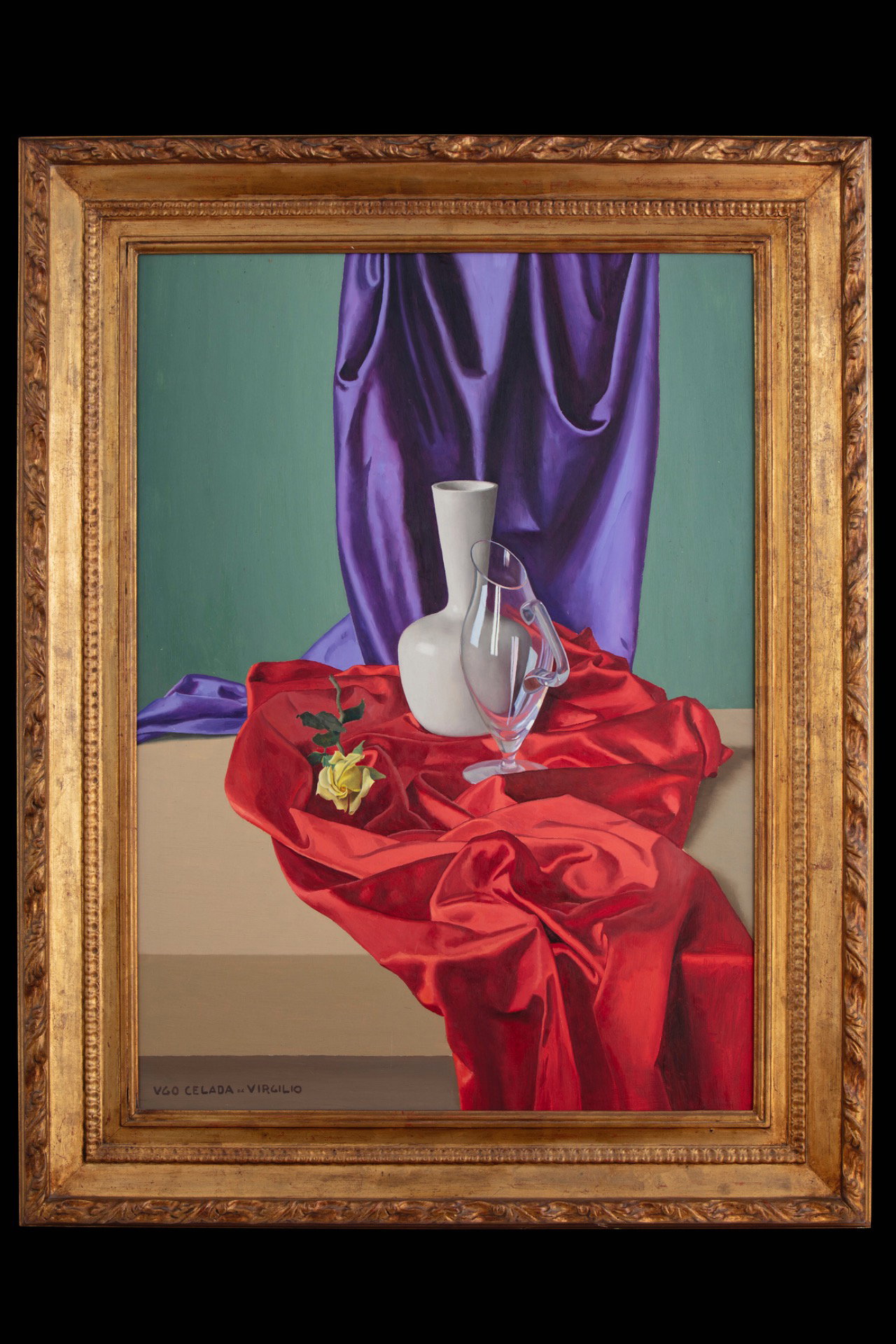
Ugo Celada da Virgilio (Borgo Virgilio 1895 – Varese 1995), Compositions, 1960s. Oil on board, 88 x 64 cm. Signed "UGO CELADA DA VIRGILIO" lower left.
The painting depicts one of the still lifes that Celada called "Compositions," consisting of two fabric drapes, in vivid red and purple colors, on which a glass jug, a cut yellow rose, and an ivory-colored vase in the background are distinguishable. The artist's painting style is characterized by precision in drawing and an extremely realistic rendering of details; attention to light and color is equally important to the artist. Celada created his own very personal style that started from Magical Realism and was also inspired by German New Objectivity.
BIOGRAPHY
Celada was born in Cesere di Virgilio, in the province of Mantua, on May 25, 1895. He began to take an interest in art from a young age, despite his father's disapproval. He began his training at the School of Art and Crafts in Luzzara (Reggio Emilia), which he completed brilliantly. He obtained a scholarship from the Franchetti Institute and enrolled at the Brera Academy. He followed the teachings of Cesare Tallone. In 1914, he had to interrupt his studies to enlist, but he used his skills for the compilation of topographical maps.
After the war, he left for Paris, but his journey stopped in Genoa, where he stayed and worked for a few months. In 1920, he participated with a work in the Venice Biennale. He also participated in 1924. From 1920 to 1926, Celada became known on the international scene: he held exhibitions at the Permanente in Milan and, in 1926, his painting for the Venice Biennale was praised by Emile Bernard, the discoverer of Van Gogh and Cezanne. The following year, Celada managed to reach Paris, where he created portraits. Back in Italy, he participated in numerous exhibitions throughout Italy. In the 1930s, Celada, although outside the cultural circuits of the regime, continued to work assiduously. After World War II, he focused mainly on portraits and still lifes.