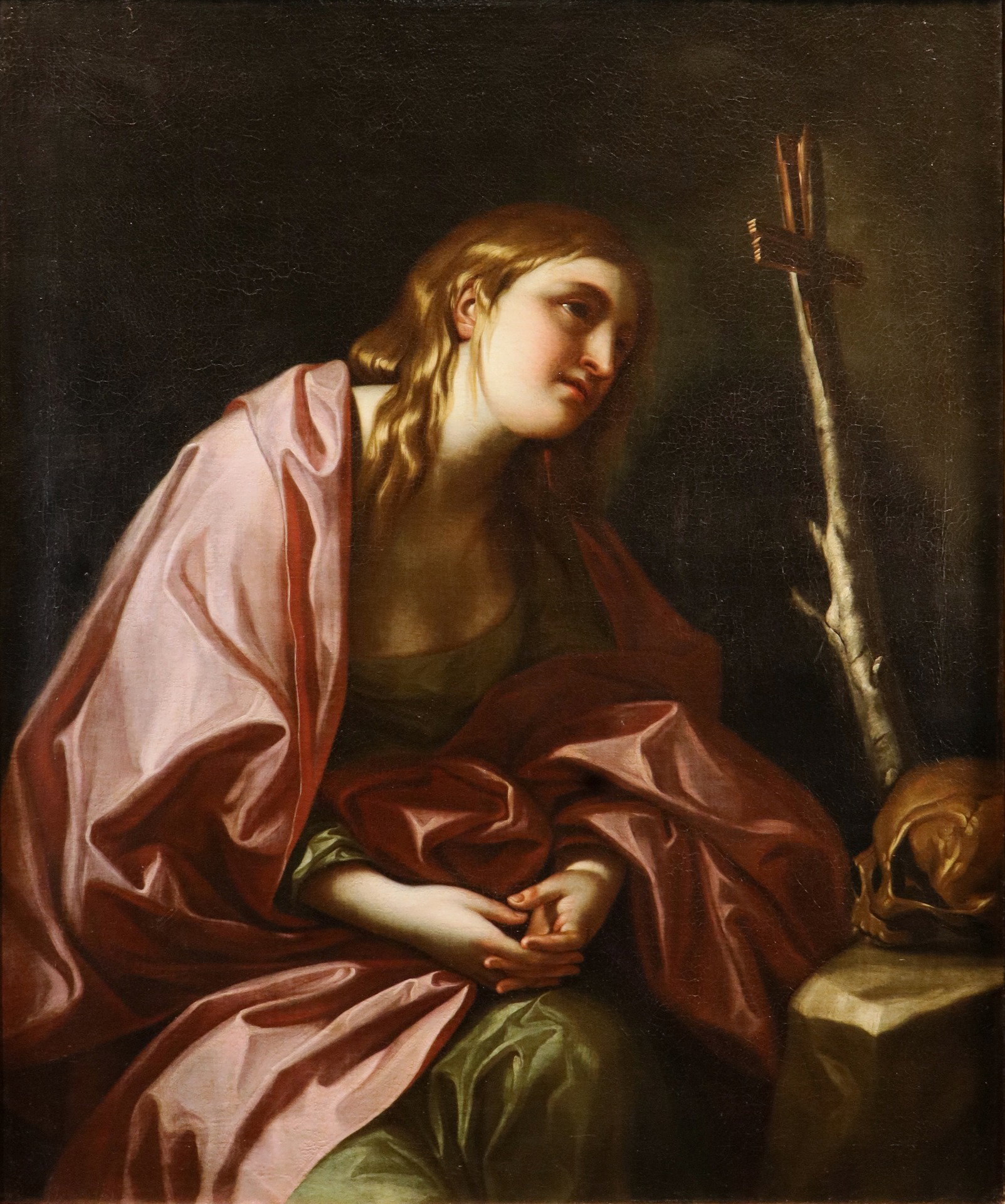
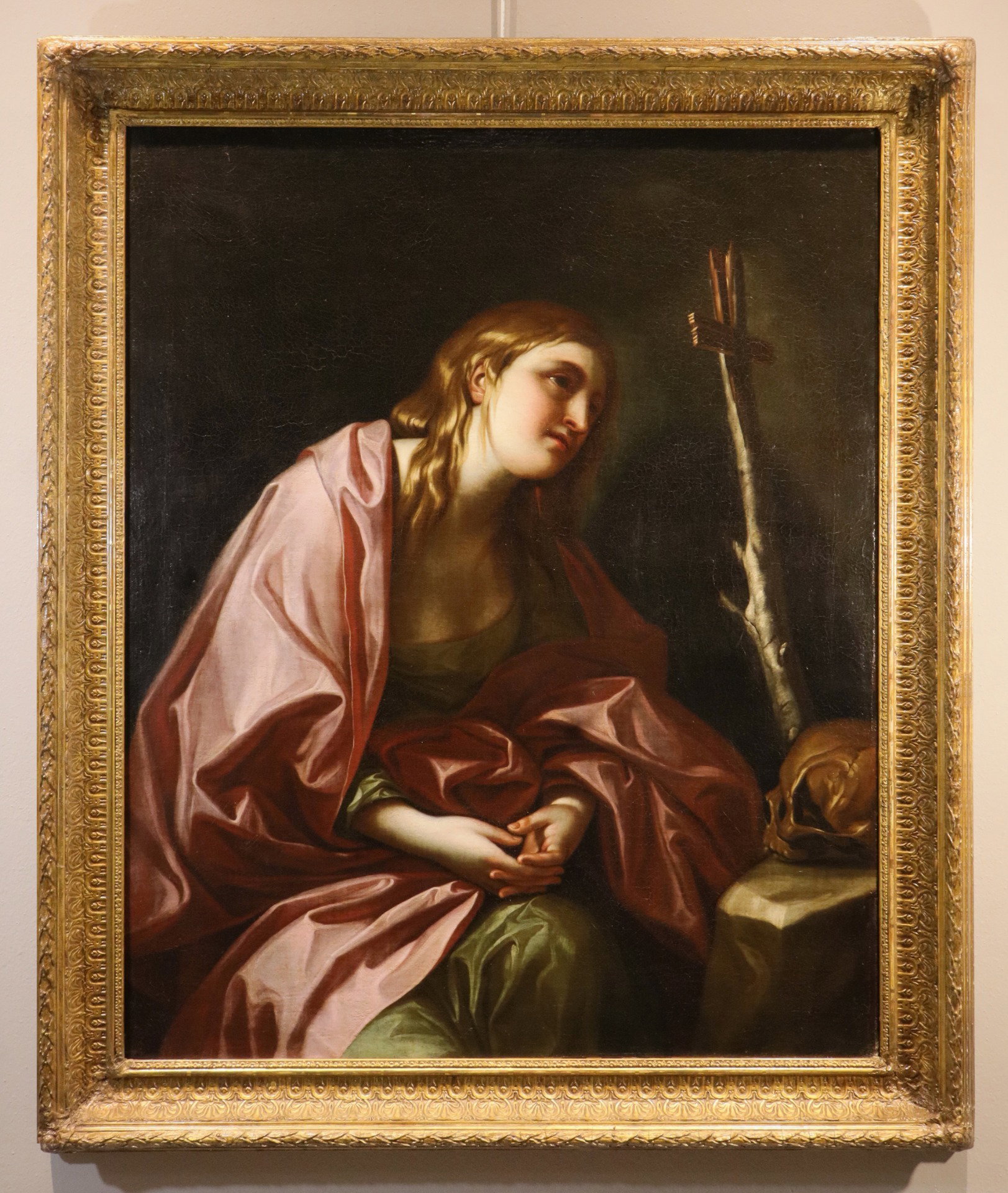
Penitent Magdalene - Workshop of Guido Reni (Bologna, 1575 – Bologna, 1642)
Oil on canvas
112 x 89 cm.
With frame 130 x 108 cm.
Full details (click HERE)
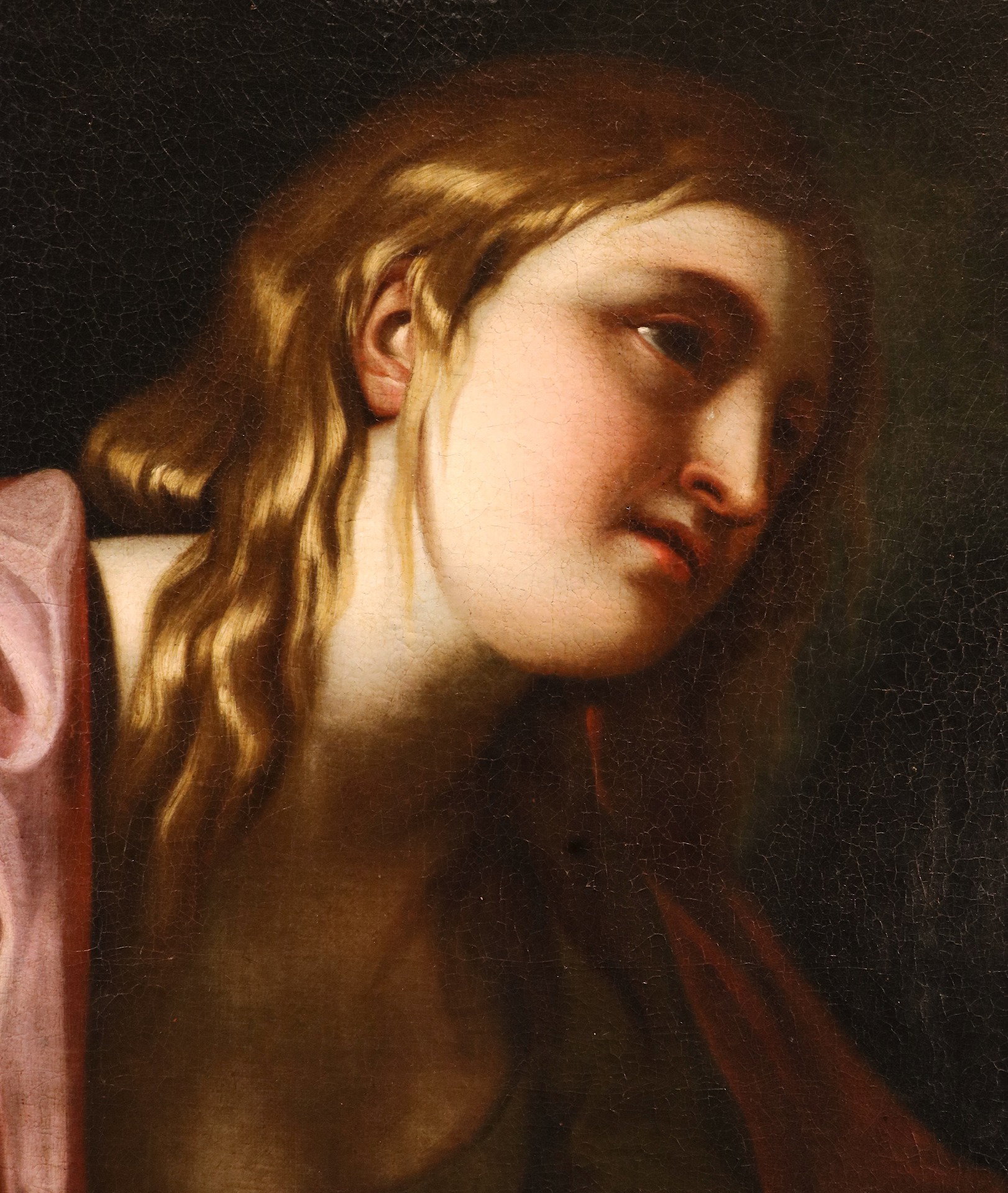
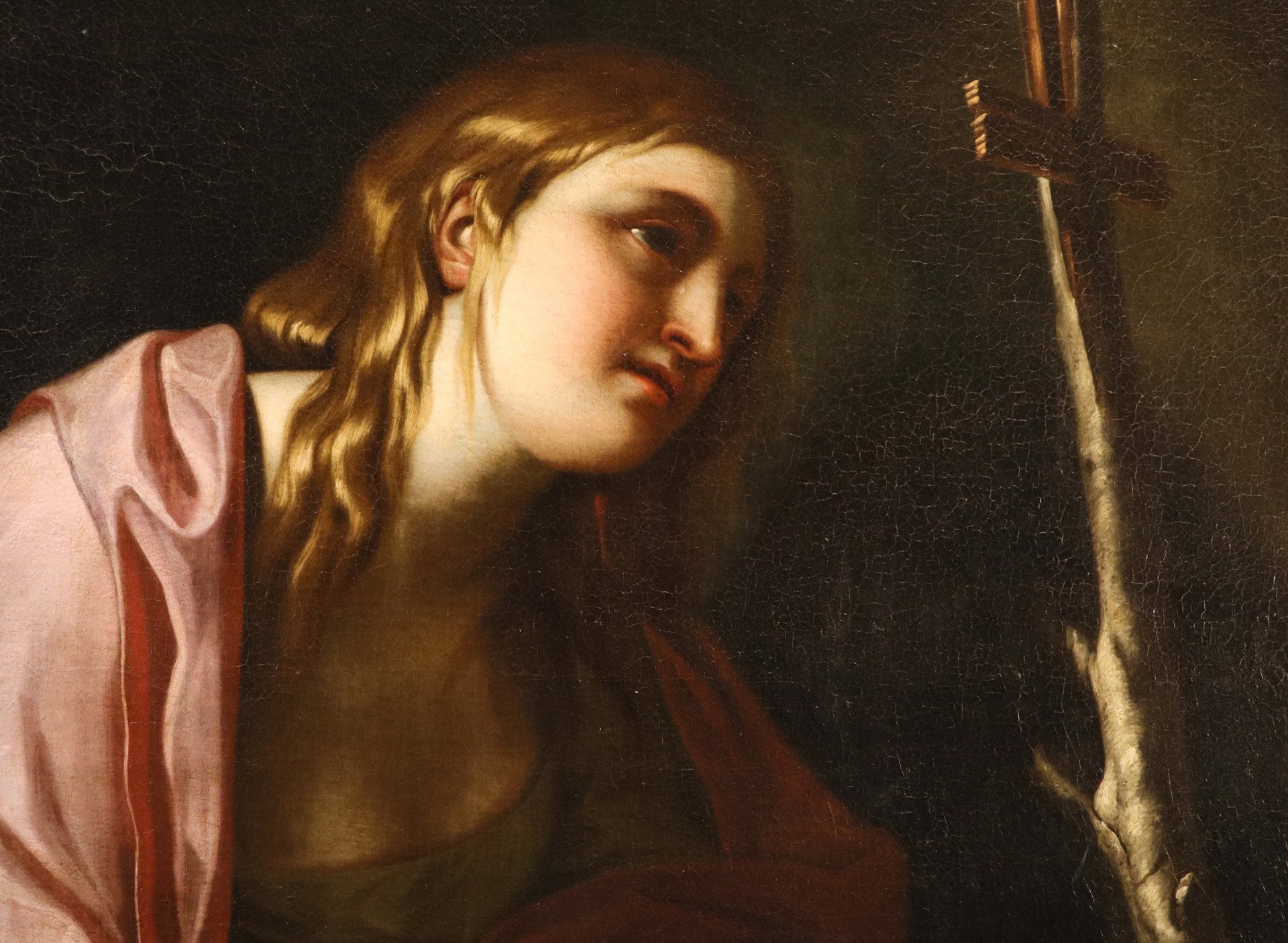
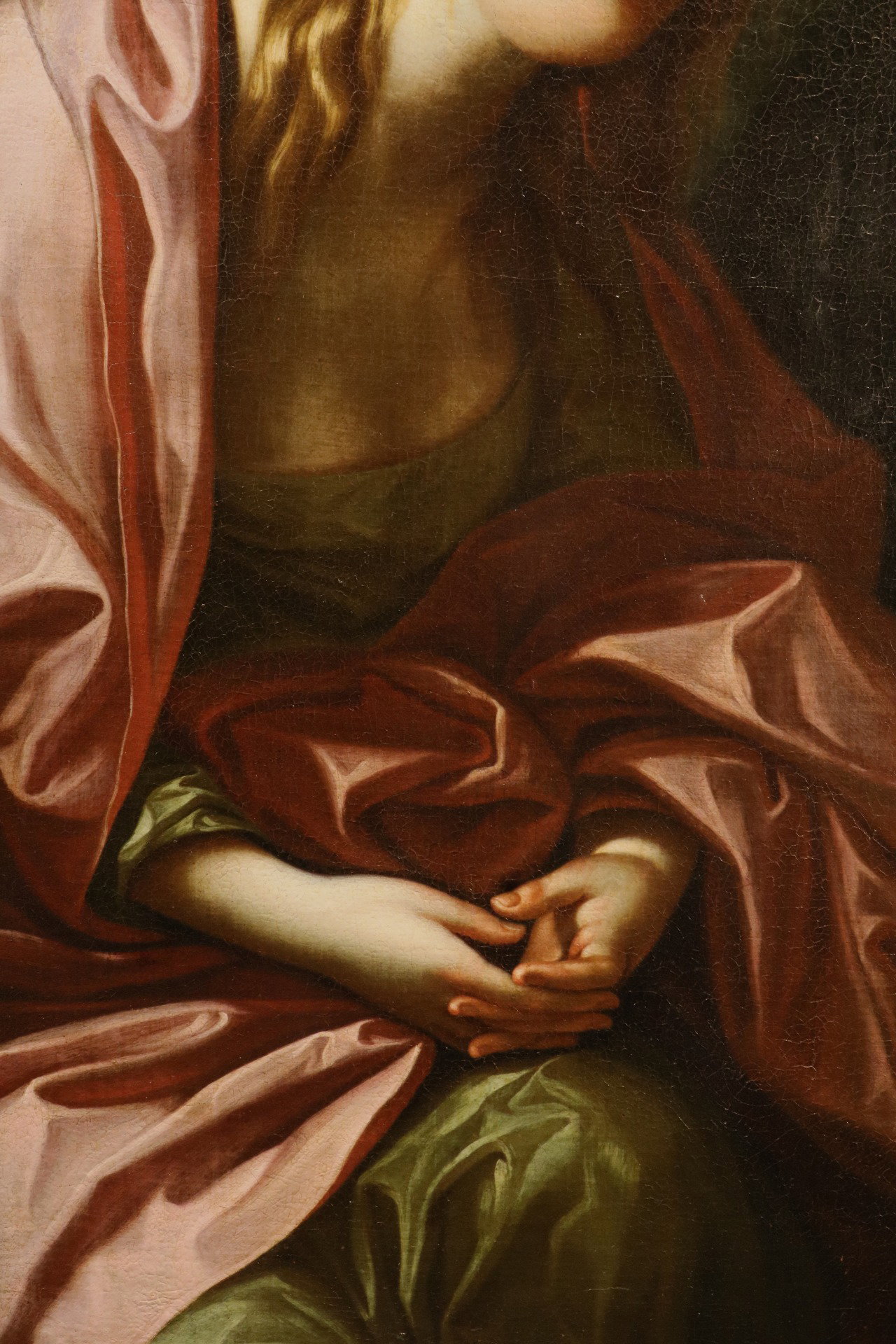
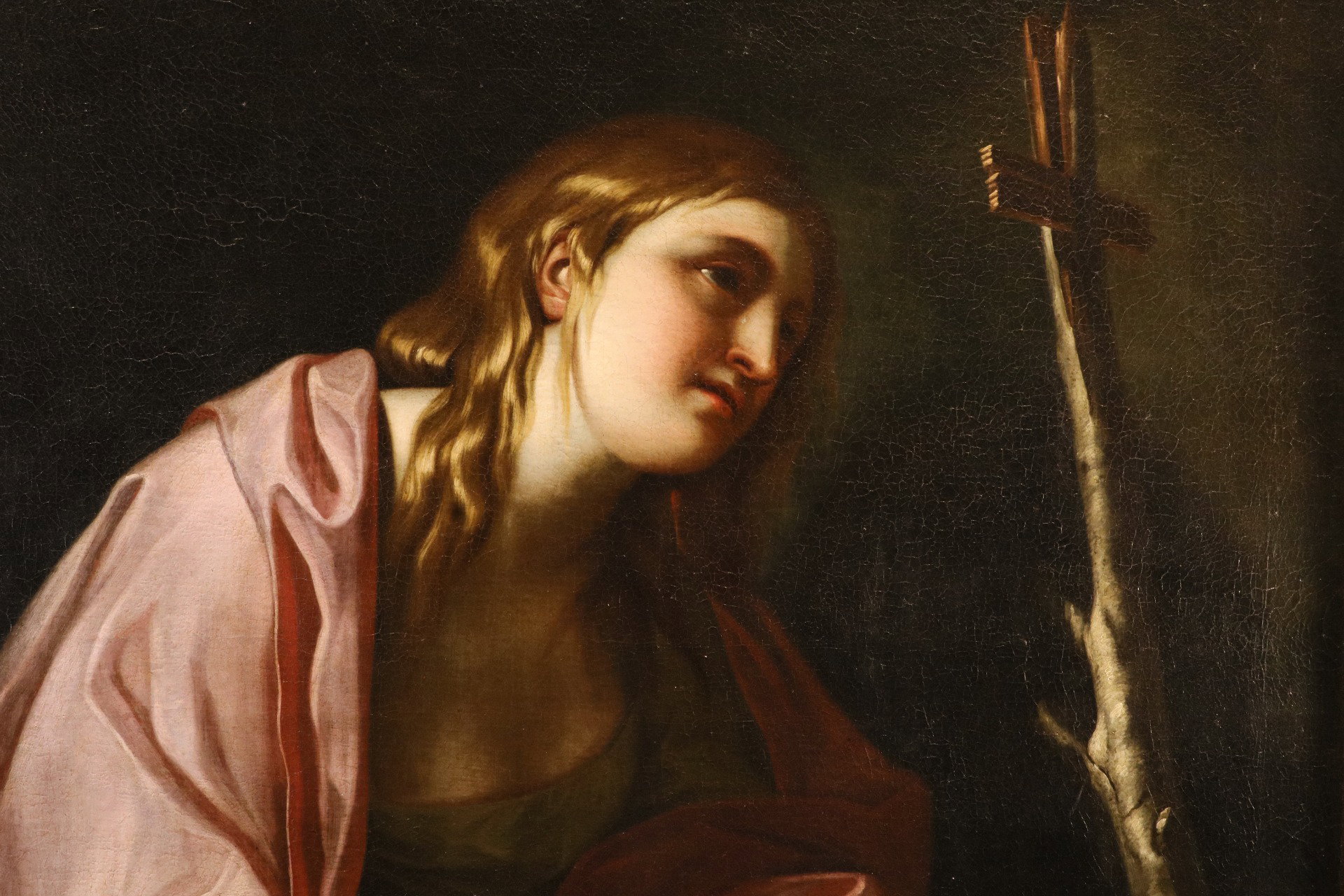
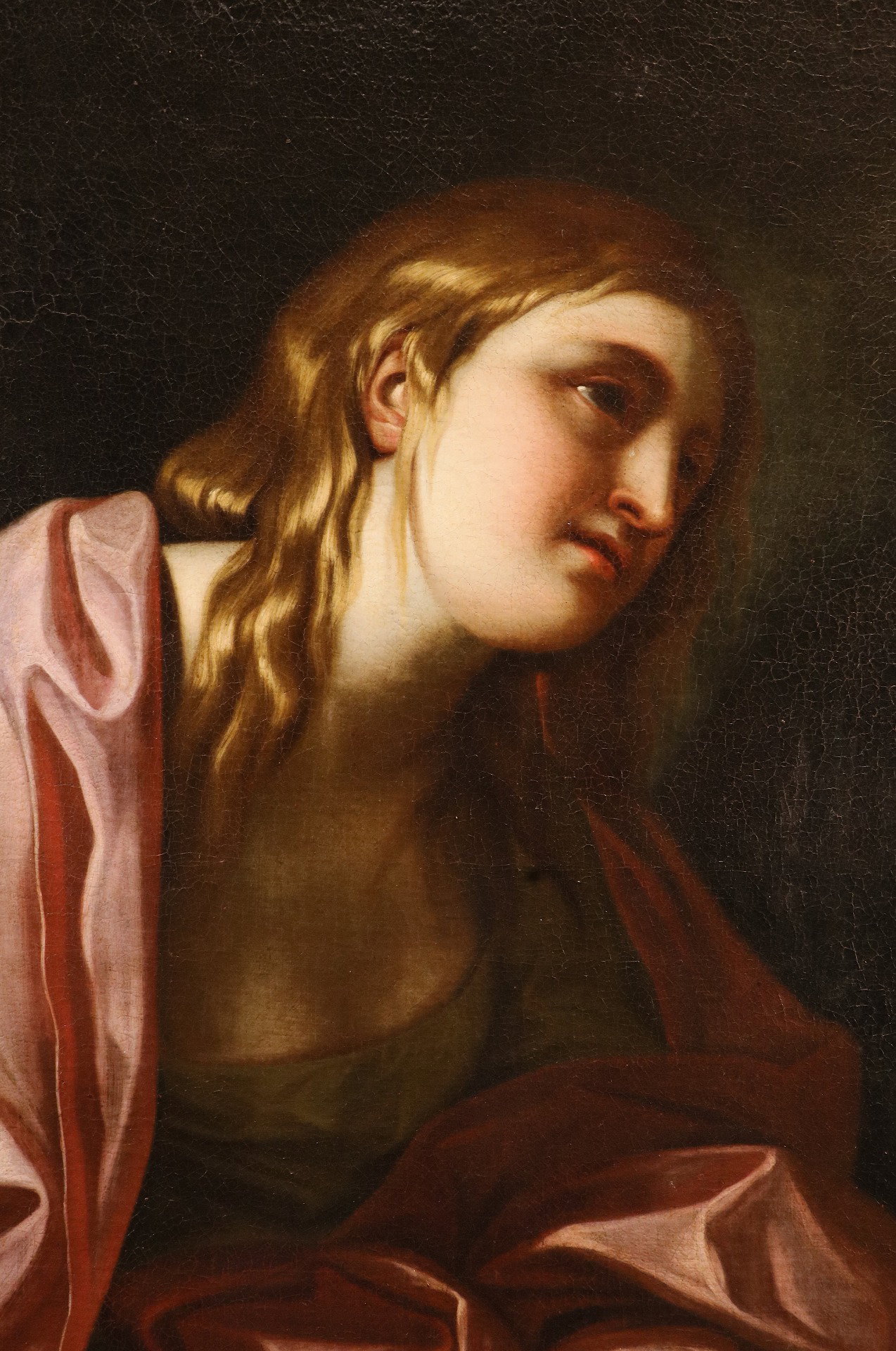
The work features a seductive Saint Mary Magdalene, recognizable by her essential beauty, her dishevelled clothes to recall her sinful past, and her long, blonde, loose hair falling over her shoulders.
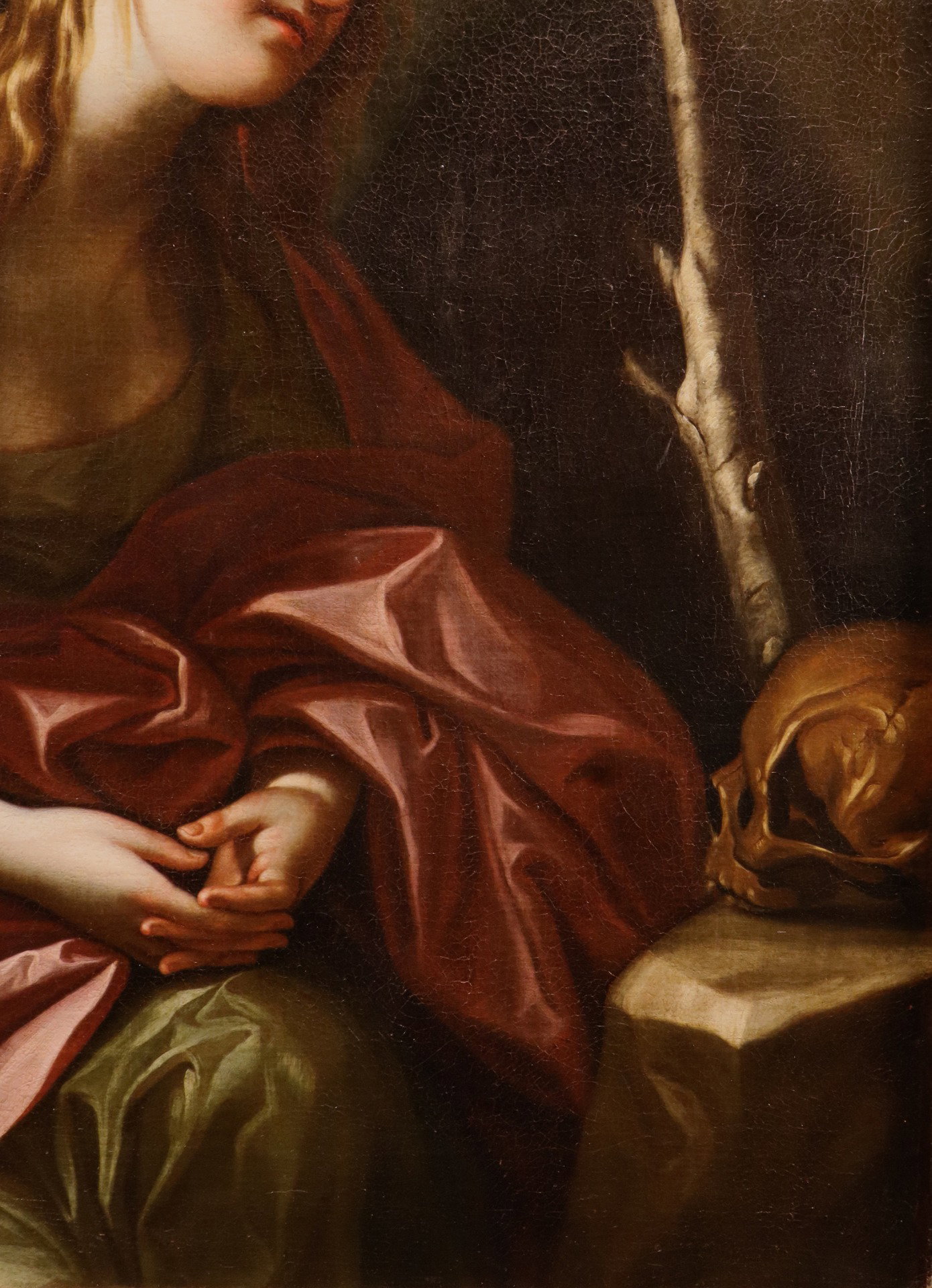
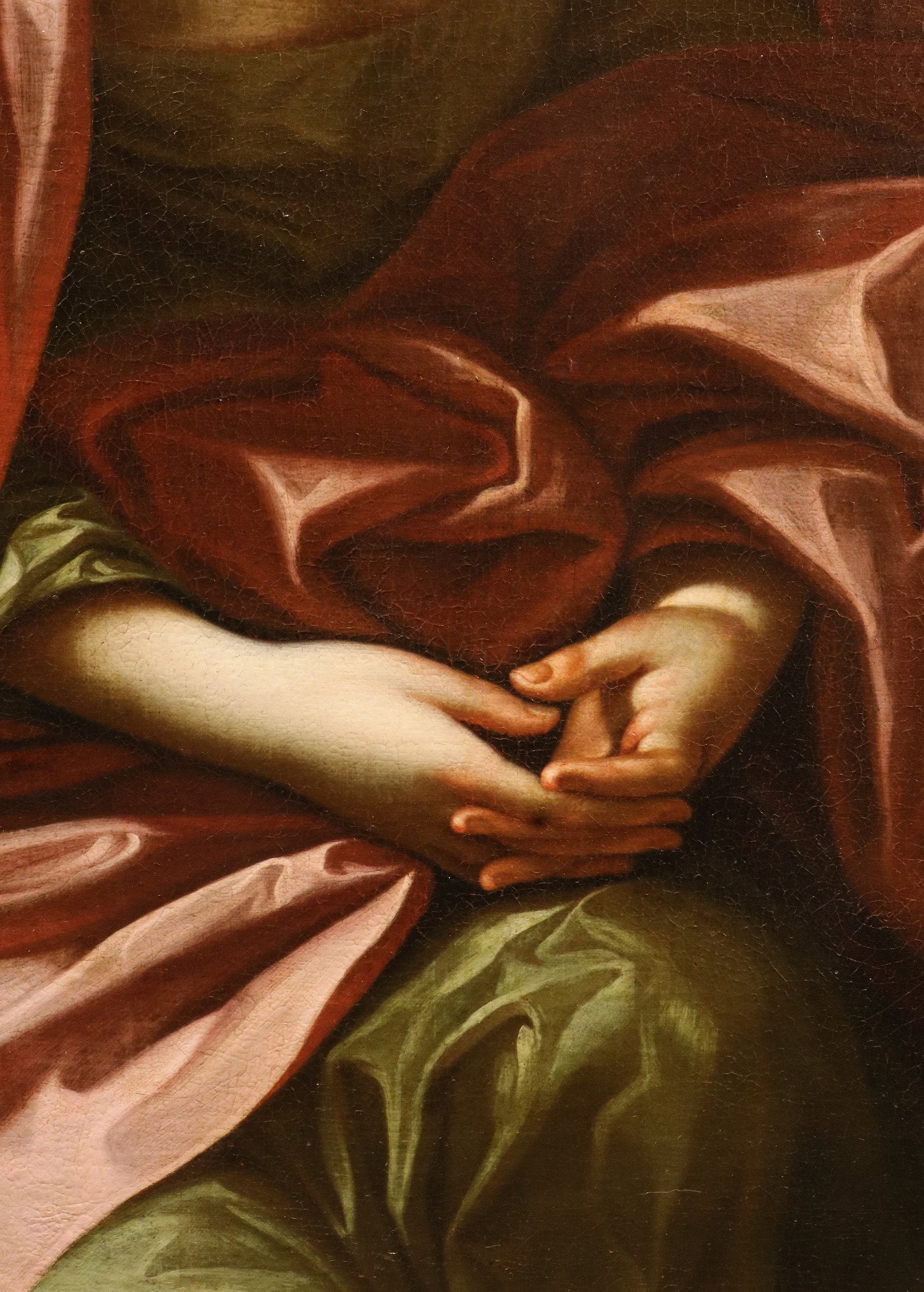
She is depicted in a penitent attitude, with hands delicately joined in prayer, absorbed in meditation and her gaze full of emotion, evoking repentance, directed towards a cross made from a branch, flanked by a skull, symbols typical of her iconography.
She is wrapped in a cloth softly resting on her shoulders, simple yet characterized by a strong femininity, in a perfect balance between the sensuality of the sinner and her spiritual ascent.
Although our Magdalene at first glance evokes the famous composition by Anton Raphael Mengs (Aussig, 1728 – Rome, 1779), now preserved at the Prado Museum in Madrid**, it is not actually a work from the same period or connected to the same master, but a beautiful 17th-century painting.
Mengs' version, as is easily seen, dating to the height of the eighteenth century, follows a style rooted in the precepts of Neoclassicism where, compared to the seventeenth century, the painting has little contrast and the features are notably softened by a clear, sharp, and diffused light. Neoclassical painting aimed, in fact, at a perfect and sublime beauty, drawing inspiration from the examples of classical antiquity.
** https://www.museodelprado.es/en/whats-on/exhibition/anton-raphael-mengs-1728-1779/4be2964e-3169-c21d....
As indicated in the Prado catalogue, Mengs indeed used a 17th-century work, now lost, which was at the time considered to be by the greatest exponent of Bolognese classicism, Guido Reni, and later attributed to his pupil Giovan Gioseffo Dal Sole (1654/1719).
This practice of 'artistic dialogue across centuries' was widespread in Neoclassicism; for example, Pompeo Batoni also referred to a famous, though lost, prototype by Correggio for his renowned "Reclining Magdalene Reading."
Returning to our painting, we are therefore inclined to place its execution by a skilled Baroque painter active in the 17th century, specifically a follower or pupil of Guido Reni, whose workshop produced numerous representations of the Penitent Magdalene; among these are the famous painting in Palazzo Barberini or the one in Quimper Musée des Beaux-Arts (https://www.artisorelle.it/opere-arte/2393), both by Reni himself, or the "Penitent Mary Magdalene" attributed to Giovan Gioseffo Dal Sole (Palazzo Pellegrini a S. Cecilia, Verona, https://catalogo.cultura.gov.it/detail/HistoricOrArtisticProperty/0500717038), and finally "Saint Mary Magdalene Adoring the Crucifix" by Luca Ferrari, also a pupil of Reni (formerly Prince R. Pignatelli Collection, https://catalogo.fondazionezeri.unibo.it/scheda/opera/58390/).
ADDITIONAL INFORMATION:
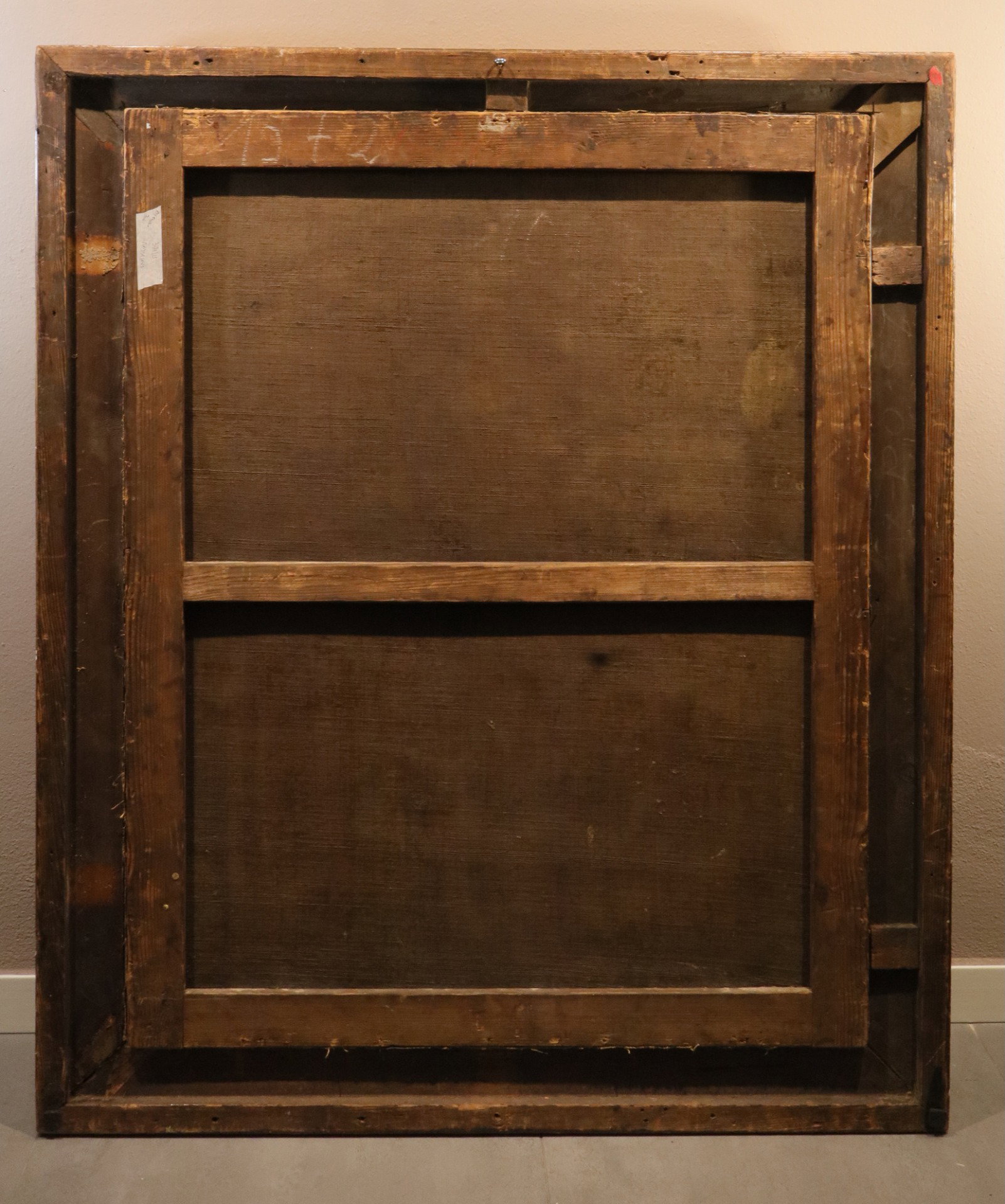
The work is sold with a pleasant frame and is accompanied by a certificate of authenticity and a descriptive iconographic sheet.
We handle and organize the transport of purchased works, both within Italy and abroad, through professional and insured carriers.
It is also possible to view the painting at our gallery in Riva del Garda; we would be delighted to welcome you to show you our collection of works.
Contact us, without obligation, for any additional information.
Follow us also on:
INSTAGRAM https://www.instagram.com/galleriacastelbarco/?hl=it
FACEBOOK https://www.facebook.com/galleriacastelbarco/