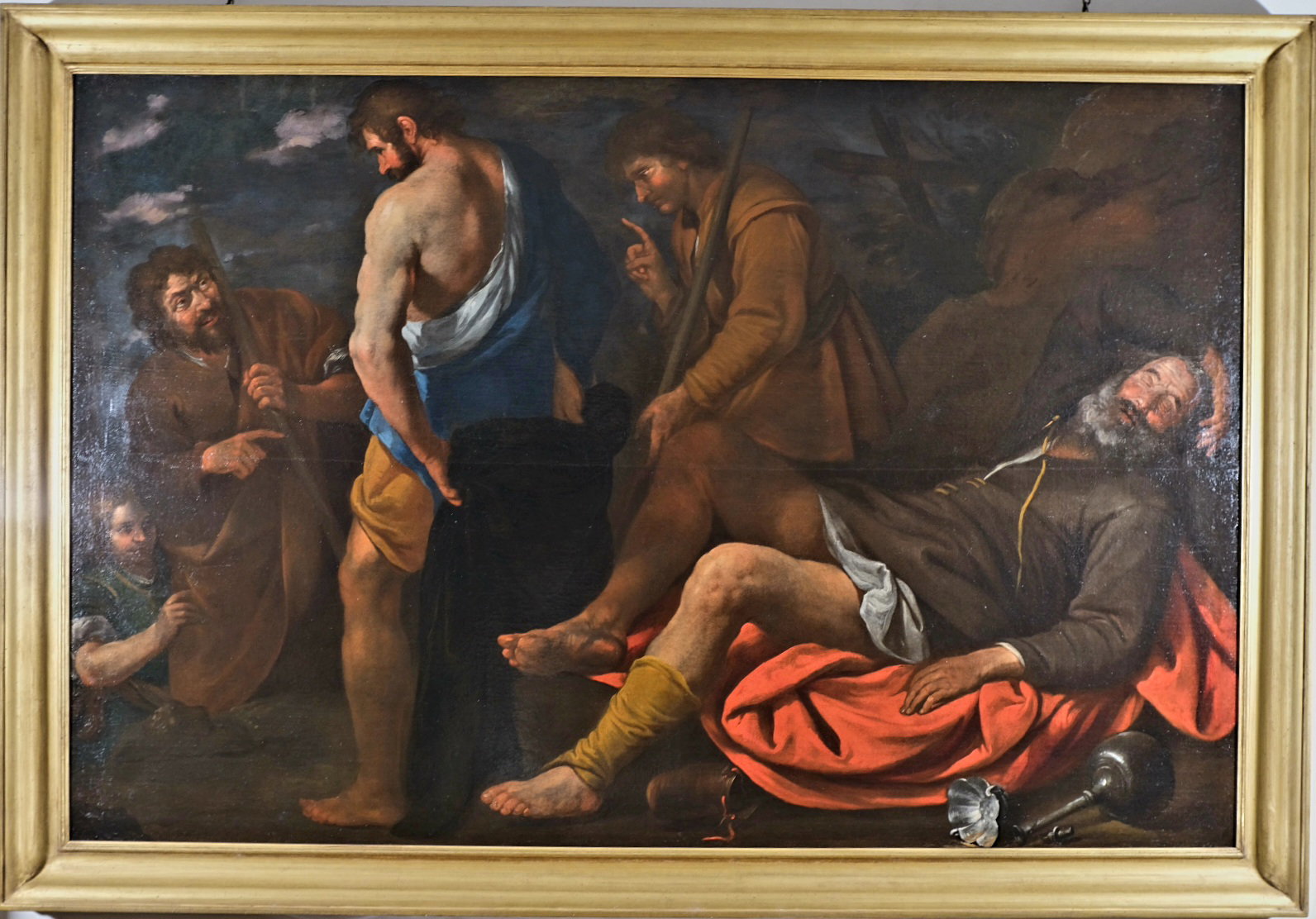
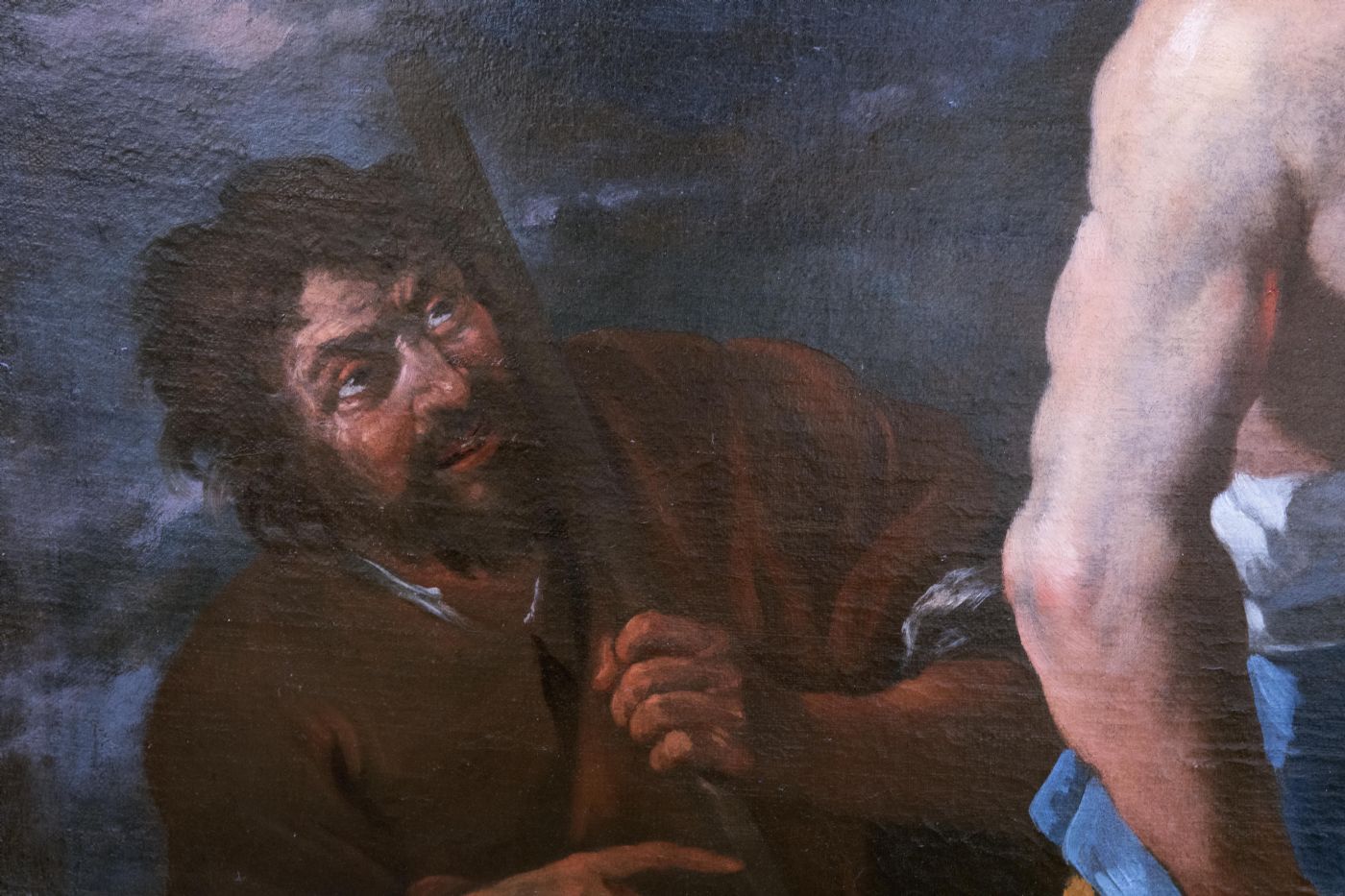
"Drunkenness of Noah" museum-quality oil on canvas by Giovanni Andrea de Ferrari (Genoa 1598-1669). The painting is accompanied by an expertise report by Dr. Anna Orlando and was exhibited in the section dedicated to Genoese Baroque painting at the "Art and Wine" exhibition curated by Annalisa Scarpa and Nicola Spinosa, held in Verona, Palazzo della Gran Guardia, from April 11 to August 16, 2015, and later extended.
This painting, autograph and unpublished until 2014, with a more elongated and horizontal format and with minimal variations, compared to the already known version exhibited at the "National Gallery of Parma," is a masterful example of Giovanni Andrea de Ferrari's maturity. The work illustrates the biblical episode from Genesis (9:20-27). Noah, after building a vineyard, one day drank too much and fell asleep half-naked in a state of intoxication. His sons Shem and Japheth, with gestures of extreme respect and modesty, walk backward to cover their father with a cloak, while Ham (usually depicted in the act of mocking him) observes the scene. It is a scene that celebrates filial piety and human fragility and is also interpreted as a prefiguration of the mockery of Christ on the cross, which would explain the presence of a cross in the background on the right.
The large dimensions of the canvas give it a solemn, almost theatrical aspect, typical of the large Genoese commissions of the 17th century. The palette is rich, with deep reds and intense blues that emerge from the brown background. The dramatic luminism reveals the influence of Bernardo Strozzi and the Flemish lesson of Van Dyck, mediated by the naturalistic sensibility of the author, as well as the more recent and fresh suggestions of Fiasella. The rendering of still life details in the foreground, such as the overturned cup and flask, is extraordinary, testifying to de Ferrari's attention to real data.
The work is in excellent condition, maintaining the freshness of the brushstrokes and the brilliance of the original pigments.
Trained in the workshop of Bernardo Castello (1610-12) and Bernardo Strozzi (c. 1613-19), where he learned the use of a rich and full-bodied color that materializes on the canvas. His early works show the influence of his master, so much so that they are often considered works by Strozzi. However, his maturation sees him progressively distancing himself from his master's style and approaching other painters in the 1920s. The proximity to Fiasella will be fundamental in the fourth decade of the century. And it is in these years that the painter expresses himself in the manner of his early maturity, when he acquires his own style that combines the coloristic taste of Strozzi, with the new lesson of a pictorial execution by glazes, introduced in Genoa by the Flemings and particularly by Jan Roos and Van Dyck. And it is in this particular moment that our canvas is placed, when de Ferrari abandons the dimensions of altarpieces, to dedicate himself to easel works for private commissions.
The work we propose has several pentimenti (changes of mind), which, in addition to attesting to its autograph status and freshness of execution, not typical of a workshop replica or copy, also indicate de Ferrari's own way of painting with delicacy and spontaneity, with that freshness that makes the material vibrant and almost sensual.
Canvas dimensions 140x215 cm, with frame 165x240 cm.
The frame is of recent artisan manufacture, made to measure for the painting and gilded with pure gold leaf.