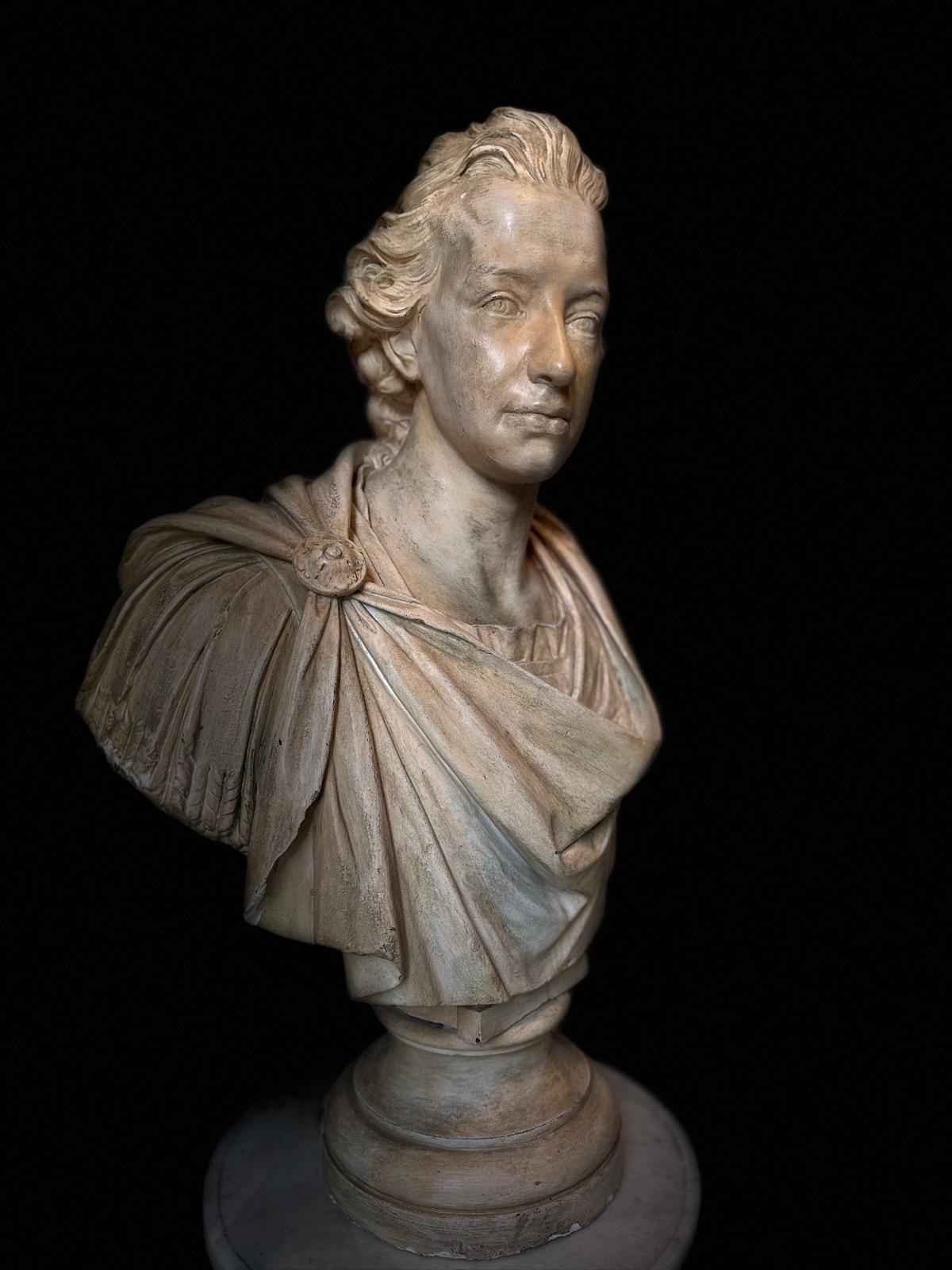
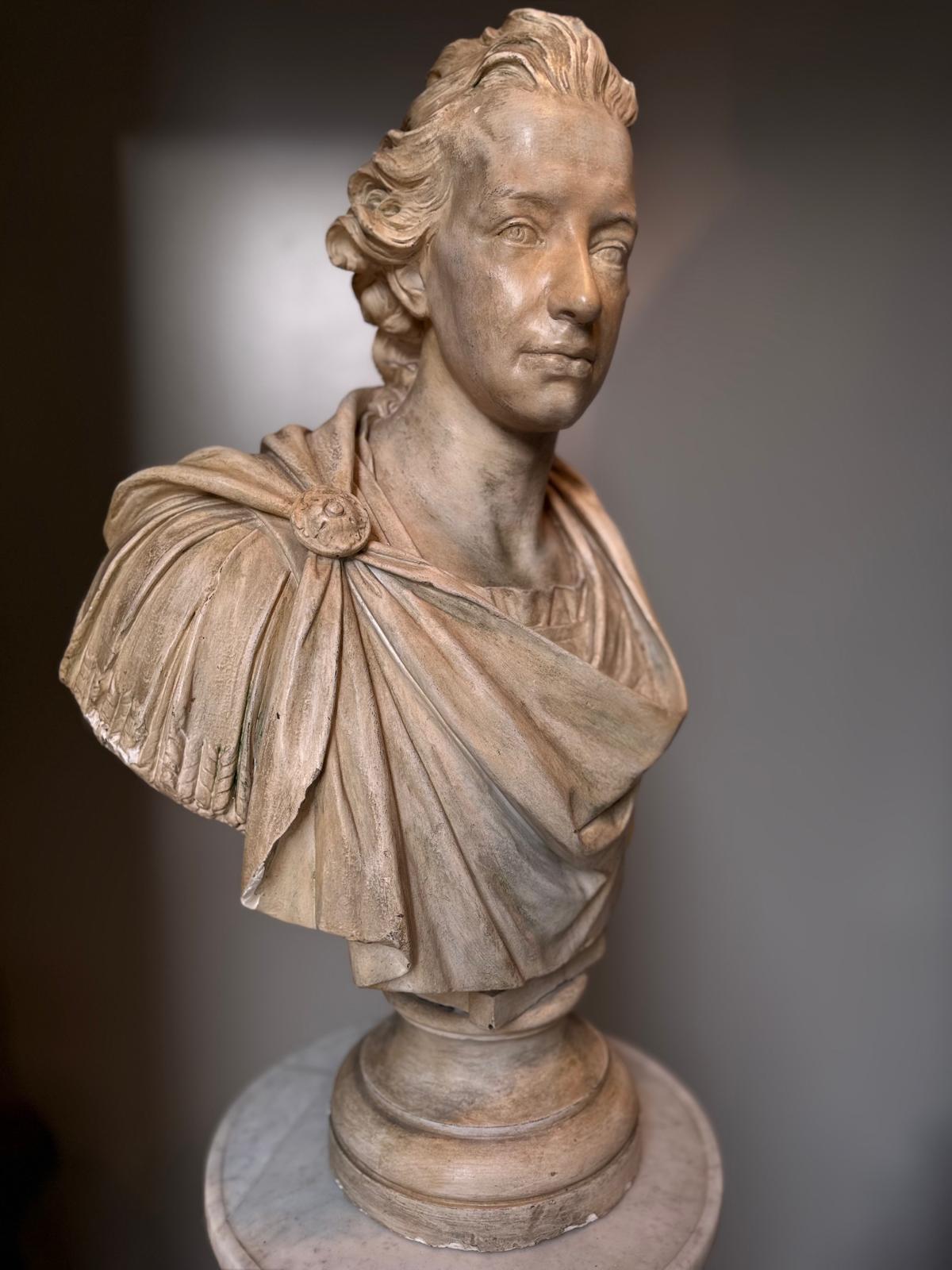
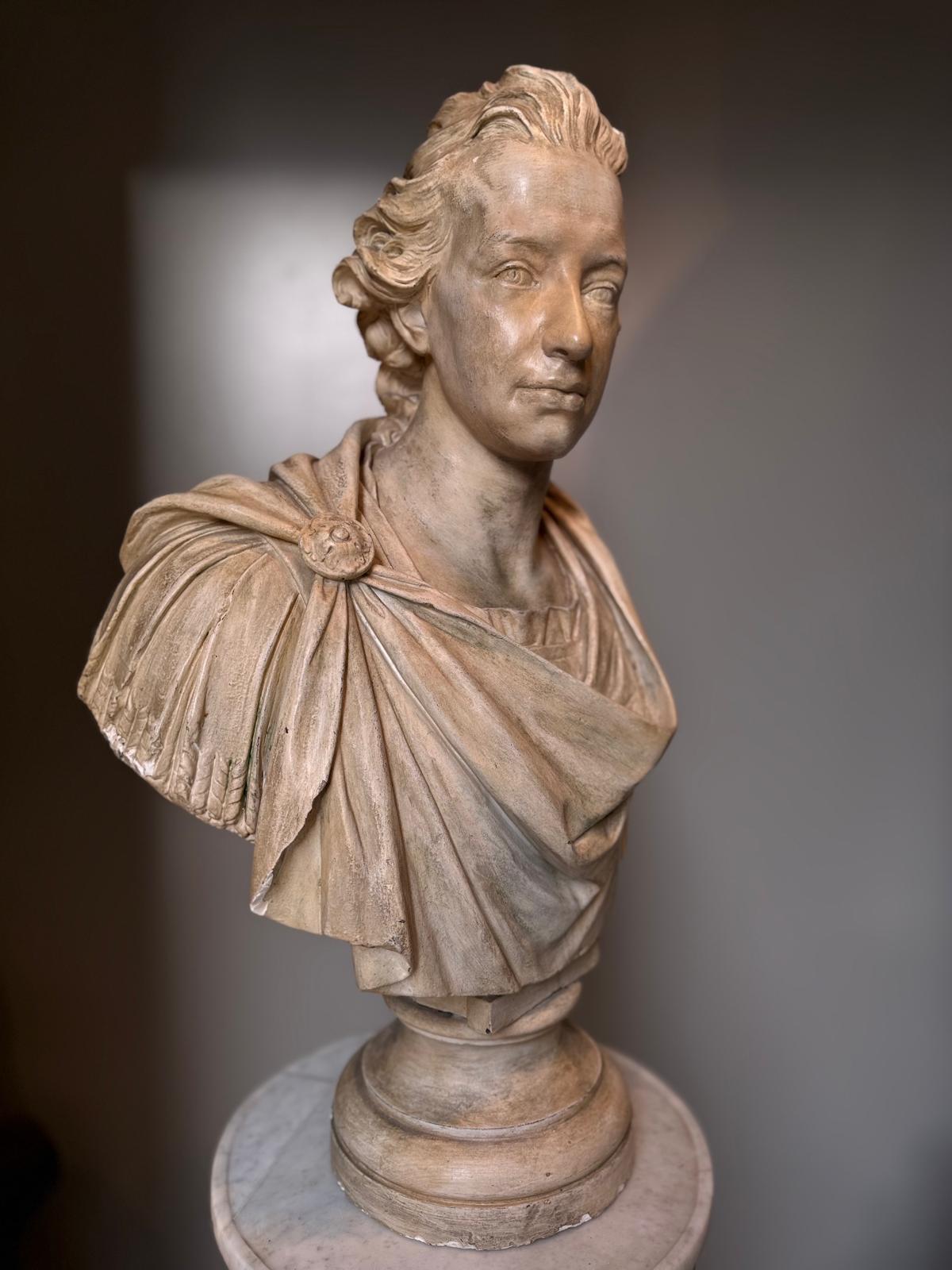
This patinated stucco bust is a sculptural portrait of the Archduke of Austria and Grand Duke of Tuscany, Peter Leopold, later Emperor Leopold II.
The bust is attributed to Innocenzo Spinazzi
Dimensions: 83cm x 75cm x 31cm (circa 1770s)
Some minor chips and old restorations, consistent with its age and use.
A rare example of Spinazzi's portraiture, one of the foremost sculptors active in Florence in the late 18th century. Trained in Rome in the workshop of Bartolomeo Cavaceppi, he brought a rigorous neoclassical language to Tuscany, updated with antiquarian taste.
This bust of Peter Leopold of Habsburg-Lorraine reflects the Grand Ducal court's desire to align its image with the model of Roman imperial portraits: composure, frontality, and measured idealization. It is not by chance that the Gazzetta Toscana in 1773 emphasized that the work was made "in the style of the busts of ancient emperors."
The production of multiple versions in stucco and plaster testifies to the iconographic success of the portrait and its suitability for Florentine private collectors.
Biography of Innocenzo Spinazzi (1726–1789)
Innocenzo Spinazzi was one of the leading figures in Italian sculpture in the second half of the 18th century, a refined interpreter of the transition from late Baroque to Neoclassical language. His career developed between Rome, where he trained, and Florence, where he became the official sculptor of the Habsburg-Lorraine court.
Training in Rome and early years
Spinazzi was born in Rome in 1726. He trained in the workshop of Bartolomeo Cavaceppi, one of the most important restorers of ancient sculpture of the time.
Here, Spinazzi acquired:
a deep familiarity with classical sculpture;
a solid technique in philological restoration and fragment reintegration;
an aesthetic taste updated on antiquity, which allowed him to move naturally within the emerging neoclassical current.
During his Roman years, he produced works in marble and plaster and participated in the workshop's activities, which was highly frequented by European collectors seeking sculptures reborn "in the antique style."
Arrival in Florence (1770) and appointment as court sculptor
In 1770, Spinazzi was called to Florence at the request of Grand Duke Peter Leopold of Habsburg-Lorraine, who intended to renew Medici artistic production towards the new values of Enlightenment rationalism.
In Florence, Spinazzi immediately received prestigious commissions:
restorations for the Uffizi Gallery and Grand Ducal collections;
creation of celebratory busts and monuments;
interventions in public palaces and Lorraine residences.
The court appreciated his ability to combine neoclassical measurement, formal purity, and psychologically vivid portraiture.
Portraiture
One of the fields in which Spinazzi excelled was sculptural portraiture.
His bust of Peter Leopold, modeled in plaster, stucco, and marble in various versions, became a veritable official portrait of the Grand Duke.
The Gazzetta Toscana, in 1773, noted that the bust was "in the style of the ancient emperors": an acknowledgment of the classicist approach that Spinazzi had learned in Rome and was now transferring to the Tuscan context.
His portrait works are distinguished by:
rigor in anatomical rendering;
ellegance of surfaces treated with extreme smoothness;
balance between idealization and fidelity to the likeness;
poses that recall Augustan and Trajanic models.


.jpeg)
.jpeg)
.jpeg)
.jpeg)
.jpeg)
.jpeg)
.jpeg)