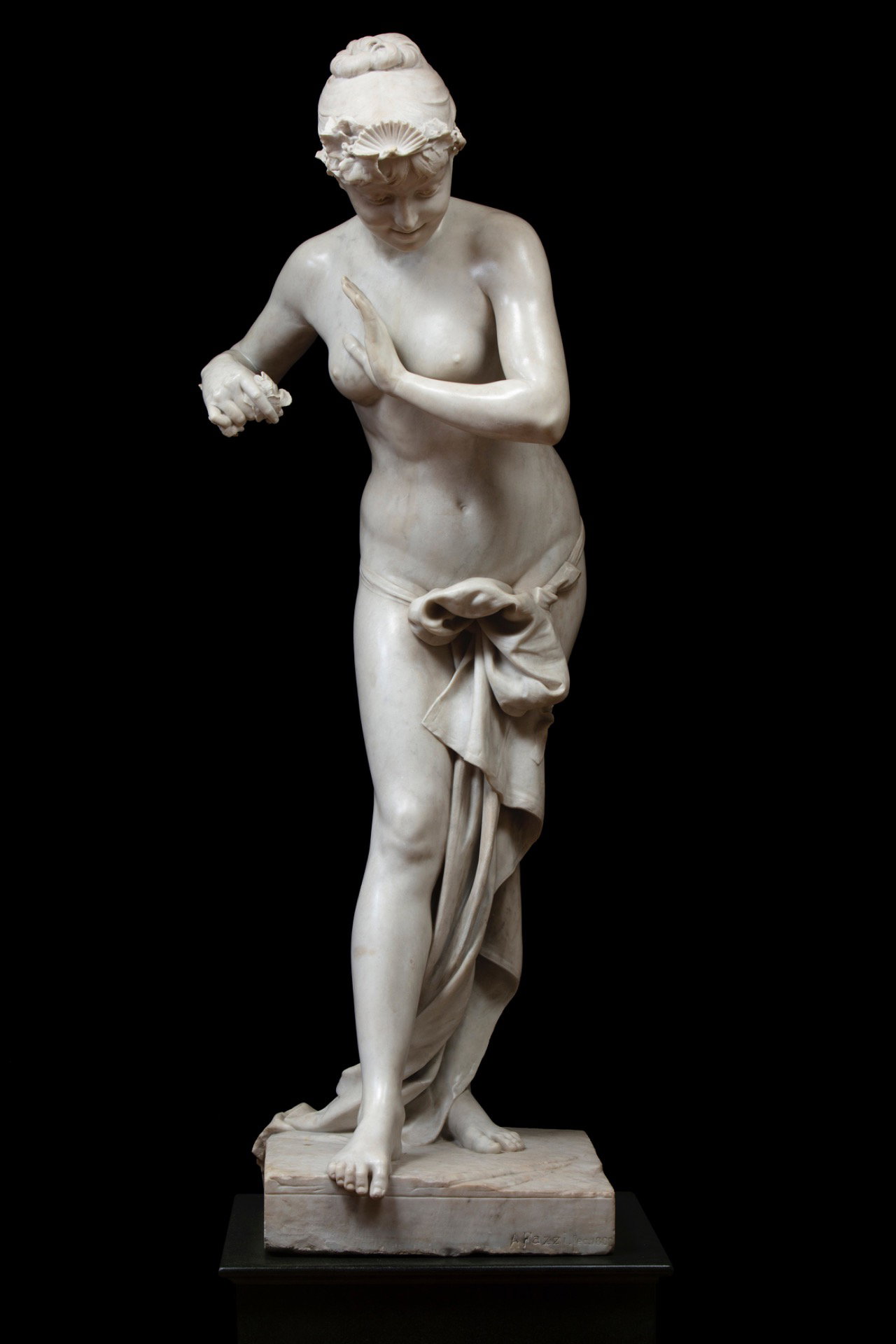
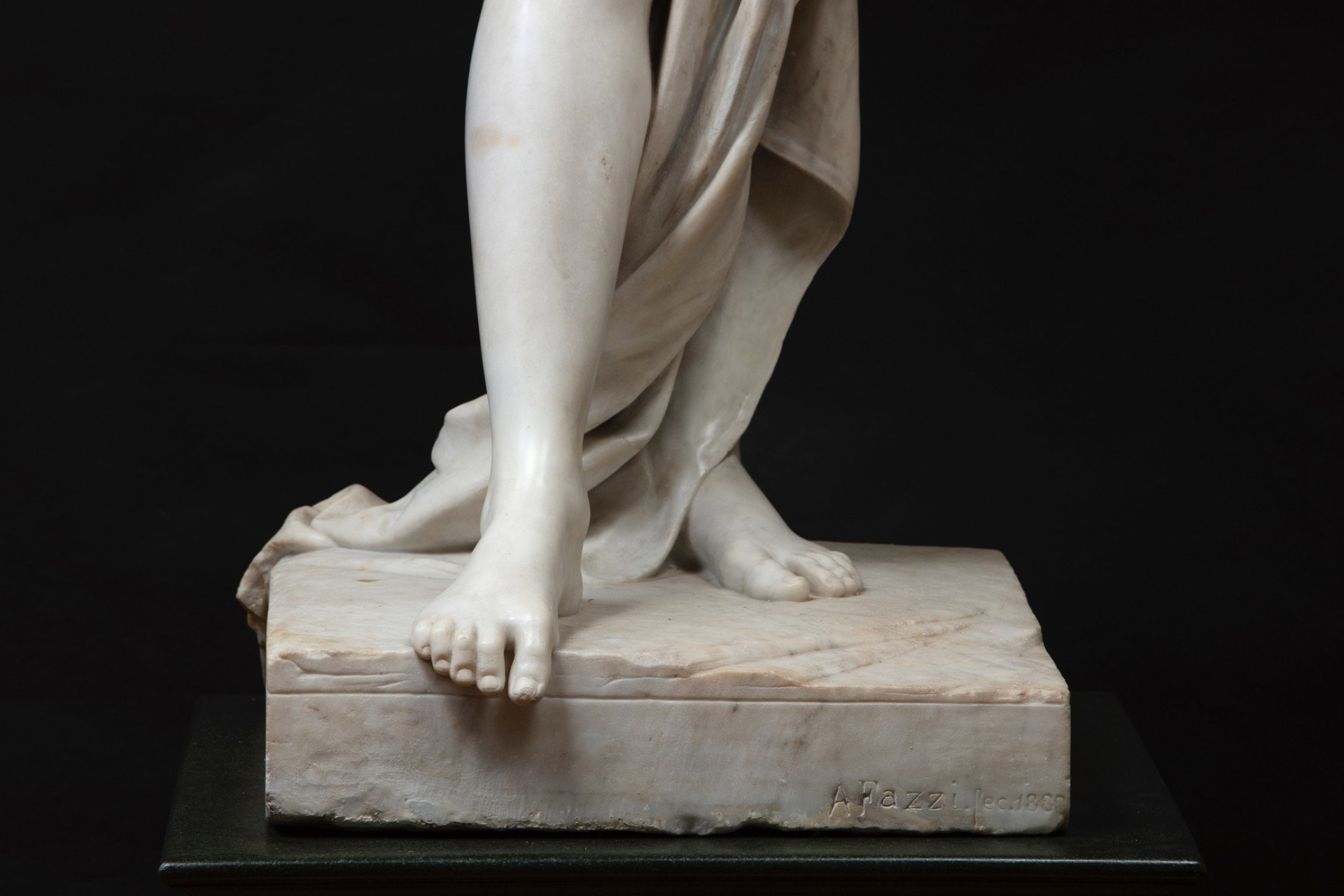
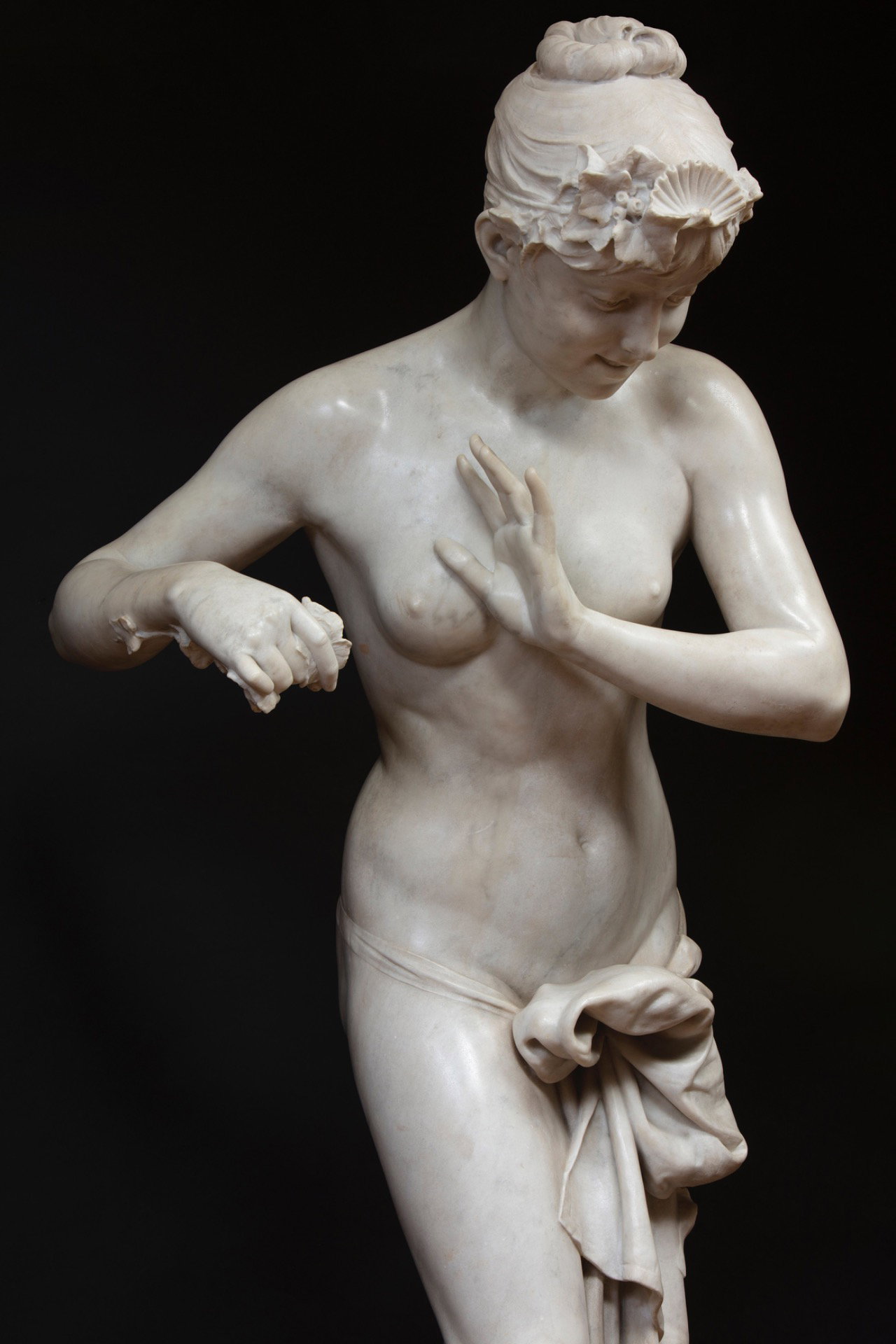
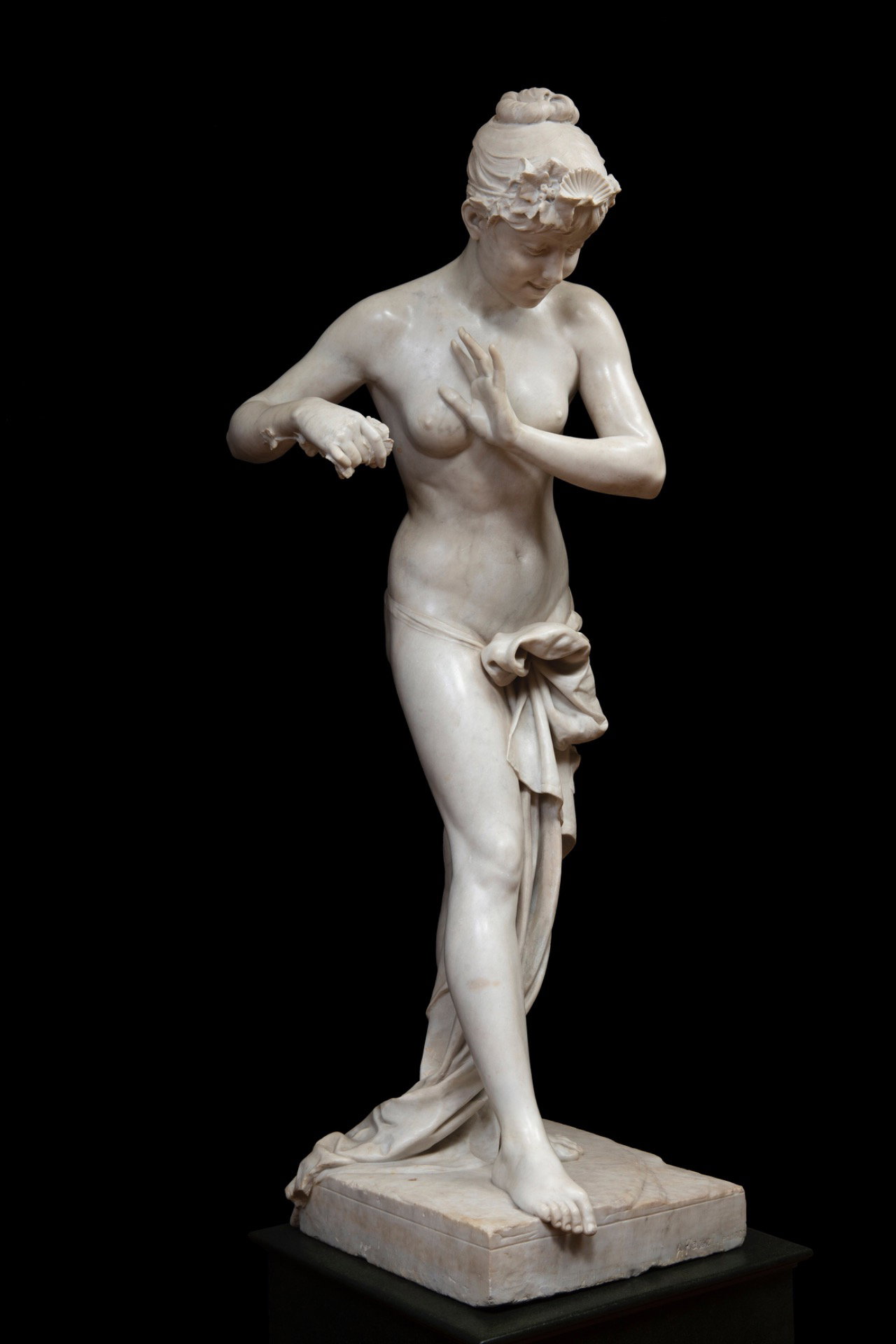
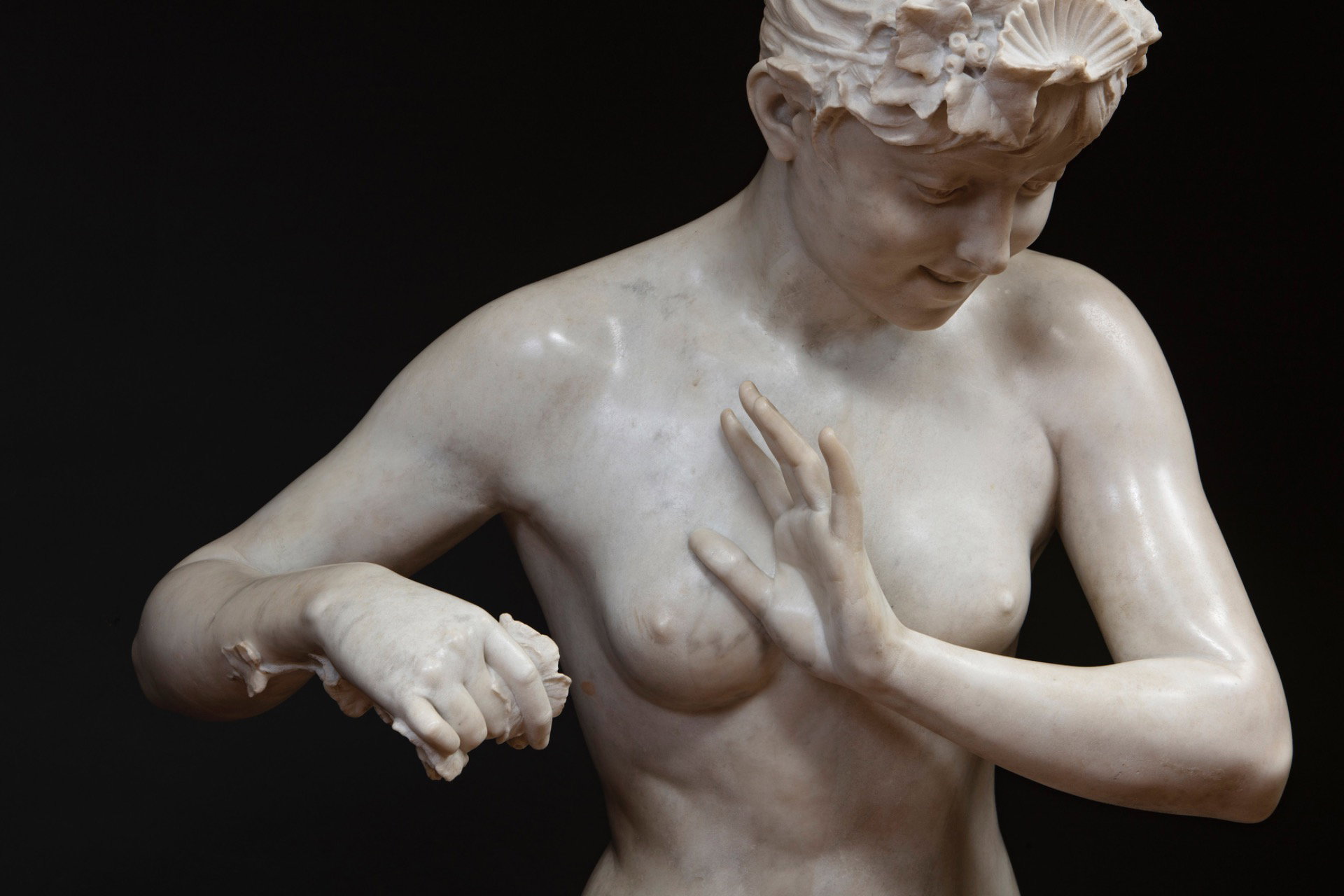
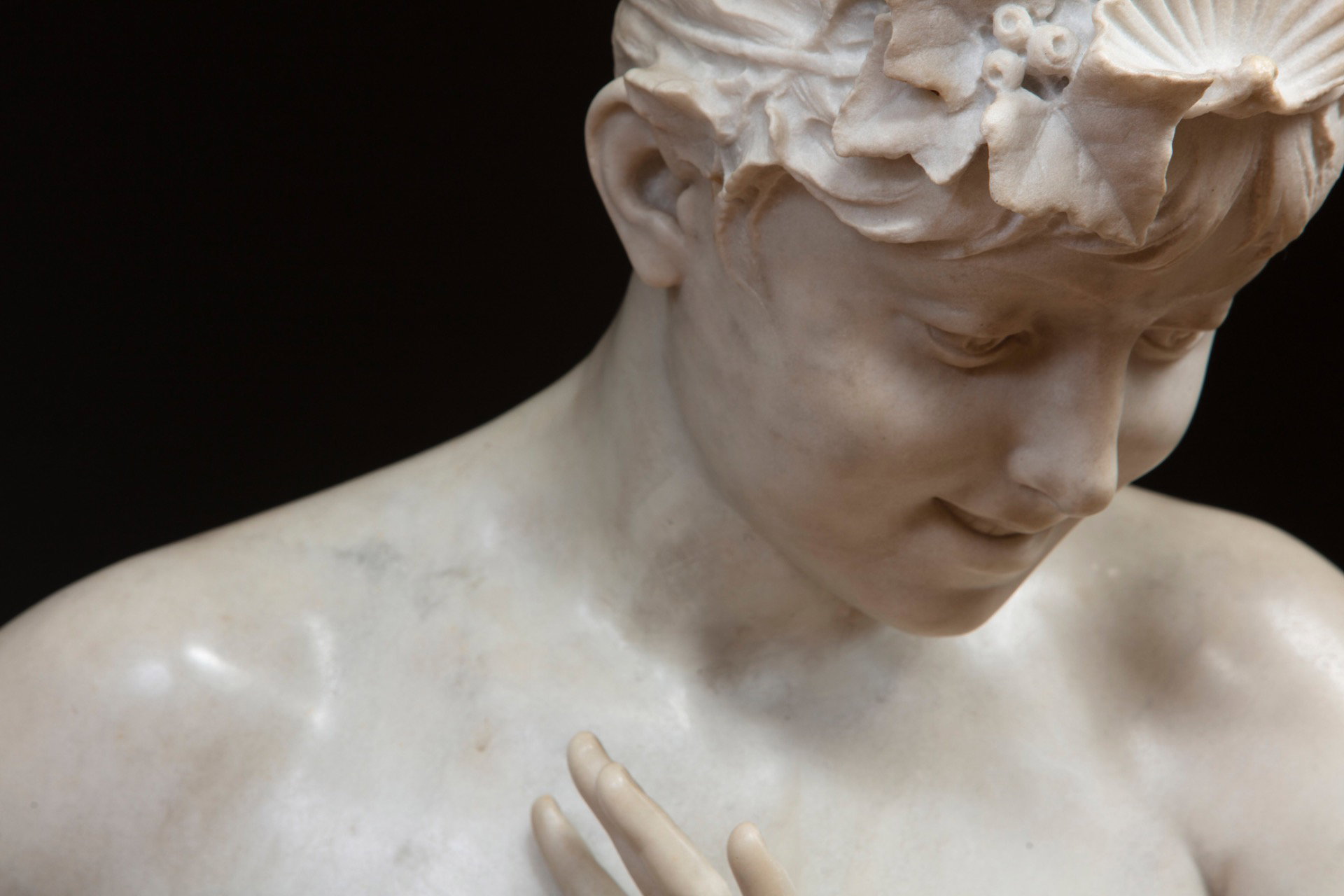
Arnaldo Fazzi (Lucca 1855- Florence 1944) "Girl Playing with the Waves", 1883
White marble, 150 cm.
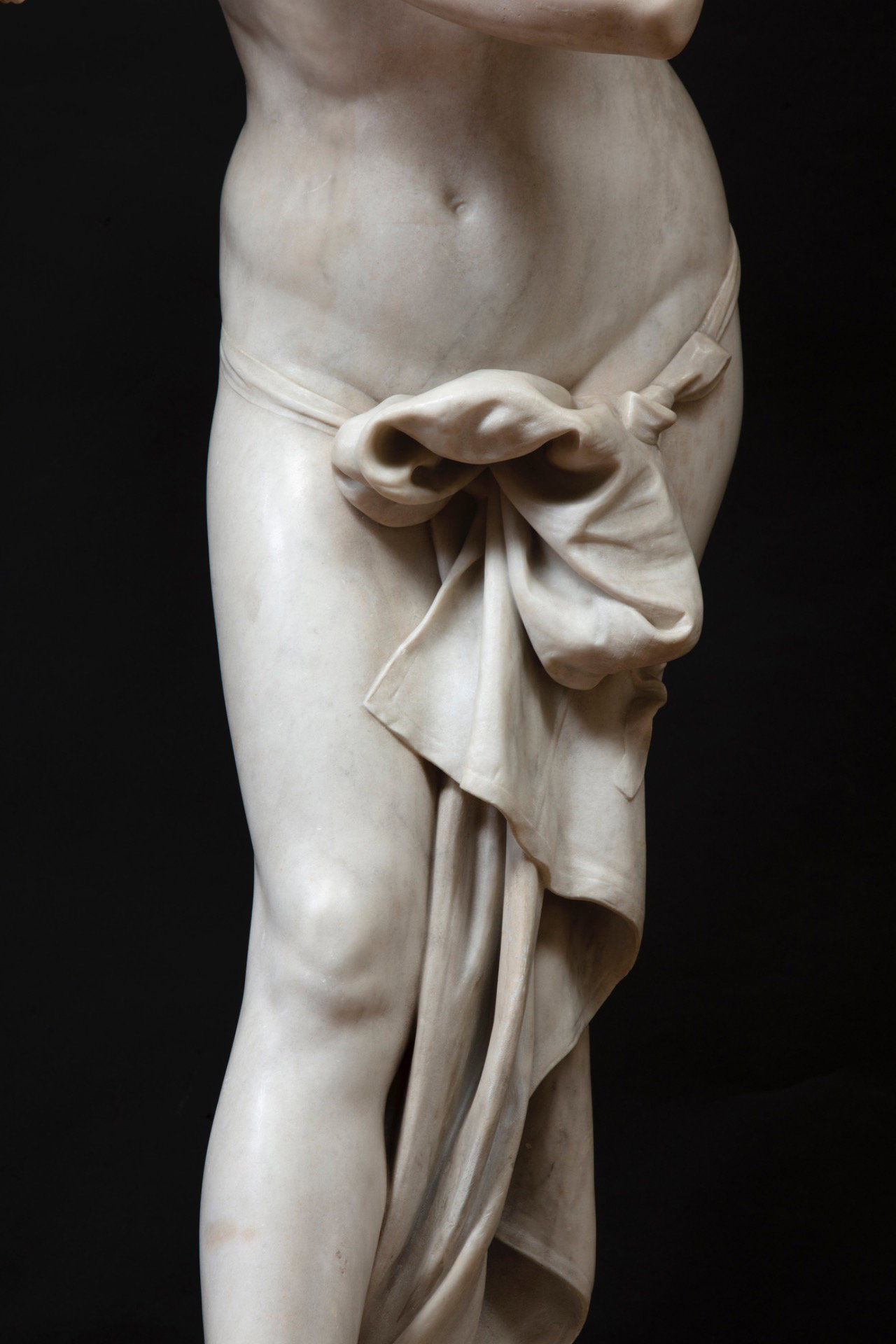
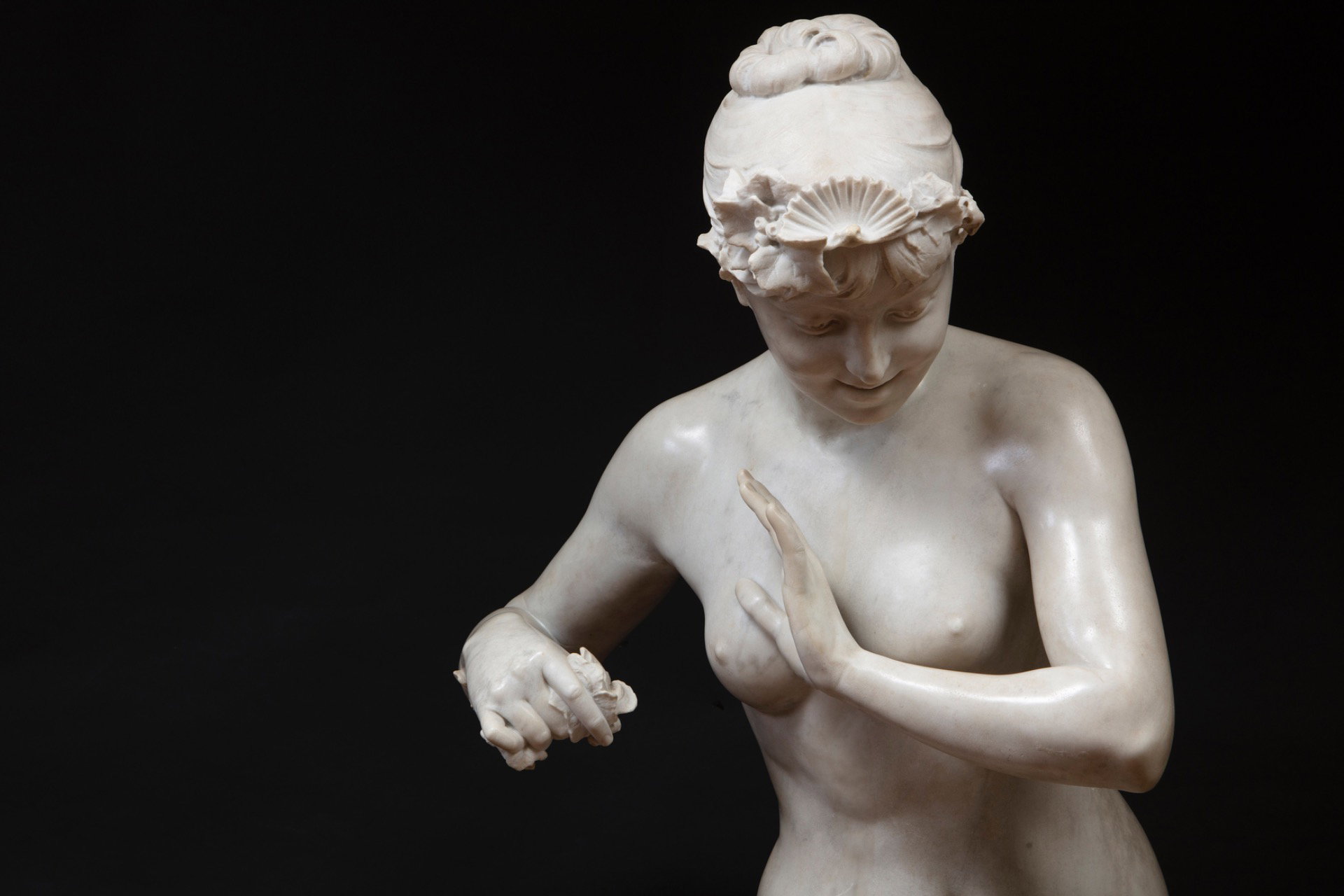
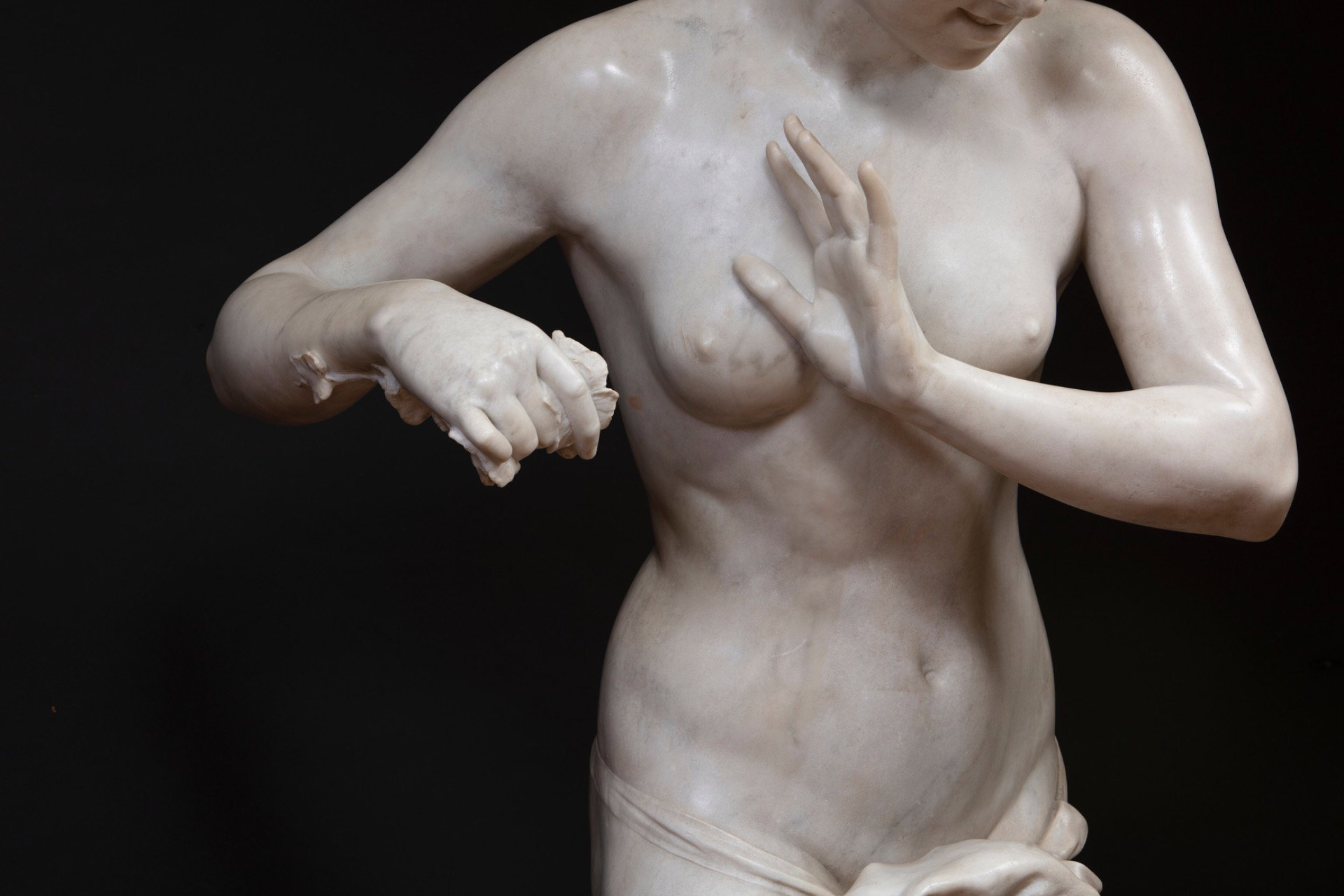
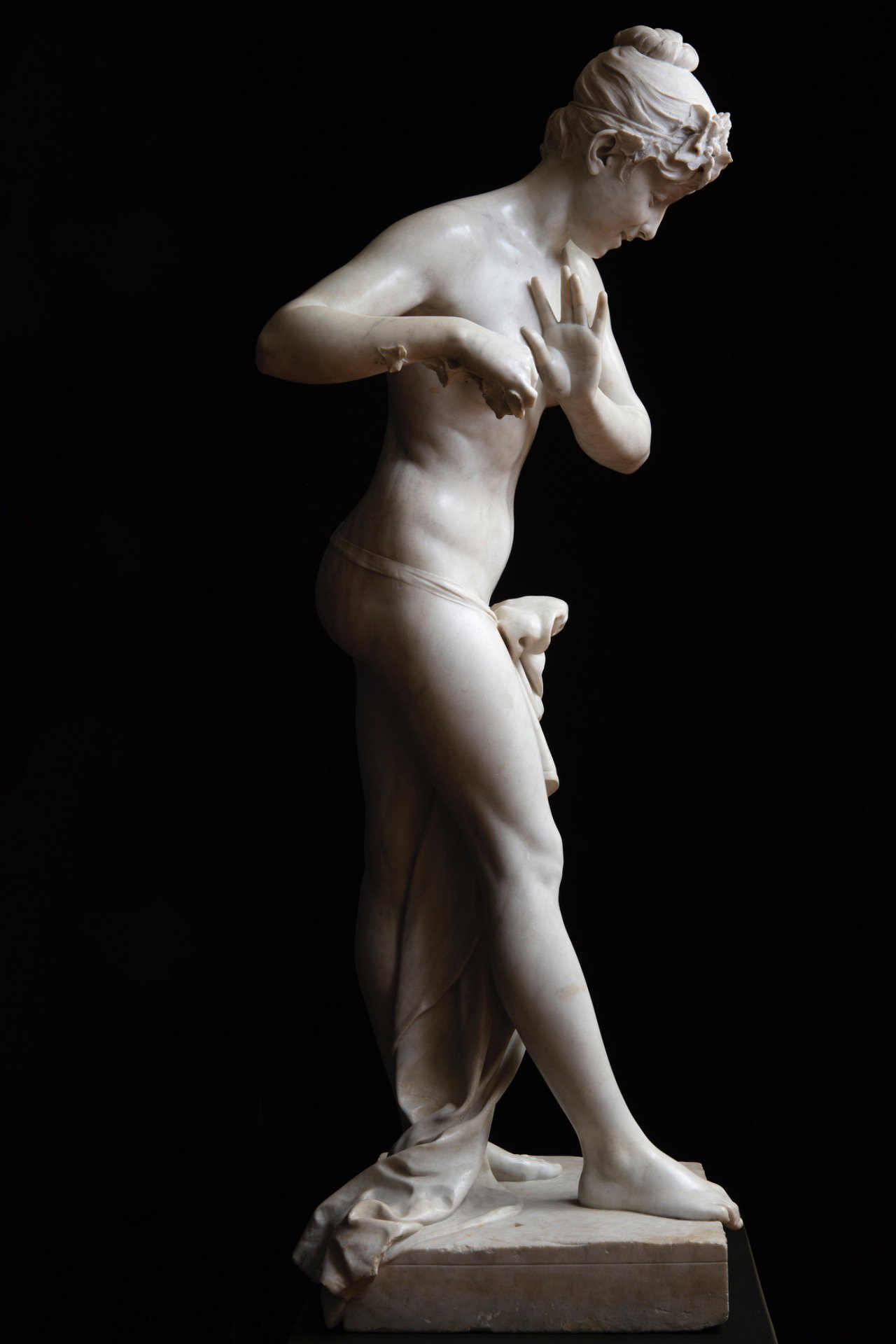
The sculpture represents a graceful young woman, covered by a drape that descends elegantly on her hips, intent on playing with the water on the shore of a beach. The girl is portrayed laughing and holds some very delicate roses in one hand, while the other is raised in a gesture of surprise. Her hair, gathered in a soft bun, is embellished with a wreath of ivy, a symbol of purity; in the center of the crown is a shell, an attribute linked to Venus, making this work a probable tribute to the Goddess of Beauty. With one foot she advances on the sand breaking the "fourth wall," as if wanting to escape from the beautiful marble prison on which she is placed to enter the real world. This work was created by the sculptor for the Solemn Exhibition of the Society for the Encouragement of Fine Arts of Florence, which took place in 1883.
BIOGRAPHY
Arnaldo Fazzi was born in Lucca in 1855; son of a watchmaker, he attended the Academy of Fine Arts in his city and then, at the age of 22, moved to Florence to perfect his studies with the Sienese sculptor Giovanni Dupré. In 1881 he made his debut with a marble statuette, The Falconer, at the Salon in Paris; it is the beginning of a discreet career, dotted with even public commissions, such as the statue dedicated to Garibaldi for a square in Città di Castello in 1888. The following year he participated in a competition for the project of the monument to Ugo Foscolo intended for the Church of Santa Croce in Florence, winning in a tie with other artists; despite the praise of the critic Diego Martelli, the commission did not choose his project for the realization of the work. In 1891 he assumed the position of teacher at the professional school of decorative and industrial arts in Florence; two years later he was commissioned by the administration of his hometown a bronze statue to commemorate the memory of Matteo Civitali, a famous Lucchese sculptor of the 15th century, still preserved under the arcades of Palazzo Pretorio. In 1895 he participated and won the national competition for the funerary monument of the Paduan entrepreneur Antonio Pedrocchi, while the following year he exhibited his design for a fountain decorated in cement at the Exhibition of Fine Arts in Florence. In 1900 Fazzi was appointed professor of sculpture at the Academy of Fine Arts in Lucca, where he trained as a young man; three years later, the institutions of the same city commissioned the sculptor to make a bronze medallion depicting King Umberto I for the atrium of the town hall. In 1904 he finished a marble bas-relief in the apse of the family chapel of the Marquis Sardini in the cemetery of Lucca and is a member of the provincial committee for the Milan Exhibition of 1906. The latest public recognition came following the national competition for the execution of one of the reliefs depicting the Fame of the propylon on the left of the Vittoriano in Rome and in 1910 he also participated in the competition announced by the Municipality of Genoa for a Monument to the Thousand intended on the rock of Quarto, winning the money prize. In the following three years, his presence is remembered among the members of the Artistic Council of the Association of Italian Artists of Palazzo Strozzi in Florence and at the VIII edition of the Exhibition organized by the association, where he presented the bronze sculpture The Angels of Sin. After more than three decades of teaching, Fazzi retired to Florence, where he died in 1944.
Bibliography:
A. Panzetta, "Dictionary of Italian sculptors of the 19th century", Turin 1989, pp. 73s.
M. Pierini, "Fazzi Arnaldo" in Dizionario Bibliografico degli italiani, Vol. 45, 1995, Istituto della Enciclopedia Italiana Treccani
P. Pacini, "Of painting. Technique and art", Ferrara 1992, p. XXVI.