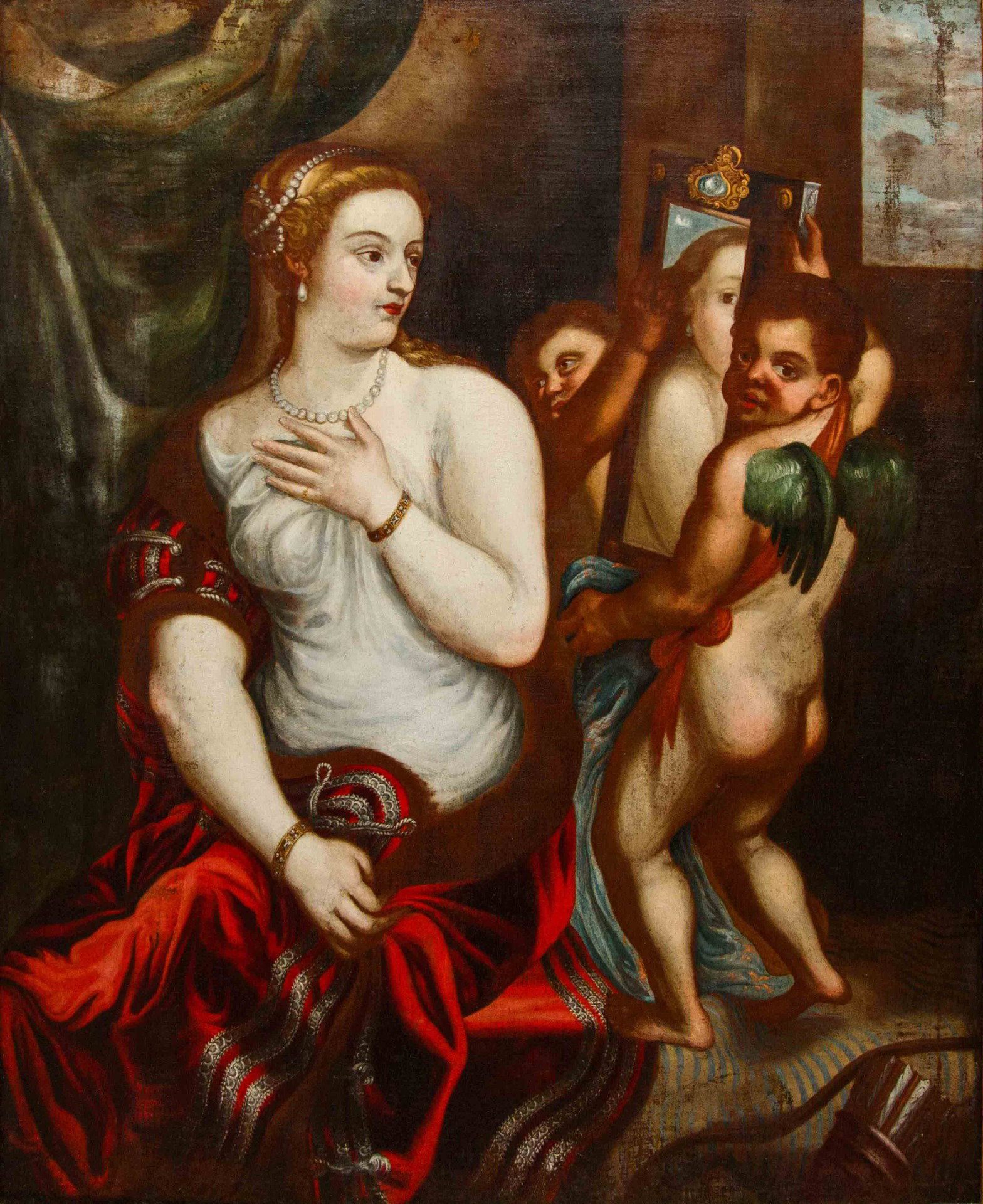
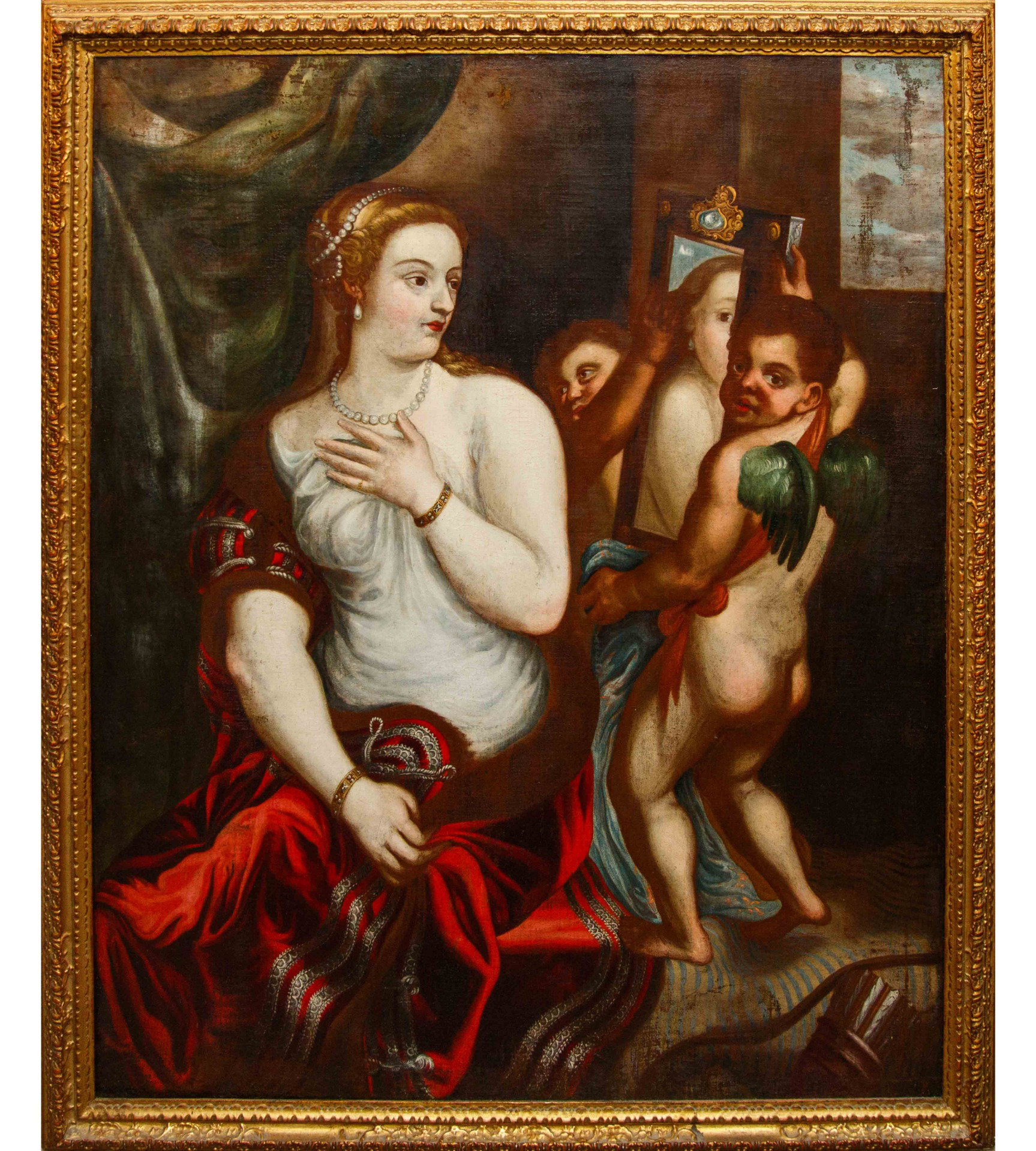
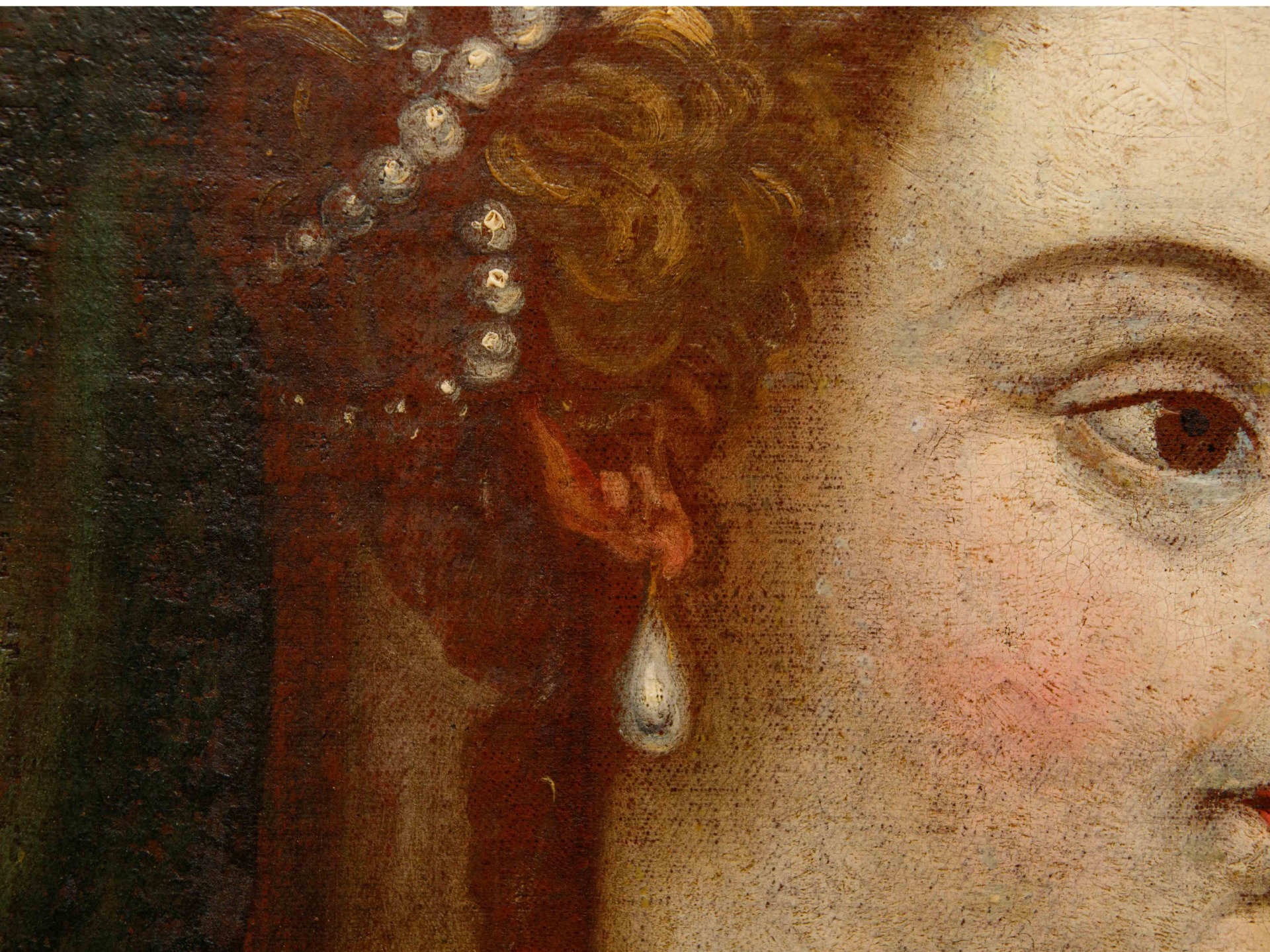
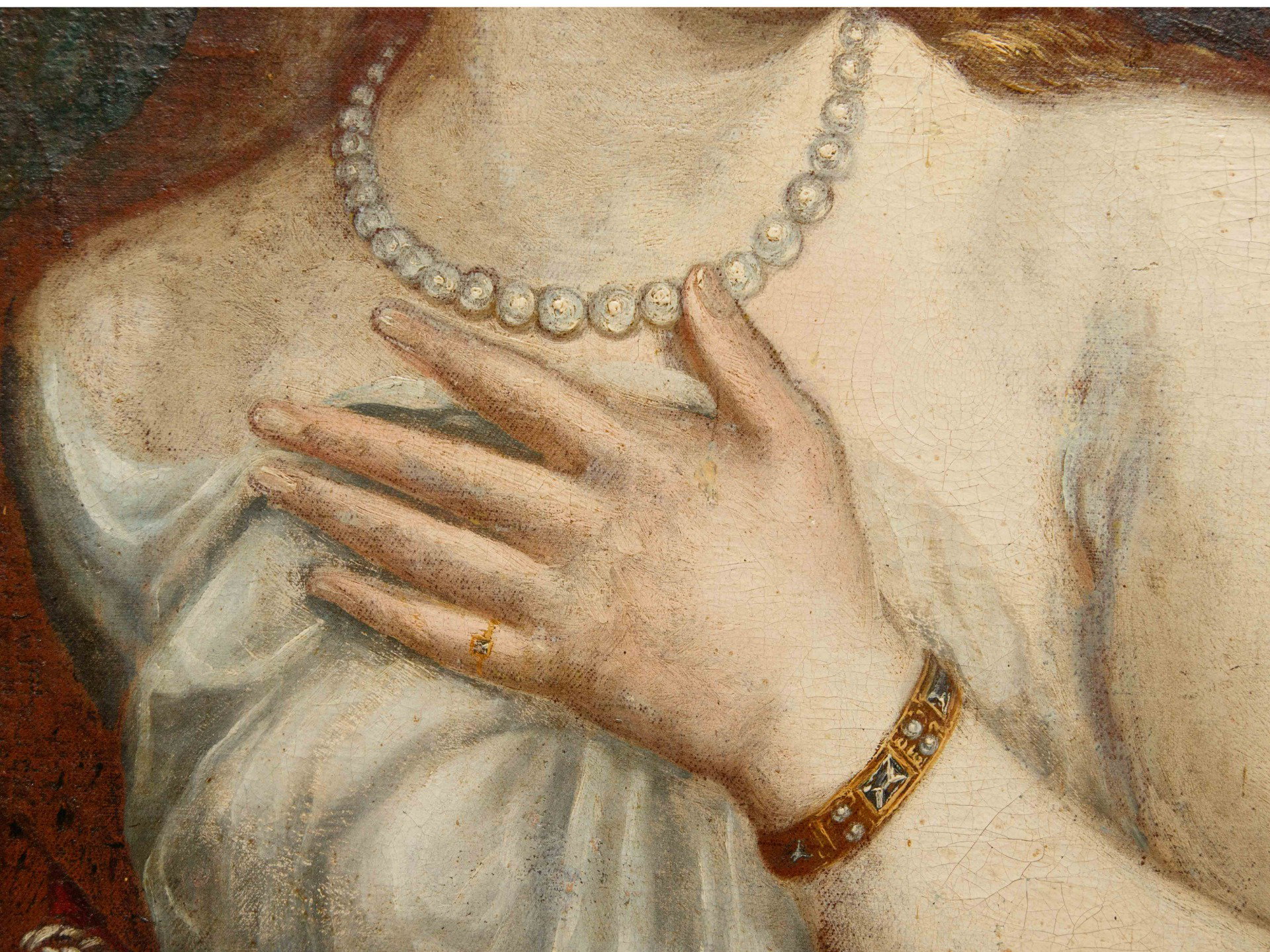
Workshop of Titian Vecellio, 17th century
Venus at the Mirror
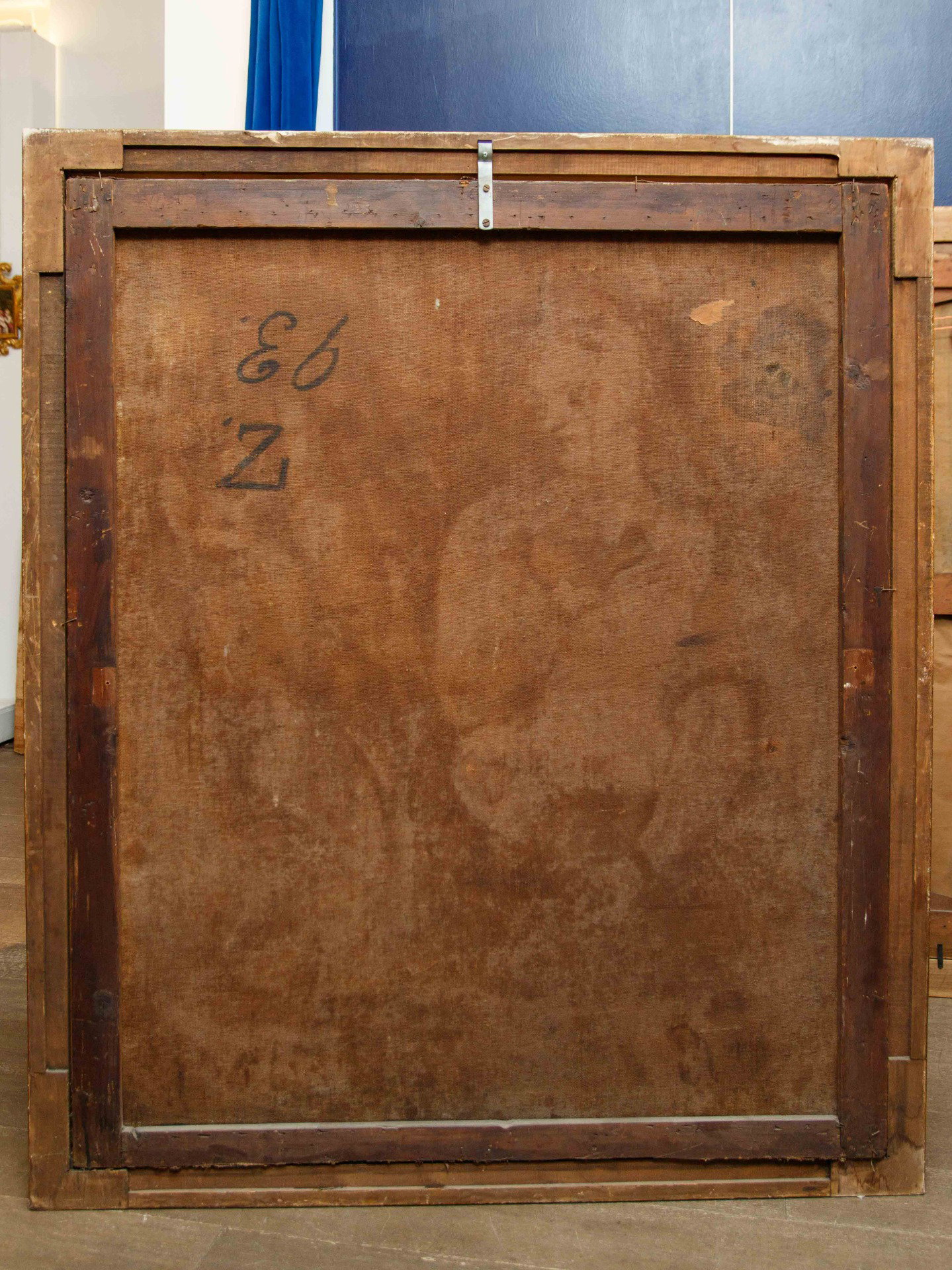
Oil on canvas, 140 x 117 cm
With frame, 153 x 129 cm
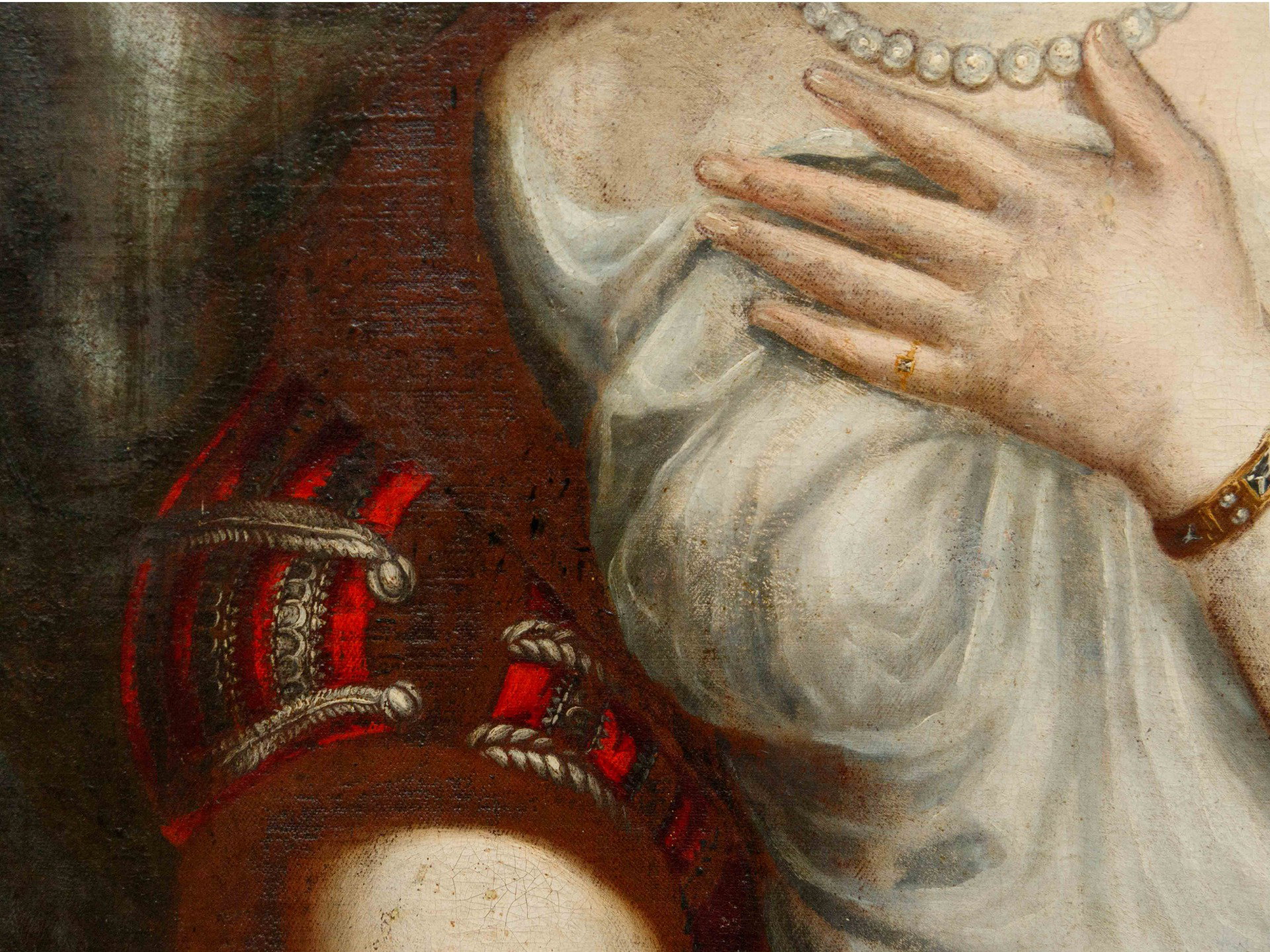
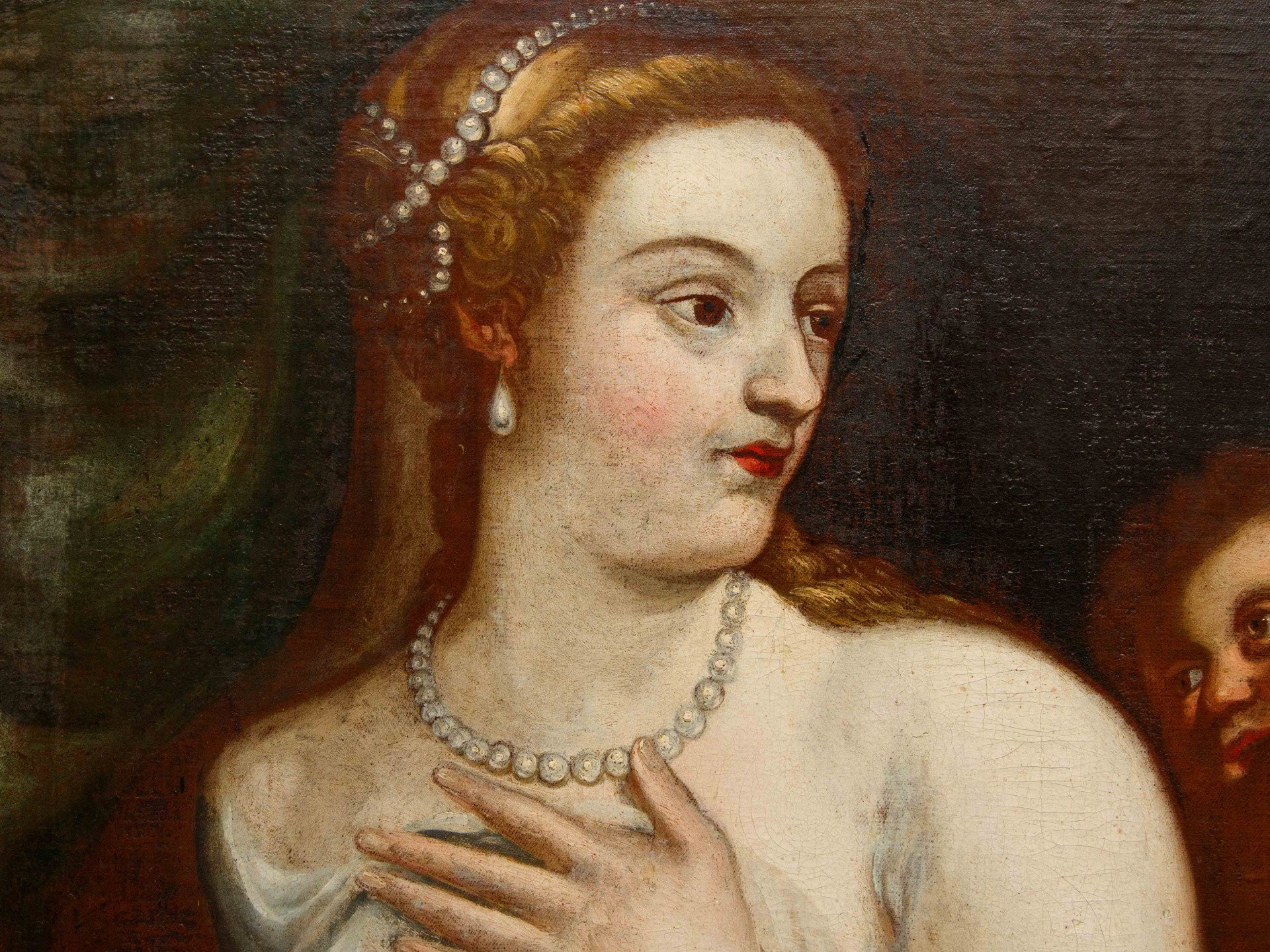
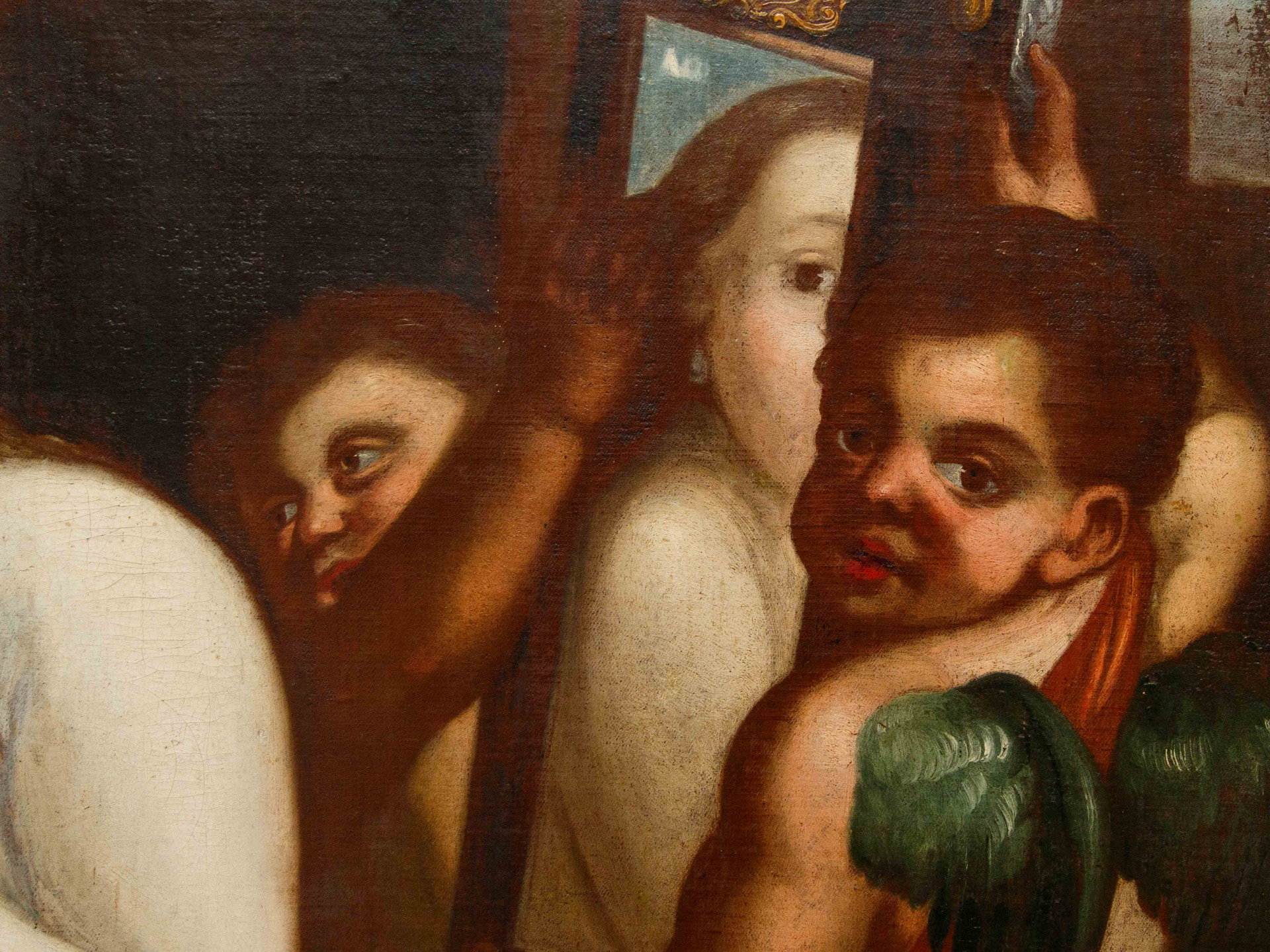
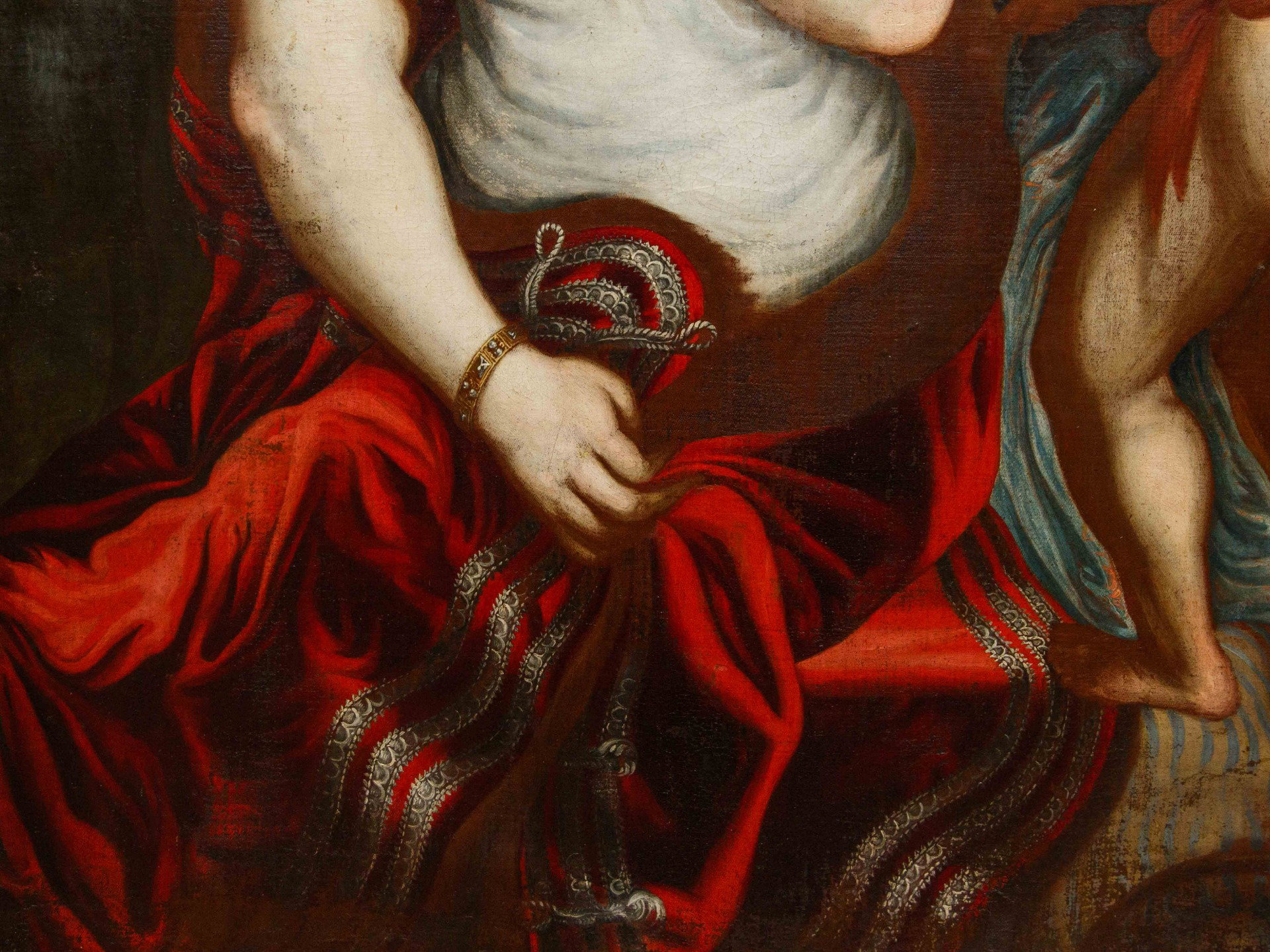
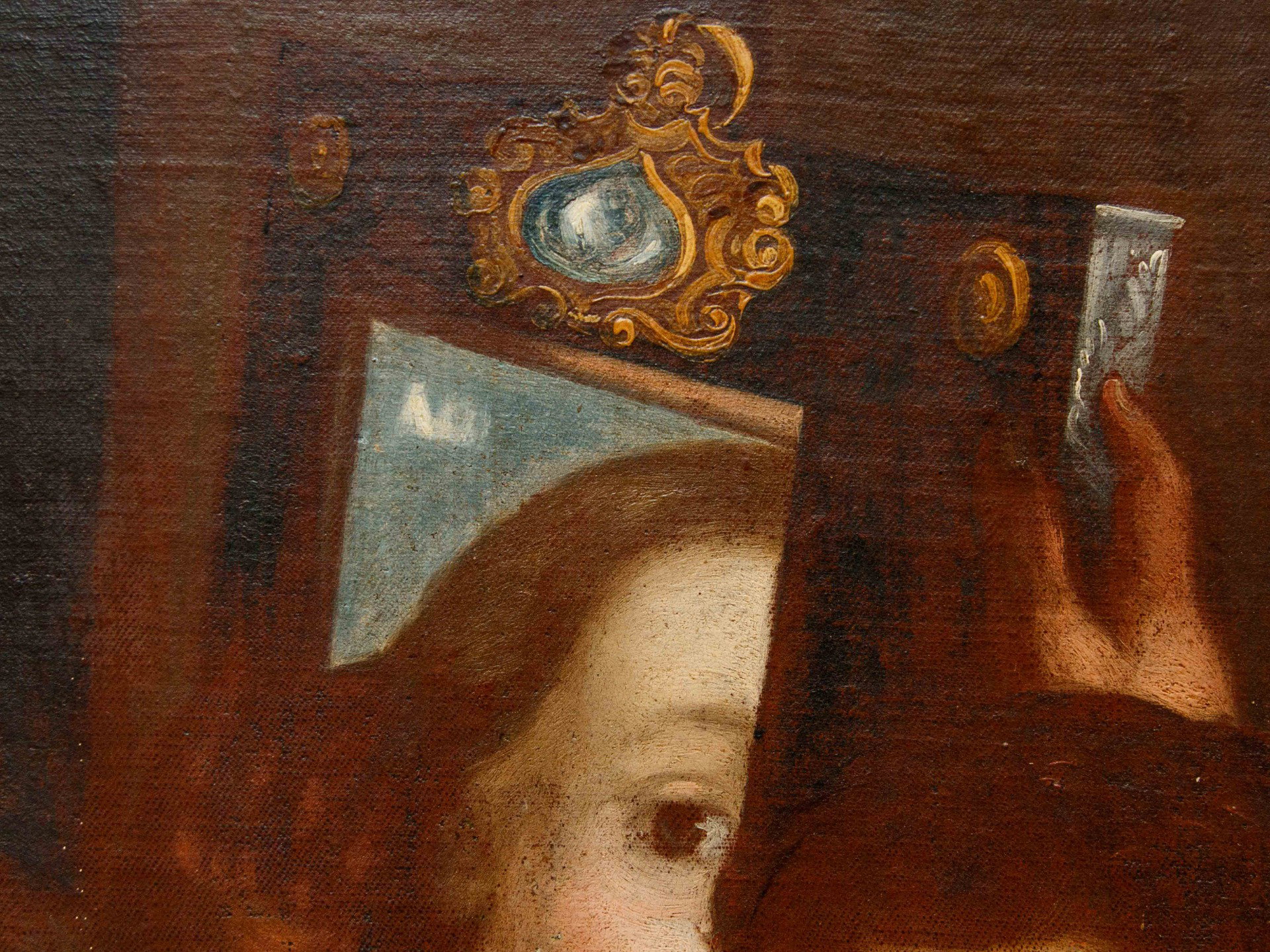
The painting in question ingeniously reprises the iconography of Titian's Venus at the Mirror, currently housed at the National Gallery of Art in Washington and dated around 1552-1553. The iconographic theme of Venus at the Mirror is one of the most successful in Titian's production. The artist from Cadore tackled this subject on some thirty occasions throughout his long career. Works bearing this subject, now lost, were once in the collections of Charles V and the wealthy merchant Niccolò Crasso. The version currently exhibited in the halls of the National Gallery of Art in Washington is considered by art historians to be one of the most successful interpretations of this subject. It is likely the first instance where the artist from Cadore chose to portray the Greek divinity not in a languid reclining pose, but in a dressing scene, a situation he had already experimented with when depicting anonymous women. In this case, the goddess's pose recalls the model of a Venus Pudica, possibly the so-called Venus de' Medici, which was in Rome at the time, and which the painter had the opportunity to see during his stay in the city in 1545-1546, "learning from the marvelous ancient stones." The value of this variation of the subject was first recognized by Titian himself. After completing the work, he decided not to sell it but to keep it for himself and display it in his workshop, located in Venice at the Biri di San Canciano, for over twenty years. The reason why Titian kept a painting of such high quality for so long is uncertain, but this Venus might have served as a source of inspiration for those who worked for the artist or visited him. For the members of Titian's workshop, it could have served as a model to admire and imitate; furthermore, the painting might have prompted visitors to commission similar images, acting as a highly functional form of advertising before the term existed. It is also due to the prolonged presence of the canvas in Titian's Venetian studio that various contemporary or slightly later copies of this painting exist, among which the present work can certainly be included. Following the death of the artist from Cadore and his son Orazio, who worked in his father's studio between the 1570s and 1580s, the painting was purchased by the noble Venetian family Barbarigo, who already owned various Tizianesque paintings in their rich residence on the Grand Canal, Ca' Barbarigo alla Terrazza. It is precisely at Ca' Barbarigo that the two greatest scholars of 17th-century Venice, Carlo Ridolfi and Marco Boschini, located "a Venus up to the knees, who admires herself in the mirror with two Loves," unanimously identified by art historians with the painting in question. In the 18th century, the Barbarigo collection became a mandatory destination for cultured travelers and young European aristocrats visiting Venice during the Grand Tour: Cochin described it as a "school of Titian," and de Brosses mentioned the Venus at the Mirror as "parfaitement beaux." The work, still in the Barbarigo collection in the 19th century, is cited in the first official catalogue of the collection, drawn up in 1845 by Giovanni Carlo Bevilacqua, which also refers to the presence, at the palace on the Grand Canal, of two paintings by Bellini, thirteen by Giorgione, one by Palma il Vecchio, and one by Tintoretto. In 1850, the last heir of the Barbarigo family, having fallen into disgrace, sold various paintings to Tsar Nicholas I of Russia. The work was exhibited in the halls of the Hermitage in St. Petersburg until the 1930s. In 1930, in order to accumulate foreign currency for the first of the Soviet Union's five-year economic plans, the Soviet government secretly sold the Venus, along with twenty other masterpieces from the museum, to the American billionaire Andrew Mellon. Six years later, in 1937, Mellon donated his collection of 121 paintings and 21 sculptures, including the splendid Venus at the Mirror by Titian, to the American government to form the initial core of the National Gallery of Art in Washington, founded on his initiative. The Venus in Washington, with its meticulous treatment of surface textures and their tactile sensuality, a characteristic feature especially in Titian's painting production of the 1550s, embodies the ideal of beauty of that era while revealing, rather than concealing, the softness of the goddess's pale flesh enveloped in a red drape adorned with gold and silver embroidery and lined with soft fur. The visual success of this popular version of Titian's Venus at the Mirror, disseminated through contemporary copies and numerous engraved reproductions, was immense, even among the great artists of the following century: particularly relevant in this regard are the versions by Rubens (Madrid, Museo Thyssen-Bornemisza) and Van Dyck (London, British Museum). The canvas presented here is attributable to the master's workshop; the artist manages to faithfully reinterpret the illustrious model, conferring the same monumentality upon the female figure. The radiance of the goddess's skin contrasts sharply with the deep red of the embroidered mantle that partially covers her body and with the green drapery behind her, in an interesting interplay of light and shadow. Details of particular elegance, borrowed from the master's masterpiece, coincide with the precious jewels and the elaborate frame of the mirror vigorously supported by two putti, here in the interesting variation of the one in the foreground who communicates with the viewer.
For Italy only: with Ars Antiqua it is possible to pay all amounts in installments up to a maximum of €7,500 at ZERO INTEREST, for a total of 15 INSTALLMENTS
Ex. Total €4,500 = Monthly installment €300 for 15 months.
Ex. Total €3,600 = Monthly installment €720 for 5 months.
For amounts exceeding €7,500 or for longer payment terms (over 15 installments), we can provide a personalized payment plan.
Contact us directly for the best quote.
LIVE TV
– SUNDAY 5:00 PM – 9:00 PM Dig.terr. 126 - Sky 824
– Streaming on our website www.arsantiquasrl.com and on our social media Facebook and Youtube
All works offered by Ars Antiqua are sold with a certificate of authenticity in accordance with the law and an accurate in-depth analysis.
It is possible to view the works directly at the gallery showroom in Milan, at via Pisacane 55 and 57.
We personally organize transport and delivery of the works, both for Italy and abroad.