Dimensions: h: 60; d: 22; w: 44 [cm]
Gilt bronze mantel clock – signed S. Marti, Paris, médaille d'Or
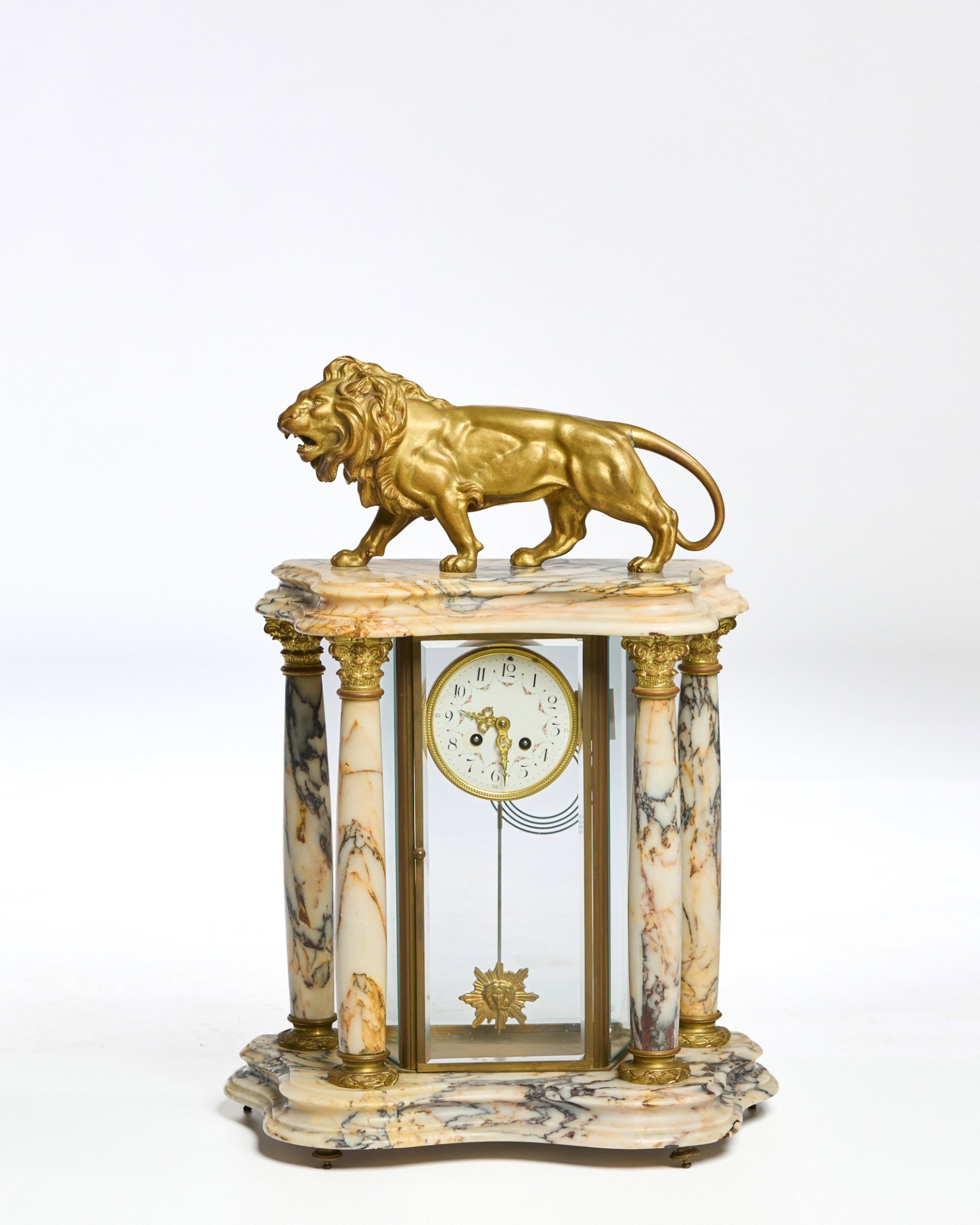
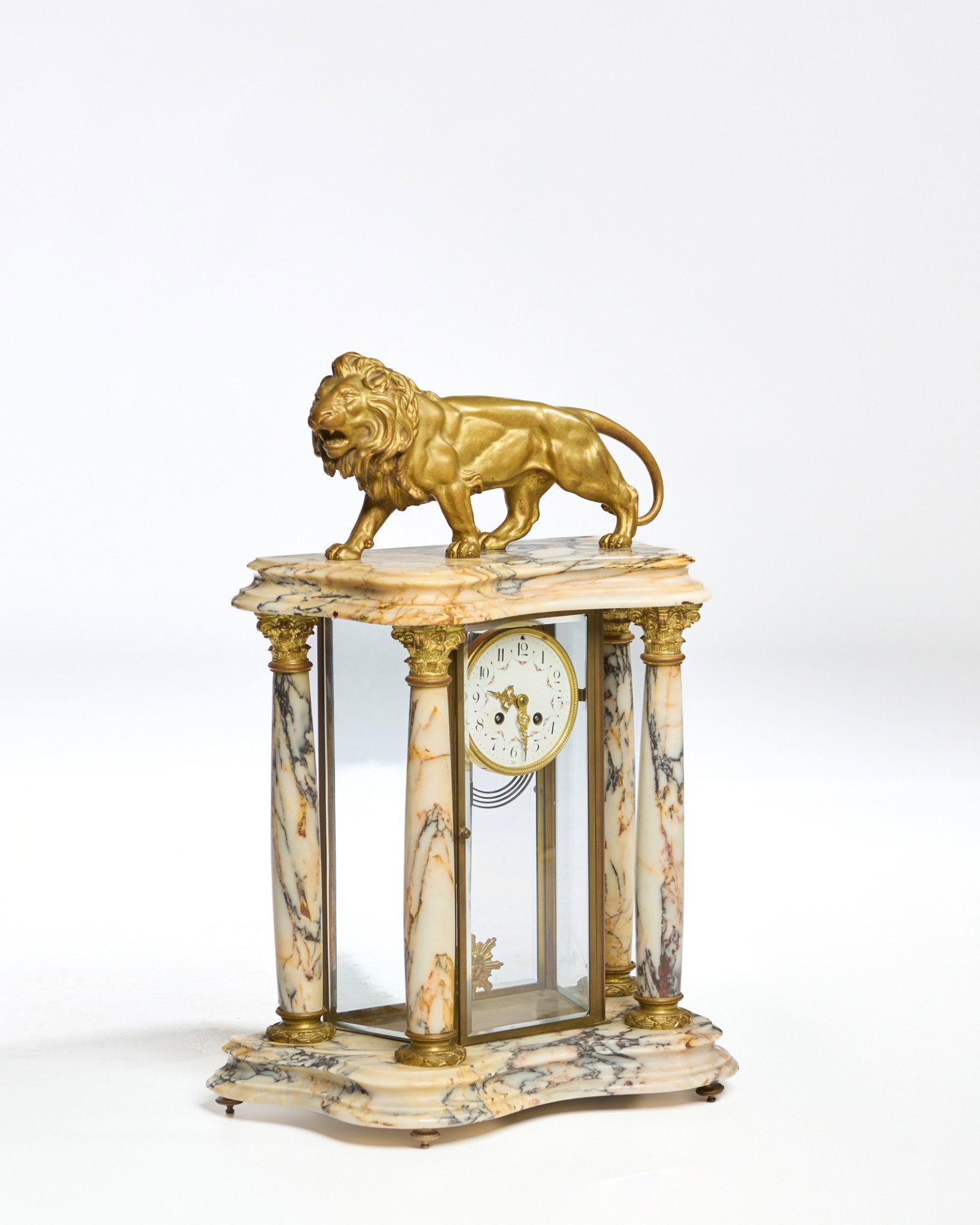
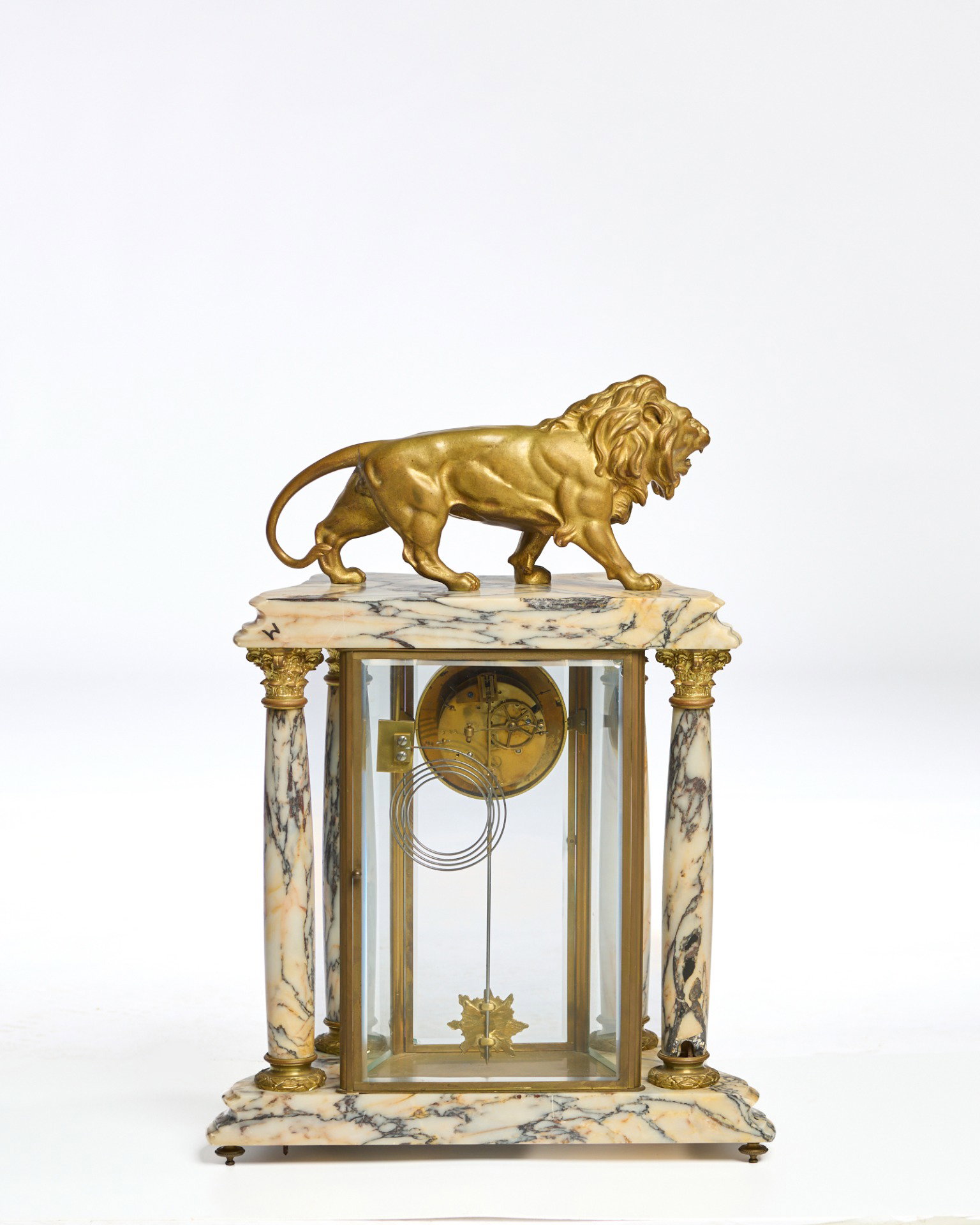
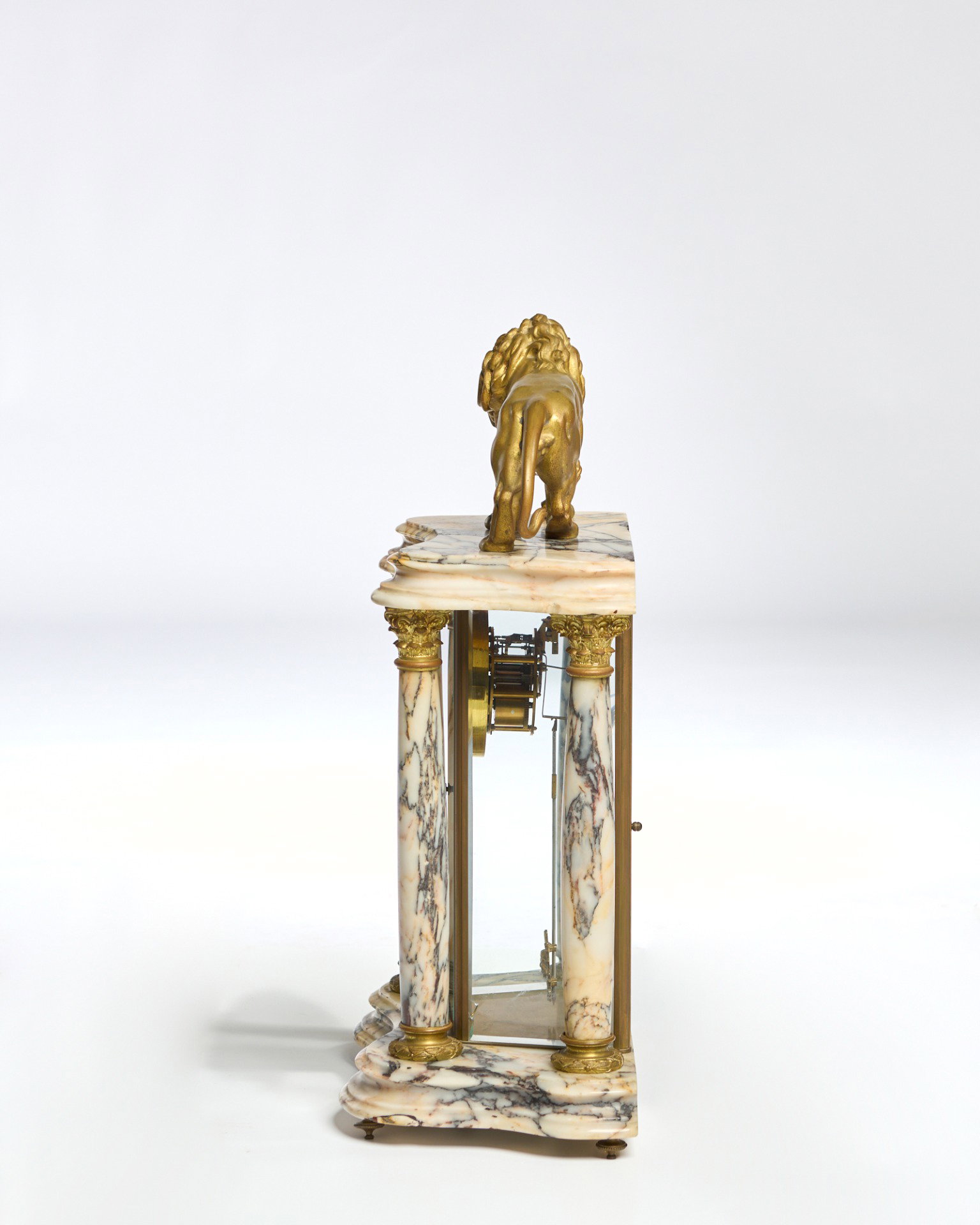
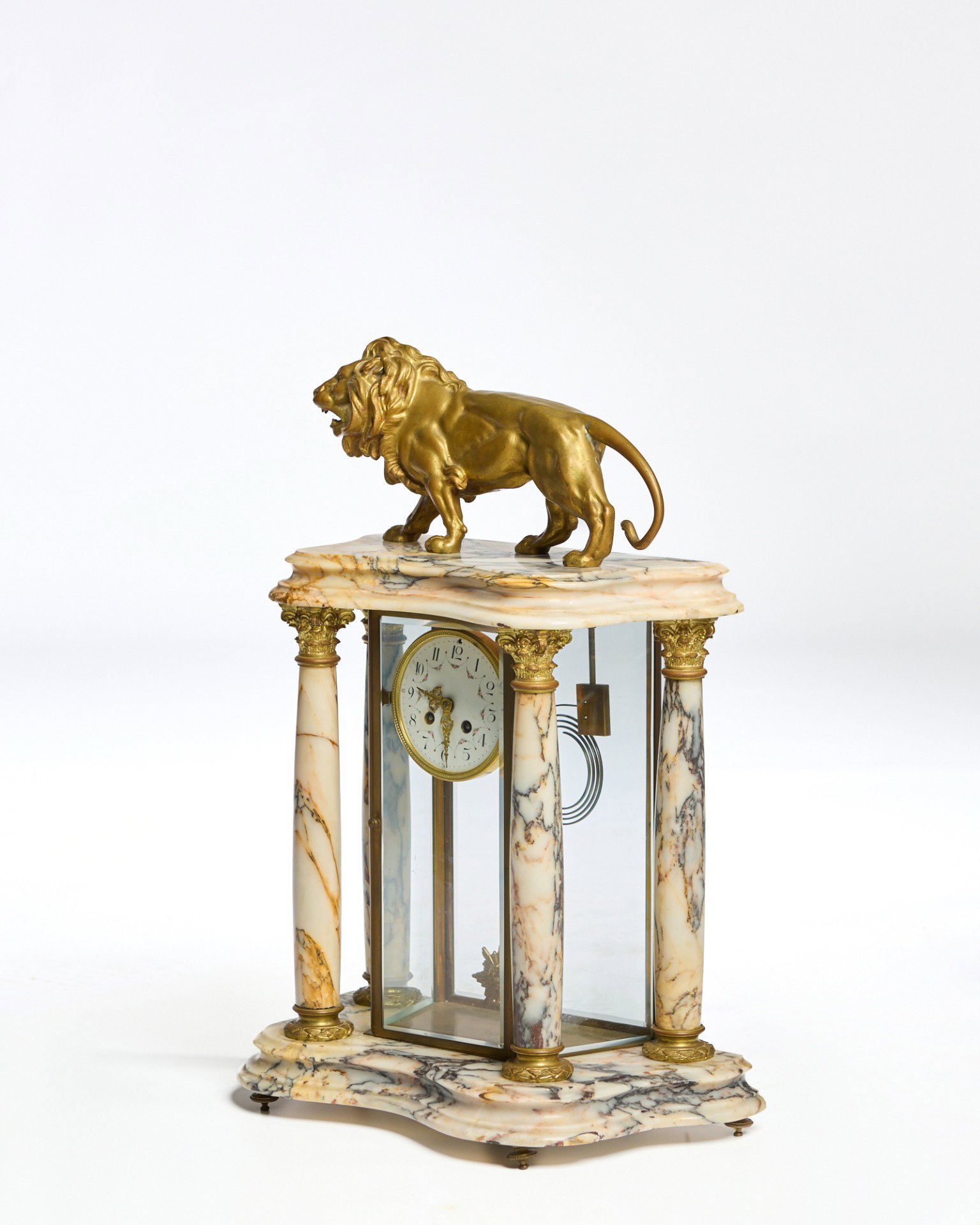
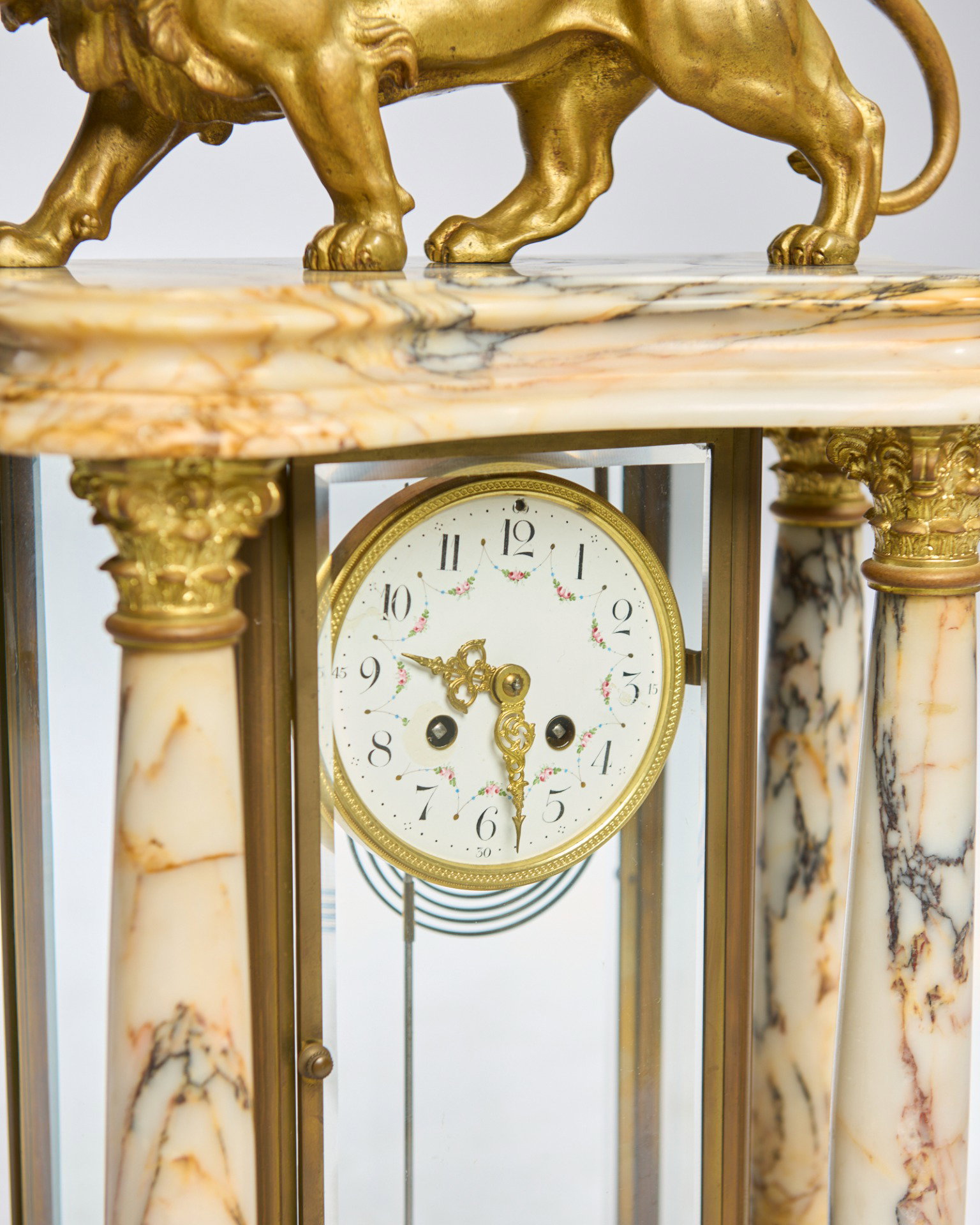
Elegant gilt bronze mantel clock, finely chased and surmounted by a leonine figure that lends strength and monumentality to the overall piece. The enameled dial, decorated with Roman numerals, is housed within a richly adorned structure with classical motifs, acanthus leaves, and fluted columns, typical of the French Neoclassical taste still in vogue in the second half of the 19th century.
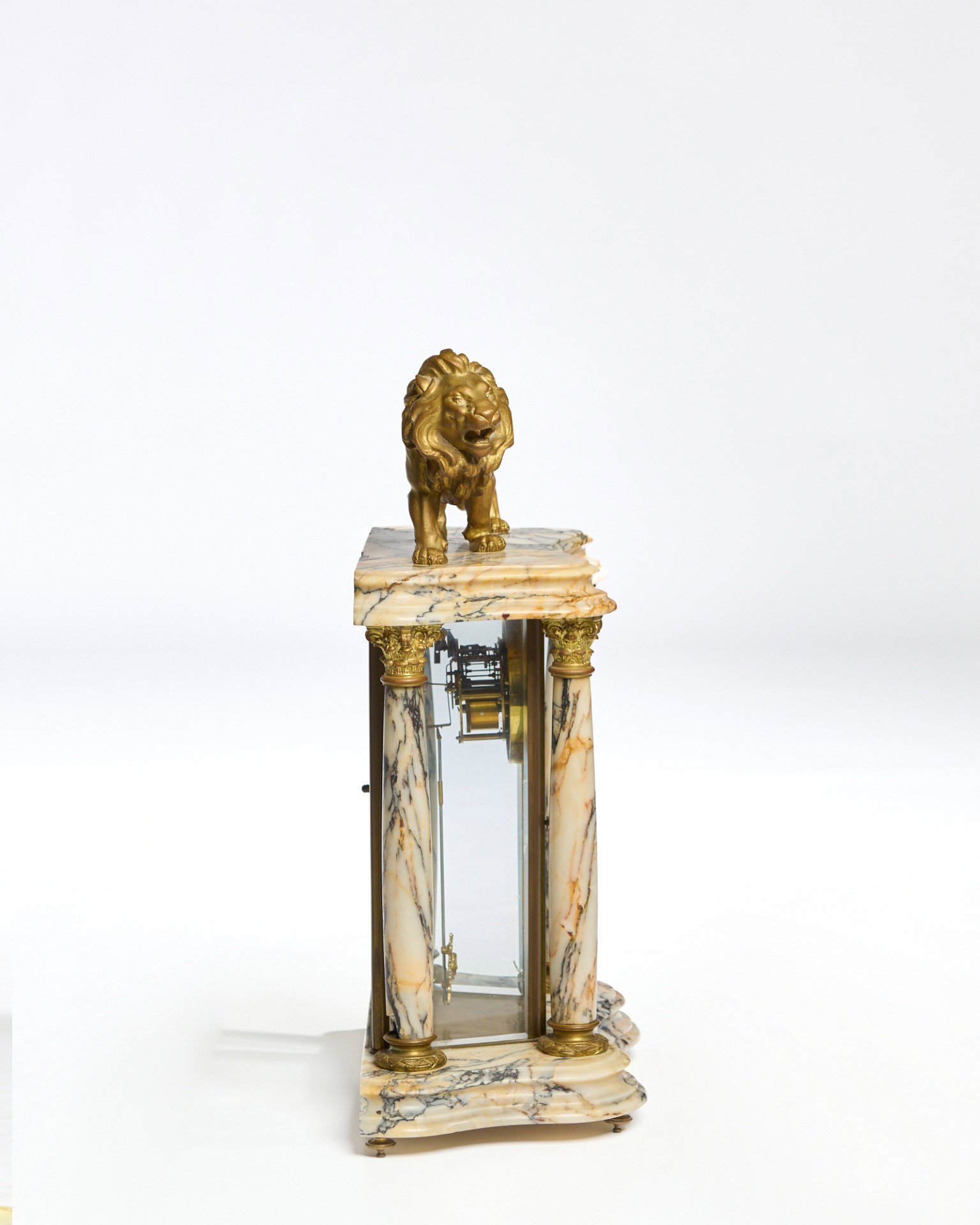
The movement's rear is stamped S. Marti, medaille d'Or, Paris. A renowned clockmaker active in Paris from 1832.
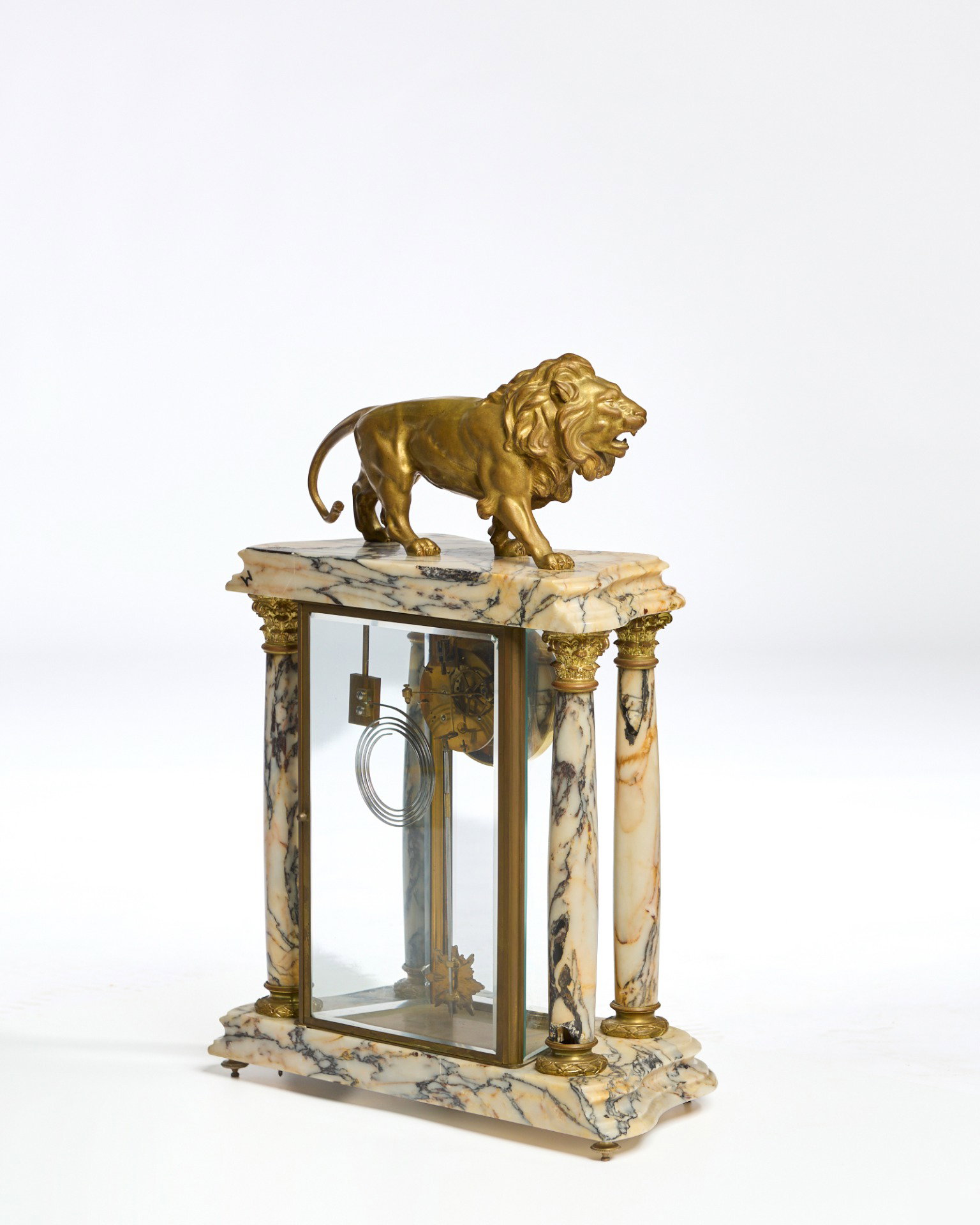
The original pendulum and the eight-day winding mechanism, with striking at the hours and half-hours, confirm its construction quality and overall integrity. The numbering "238" engraved on the case suggests limited or commission production, which increases its rarity.
A collector's item with significant decorative impact.
Dimensions: h: 60; d: 22; w: 44 [cm]
Origin
France
Author
Samuel Marti
Material
marble, gilt bronze
Details:
The pendulum
An element of great fascination is the visible pendulum, with a gilt sun-shaped decoration, a clear reference to the "Sun King" and the symbolism of light, reason, and power. This detail recalls the French tradition of late 18th-century table clocks, which persisted in high-quality 19th-century productions.
Materials and structure
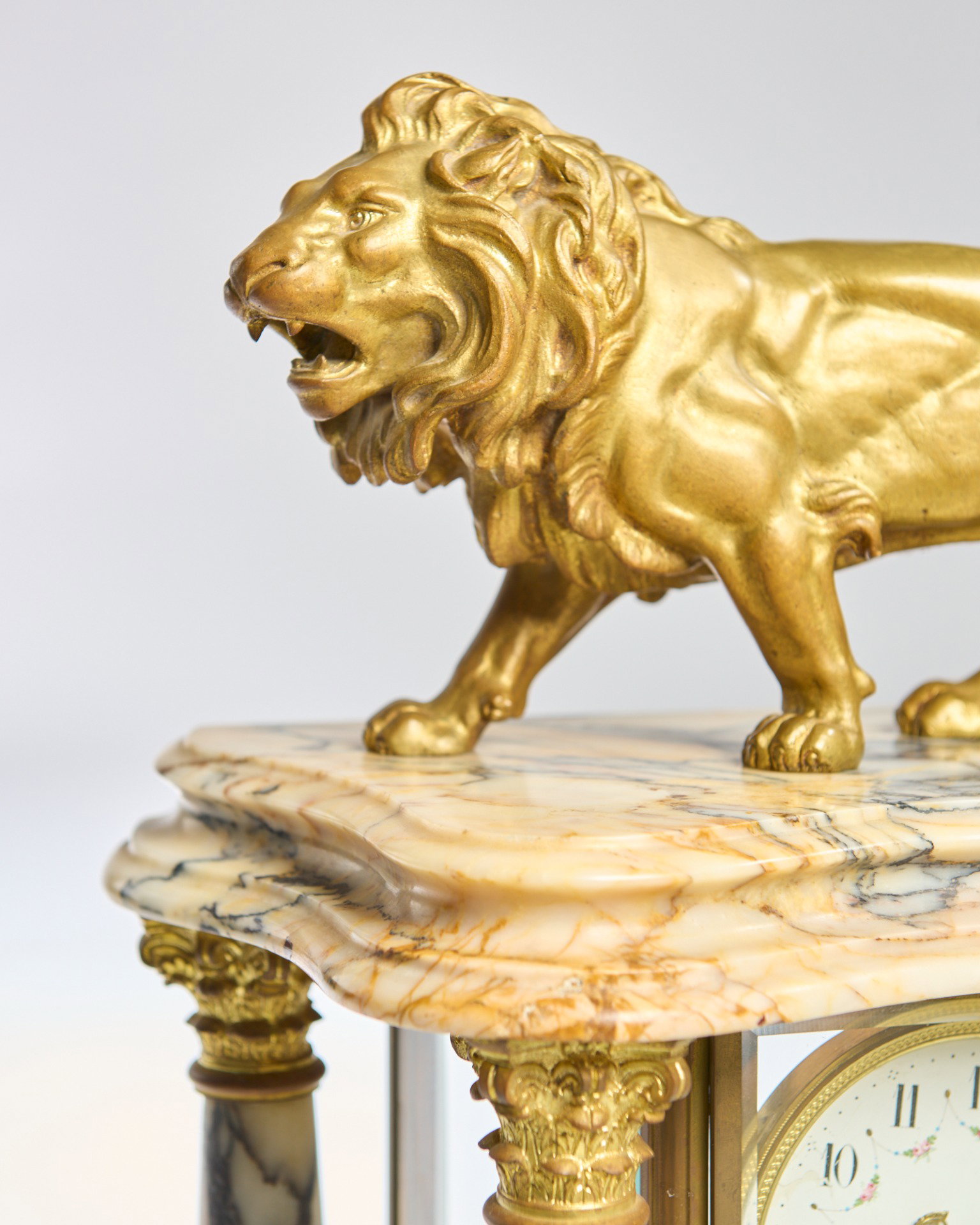
The clock is made of finely polished polychrome marble, with a shaped base and two side columns framing the dial case. The metal parts are in gilt bronze, cast and chased, testifying to the great execution quality. Particularly striking is the top sculpture, depicting a roaring lion, a symbol of strength and vigilance, which lends a heraldic and solemn imprint to the entire composition.
Gilt bronze lion
Gilt bronze sculpture depicting a roaring lion, a symbol of strength, authority, and protection. A decorative element of great impact, it adds majesty to the entire composition.
Samuel Marti: mechanical genius and signature of 19th-century Parisian watchmaking
Origins and historical context
Samuel Marti was a Swiss watchmaker naturalized French, active from 1832. His company was founded in Montbéliard, in the Alsace-Franche-Comté region, an area traditionally linked to precision mechanics. The business was later moved to Paris, which at the time was one of Europe's main centers for the production of mantel clocks, pendules, and salon regulators.
Marti operated in an era of great artistic and technological ferment: the second half of the 19th century saw the emergence of universal exhibitions, the spread of cabinetmaking and bronze-making art, and the rise of the bourgeoisie, which popularized decorative objects with symbolic and representative functions, such as salon clocks.
Awards and recognitions
Samuel Marti quickly distinguished himself for the mechanical quality and precision of his movements. In 1860, he won the Bronze Medal at the Exposition Universelle in Paris, one of the highest honors for a clockmaker of the time. This award was engraved on his movements with the inscription:
"Médaille de Bronze – S. Marti – Paris 1860"
Some later movements also bear "Médaille d'Argent" or "Médaille d'Or," as the company continued to receive awards at subsequent exhibitions, consolidating its reputation.
Collaborations and production
Samuel Marti did not only produce complete clocks but was primarily a supplier of movements to other craftsmen:
Bronze workers and cabinetmakers purchased his movements to incorporate them into cases made of marble, gilt bronze, carved wood, or alabaster.
He worked closely with Japy Frères and Vincenti, two other famous French houses, creating an integrated production network.
Some of his movements are found in clocks signed by Leroy, Denière, Raingo Frères, and other famous manufacturers and retailers of the era.
Typical characteristics of his clocks
Visible pendulum movements: Many Marti clocks featured an exposed pendulum with a glass structure on multiple sides, known as "four-glass" or "regulator de cheminée."
Imperial or allegorical decorations: Often surmounted by gilt bronze figures such as lions, winged Victories, bears, or trophies.
High precision: Generally 8-day movements, with striking at the hours and halves, often equipped with fine regulation.
Legacy and collectible value
Today, clocks signed by Samuel Marti are highly appreciated by collectors, especially if complete, functional, and with original decorative elements.
Samuel Marti was born on September 20, 1811, in Langenthal, Canton Bern, Switzerland. He was the son of Jean Marti and Barbe Neukom. In 1830, he moved to Montbéliard, France, and married Camille Adèle Masson in Montbéliard in 1851. They had four children: Camille Emilie in 1852, Louise Amélie in 1852, and the twins Samuel Augustus and Emilie Suzanne, Eugénie on December 4, 1857. Samuel Augustus Marti later became his father's successor in the business. His son André Samuel Jules Marti (1890-1958) married Jenny Alice Marthe Japy, a descendant of Auguste Julien Japy. In 1849, his company won a bronze medal at an exhibition in Paris, and in 1900, it won a gold medal in Paris.