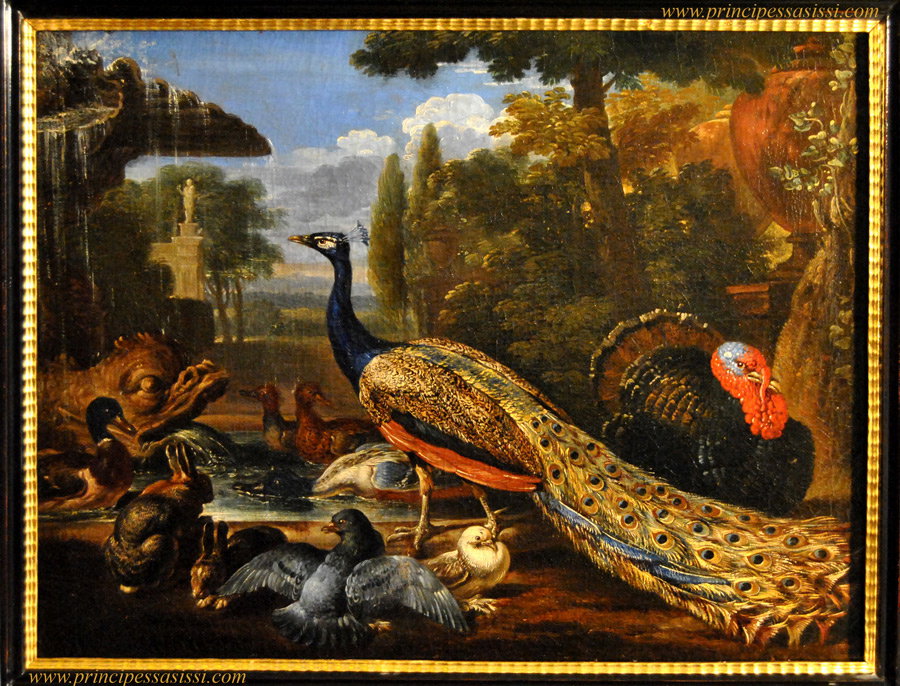
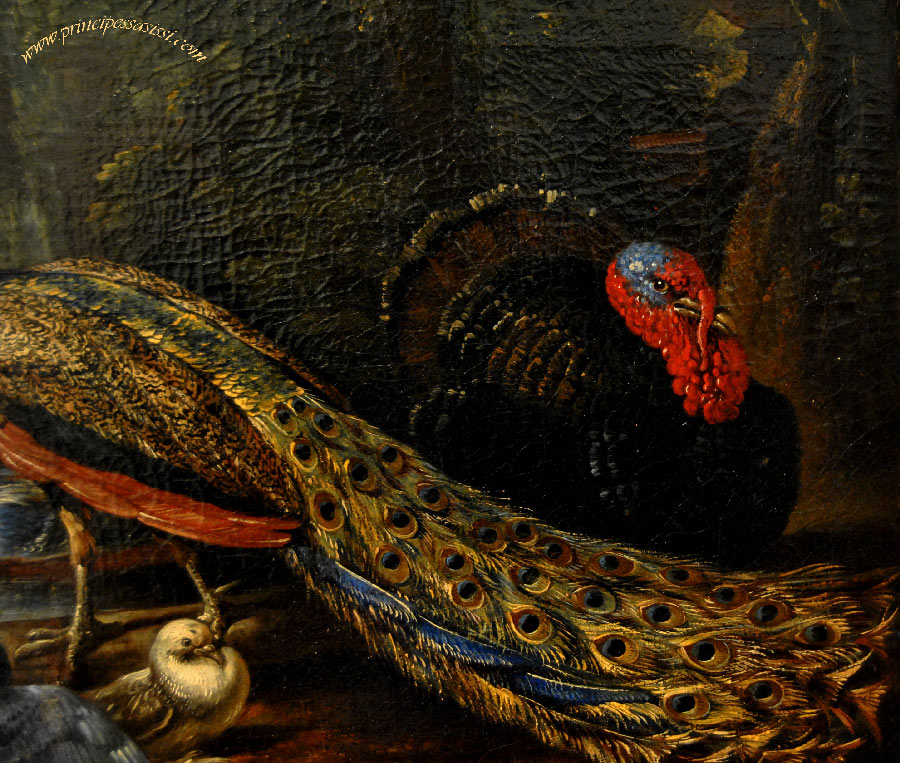
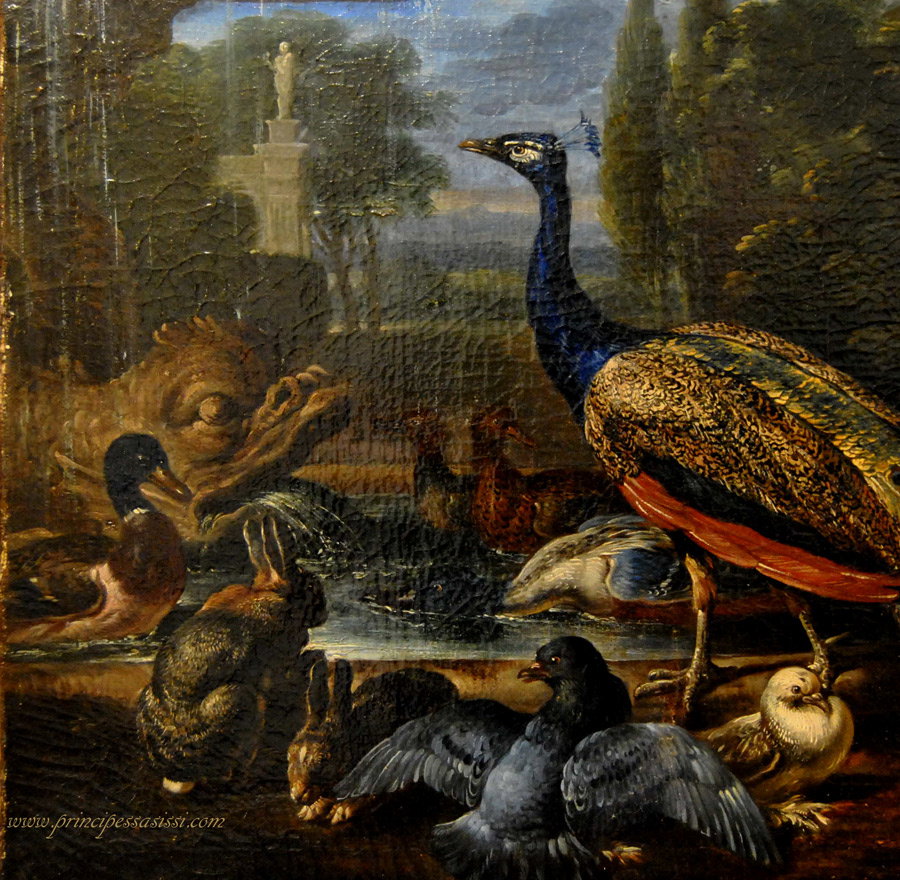
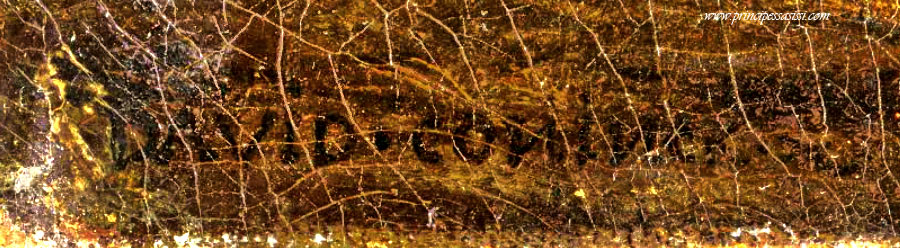
David de Coninck (Antwerp 1636 – Brussels 1699?), circa 1670-80, probably in Rome. Important oil on canvas, originally signed. Game in a wooded landscape within the park of a castle near a fountain. A peacock, a parrot, a turkey, doves, hares, geese, and a guinea pig. Provenance: prestigious European private collection. In excellent condition with conservative and limited restoration done professionally. Lined in the 19th century. Canvas dimensions: 63.5 x 49 cm. With frame: 66 x 52 cm.
The painting is characteristic of the Flemish artist who influenced an entire generation of French, Italian, and Dutch still life painters. The painting depicts a park with various exotic and non-exotic animals – a peacock, a turkey, hares, a guinea pig, and geese. A painting with a similar composition was auctioned on July 7, 2005, at Sotheby’s London (lot number 128); another similar work on January 29, 2015, at Sotheby's New York.
David de Coninck was a pupil of Pieter Boel and probably also of Jan Fyt. In 1663 he was admitted to the Guild of Saint Luke in Antwerp as a master. In 1670, stopping in Bavaria, Vienna, and Venice, he reached Rome, where he settled. In Rome, in 1686, he became a member of the Academy, shortly before returning to Antwerp in 1687. In 1699 he moved to Brussels and in 1701 he was admitted to the local guild as a master and then to Paris. His still lifes with fruits and game, his hunting scenes, and animal paintings usually have warm and full tones and follow the compositions of Jan Fyt, a great Flemish painter. It is not known when and how he died. He rarely signed his works, which are generally of high quality and similar in style to the works of Boel, Fyt, and even Frans Snijders, with whom he is often confused. This work, signed in original, is, for this reason, particularly precious and rare. De Coninck's work influenced other artists in Italy such as Baldassare De Caro, Giovanni Crivelli (called 'il Crivellino'), Nicola Malinconico, Franz Werner von Tamm, and Jacob Xavier Vermoelen. Similar works by this author are kept at the Museum of the Royal Palace of Genoa, at the Musée Fesch in Ajaccio, at the Musée des Beaux-Arts de Nantes, at the Museum of Fine Arts of Ghent, Belgium, at the Victoria Art Gallery in Bath, UK, at the National Gallery of London, at the Rijksmuseum of Amsterdam, at the Museum of Fine Arts of Ghent (Belgium), and others.
Literature: L. Laureati, David de Coninck in "La natura morta in Italia", pp. 802 - 807. Puyvelde van Leo, La peinture flamande a Rome.
In compliance with the provisions of the New Code of Cultural Heritage, the selling company provides, at the time of sale, a detailed written photographic guarantee of originality and provenance of the works sold. The data with which the works are described and then contained in the written guarantees are express determinations resulting from accurate and documented technical/historical/artistic investigations, even of expert importance.