Vittorio Amedeo Cignaroli (Turin 1730-1800)
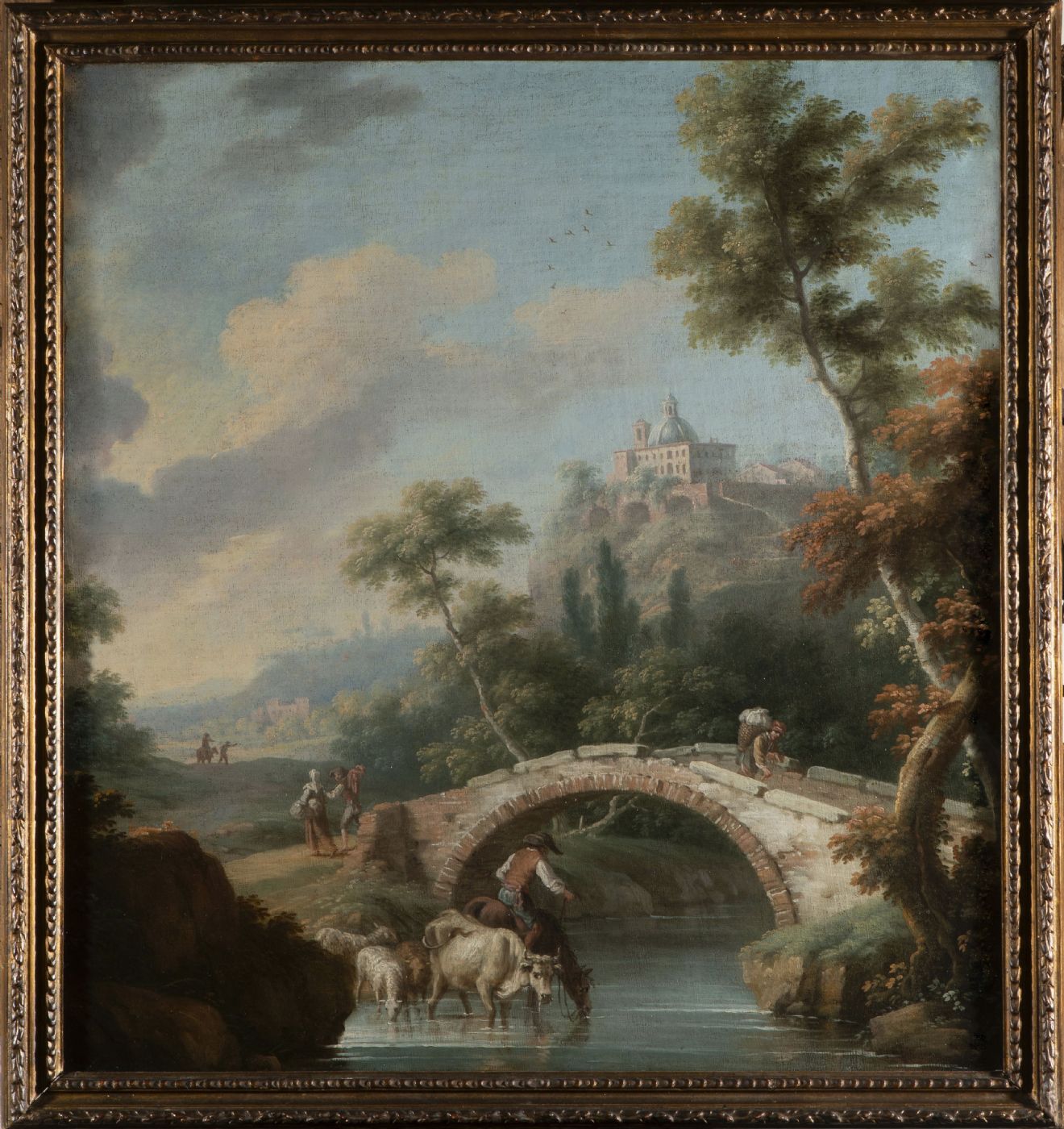
Animated landscape with a view of the Monte dei Cappuccini with the old lead dome
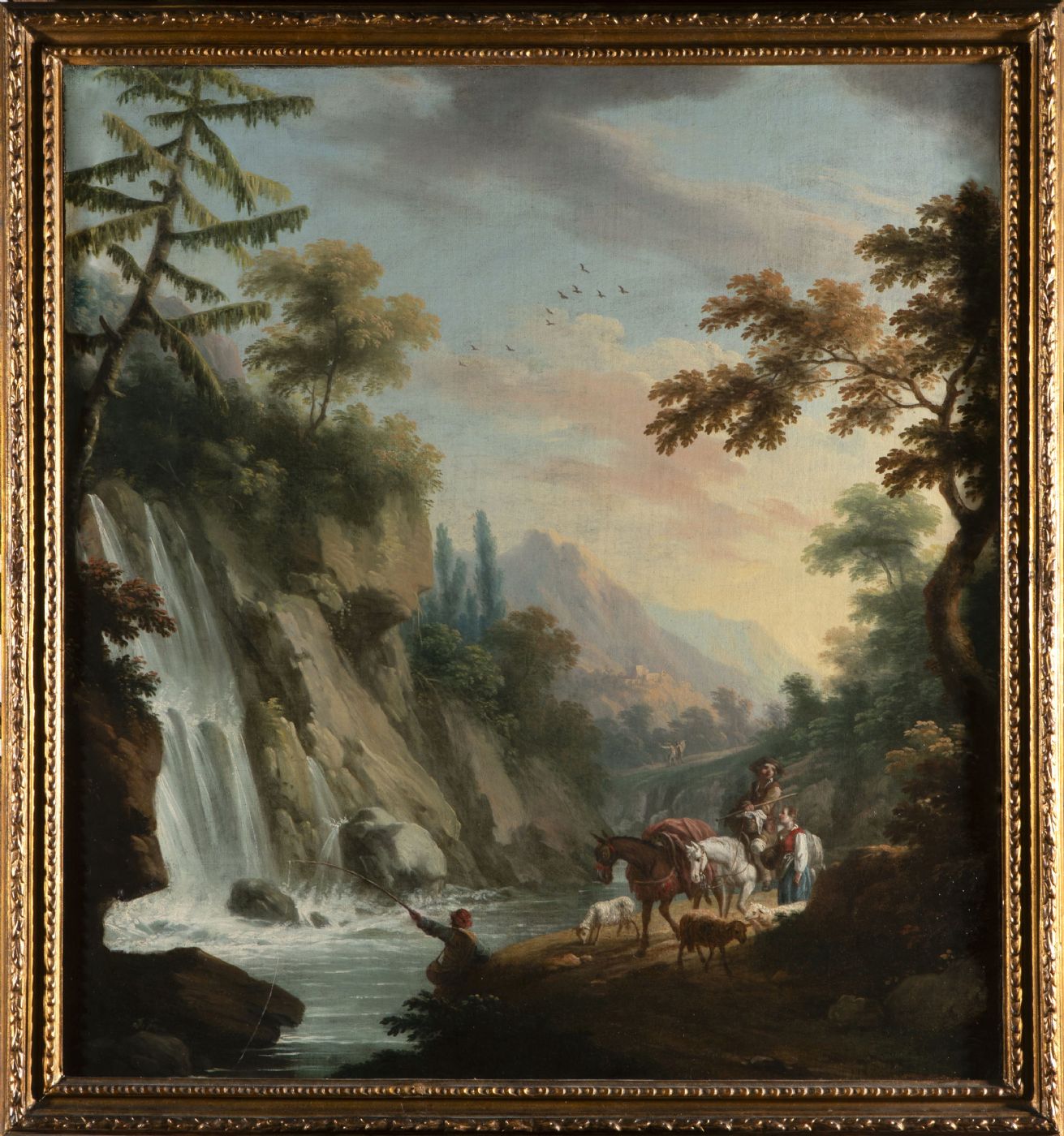
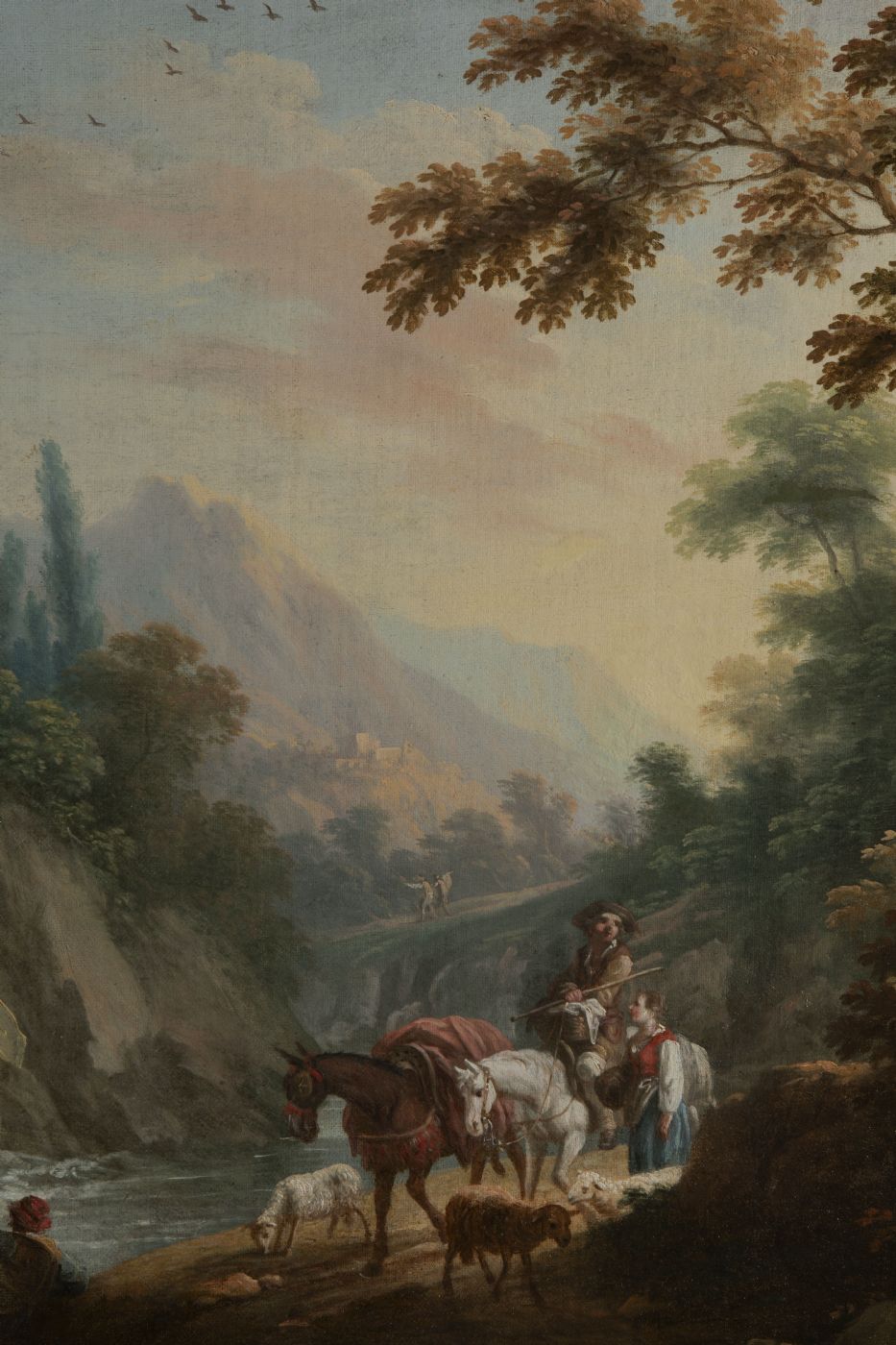
Animated landscape with waterfall
18th century
Oil on canvas, 98 x 92 cm
CIGNAROLI, Vittorio Amedeo Gaetano. - Son of the painter Scipione and Marianna Caretti, he was born in Turin around 1730. The date of birth is established on the basis of the death certificate, which says he was "70 years old". A. Baudi di Vesme (Schede Vesme) clarified the confusion that arose around his name, whereby his person had previously been split into Vittorio Amedeo and Gaetano. According to family tradition, C. trained with his father, from whom he absorbed Venetian culture, but with a different orientation. A more affected taste and Arcadian nostalgia distinguish C. from his father, of whom he was a collaborator; his somewhat cloying manners, but supported by a secure skill of the trade, met with extraordinary success in the Savoy court and the Piedmontese aristocracy. It is precisely with Vittorio Amedeo that the Cignaroli workshop expanded greatly, welcoming many assistants and thus making a distinction between autographed and workshop production still difficult today. C.'s work is documented from 1749 to 1794. An exhaustive list is reported in Schede Vesme, which is referred to for data relating to the activity carried out in the castles of Venaria, Moncalieri and Rivoli, of which all trace has been lost (many paintings passed on the antique market) following the devastation and spoliation of those royal residences. From 1749 to 1758 he is mentioned for works in the Royal Palace (a fire screen) and above all for a first group of paintings for the castle of Venaria. In 1762 he was appointed prior of the Compagnia di S. Luca in Turin. The following year he obtained the first commission for the Stupinigi hunting lodge, which was to become the site of one of his most important interventions: four overdoors with Hunting scenes and various figures, still in place in the living room of the eastern apartment. The decoration dates back to 1779, formerly in the Palazzo Peiretti di Condove in Turin (now in a private collection in Paris). In 1771 he began the series of Deer Hunts for Stupinigi, among his best-known works, intended for the squires' hall in the king's apartment and still in place: these are a total of nine canvases, executed between 1771-72 and 1778, with extensive collaboration of assistants. In them, the aims and limits of C.'s painting are clearly revealed, aimed at keeping alive an Arcadian world that has now been surpassed and which is resolved in the ways of a mannerist decoration. In 1778 C. became a professor at the renovated Royal Academy of Painting and Sculpture in Turin. In 1782 Vittorio Amedeo III appointed him "our painter in landscapes and groves". In the Royal Palace, where he is cited for payments in 1788-89, four overdoors with views of the Castle of Moncalieri, the Monte dei Cappuccini and two unidentifiable landscapes remain in the apartment of Madama Felicita (U. Chierici-R. Amerio Tardito, Pal. reale..., Madama Felicita's Apartment, Turin 1971, pp. 5, 9, 14). Important is the group of twenty-five paintings from the Turin Civic Museum of Ancient Art, some of which reveal the study of the Dutch and Flemish masters of the royal collections. Of these, two are cartoons for tapestries: Peasants and a juggler who makes a fake bear dance, around 1760, and Young people having breakfast on the grass with two peasant women from the Scenes campestri series, translated into tapestry by F. Demignot (for other tapestries from the Turin factory for which C. provided the cartoons and which are kept in the Turin Civic Museum and at the Quirinale in Rome, see M. Viale Ferrero, in Mostra del Barocco piemontese, II, Arazzi). The others are landscapes and sacred scenes, also, like the two previous ones, in oil on canvas, except for five landscapes in gouache on paper which stand out for cold tones, quite unusual in Cignaroli's painting. Two other tapestries based on his designs (Landscape with two figures, Landscape with jugglers and beggar) are in Palazzo Carignano. In the Galleria Sabauda there is a probable self-portrait with a globe, datable to the 1960s (N. Gabrielli, La Gall. Sabauda, Maestri italiani, Turin 1971, fig. 487). In the Chiablese Palace in Turin, in the mirror room, there remain four overdoors with Stories from the Old Testament which are considered (Griscri, in Mostra del Barocco piem., II, Pittura, p. 110) from the late period. Other works by C. are: four River landscapes in the castle of Agliè (not to be confused with those of Scipione), six Landscapes with hunting scenes in the villa of Carpeneto in La Loggia near Turin and numerous landscapes in private European collections. Two Hunting Scenes are kept in the Museum of Fine Arts in Budapest (Bull. du Musée hongrois des Beaux-Arts, 1972, n. 39, p. 100, ill. 80 s.). He married Rosalia Ladatte in 1766, daughter of the sculptor Francesco, a painter, who also became his collaborator and died in 1792 (I. Nepote, in Schede Vesme, p. 317). Of their sons, Angelo was a painter. C. died in Turin on February 17, 1800. Bibl.: G. Chevalley, The architects, the arch. and the decoraz. of the Piedmontese villas of the 18th century, Turin 1912, pp. 64, 69, 117, 142, 151; G. Delogu, Minor Ligurian, Lombard, Piedmontese painters of the 17th and 18th centuries, Venice 1931, pp. 238241; V. Moschini, Italian painting of the 18th century, Florence 1931, p. 35; L. Rosso, The painting and sculpture of the 18th century in Turin, Turin 1934, pp. 43, 51; R. Buscaroli, Landscape painting in Italy, Bologna 1935, pp. 385 f.; G. Lorenzetti, Italian painting of the eighteenth century, Novara 1942, p. XLI; A M. Brizio, Ilcastello del Valentino. The paintings, Turin 1949, p. 230; V. Golzio, Seventeenth and Eighteenth Centuries, Turin 1950, p. 792; M. Bernardi, The Stupinigi hunting lodge, Turin 1958, plates XI, XII, XIII, XIV; L. Mallé, The figurative arts in Piedmont, Turin 1961, pp. 393, 396 f., 405, 428; Schede Vesme, I, Turin 1963, pp. 317-19 (with bibl.); Exhibition of the Piedmontese Baroque (catalog.), Turin 1963, I, The Exhibition, plate 17; II, Painting, pp. 15 f., 110-113, plates 170-183; Tapestries, pp. 18 f., plates 25-27; III, Furniture and carvings, plate 260; L. Mallé, The paintings of the Museum of Ancient Art, Turin 1963, pp. 40-46; A. Pedrini, Villas of the 17th and 18th centuries in Piedmont, Turin 1965, p. 202; Furniture Museum, Stupinigi, Turin 1966, pp. 82, 88, 138, 139; A. Verdoia Oberto, V.A.C., Savona 1967 (with bibl.); L. Mallé, Stupinigi, Turin 1968, pp. 196-200, 236, 237, 446-449 (with bibl.); Gall. G Caretto, Exhibition "Painting in Piedmont in the 18th century."(catalog.), Turin 1977, nn. 4-17 (continues in the error of splitting the personality of C.); Museums of Piedmont. Restored works of art... (catalog.), edited by G. Romano, Turin 1978, p. 165; Figurative and architectural culture in the States of the King of Sardinia - 1773-1861 (catalog.), edited by E. Castelnuovo-M. Rosci, Turin 1980, pp. 1420 f., s.v.; U. Thieme-F. Becker, Künstlerlexikon, VI, pp.587, s. De TRECCANI.IT