Gilded Leather Hanging
"THE MYTH OF HERCULES"
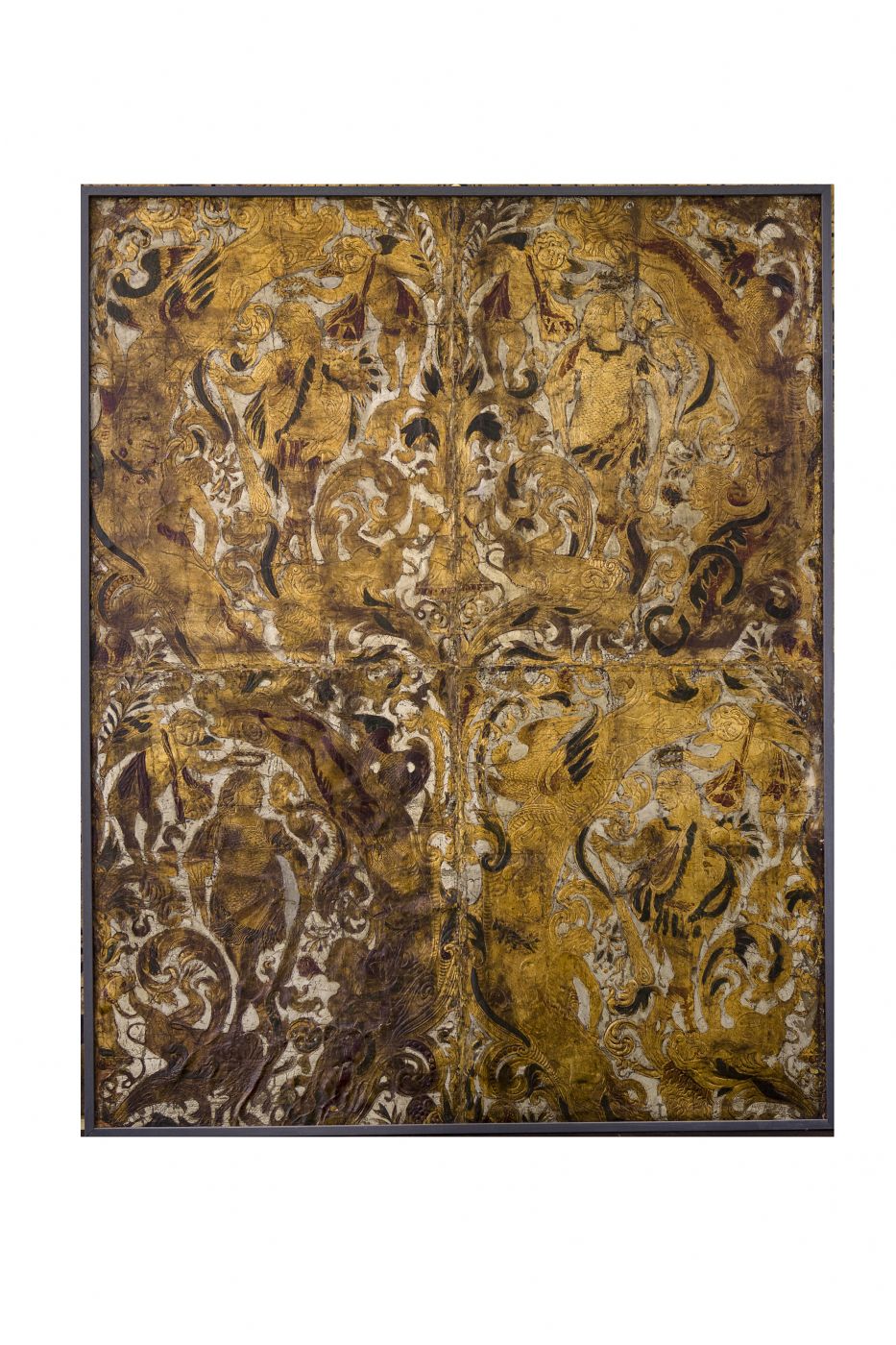
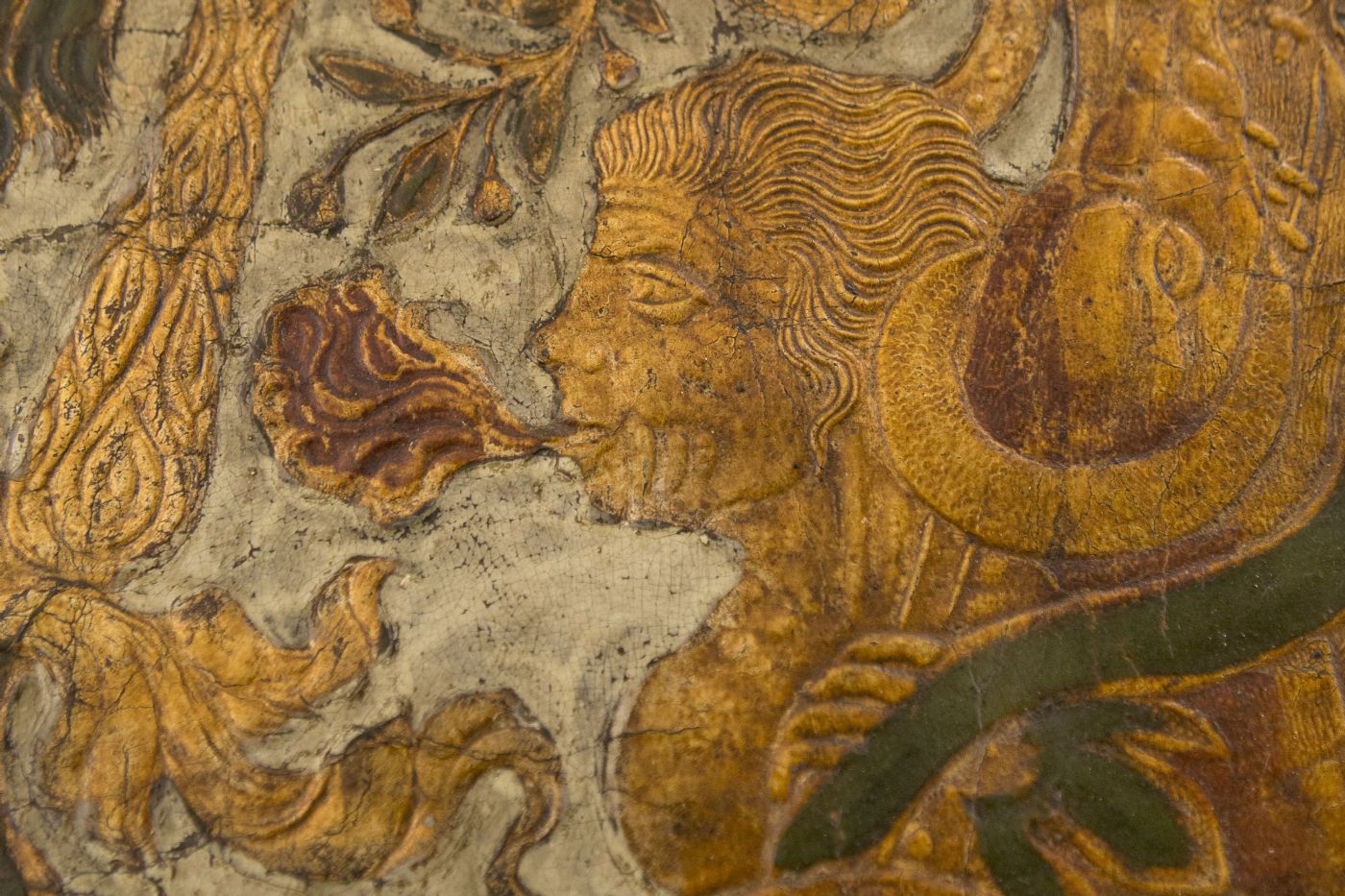
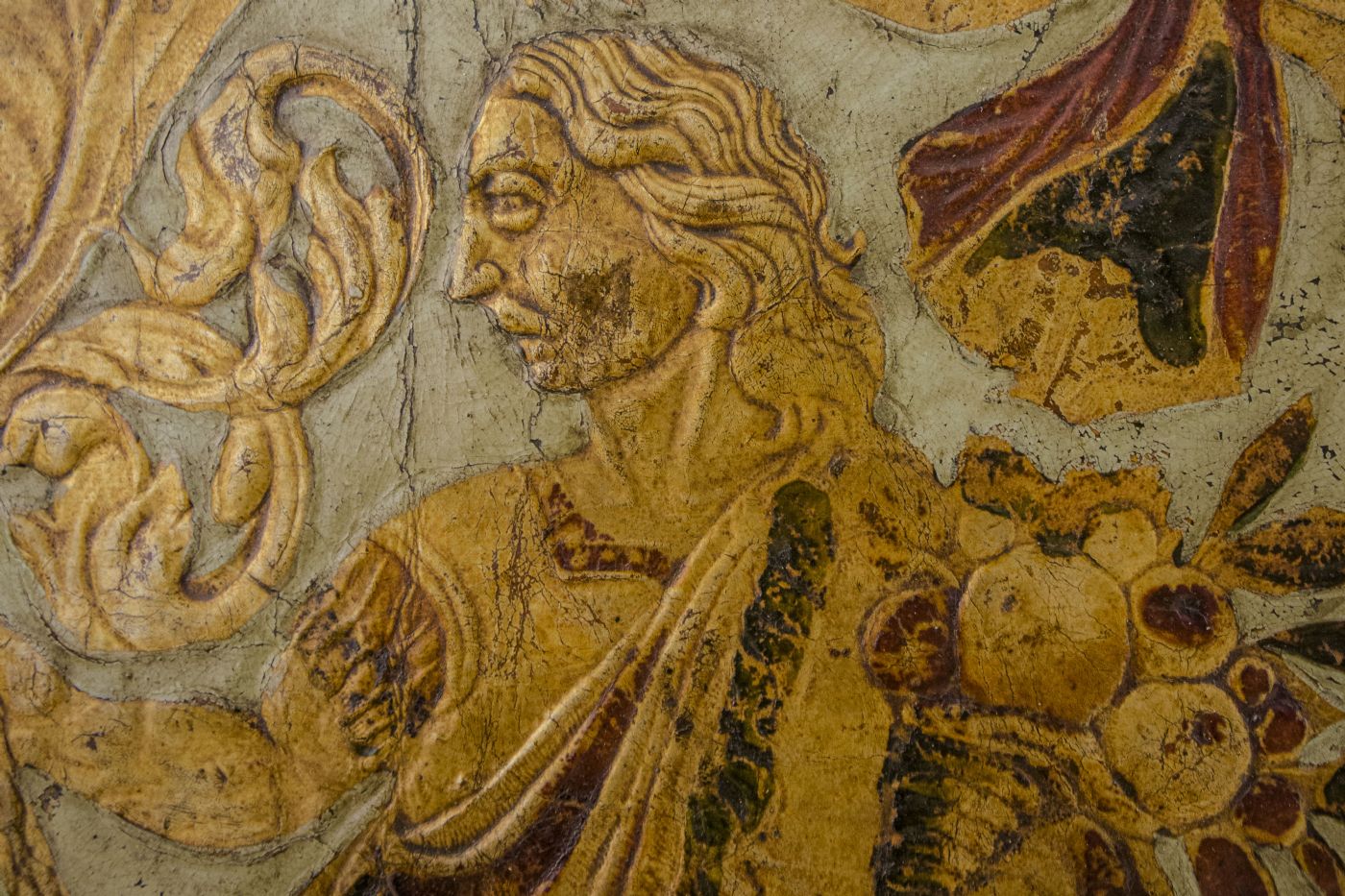
The study and exploration of classical themes continue and are revisited, interpreted with new formal features; in this case, the chosen theme is the famous myth of Hercules. The theme is the apotheosis of the character of the myth, who struggles continuously as a mortal man, although some deities often come to his aid. Hercules is the character who occupies the central space of the individual modules, which make up the apparatus in pairs symmetrical open book style. Next to him appears a cherub with a laurel branch and a crown that he is placing on the hero's head, clad in leather armor with the classic stripes, holding in his fist the club built with an "olive trunk"; like the primitive hunters, he has a mantle on his shoulders. In version A, he holds a cornucopia on his arm (according to the poet Ovid, it was one of the two taurine horns of the river god Acheloo, broken by Hercules and which the Naiads filled with fruit and flowers, a symbol of abundance). In version A, Heracles rests his feet on the Nemean lion. In version B, he wields the club with his left hand, wears scale leather armor in the Roman style and on his shoulder the goat skin, a tribute from the farmer Molorco, who had hosted him and given Hercules the goat, which is then offered to the gods. In this version, Hercules rests his feet on the Hydra. In both modules, there is a very elaborate lateral band, a naturalistic element, representing a large trunk, from which several branches detach on both sides, ending in swirling volutes that fill the spaces around the figure and also outside. The alternation of the modules creates an elegant sinuous band, which will host the figures mentioned in the series of the so-called labors. The band is a motif that is then doubled creating a beautiful decorative element. In module A, in the band, appear the centaur, the head of the Cretan bull, a bird of prey and a lion's body (?). In the band of module B, animals and figures with delicate reliefs and punch marks are inserted: the deer, birds of prey, the head of the wild boar, the face of Nereus and the coils of the Triton. In the center, the dog Cerberus, held by a chain among the foliage, constitutes the point of tangency of the two modules. The numerous tendrils, sinuous, curving and dividing, are a clear example of the creative moment of the mid-17th century, where every space is exploited in a rich, elegant and redundant way. To underline the passion of the hunt, an element of leisure, of skill, with its relationship with nature, with the beautiful horses adorned with costumes and all the accessories. The Hunters then appeared in the sumptuous banquets visible in contemporary paintings.The background of the compositions painted in oil in these examples is of two shades: light yellow ocher; generally the color of the backgrounds was chosen by the client in relation to the environment where the leather hangings were hung
PERIOD: 17th century. 1660
DIMENSIONS: 149x118cm
MANUFACTURE: Holland
AUTHOR: Hans Le Maire
PROVENANCE: Private Collection
RELATED MANUFACTURES
Musée National de la Renaissance in Ecouen (F), Rosenborg Castle in Copenhagen (DK)