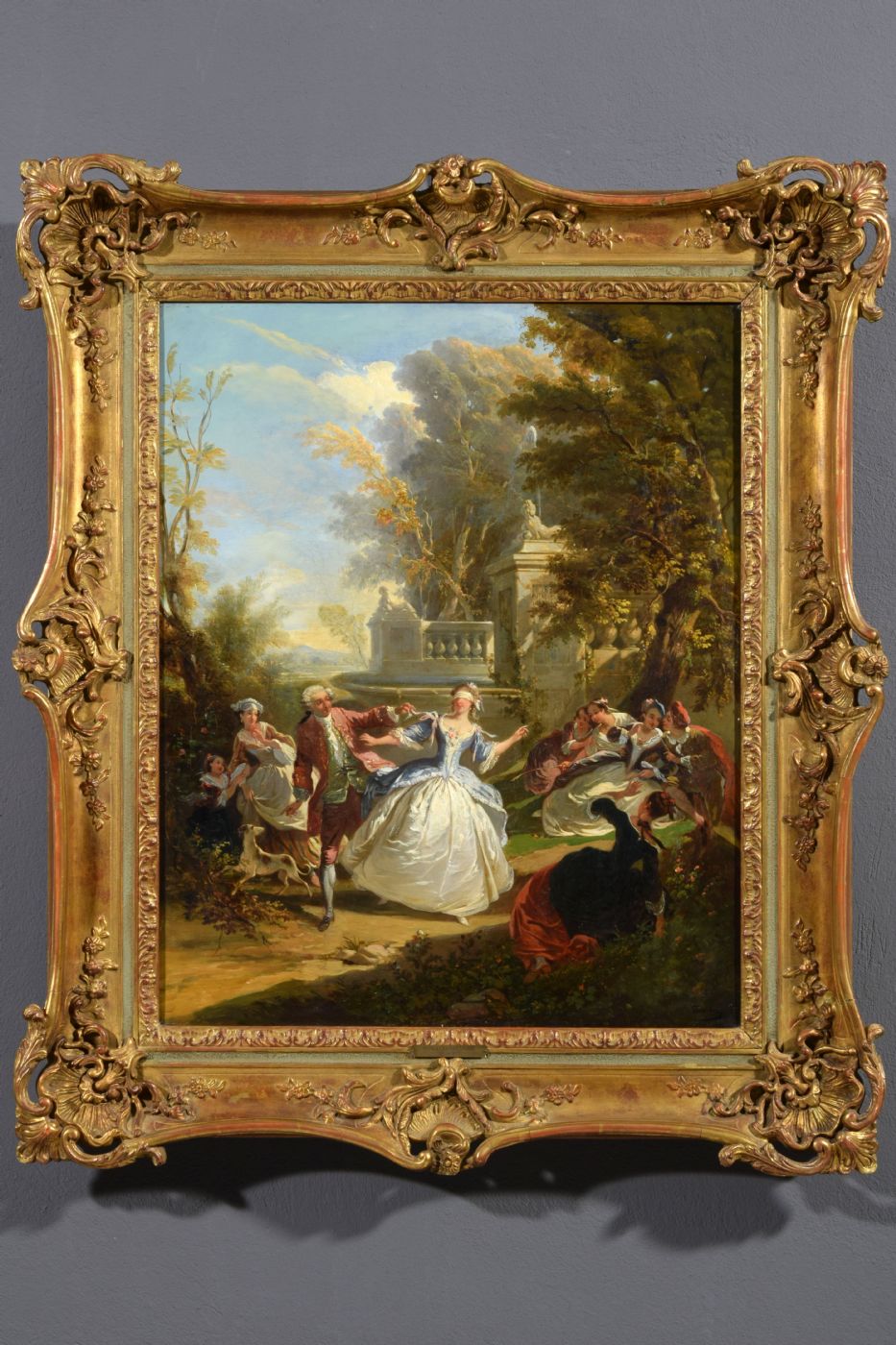
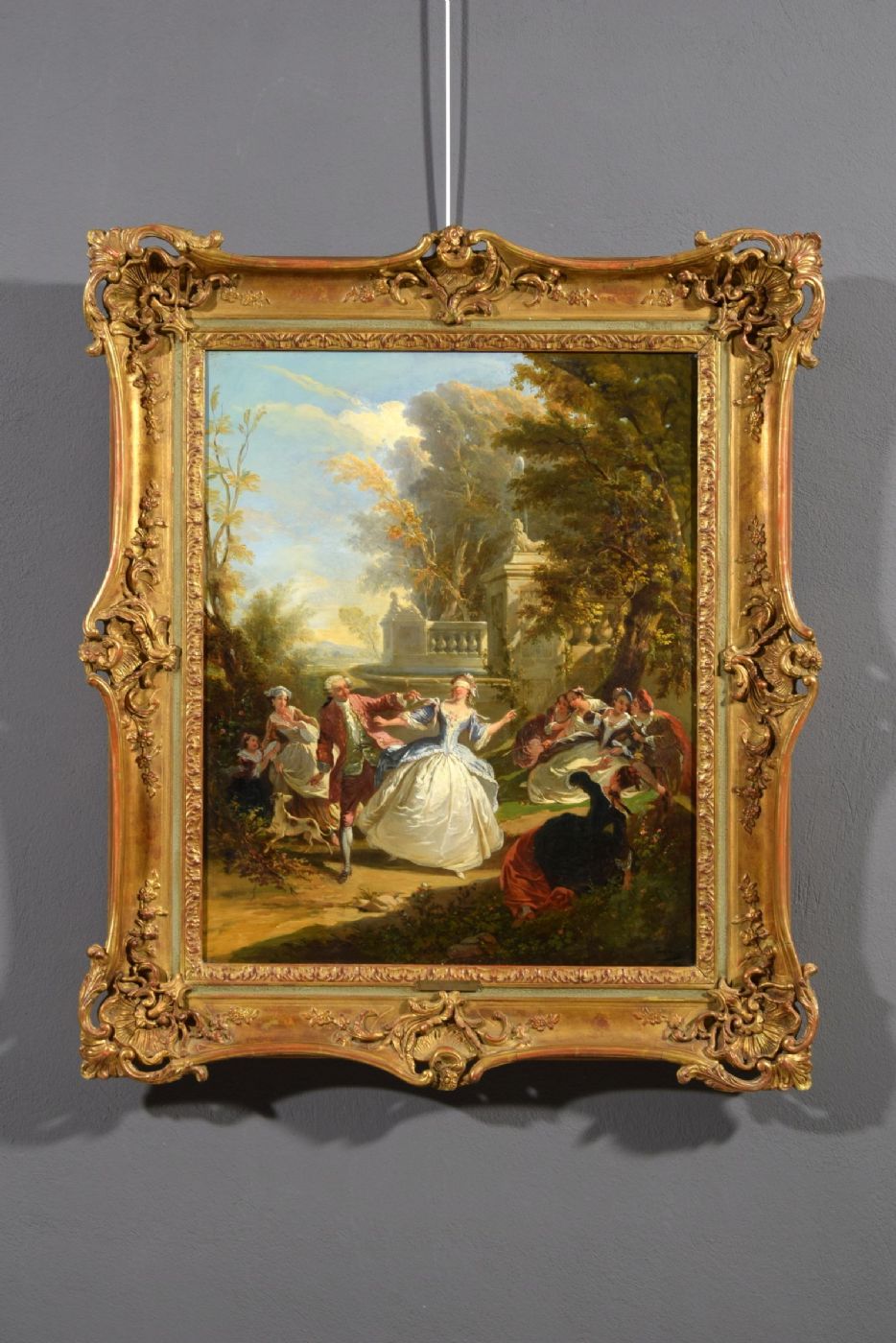
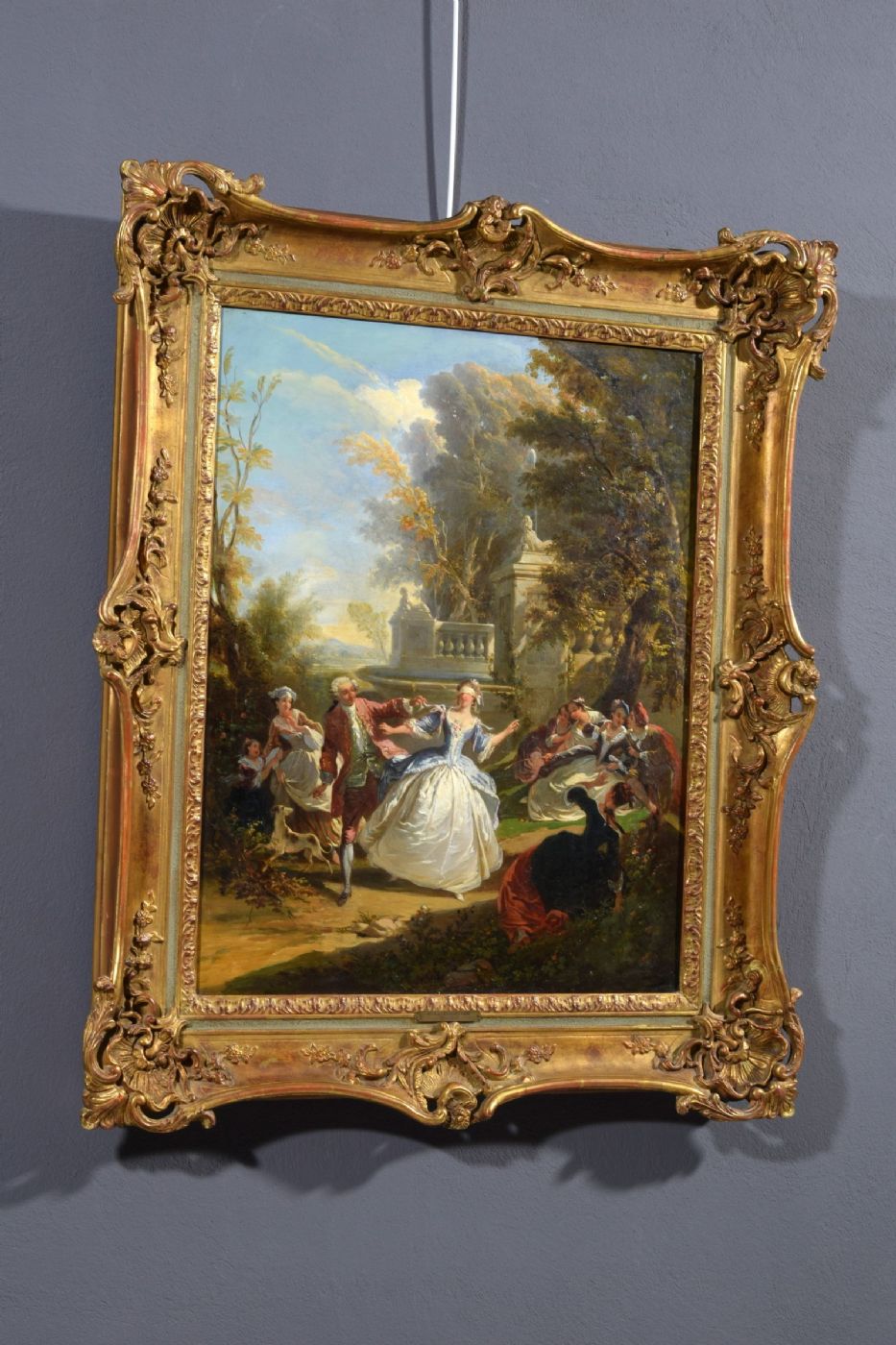
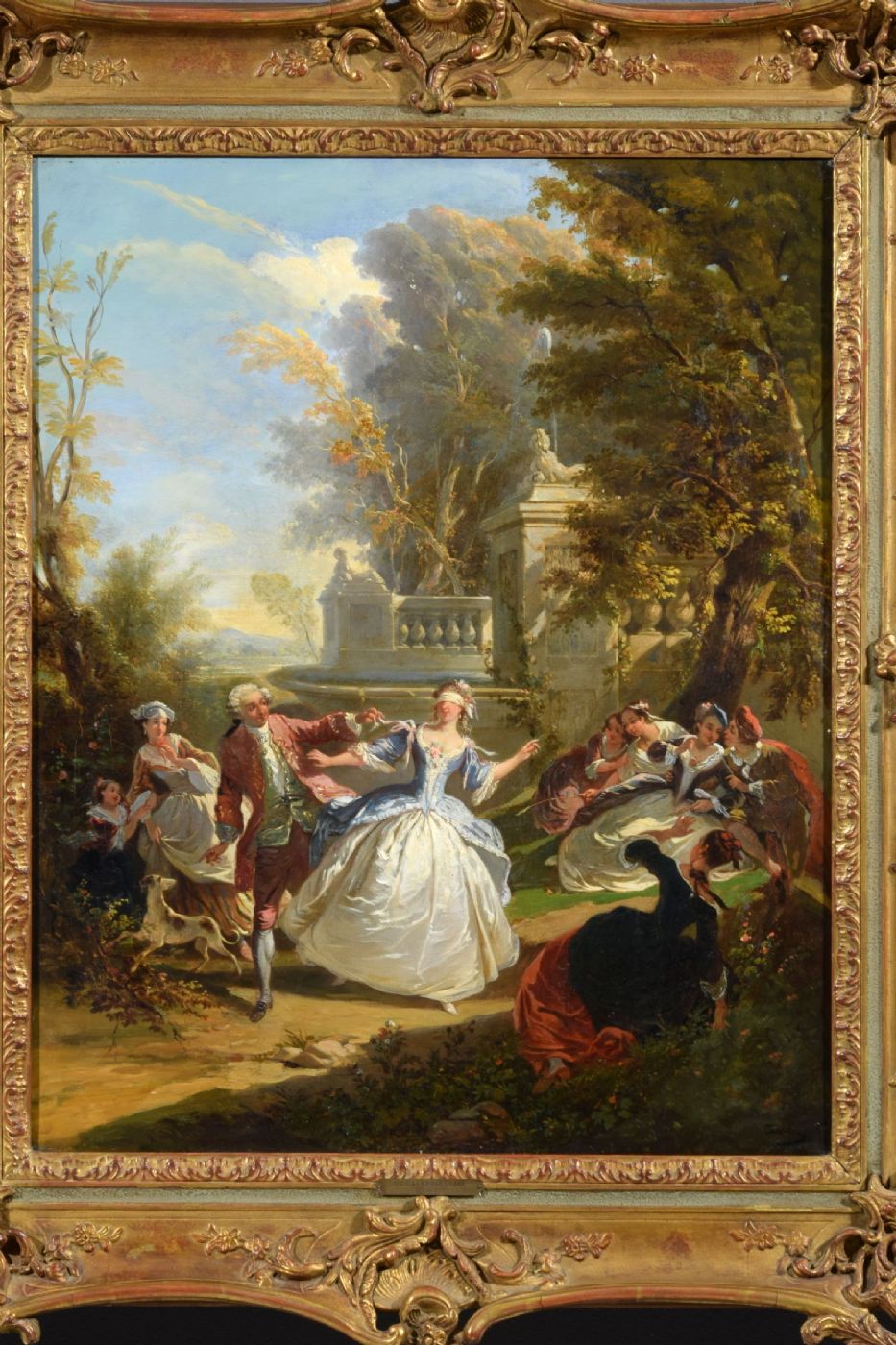
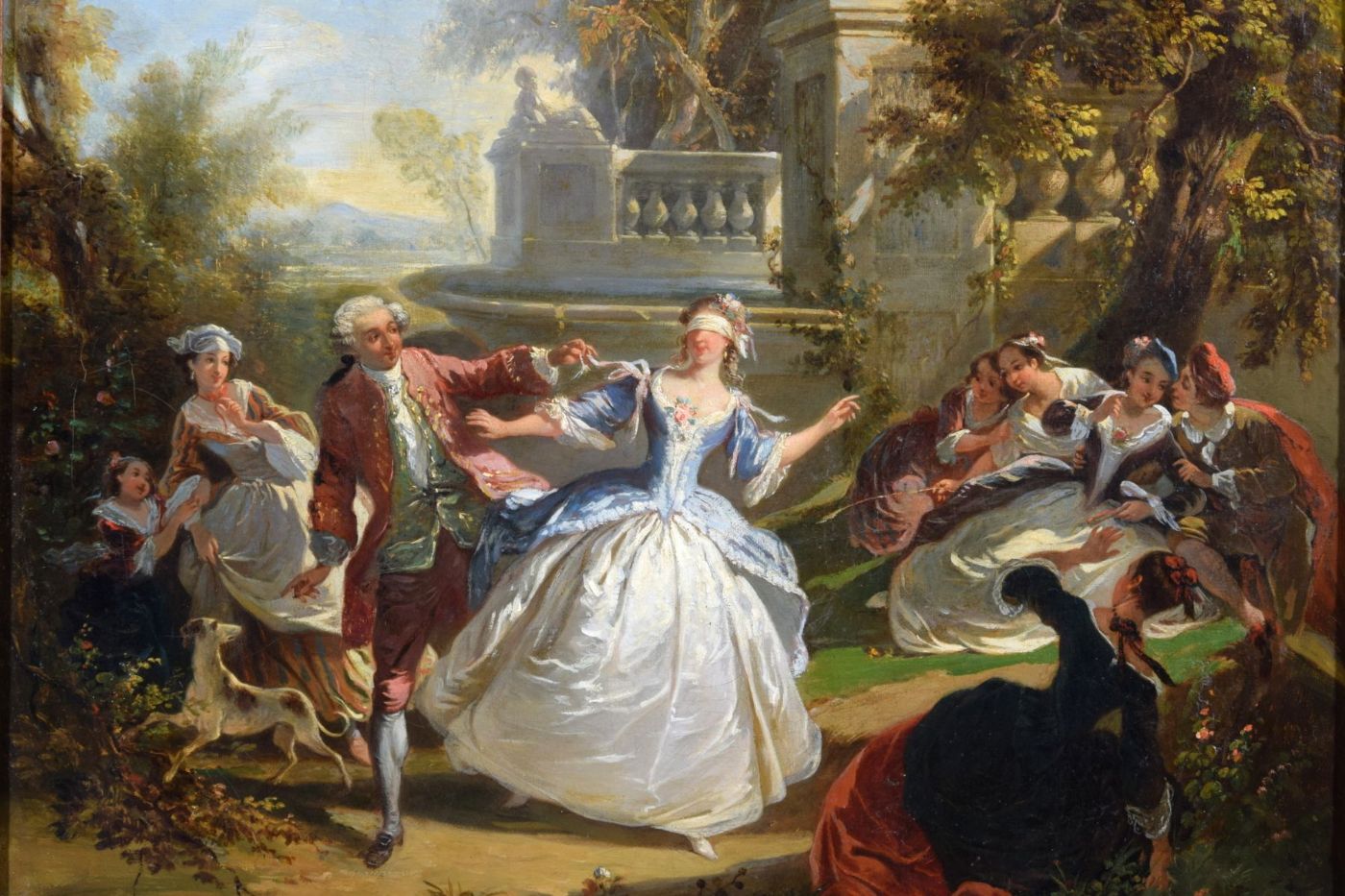
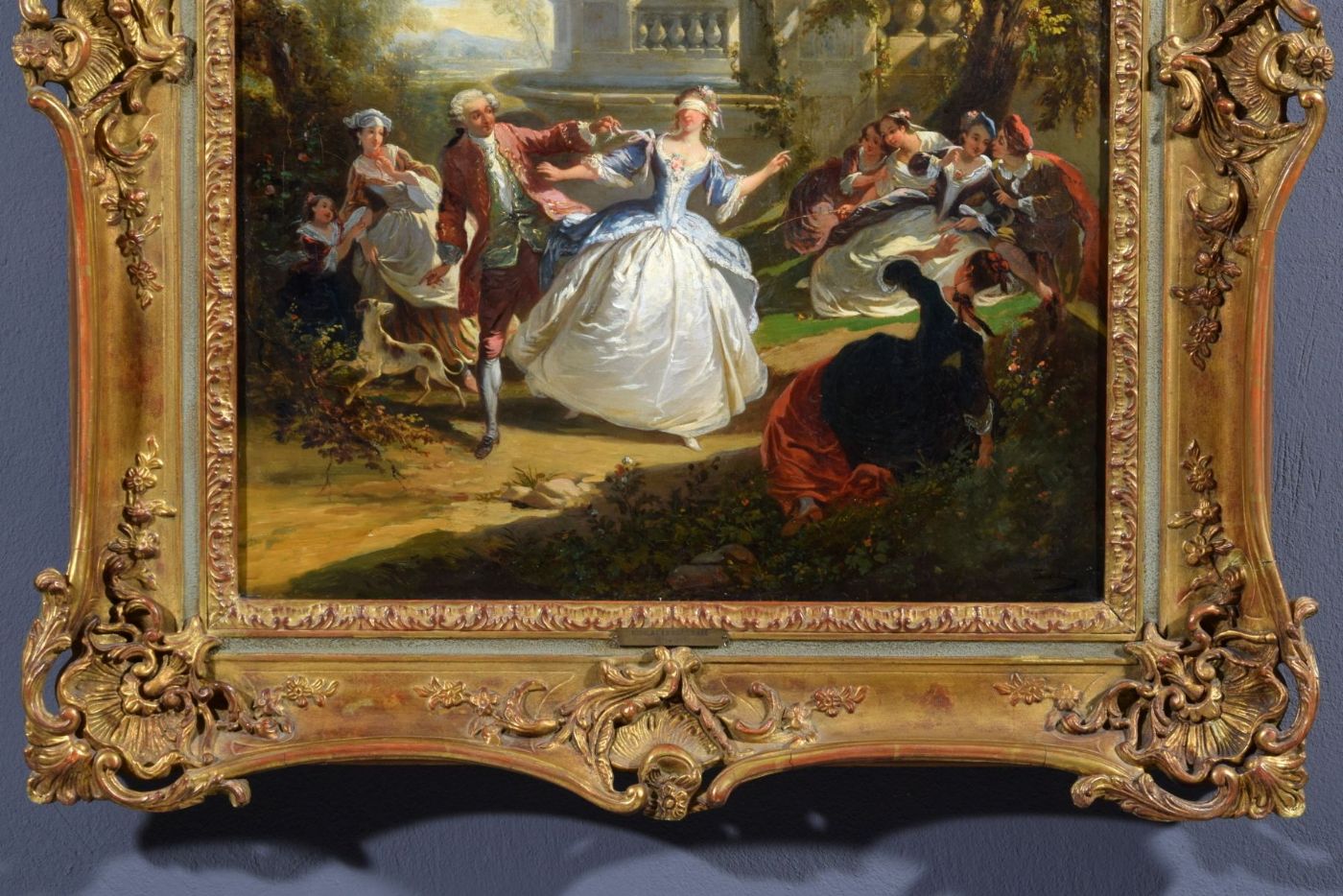
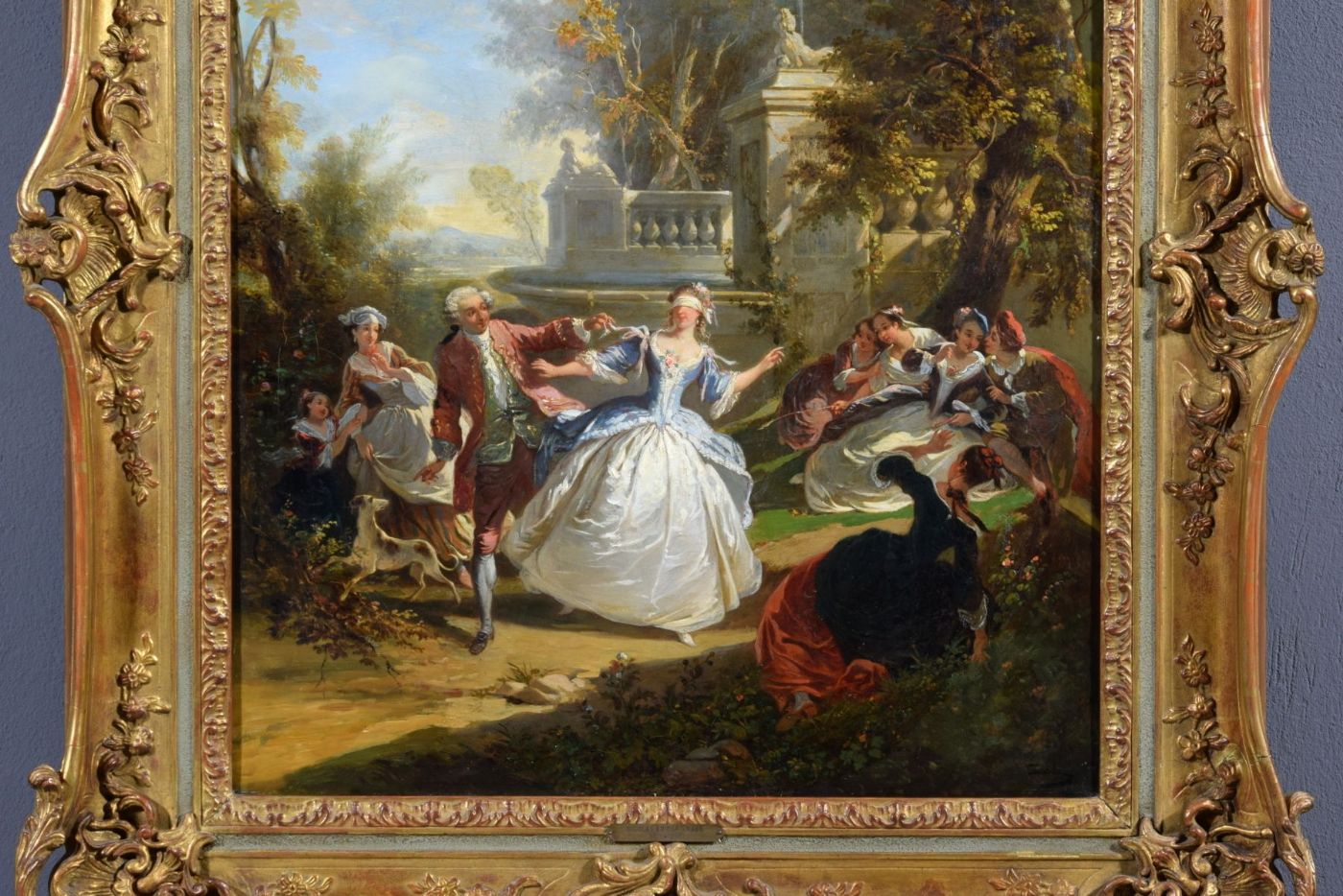
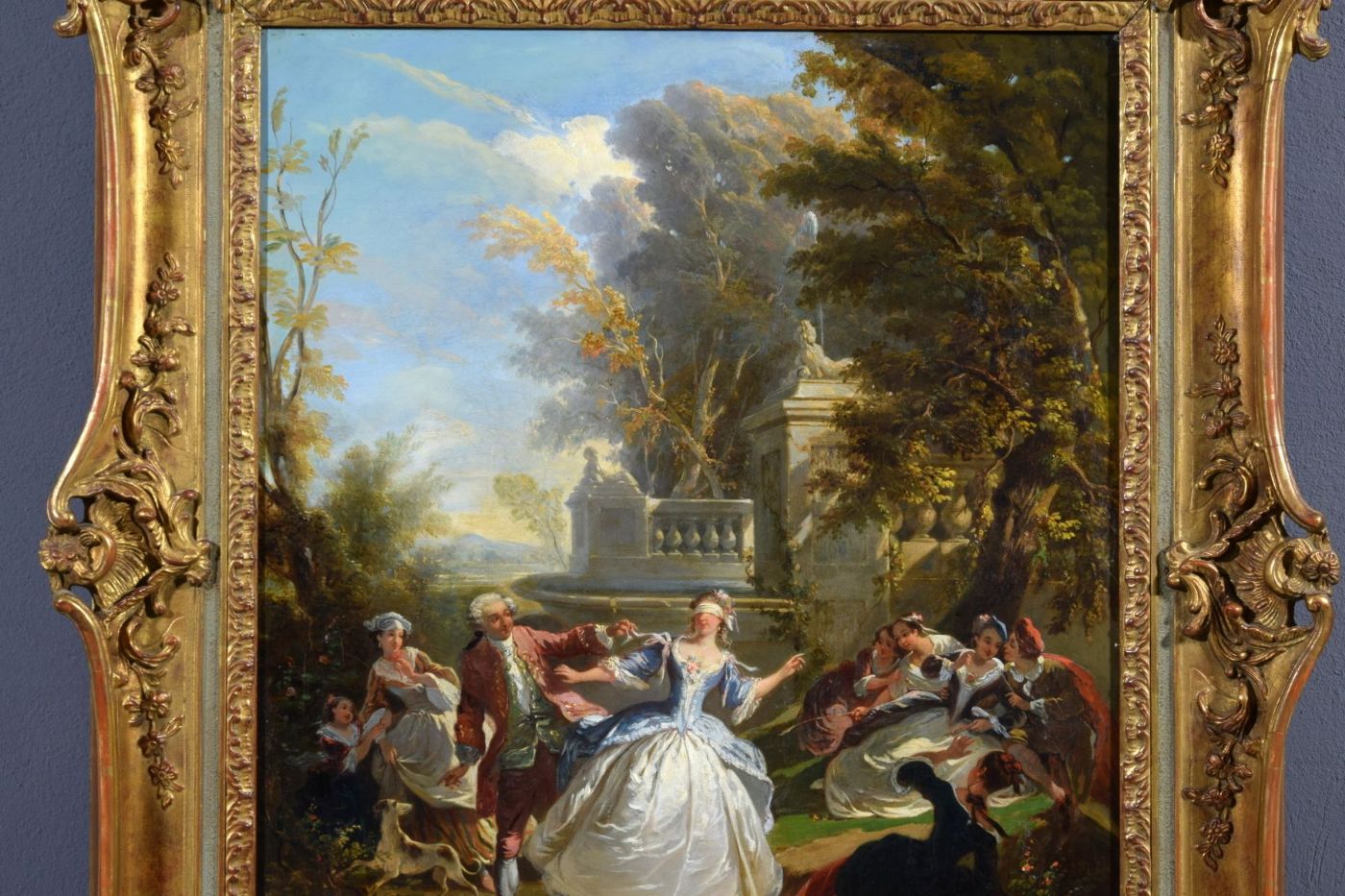
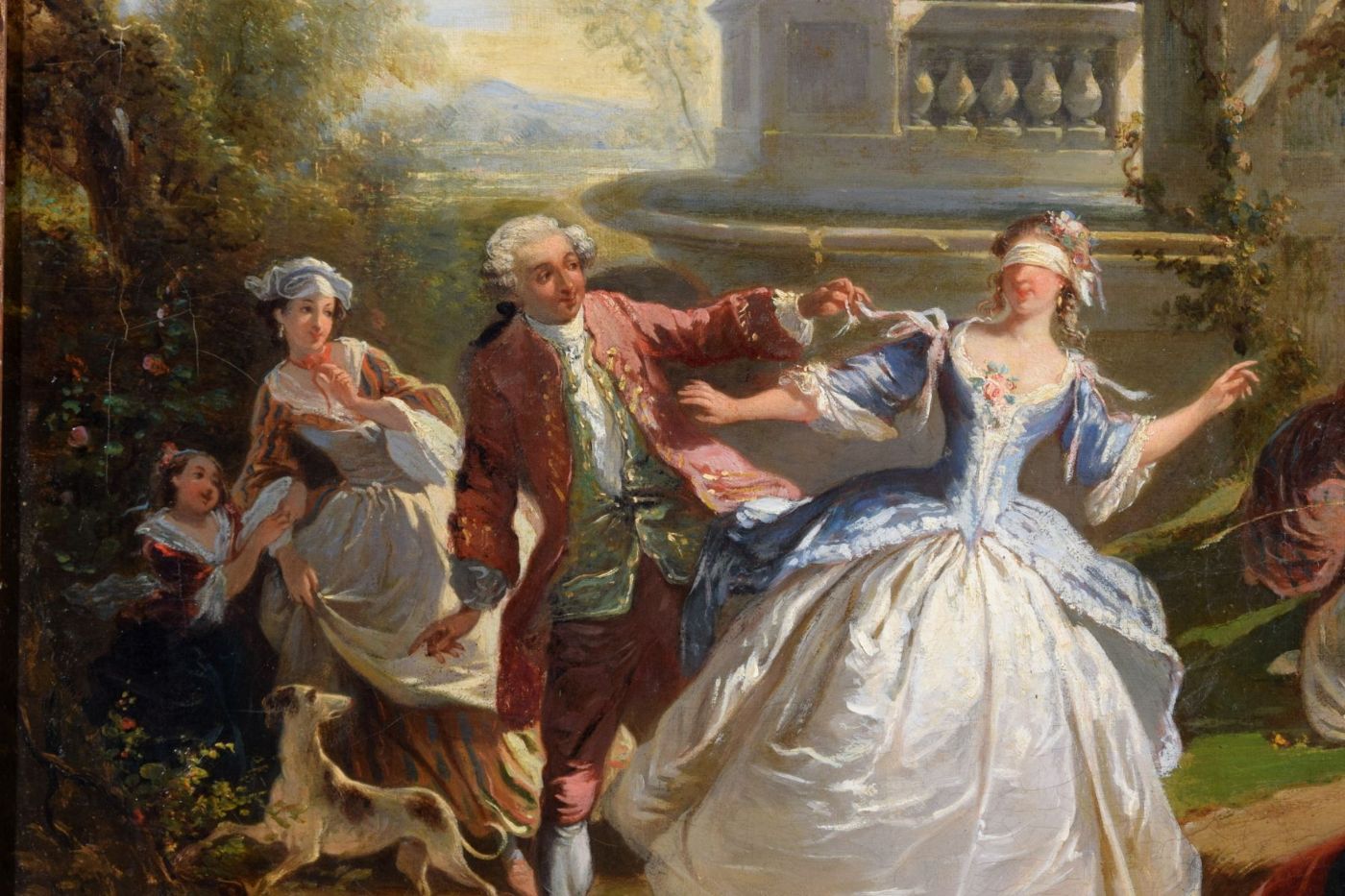
Nicolas Edward Gabe (Paris, 1814-1865), Blind Man's Bluff
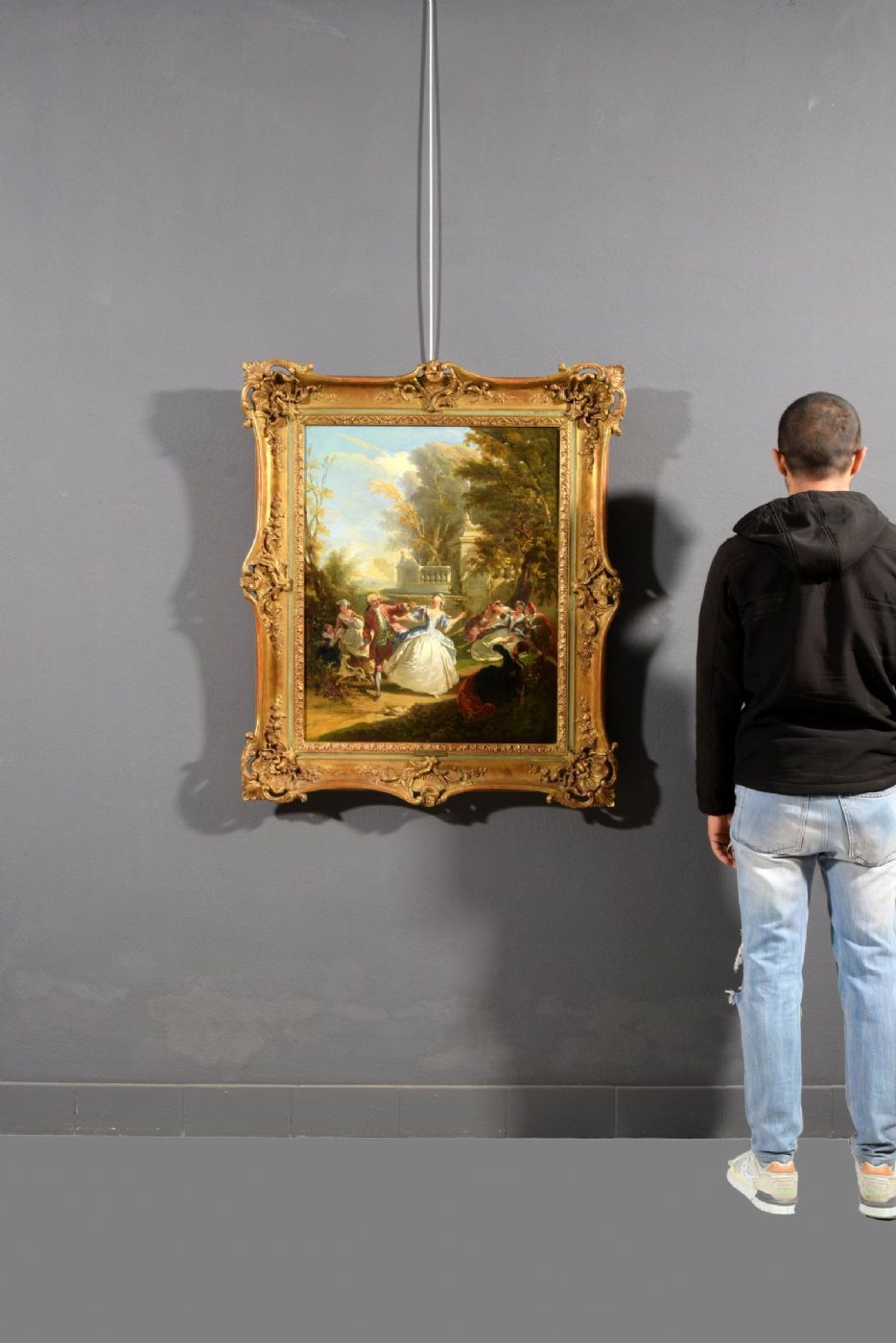
Oil on canvas, cm h 72 x w 58 (without frame); with frame cm h 98 x w 84 x d 8
Price: private negotiation
Object accompanied by a certificate of authenticity and expertise (downloadable at the bottom of the page)
The painting, made with oil on canvas, depicts some nobles in eighteenth-century clothes while playing blind man's bluff in the garden of an aristocratic palace. The work is signed in the lower right corner "EGabe", as the French painter Nicolas Edward Gabe (Paris, 1814-1865) usually left his name. It is a 19th-century painting clearly inspired by the French Rococo models of the eighteenth century, both for the stylistic choice and, as we will see, for the subject.
Nicolas Edward Gabe lived and worked in Paris and France and specialized in painting portraits, figures, historical scenes and landscapes. He used various techniques, from the more traditional oil on canvas, to oil on panel and copper or watercolor on paper, as several works that have come down to us today demonstrate.
Studies on his life and professional fortune are almost non-existent. However, the discovery of several of his works, signed and often dated, allows us today to outline his artistic figure.
Several of his works fully express the taste and sensibility that developed in the first half of the 19th century in France. Gabe was in fact an exponent of that historical Romanticism which saw depicted the various political, social and industrial struggles that marked the century, or historical episodes of military news, also portraits and genre scenes. Influenced by the continuous disorders under Napoleon III and the restoration of the monarchy, Gabe developed, like many other contemporary artists, an emphasis on emotion and the glorification of the most romantic past, towards the recovery of eighteenth-century Rococo models.
This style tended to reproduce the typical feeling of aristocratic life, idle, free from worries or that of the light novel. In painting, the gallant scene was much appreciated, an aristocratic variant of the genre scene, representing women engaged in the toilette, in boudoirs or in hedonistic rituals that become a symbol of a more streetwise and worldly vision of art. Painters used delicate colors and curved shapes to express the value of grace and lightness.
Among the major exponents, for painting, we mention Jean-Antoine Watteau, François Boucher, Jean-Marc Nattier and Jean-Baptiste Pater.
Gabe was inspired several times by their works by re-proposing in his canvases subjects and typically Rococo style.
The subject of the dance in the park and above all the game of blind man's bluff was often depicted in eighteenth-century painting, as it well represented the
Blind man's bluff is a game of very ancient origin and dates back to the time of Ancient Rome, even if the sources are always very conflicting. It represents a variant of another famous outdoor game called tag, which spread in Victorian England. It was widely practiced by the nobility in eighteenth-century France. The game represented only a viaticum of the love relationship, a pretext to encourage sentimental relationships between the young people of the time. The blind man's bluff of the nobles of the eighteenth century could also take place with only two players, in which one was blindfolded and the other the competitor to be captured.
The purpose was therefore only to create an approach between a probable couple of lovers. On the other hand, the eighteenth-century ludic world was streetwise, full of tricks and deceptions. The nobles spent their time in futile games such as blind man's bluff, chess or hunting in the parks. In this way, the nobility of the Ancien Regime, living in court, was deliberately distracted and removed from political life, whose choices were the prerogative of the absolute monarchy.
The comparison of the canvas by Gabe, the subject of this study, with some works by Jean-Baptiste Pater (Valenciennes, 29 December 1695 – Paris, 25 July 1736) highlights the sources of inspiration to which the 19th-century author looked.
Carlotta Venegoni