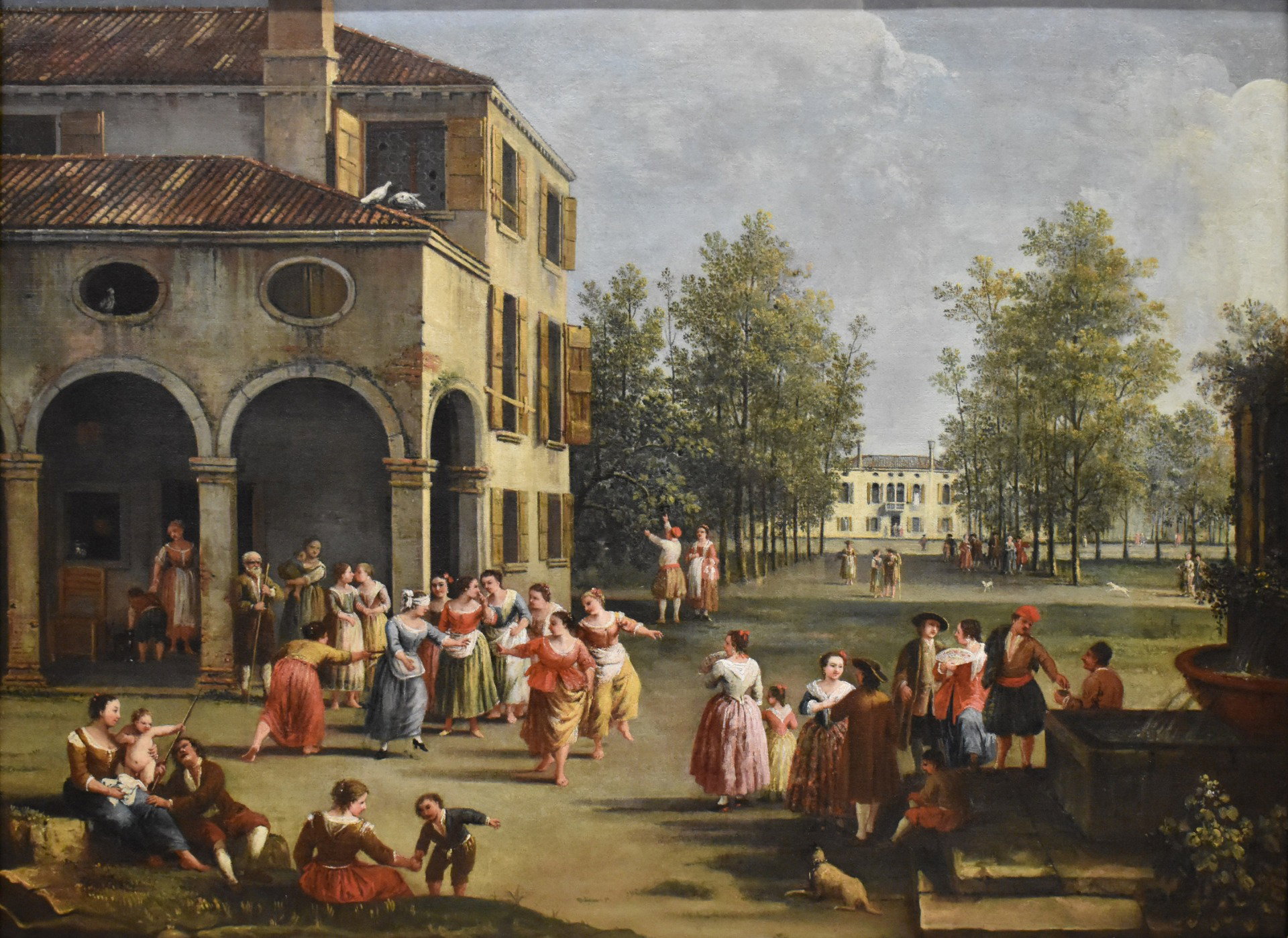
Giovanni Battista Cimaroli (Salò 1687 – Venice 1771) "View of a Villa", oil on canvas, 82×113.5 cm.
Provenance: Lorenzelli Gallery, Bergamo.
Bibliography: D. Succi, A. Delneri, The mainland from the lagoon. Landscape painting in the Veneto between Baroque and Rococo, in Antonio Francesco Peruzzini, edited by M. Gregori and P. Zampetti, Milan 1997, p. 59. P. A. Orlandi, P. Guarienti, Abecedario pittorico, Venice 1753, p. 272.
Published in 1971 by Hermann Voss with the attribution to Gianfrancesco Costa, this delightful landscape of the Venetian hinterland has been attributed by Succi - Delneri to GIOVANNI BATTISTA CIMAROLI (Salò 1687 - Venice 1771), one of the most admired view painters and landscapists of the Venetian eighteenth century.
According to the contemporary testimony of Pietro Guarienti, Cimaroli "studied painting in Brescia under Antonio Aureggio and Antonio Calza, landscape painters, and worked for commissions coming from England and other distant cities, which appreciated his paintings." After a stay in Bologna from 1711 to 1713, the artist moved to Venice to marry the flower, fruit, and animal painter, Giovanna Caterina Pachman. Registered with the Fraglia of Venetian painters from 1726 to 1737, Cimaroli was widely established in the lagoon city in the early 1920s, and his fame as a landscapist earned him, in 1722, the request to collaborate on the well-known series of paintings depicting the allegorical tombs commemorating the heroes of modern English history, commissioned by the Irish entrepreneur Owen Mc Swiny: an undertaking in which the most famous masters of the time were called to participate, from Canaletto to Pittoni, from Marco and Sebastiano Ricci to Piazzetta, Balestra, Valeriani, and Mirandolese.
The painter's notoriety is confirmed by the presence of his paintings in the most important Venetian collections such as that of Joseph Smith, English consul to the Republic and patron of Canaletto and Zuccarelli, where at least six paintings by the artist appeared, later sold along with his collections to George III of England. The gallery of Matthias von der Schulenburg, commander-in-chief of the armies of the Serenissima, included, in addition to two typically Cimarolian canvases with "Countries with animals and waters", also three views of Venice by the artist: a "Perspective of the Zattere", purchased on February 8, 1736 for twenty sequins, and a pair of views with the tip of the Dogana and the church of Santa Maria della Carità, for which the considerable sum of fifty sequins had been paid on July 12, 1736. The documents of the Schulenburg gallery prove irrefutably that, towards the end of the 1930s, Cimaroli was also established as a view painter, finding his own original stylistic code inspired by Canaletto's models and characterized by the firm rendering of the architectures enlivened by unmistakable and graceful figures.
In landscape painting Cimaroli found an original expressive vein, combining Marco Ricci's vision of nature with Francesco Zuccarelli's repertoire of Arcadian and bucolic themes: a painting with a fresh narrative tone that with descriptive minuteness perfectly renders the delight of daily life in the Venetian hinterland, where gentlemen and commoners share the relaxing beauty of the landscape.
Particularly successful are the landscapes set along the banks of the Brenta where villas and villages are composed in delightful scenarios between the imaginary and the real, like this splendid view of a villa characterized by striking chromatic tones. An example of Cimaroli's most successful vein, the painting is animated by a very lively foreground, where a small group of peasant girls plays blind man's bluff under the pleased gaze of the onlookers, lords and commoners: a graceful bouquet with a naïve fragrance that unites nobility and humble classes in a sort of carefree coexistence in the placid flow of the good old days. The playful scene is inserted in a pleasant landscape view, between the shady portico, the bubbling fountain and the tree-lined avenue that leads to the manor house whose clear Renaissance façade harmoniously closes the background.
The pictorial refinement of this dazzling landscape and the delightful Goldonian irony with which the artist interprets the Zuccarellian models, make the painting, datable to around the mid-1940s, one of the highest expressions of Giovanni Battista Cimaroli's creative happiness in the celebration of contemporary life.
Dario Succi