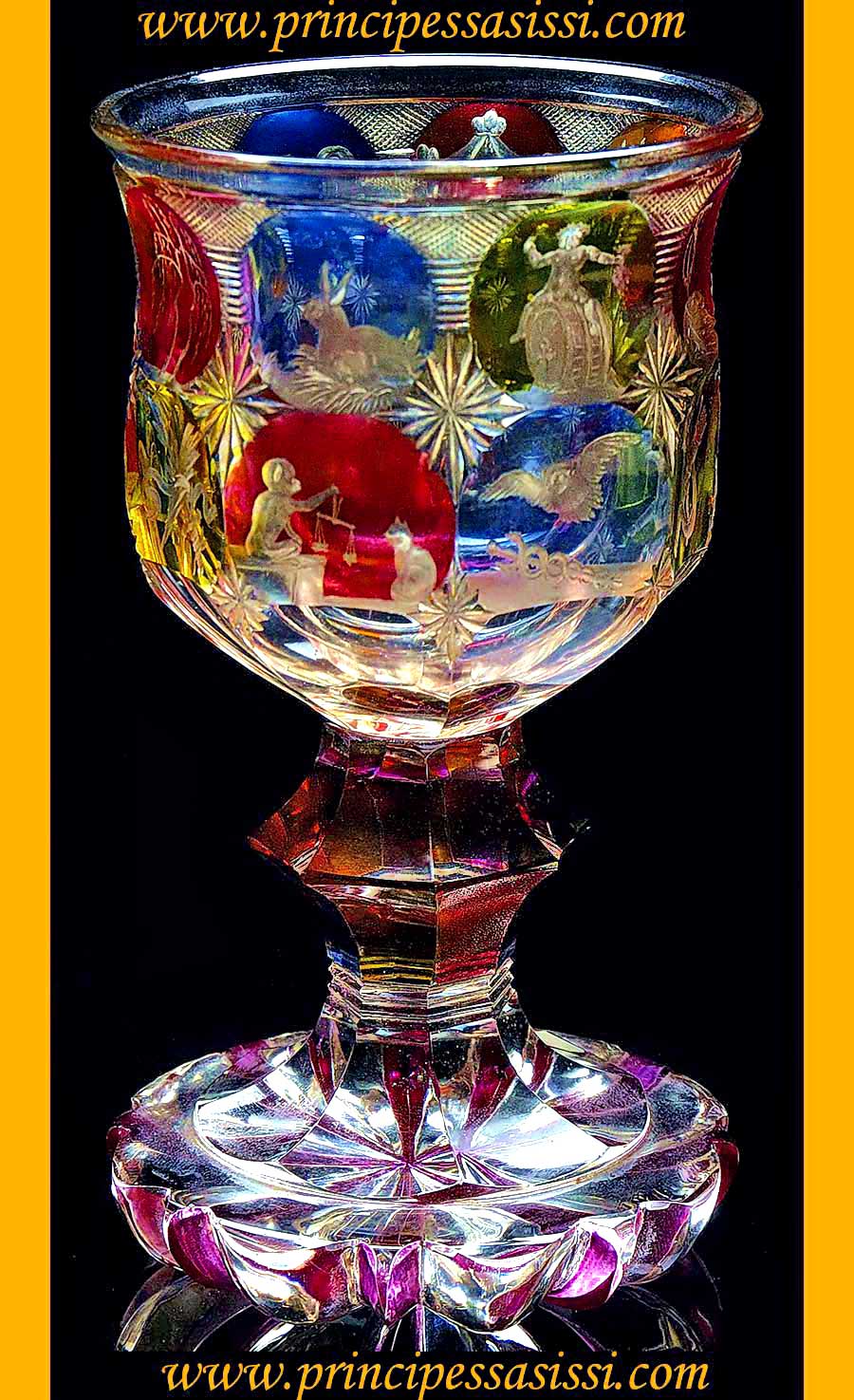
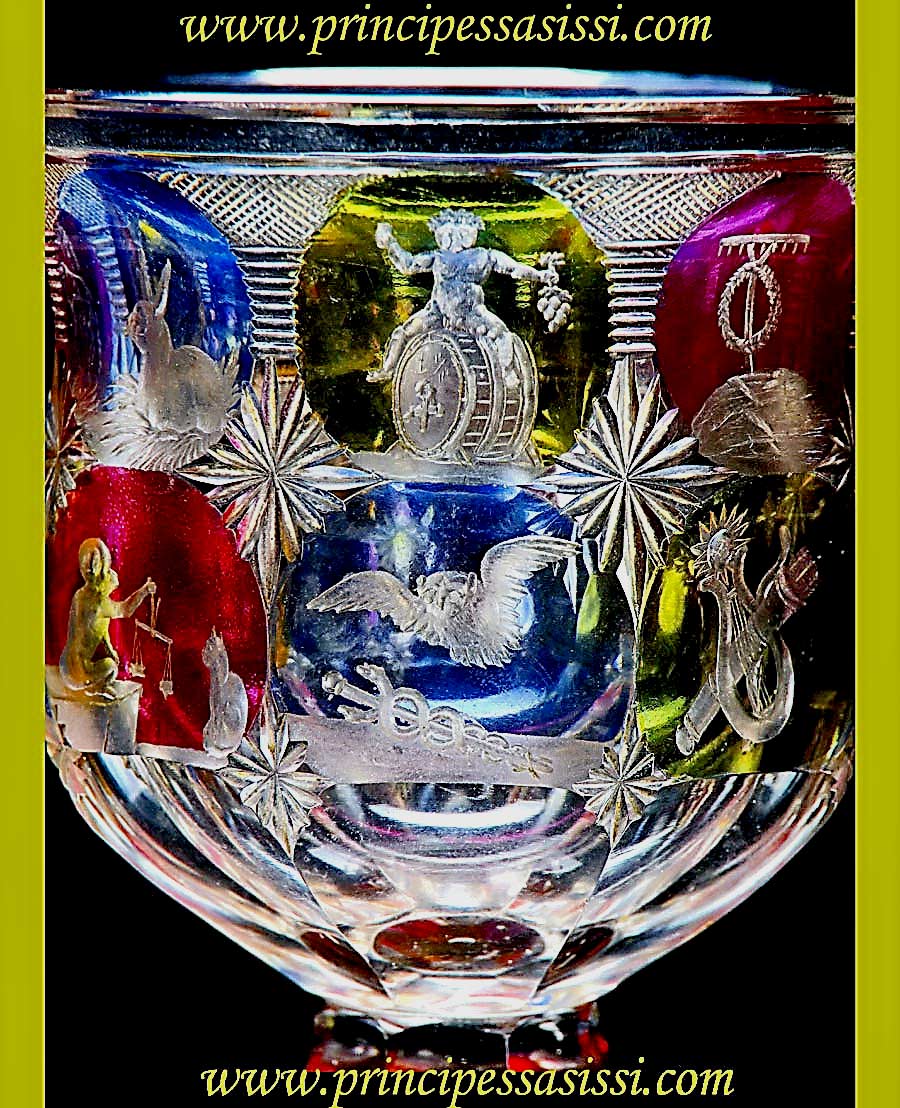
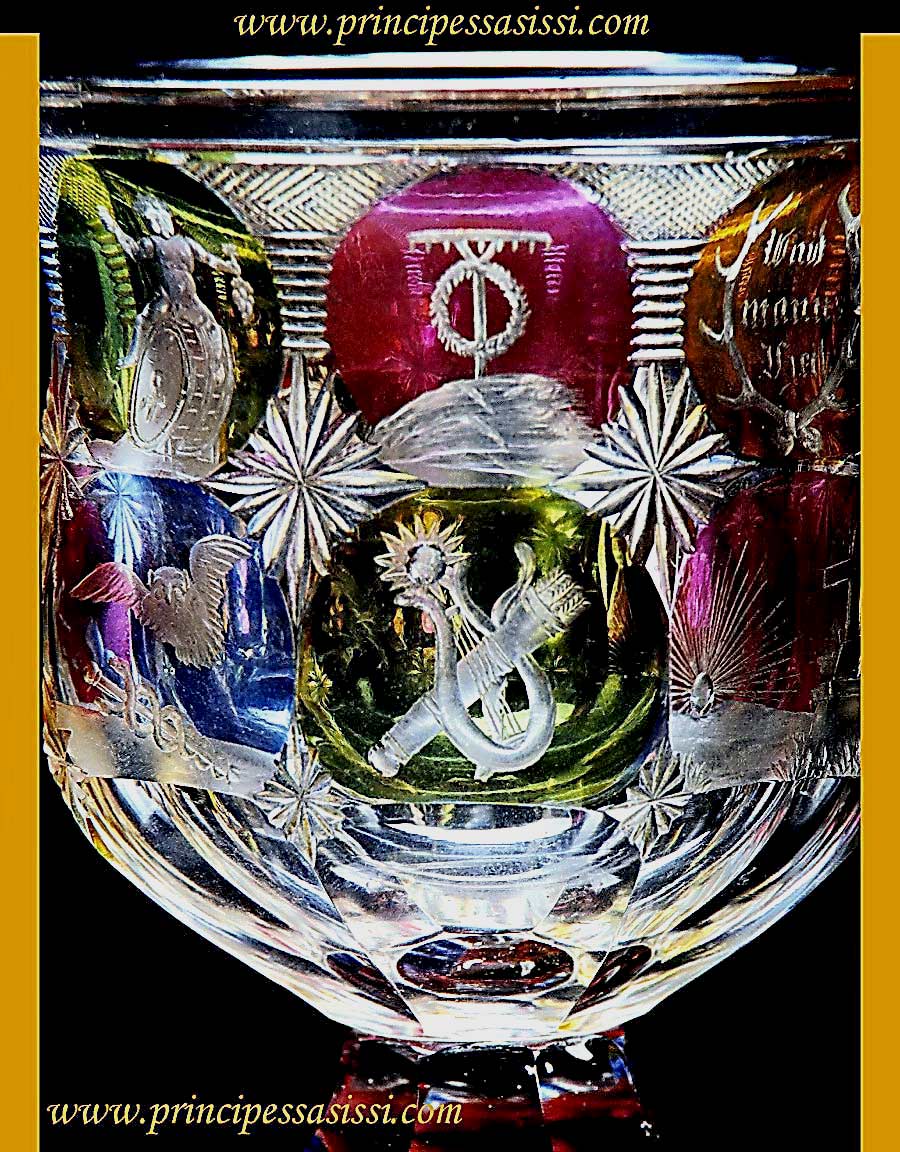
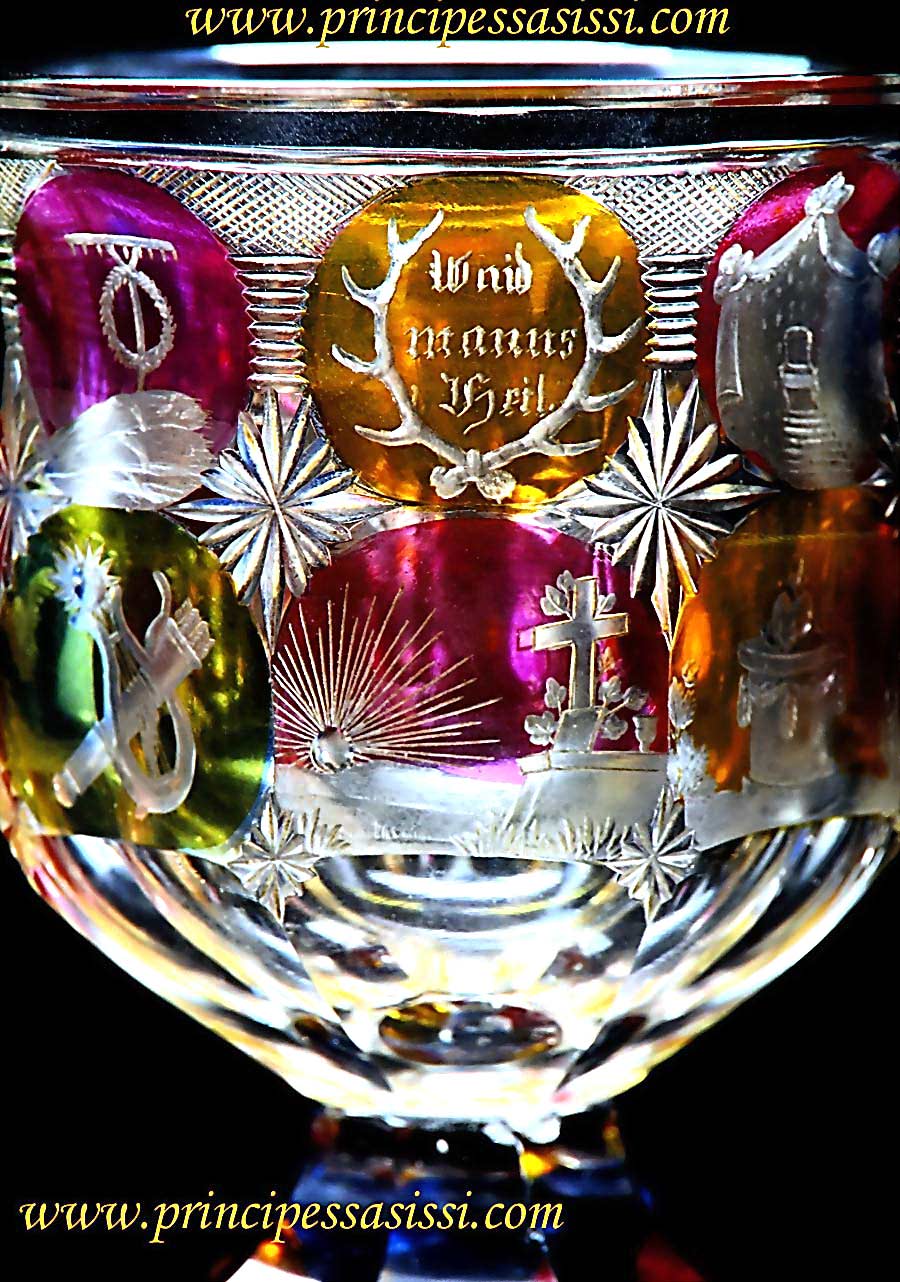
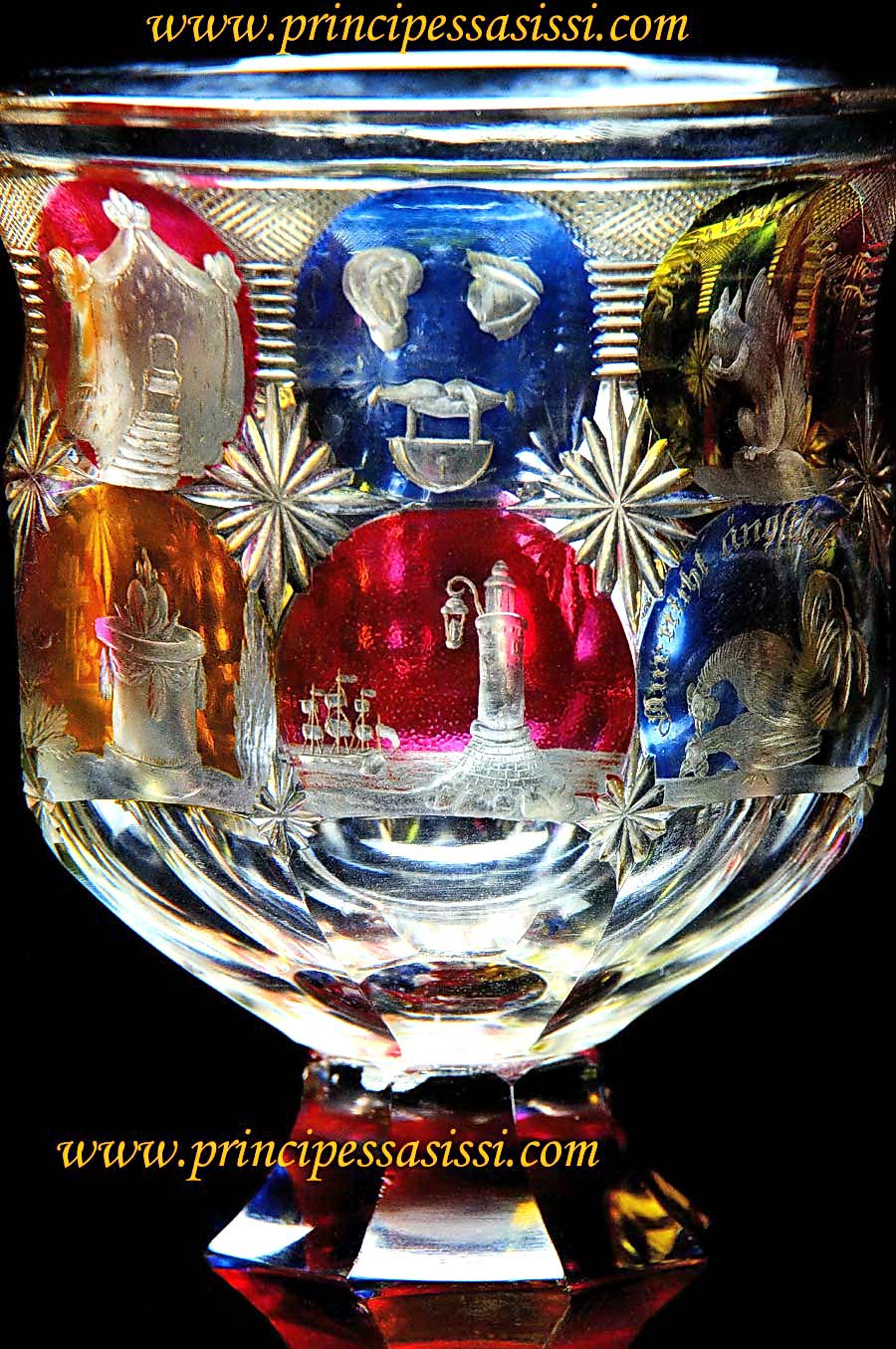
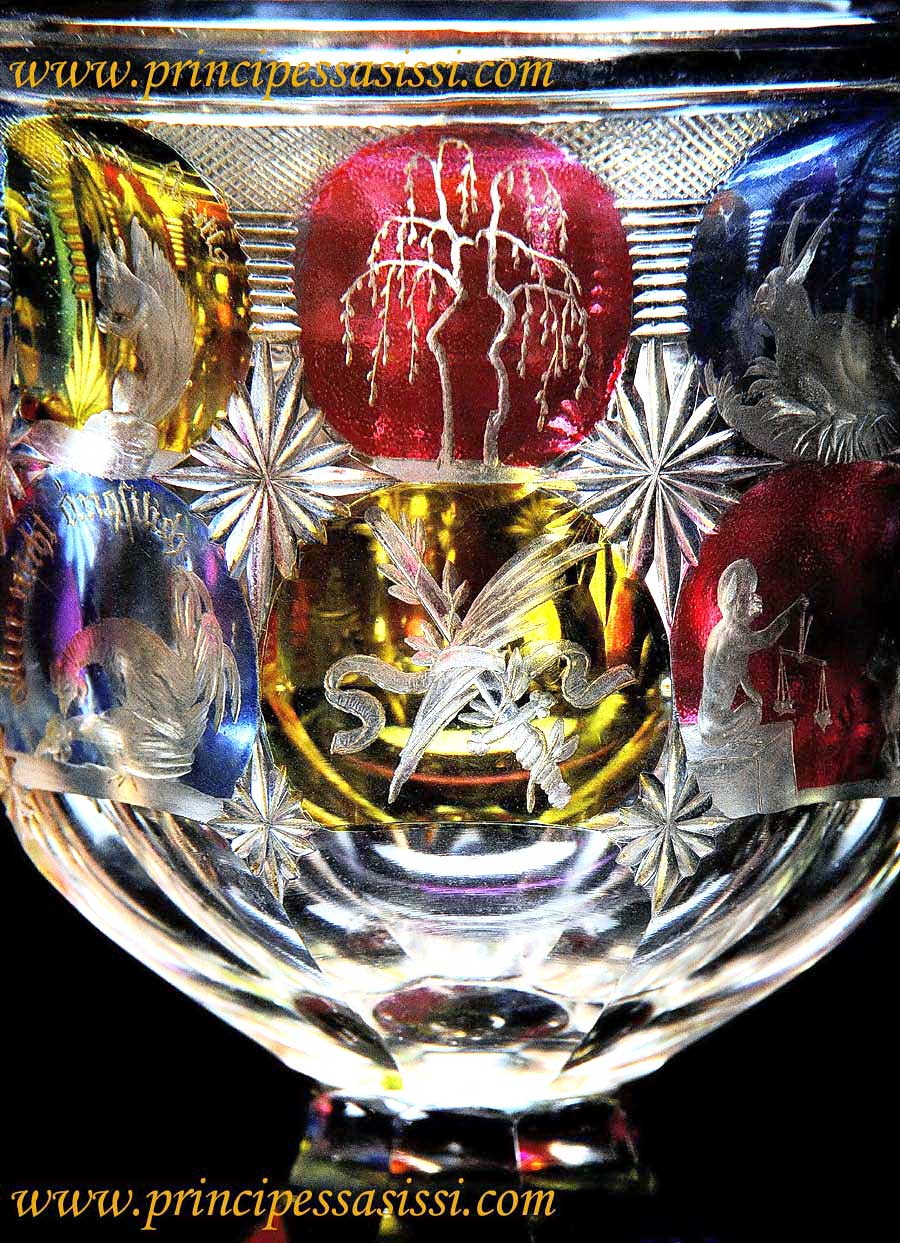
Likely from the workshops of Friedrich Egermann, North Bohemia, Giant Mountains. Circa 1830. Novy Bor (Haida). Rare goblet from the early Biedermeier period in clear fused crystal, lasurized in various colors (purple and light blue, typical of the Egermann manufacture, as well as yellow, pink, and green). Refined grinding depicting 17 mysterious and fascinating archaic and esoteric Masonic symbols and allegories (friendship, peace, justice, prosperity, hope, resurrection, conflict between good and evil, lies and truth, etc.). Measures 15 cm in height and 8 cm in width. In good condition with normal signs of use attributable to age. Literature: Das Boemische Glas Band II. Passauer Glasmuseum. Brosova Buqouy, Spiegl. Gustav Pazaurek-Eugen von Philippovich, Glaeser der Empir und Biedermeierzeit, Klinkhardt Braunscheig. Arnold Busson, Biedermeier Steinglaser.Glas aus funf Jahrhundert, Michael Kovacek, Wien 1990.
Friedrich Egermann, born on March 5, 1777, in Schluckenau, Northern Bohemia, died on January 1, 1864, in Haida (now Novy Bor), was a great artist, technician, and glass entrepreneur. Of German-Bohemian ethnicity from the Sudetenland, he was one of the most important figures in the world history of glass, to whose art he dedicated his entire life. From squalid conditions of poverty, he became one of the most esteemed glass artists of the Biedermeier era, as well as a wealthy entrepreneur. He learned the basics of the art from his uncle Anton Kittel, as well as from the Kreibitzer corporation of glass painters, gilders, and carvers. He studied in Saxony and practiced porcelain at Albrecht Castle in Meissen. At the age of 29, he married Elisabetta Schürer, the daughter of the entrepreneur Benedetto Schürer from Blottendorf, who then financed him in his experiments and works. Initially, thanks to his experience in Meissen, he dealt with refined painting on white glass called "milk" and "alabaster" glass, with which he achieved his first successes. Egermann began experimenting with dyeing thin-layer glass in 1816, until the invention of the famous Lithialina glass. Around 1820, Egermann had such success that he became the first citizen of Haida (now Novy Bor), where he built one of the most important glass factories in Bohemia. At the same time, as successor to his uncle, the master glassmaker Anton Kittel, he became administrator of the Neuhütte Röhrsdorf glassworks. Friedrich Egermann's great invention, obtained partly by chance through experiments, was "Lithialina" glass, i.e., imitating marble and semi-precious stones (jasper, agate, lapis lazuli, etc.). This invention, obtained at the University of Technology of Vienna, earned him the imperial privilege in 1829. He also invented and patented the famous ruby red color of Bohemian goblets, obtained with gold salts. Successes achieved after 16 years of hard work, with about 5,000 experiments. Thanks to the invention of "lithialina" and "Egermann ruby," he obtained great recognition. He was given the title of "privileged producer"; from the "Society for the encouragement of commerce in Bohemia" he obtained silver and gold medals. He was known and esteemed throughout Europe. Even today in Novy Bor (Haida) there is a glass factory dedicated to him. His artifacts are among the most expensive and sought after in the world antique glass market, mostly kept in museums, important antique galleries, and prestigious private collections.
Literature: Egermann Friedrich Austrian Biographical Encyclopedia 1815-1950 (ABL). Volume 1 - the Austrian Academy of Sciences, Vienna 1957, p 220