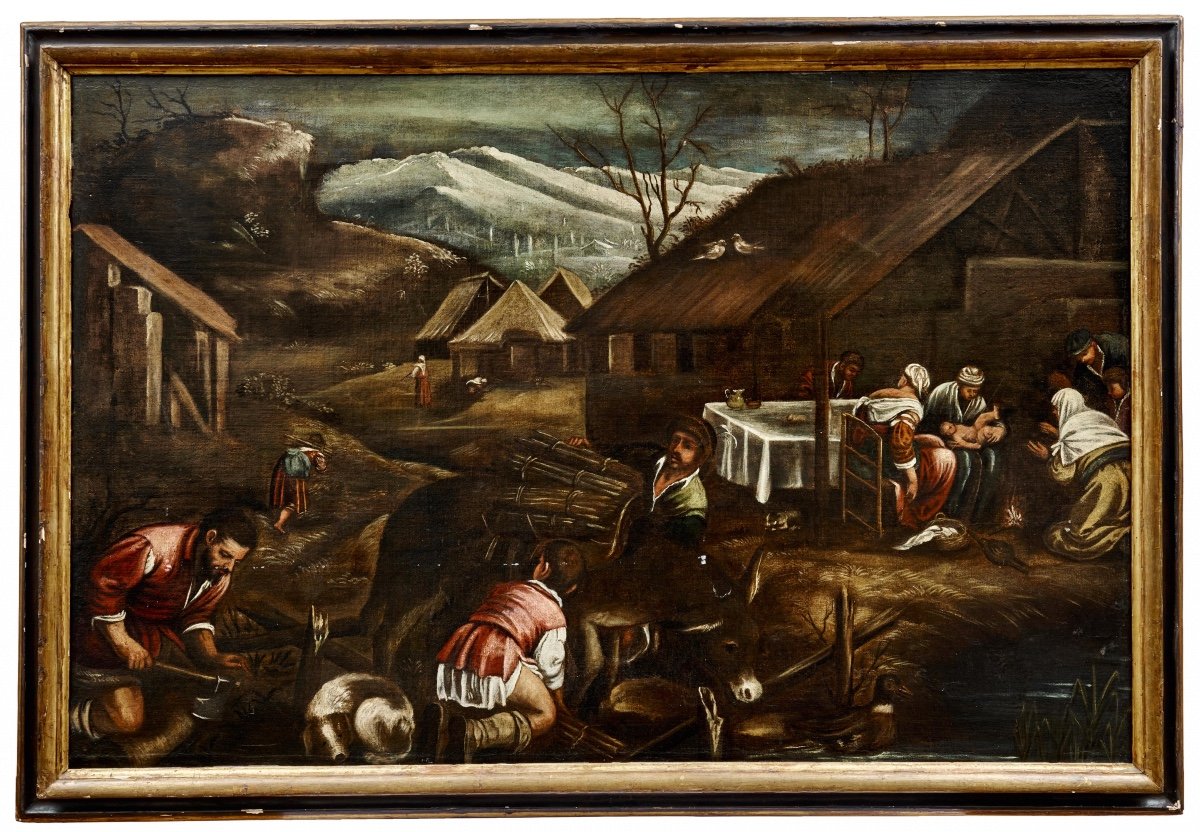
Giovanni Battista Bassano (Bassano del Grappa 1553 - 1613) "Winter" oil on canvas.
cm 103x155
Expertise Ugo Ruggeri
The painting, depicting Winter (oil on canvas, cm. 103x155), which I identify
in the attached photograph, is the work of an interesting follower of the Bassano workshop who is, in my
opinion, to be identified as Giambattista da Ponte (Bassano 1553 - 1613).
The work is a version of the canvas of equal subject, but of smaller dimensions (cm. 75x107),
belonging to the Kunsthistorisches Museum in Vienna, signed by Francesco Bassano ( E. Arslan, I
Bassano, Milan 1960, vol. 1, p. 225), in series with the other three Seasons, in a group that takes up
prototypes of Jacopo in the genre of canvases of the Galleria Borghese in Rome (P. Della Pergola, La
Galleria Borghese in Roma, Rome 1955, pp. 101-102), also attributed to Francesco or to the
collaboration of both.
Third son of Jacopo, Giambattista uses and makes his own the themes and movements of his father and two brothers, Francesco and Leandro, with a shortened and sober formal synthesis that also appears here
evident.
Useful comparisons can be made, in this regard, with the Crucifixion of the Bonn Museum, already
part of the series of paintings supplied by Francesco Bassano to the church of Sant'Antonio in
Brescia (see Arslan, cit., I, p. 227; II, fig. 246), a work that is characterized by a broad definition and
precise chromatic planes that are reflected in the painting examined here.
Not dissimilar appear, moreover, also the results of the Rest on the Flight into Egypt of the Gaspari collection in Munich, persuasively attributed to him by Arslan (cit., 1, p. 228; 11, fig. 265),
similar in the wide and relaxed flow of the folds.
Due to the close fidelity to the prototypes of the workshop, and for the evidence of the pictorial matter it is possible
to hypothesize an execution of this interesting find still within the sixteenth century.
Ugo Ruggeri